
Tennis elbow exercises and physiotherapy
What is tennis elbow?
The muscles on the back of your forearm lift your wrist and fingers and steady your hand when you grip. They share a tendon that attaches to the bony point on the outer side of the elbow (lateral epicondyle). Tennis elbow is pain where that tendon attaches, when it has taken more load than it can handle. The medical name is lateral elbow tendinopathy, and you may also see lateral epicondylitis or lateral epicondylalgia.
You may read that the tendon is inflamed. A flare can bring some inflammation, but in pain that has lasted a while the main change is in the tendon's structure. The US physical therapy guideline notes that by the time people seek care, the inflammation has often settled while the pain remains. That is one reason the focus is on loading the tendon rather than only resting it.
Despite the name, you do not need to play tennis to get it. The NHS says it is more common between the ages of 35 and 54, and links it to gripping combined with repeated twisting of the wrist and forearm. Risk factors listed in the US physical therapy guideline include handling heavy tools or loads and repeated bending and straightening of the wrist or elbow for more than 2 hours a day. Having smoked in the past and jobs where you have little control over your work are on the list too.
The typical picture is pain at the outer elbow when you grip, lift or twist. Picking up a full mug or kettle with the palm facing down is a classic trigger. The pain can spread into the forearm, and the bony point is often tender to press.
Why does exercise help tennis elbow?
The tendon needs to get used to load again, and exercise lets you build that up in steps you control. The US clinical practice guideline for physical therapists recommends resisted exercise for the muscles that lift the wrist (wrist extensors), and it accepts static holds, lifting and slow lowering (Lucado and colleagues, 2022). It suggests building up from static holds to lifting and then to slow lowering, as long as the elbow tolerates each step. It also recommends combining exercise with other treatment, such as hands-on therapy.
Two trials from one research group in Brisbane give a realistic picture of what physiotherapy can do. In the first, 8 sessions of elbow mobilization and exercise did better than a wait and see approach at 6 weeks, and by 1 year the two groups were similar (Bisset and colleagues, 2006). In the second, people who had physiotherapy with a home exercise program did better at 4 weeks than people who had only a dummy injection, but by 1 year there was no significant difference (Coombes and colleagues, 2013). In both trials, most people who did not have a steroid injection were much better by a year, and in the first trial that included people who simply waited.
So the exercises are a way to ease pain sooner and get strength back while the tendon settles. They are not a quick fix.
How to use this program
Pick the stage that matches your elbow today. If you are unsure, start at stage 1. Move up when the current stage feels easy and your elbow is no worse the next morning. If you have had surgery on the elbow, follow the program your surgeon or physio gives you rather than this one.
Many programs use 2 to 3 sets of 10 to 15 slow repetitions for the strength exercises, once a day or every second day, with a weight light enough that the last few repetitions still look controlled. The US guideline suggests about 3 sets of 15, kept up for 6 to 12 weeks. Stretches are often held for 15 to 30 seconds, a few times each. The US guideline recommends strengthening but makes no recommendation for stretching on its own, so treat the stretch as an extra. Your physio will adjust the exercises and the numbers to your elbow and to what you need to get back to.
A little discomfort at the outer elbow during the exercises is common. Many programs accept mild discomfort that settles within a few hours and is no worse the next morning. Sharp pain during a repetition means stop that exercise. If the elbow is clearly worse the next morning, the load was too much. Drop back a step rather than stopping altogether.
The exercise program
Stage 1: Settle the elbow and start gentle loading
For an elbow that hurts with everyday gripping, such as lifting a kettle or shaking hands. The first strength exercise, a static hold for the wrist (isometric wrist extension), has no video yet: sit with your forearm resting on a table, palm down with your hand just past the edge, put your other hand on the back of it, and push up into that hand so nothing moves. Keep the push light to moderate, well short of your hardest, and keep breathing normally; the pain should not build as you hold, and if it does, or the elbow is worse the next morning, push more gently or hold for less time. Programs vary. Many use holds of about 30 to 45 seconds, repeated about 5 times, once or twice a day. The stretch for the back of the forearm is optional and gentle, a mild pull and never sharp pain at the elbow, so leave it out for now if it leaves the elbow aching afterward.
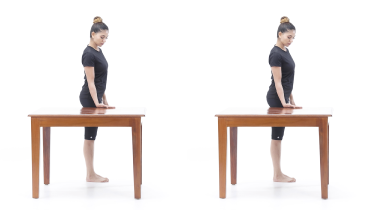 Wrist extensor stretch
Stage 2: Strengthen the wrist and forearm
When the static holds feel easy and gripping in daily life is a little less sore. Wrist extension with a weight is the main exercise in many tennis elbow programs, and a small water bottle is light enough to start with. If lifting hurts more than lowering, use your other hand to help the weight up and let the sore side lower it slowly on its own. Many programs also add turning the palm up against a band, which works the muscle that turns the forearm (supinator). That muscle starts close to the sore tendon, so begin with the lightest band.
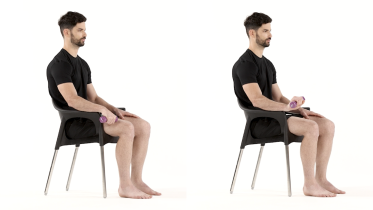 Wrist extension with weight
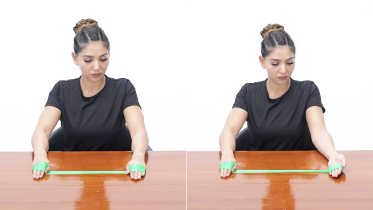 Forearm supination with band
Stage 3: Heavier loading and the rest of the arm
When 2 to 3 sets of wrist extension with a light weight feel easy and the elbow settles well the next day. Keep going with the wrist extensions and increase the weight in small steps. The biceps curl builds strength for lifting and carrying, but you still grip the weights, so start light. The band row and shoulder rotation are for people whose physio finds weakness around the shoulder or shoulder blade, which is when the US guideline suggests adding them. This is also the stage to practice what you need to get back to, such as carrying shopping or swinging a racquet, at a lighter load and for less time than usual.
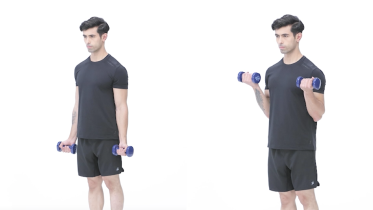 Biceps curl
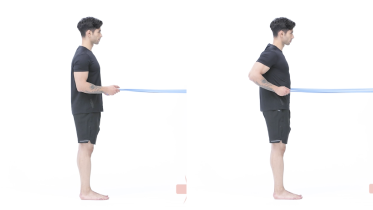 Resistance band row
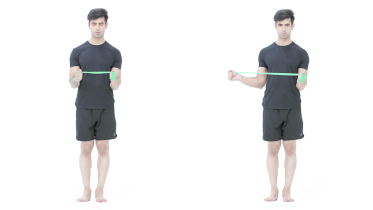 Shoulder external rotation with band
What to change at work and at home
What you do the rest of the day matters too. The NHS self-care advice is to avoid or reduce the activities that make it worse, and to try a hot or cold pack wrapped in a towel for up to 20 minutes every 2 to 3 hours. Paracetamol or an anti-inflammatory gel can ease the pain. Ask a pharmacist if you are not sure a medicine is safe for you.
Small changes to how you grip and lift often help. Lift with your palm facing up rather than down, and share the load between both hands where you can. At work, a physio can look at your desk setup, mouse and tools. The US guideline says this kind of workplace and equipment change may be part of care, based mostly on usual practice, because there are few trials of it in tennis elbow.
A forearm strap worn just below the elbow eases pain during activity for some people. Evidence that it helps over the longer term is mixed, so treat it as a support for the exercises rather than a replacement.
Your physio may also use hands-on treatment of the elbow, rigid taping for short-term relief, or dry needling. If things are still not improving after 6 to 12 months, the NHS says surgery may be an option, and a specialist can talk that through with you.
When to see a physio or doctor
See a physio or doctor if your elbow pain has not improved after about 2 weeks of looking after it yourself, as the NHS advises, or if it stops you working or sleeping. It is also worth getting a proper assessment if you are not sure the pain is tennis elbow, because pain on the outer elbow can come from the neck, a trapped nerve in the forearm or the joint itself.
If you already have a program and it is not helping after several weeks, a physio can check the diagnosis and change the load. The warning signs below need prompt medical attention.
For physiotherapists
This page gives patients a starting framework for lateral elbow tendinopathy. The 2022 JOSPT guideline supports a clinical diagnosis: pain at the lateral epicondyle reproduced by palpation, resisted wrist or finger extension, and stretch of the wrist extensors. It recommends the PRTEE and/or the DASH as outcome measures (grade A) and pain-free grip strength among the physical measures. Differentials it lists include cervical radiculopathy, radial tunnel syndrome, posterior interosseous nerve syndrome, plica, radiocapitellar chondromalacia and posterolateral rotatory instability.
The guideline gives grade B recommendations to resisted wrist extensor exercise (isometric, concentric or eccentric) in subacute or chronic cases, to exercise combined with other interventions including manual therapy, to local elbow mobilization or manipulation, to dry needling and to rigid taping for irritable presentations. It suggests 3 sets of 15 for 6 to 12 weeks, progressing from isometric to isotonic to eccentric without exacerbating symptoms. Shoulder and scapular training is grade C, when impairments are found. A counterforce brace or wrist orthosis may be worn during activity for immediate relief (grade F), but conflicting evidence means no recommendation for intermediate or long-term use.
Prognosis is hard to predict, and a subgroup has long-lasting pain whatever the treatment. Coombes and colleagues (2015) suggest shaping management around factors such as coexisting neck pain, tendon tears and signs of widespread pain sensitivity. Base progression on pain-free grip and the 24-hour response rather than a fixed sheet.
See a doctor promptly if
- Emergency: after a fall or a blow to the elbow, the arm has changed shape or sits at an odd angle, a bone is showing through the skin, a cut is bleeding heavily, or the hand has gone numb or tingly or turns cold, pale or blue. Go to an emergency department or call emergency services straight away, and do not drive yourself.
- The pain started with a fall or a blow to the elbow, and the pain is severe, you heard a snap, the elbow is swollen or bruised, or you cannot bend or straighten the arm. Go to an urgent care center or emergency department the same day.
- The elbow locks, catches, or feels unstable, as if it slips or gives way.
- You have numbness, tingling or pins and needles in the hand or fingers, or pain that spreads from your neck down the arm. If one side of your face or body suddenly goes numb or weak, or your speech becomes slurred or muddled, call emergency services, even if it goes away.
- Your wrist or fingers will not lift properly (the fingers may droop at the knuckles), or your hand keeps getting weaker, not just sore.
- The elbow is hot, red and swollen, or you have elbow pain with a high temperature or feel hot, cold or shivery. Get medical advice the same day, and go to an emergency department if you feel very unwell. This can be a sign of infection in the joint, which needs treatment quickly.
- The pain is there at night or at rest and keeps getting worse. See your doctor within a few days. If you have had cancer, now or in the past, or are losing weight without trying, see your doctor sooner, within a day or two, and mention it. This applies even if the pain is not getting worse. If you are being treated for cancer now, contact your cancer team the same day.
- A sudden pop or snap at the front of your elbow, sudden sharp pain there, or the muscle at the front of your upper arm bunches up or changes shape. Stop and go to an urgent care center or emergency department the same day, even if you can still bend the elbow, as this can be a torn biceps tendon.
Common questions
How long does tennis elbow take to heal?
It varies a lot. The NHS says tennis elbow usually goes away with rest but can sometimes last over a year. In two trials from Brisbane, most people who did not have a steroid injection were much better by 12 months, and in the 2006 trial that included people who simply waited. Much better is not always pain free, though: the US physical therapy guideline notes that many people still have some symptoms after a year, and it can come back. A physio can help if it is slow to settle.
Should I rest tennis elbow or exercise it?
Usually a bit of both. Cut back on the gripping and lifting that clearly flare it, but keep the arm moving. The US physical therapy guideline recommends resisted exercise for the muscles that lift the wrist. Many programs start with gentle static holds and build up to lifting a weight. Your physio will adjust the load to your elbow.
Does a tennis elbow strap work?
It can help some people in the short term. The US physical therapy guideline says a forearm strap or wrist support can be worn during activity to ease pain and help strength in the moment, if activity brings the pain on. It found the evidence too mixed to say whether a strap helps over the longer term. Use it alongside exercise rather than instead of it.
Are steroid injections good for tennis elbow?
They can ease pain for a few weeks, but the long-term picture is less good. In a trial published in JAMA, people given a steroid injection were less likely to be recovered or much improved at 1 year than people given a dummy injection, and their pain came back more often. An earlier trial from the same group found the same pattern: better at 6 weeks, then many relapses. The decision about an injection is one to make with your doctor, weighing the short-term relief against that.
Can you get tennis elbow without playing tennis?
Yes. Tennis is only one possible cause, and plenty of people who get it have never played. The NHS links it to activities that involve gripping something and repeatedly twisting the wrist and forearm, such as computer work, manual jobs and playing a musical instrument.
References
- Lucado AM, Day JM, Vincent JI, MacDermid JC, Fedorczyk J, Grewal R, Martin RL. Lateral Elbow Pain and Muscle Function Impairments: Clinical Practice Guidelines. Journal of Orthopaedic and Sports Physical Therapy. 2022;52(12):CPG1-CPG111. https://doi.org/10.2519/jospt.2022.0302
- Coombes BK, Bisset L, Brooks P, Khan A, Vicenzino B. Effect of corticosteroid injection, physiotherapy, or both on clinical outcomes in patients with unilateral lateral epicondylalgia: a randomized controlled trial. JAMA. 2013;309(5):461-469. https://doi.org/10.1001/jama.2013.129
- Bisset L, Beller E, Jull G, Brooks P, Darnell R, Vicenzino B. Mobilisation with movement and exercise, corticosteroid injection, or wait and see for tennis elbow: randomised trial. BMJ. 2006;333(7575):939. https://doi.org/10.1136/bmj.38961.584653.AE
- Coombes BK, Bisset L, Vicenzino B. Management of lateral elbow tendinopathy: one size does not fit all. Journal of Orthopaedic and Sports Physical Therapy. 2015;45(11):938-949. https://doi.org/10.2519/jospt.2015.5841
- NHS. Tennis elbow. Page last reviewed 31 May 2024. https://www.nhs.uk/conditions/tennis-elbow/
Written and checked by the PocketPhysio editorial team. Last updated 2026-09-28.
This page is general education, not a diagnosis or a personal treatment plan. See a physiotherapist or doctor for advice about your own situation.