Lizard stretch
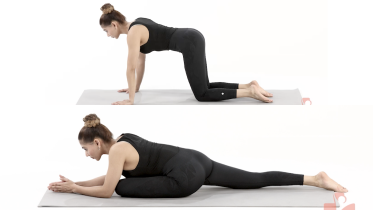
The lizard stretch is a deep, low lunge on the floor. From kneeling, you step one foot forward, walk your hands down inside that foot and lower your forearms toward the mat, letting your hips sink forward and down. It is usually aimed at the inner thigh and groin of the front leg (hip adductors), and many people also feel it at the front of the back hip. It is one of the stronger hip stretches, so it suits people who already stretch comfortably on the floor.
How to do the lizard stretch
- Kneel on a mat, with a folded towel under your knees if they are sensitive. Step the leg you want to stretch forward, foot flat, so you are half kneeling.
- Place both hands on the floor on the inside of your front foot. Slide the back knee a little further back if you need more room.
- Lunge forward, keeping the front knee over the front foot rather than letting it roll in or out.
- Lower your forearms toward the floor inside the front foot as far as is comfortable, and let your hips sink forward and down.
- Hold still and breathe slowly. To come out, press back up onto your hands, draw the hips back to half kneeling, then change sides.
What you should feel
A strong stretch along the inner thigh and groin of the front leg, and often at the front of the back hip. It should ease slightly as you breathe, not sharpen.
Common mistakes
- Letting the front knee roll inward or drift well past the toes.
- Forcing the forearms to the floor before the hips are ready. Stay on your hands, or rest your forearms on a block or a thick book.
- Bouncing in the bottom position.
- Holding your breath.
How often
Many programs use 2 to 3 holds of 20 to 30 seconds on each side, once a day or a few times a week. Your physio will adjust this.
Stop and check with your physio if
- Sharp or pinching pain at the front of the hip or deep in the groin.
- Pain in the front knee, or pressure pain in the back knee where it rests on the floor.
- Pain, numbness or tingling that runs down the leg.
From the clinic
Most people cannot get their forearms to the floor at first, and that is fine. Staying up on your hands, or taking a shorter lunge, gives a gentler stretch. For a milder inner thigh stretch, start with the butterfly stretch. If the front of the back hip feels tighter than the groin, the hip flexor stretch works on that area by itself.
If you have had a hip replacement, get the go-ahead from your surgeon or physio before you try the lizard stretch. Sinking into the low lunge bends the front hip well past a right angle while the back leg is stretched out behind you, and many surgeons ask you to avoid that for the first months after some operations. If you are pregnant and have pain at the front or back of your pelvis, check with your physio before you try it, and keep your stance only as wide as feels comfortable. After a recent groin strain, let your physio decide when a stretch this strong is right for you.
Written and checked by the PocketPhysio editorial team. Last updated 2026-09-26.
This page is general education, not a diagnosis or a personal treatment plan. If you have pain, an injury or a health condition, see a physiotherapist or doctor before starting new exercises.