
Ankylosing spondylitis exercises and physiotherapy
What is ankylosing spondylitis?
Ankylosing spondylitis is a long-term condition in which the spine and other parts of the body become inflamed. It belongs to a group called axial spondyloarthritis. The name ankylosing spondylitis is used when the changes show on an X-ray, and non-radiographic axial spondyloarthritis when they do not. The NHS says both tend to start in teenagers and young adults.
Back pain and stiffness are the main symptoms, often with pain and swelling in other joints, pain where tendons attach to bone, and marked tiredness. Symptoms build up over months or years and can come and go. Where the ribs join the breastbone, the inflammation can cause chest pain and make it hard to take a deep breath. Have any chest pain checked by a doctor rather than assuming it is AS, and see the warning signs below. The NHS lists thinning of the bones (osteoporosis), fractures of the spine and heart and circulation disease among the possible complications.
How inflammatory back pain differs from ordinary back pain
The pattern of the pain is the main clue. The NHS describes pain that gets better with exercise but does not improve, or gets worse, with rest. Pain and stiffness are worse in the morning and at night, and you may wake regularly in the night because of it. That is close to the opposite of most everyday back pain, which often eases with rest.
Age matters too. NICE advises doctors to think about axial spondyloarthritis when back pain started before the age of 45 and has lasted longer than three months, alongside other features such as buttock pain or pain that improves with movement. There is no single test, and the NHS notes that confirming the diagnosis can take years.
Diagnosis and medicines belong with your doctor and the rheumatology team, a specialist in joint and muscle conditions. The ASAS-EULAR recommendations name anti-inflammatory painkillers (NSAIDs) as the first-choice medicine, with other treatments such as biologic medicines for people who need more. This page covers the exercise and physio side, which works alongside that care rather than replacing it. If this pattern sounds like your back pain and you have no diagnosis, see your doctor.
Does exercise help ankylosing spondylitis?
Yes, and it is part of the standard advice. The 2022 ASAS-EULAR recommendations state that patients should be educated about axial spondyloarthritis and encouraged to exercise on a regular basis and stop smoking, and that physiotherapy should be considered. The systematic review behind them confirmed that education and exercise work, and so do NSAIDs (Ortolan 2023).
NICE in the UK goes into more detail. It advises referral to a specialist physiotherapist for an individual, structured exercise program. The program should include stretching, strengthening and posture exercises, deep breathing, spinal extension, movement exercises for the lower, middle and upper spine, and aerobic exercise. The stages below follow that mix.
The size of the benefit is modest. A Cochrane review of 14 trials with 1,579 people found that, compared with no exercise program, exercise probably slightly improves function, may reduce pain and probably slightly lowers how active people rate their disease, measured at the end of the program (Regnaux 2019). Compared with usual care, it made little or no difference, and the review could not say whether exercise improves spinal movement or tiredness. The practical message from NASS is that exercise needs to be regular, consistent and kept up over the long term.
Posture and breathing
The NHS says keeping active can improve your posture and the range of movement in your spine, and help stop it becoming stiff and painful. NASS advises a daily home routine with stretches, particularly for the muscles at the front of your chest, shoulders and hips. A physio will also teach you how to check your posture regularly, so you notice early if it is changing.
Everyday set-up counts as well. NASS suggests looking at your computer screen position, how you sit at a desk and your driving seat, and taking regular breaks from long drives. Breaking up long spells of sitting with a few of the stage 1 movements is an easy habit to start.
Breathing work is part of the NICE program, and NASS lists lung capacity among the things exercise for AS aims to improve or keep. The breathing with arm raises exercise in stage 1 and the chest opening work in stage 2 cover this. If you smoke, stopping is part of the ASAS-EULAR advice.
How to use this program
Start with stage 1 and make it a daily habit. Add stage 2 when stage 1 feels familiar, and stage 3 when both are part of your week. The stages build on each other, so keep the earlier ones going. NASS's free Back to Action program is another source of AS-specific exercises, with videos, if you want more variety.
Each exercise page gives a typical starting dose. As a rough guide, many programs use 5 to 10 slow repetitions of the mobility exercises to each side, once or a few times a day, and the chin tuck often uses 8 to 10 holds of 3 to 5 seconds. Stretches are often held for 20 to 30 seconds, 2 to 3 times on each side, on most days. The strength exercises are often done as 1 to 3 sets of 8 to 15, once a day or every other day, and brisk walking often starts at 10 to 20 minutes on most days. Your physio will adjust this.
NASS says mild aches and pains while you exercise are normal, and the aching should ease off once the session is over. Ease back and get advice from your physio or doctor if you have more than mild aches and pains afterward. During a flare, keep moving but gently: NASS suggests avoiding high impact exercise such as running and doing gentle stretching instead.
The NHS notes that AS raises the risk of heart and circulation disease, so the aerobic part of stage 3 matters for more than your back. With a heart condition or high blood pressure, check with your doctor before you start. If you have high blood pressure, breathe steadily through every repetition and never hold your breath. If chest pain, pressure or tightness does not ease quickly when you rest, spreads to your arm, neck, jaw, stomach or back, or comes with sweating, feeling sick, feeling light-headed or being short of breath, call emergency services straight away, as this can be a heart attack. If it eases quickly and none of these happen, get medical advice the same day, and do not exercise again until you have been checked.
The exercise program
Stage 1: Move your spine every day
The base of the program, for every day and not only on stiff days. Mornings are often the hardest part of the day with AS, and a warm shower beforehand may make these easier. Together they move your spine forward and back, round in a turn and to each side, and add slow breathing with your arms. Keep every movement slow and inside a comfortable range.
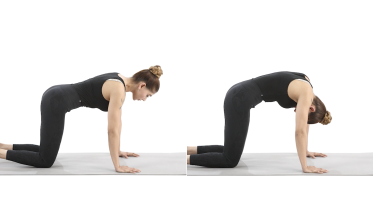 Cat-camel stretch
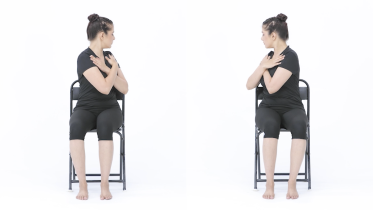 Seated trunk rotation
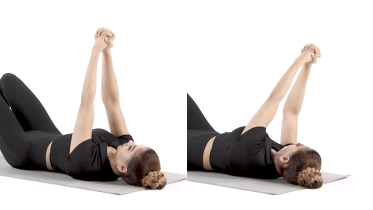 Lying upper body rotation
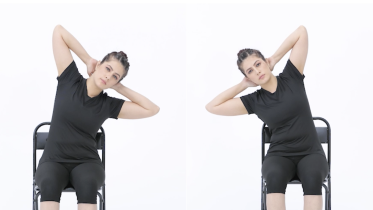 Seated side bend
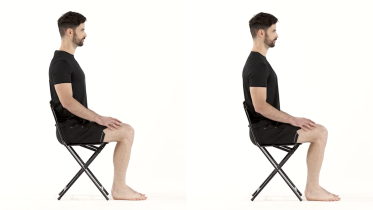 Chin tuck
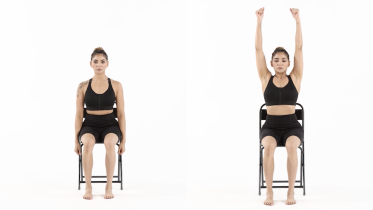 Breathing with arm raises
Stage 2: Open up your chest, upper back and hips
Add these once the daily routine feels familiar. They work on posture by bending the upper back backward and stretching the front of the chest, shoulders and hips. If parts of your spine have fused or you have low bone density (osteoporosis), check with your physio before the stick stretch and the face down positions. Leave out prone lying if you cannot lie flat on your front comfortably.
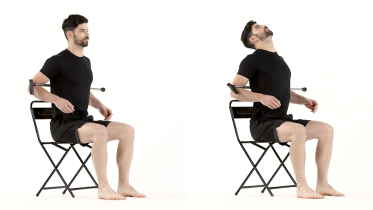 Seated thoracic extension with a stick
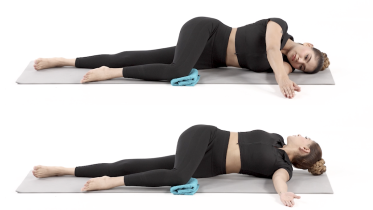 Open book stretch
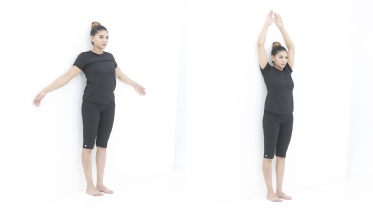 Wall angels
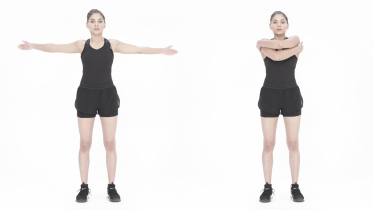 Chest expanders
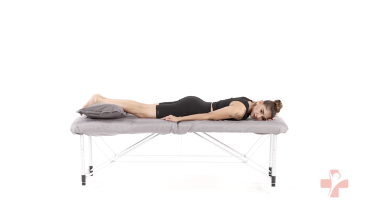 Prone lying
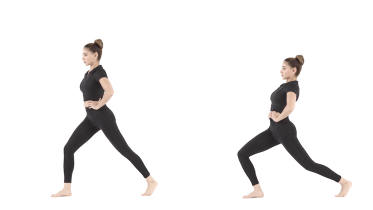 Hip flexor stretch
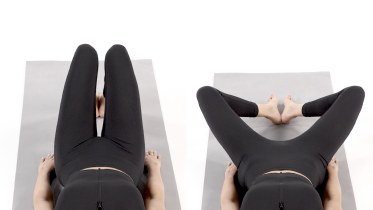 Reclined butterfly stretch
Stage 3: Build strength and fitness
For the long term, once stages 1 and 2 are part of your week. The back extension, band row and bridge strengthen the muscles that hold you upright, and brisk walking builds fitness for your heart and lungs. The lizard stretch is a stronger hip stretch for people who already stretch comfortably on the floor. Keep the stage 1 routine going every day alongside these.
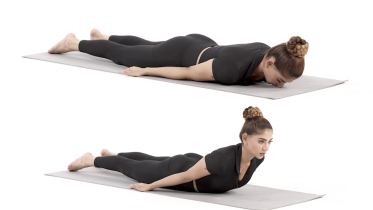 Prone back extension
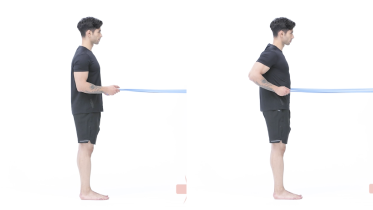 Resistance band row
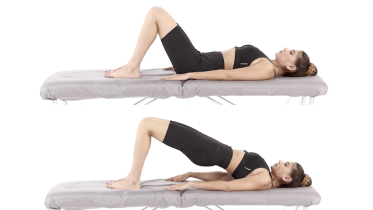 Glute bridge
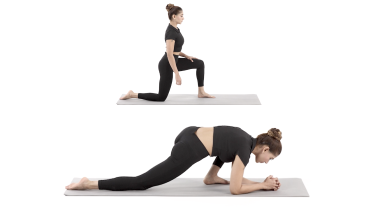 Lizard stretch
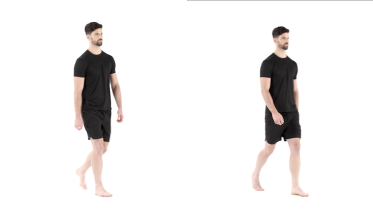 Brisk walking
What to avoid or change
NASS suggests checking with a health professional before you start a new exercise program if you have not exercised for a while, are over 65, have had axial spondyloarthritis for more than 10 years, have fusion in your spine, have osteoporosis or are in a flare. With fusion or osteoporosis, the stick stretch in stage 2 needs particular care, because all the pressure goes through one small area of your back. Ask your physio how far to take the turning and bending movements too.
Contact sports carry a real risk once the spine has stiffened. NASS explains that a hard knock or blow could break one of the bones in your spine, especially with thin bones, so talk to your physio before you take one up or carry on with one. High impact exercise brings on a flare in some people. If it does that for you, change it.
If you have had a hip replacement, get the go-ahead from your surgeon or physio before you try the hip flexor stretch, the lizard stretch, the reclined butterfly stretch or the open book stretch. Some operations limit this kind of work for the first months, so the timing depends on your surgery. After spinal surgery, follow your surgeon's program. If you are pregnant, check with your physio or rheumatology team before you start. This page is for adults: if a child or teenager has back pain and stiffness like this, their doctor can refer them to a specialist team.
Protecting a stiff spine from falls and neck injury
A spine that has stiffened or fused behaves differently when it is knocked. A systematic review of spinal fractures in people with AS found that the stiffened spine is prone to fracture after minor trauma, that most fractures were in the neck after low-energy injuries, and that diagnosis was often delayed (Westerveld 2009). A low-energy injury, such as a trip or a fall from standing height, can be enough. NICE advises that people with axial spondyloarthritis may be prone to fractures and should see a health professional after a fall or other injury, particularly if their pain increases.
So treat any new neck or back pain after a fall or knock as an emergency, even if the fall seemed small. Tell the ambulance crew or emergency staff that you have ankylosing spondylitis. Take care on uneven ground, too, and keep the walkways at home clear and well lit.
Eye inflammation (uveitis)
Inflammation at the front of the eye (uveitis, also called iritis) is linked to AS. The NHS describes a red, painful eye that is sensitive to light, and warns that it can cause loss of some or all of your vision if it is not treated promptly. NICE advises same-day assessment by an eye specialist for symptoms such as eye pain, redness, sensitivity to light or blurred vision. If this happens, get seen the same day and mention your AS. If your vision changes, light hurts your eye, the eye turns very dark red, or you also have a severe headache and feel sick, the NHS advice is to go to an emergency department straight away.
When to see a physio or doctor
If you have back pain with the inflammatory pattern described above and no diagnosis, see your doctor, who can refer you to a rheumatologist. Once you have a diagnosis, ask about a specialist physio to set up and review your exercise program, as NICE advises. See your rheumatology team or doctor if your pain is no longer controlled by your medicines and your usual routine, or if flares are becoming more frequent. The warning signs below need faster help.
For physiotherapists
This page gives patients a starting framework, not a full plan. NICE NG65 advises referral to rheumatology for suspected axial spondyloarthritis when low back pain started before 45 and has lasted more than three months, with four or more further features such as onset before 35, buttock pain, improvement with movement or improvement within 48 hours of an NSAID. Check the current version for the full criteria. It also advises a same-day ophthalmology assessment for suspected acute anterior uveitis.
ASAS-EULAR recommendation 15 advises that if the course of the disease changes significantly, causes other than inflammation, such as a spinal fracture, should be considered, with appropriate evaluation including imaging. In the Westerveld review of 345 people with AS and a spinal fracture, 67.2% had a neurological deficit on admission and mortality within 3 months was 17.7%. Keep a low threshold for referral after any trauma, even when the mechanism sounds trivial. NICE NG41 advises full in-line spinal immobilization after trauma when there is spinal pain or a condition that predisposes to spinal instability, and no standard collar with a known spinal deformity such as ankylosing spondylitis, keeping the spine in its current position.
The 2022 ASAS-EULAR update uses an ASDAS of 2.1 or more, after at least two NSAIDs have failed, as part of the threshold for biologic and targeted synthetic medicines, so your rheumatology colleagues are likely to track it. The Cochrane review (Regnaux 2019) used the BASFI for function, and the evidence on spinal mobility and adverse effects was of very low quality. Group programs, individual home programs and hydrotherapy are all options the NHS lists, so fit the format to what the person will keep up.
See a doctor promptly if
- Emergency: new neck or back pain after a fall, a knock or a jolt, even a minor one such as a trip, a bump to the head or a sudden stop in a car, if you have ankylosing spondylitis with a stiff spine. If you are not sure whether parts of your spine have fused, treat it as if they have. Call emergency services or go to an emergency department straight away, do not drive yourself, and tell the staff you have ankylosing spondylitis, so they keep your neck and back in their usual position rather than straightening them. A stiff spine can break after a small injury, and the break is easy to miss at first. If the neck or back pain started straight after the injury, or you also have numbness, tingling or weakness in your arms or legs, keep still and call emergency services.
- Emergency: any sign of a stroke, even if it goes away. That means a face that droops on one side, an arm you cannot lift or keep up, slurred or muddled speech, weakness or numbness on one side of your body or face, sudden blurred vision, double vision or loss of sight, trouble swallowing, sudden dizziness with unsteadiness or falling over, a sudden severe headache, or a sudden fall where your legs give way but you do not black out (a drop attack). Call emergency services straight away. With neck pain, these can rarely come from a tear in an artery in the neck.
- Emergency: a sudden, severe headache or neck pain that feels new and unlike anything you have had before. Call emergency services straight away.
- Emergency: new problems walking, for example your legs feel stiff, heavy or weak or you have become unsteady on your feet, new trouble controlling your bladder or bowels, or hands that suddenly become clumsy, for example you can no longer do up buttons. Call emergency services straight away. These can be signs of pressure on the spinal cord in the neck.
- Hands that have slowly become clumsy, for example trouble doing up buttons or dropping things, or numbness in both hands. Get medical advice the same day. These can be signs of pressure on the spinal cord in the neck (cervical myelopathy). If the clumsiness or numbness gets worse quickly, call emergency services straight away.
- Pain or tingling in both arms at the same time, rather than in one. Get medical advice the same day. This can also be a sign of pressure on the spinal cord in the neck.
- An arm or hand that is getting weaker. Get medical advice the same day.
- Emergency: numbness, tingling or altered feeling around or under your genitals, between your inner thighs, or around your bottom (anus), for example it feels different when you wipe after using the toilet. Call emergency services or go to an emergency department straight away. This can be a sign of pressure on the bundle of nerves at the base of the spine (cauda equina syndrome), which needs emergency treatment.
- Emergency: you find it hard to start peeing, cannot pee, cannot feel yourself peeing or cannot control when you pee, or you do not notice when you need to poo or cannot control when you poo, and this is not normal for you. The same applies to a new change in how your genitals feel during sex, or new trouble getting an erection or ejaculating. Call emergency services or go to an emergency department straight away. These can also be signs of cauda equina syndrome.
- Emergency: sciatica in both legs, or pain, tingling, numbness or weakness in both legs. The same applies if you lose feeling in one leg. Call emergency services or go to an emergency department straight away.
- A leg or foot that is getting weaker, for example your foot drags, catches on the ground or slaps down when you walk (foot drop). Get medical advice the same day. If the weakness is getting worse by the hour, go to an emergency department.
- Emergency: back or leg pain that started after a serious accident, such as a car crash or a fall from a height, or back pain with chest pain. Call emergency services.
- Emergency: neck, jaw or arm pain that comes with chest pain, shortness of breath, sweating or feeling sick. Call emergency services.
- An eye that becomes red and painful. Get it checked by an eye specialist the same day, for example at an eye emergency department or urgent eye service, and mention that you have ankylosing spondylitis. If you cannot be seen by an eye service that day, go to an emergency department. If your vision changes, light hurts your eye, the eye turns very dark red, or you also have a severe headache and feel sick, go to an emergency department or emergency eye service straight away, and do not drive yourself. This can be inflammation at the front of the eye (uveitis, also called iritis), which is linked to the condition and can harm your sight if it is not treated quickly.
- Your back or neck pain changes in a way that does not feel like your usual stiffness or flares, for example new pain in one spot, pain that gets worse when you move instead of easing, or pain that is there all the time and no longer eases when you move, even if you do not remember a fall. Get medical advice the same day and mention that you have ankylosing spondylitis. In a stiff spine, a change like this can be a fracture rather than a flare.
- Dizziness, a spinning feeling or feeling sick that comes on when you turn or tip your head, without any of the emergency signs above. Stop the exercises and get medical advice the same day. If you faint, it does not settle within a few minutes of sitting still, or you cannot stand or walk steadily, call emergency services.
- Severe pain that comes on suddenly or is getting worse quickly. Get medical advice the same day.
- Back or neck pain with a fever, or you feel hot, cold, shivery or generally unwell. Get medical advice the same day, and go to an emergency department if you feel very unwell. This matters even more if you take a biologic medicine, which can raise the risk of serious infection, so tell your rheumatology team as well. If you have a very high or very low temperature, shivering you cannot control, you are breathing very fast or finding it hard to breathe, you are confused or your speech is slurred, your skin, lips or tongue look blue, gray, pale or blotchy (on brown or black skin this can be easier to see on the palms of the hands or soles of the feet), or you have a rash that does not fade when you press it, call emergency services, as this can be sepsis.
- New back or neck pain, or a change in your usual pain, and you have had cancer, now or in the past, or you have lost weight without trying. Get medical advice the same day and mention it. If you are being treated for cancer now, contact your cancer team the same day.
- Emergency: you have had cancer, now or in the past, and your back or neck pain feels like a tight band around your body, or comes with pain spreading down an arm or leg, weakness, numbness or pins and needles in your arms or legs, trouble walking, or trouble controlling your bladder or bowels. Call your cancer team's emergency number straight away, or go to an emergency department if you do not have one or cannot get through. This can be cancer pressing on the spinal cord (metastatic spinal cord compression), which needs treatment straight away.
- Pain at night that keeps getting worse, beyond what your flares usually bring. See your doctor within a few days. If you have had cancer, now or in the past, or you have lost weight without trying, get medical advice the same day. If you are being treated for cancer now, contact your cancer team the same day.
Common questions
What is the best exercise for ankylosing spondylitis?
No single exercise stands out. NICE advises a structured program that mixes stretching, strengthening and posture exercises, deep breathing, spinal extension, movement for the lower, middle and upper spine, and aerobic exercise. The best program is the one you will keep doing, since NASS stresses that exercise needs to be regular, consistent and kept up over the long term. A specialist physio can tailor the mix to how stiff your spine is and which joints are involved.
Should I exercise during an ankylosing spondylitis flare?
Usually yes, but more gently. NASS suggests avoiding high impact exercise such as running during a flare, and talking to your physio about gentle stretching instead. Heat helps some people, for example a long hot bath or stretching gently in a warm shower. NASS also suggests agreeing a plan with your rheumatologist or doctor, before a flare comes, for how your medicines can be adjusted during one.
Is walking good for ankylosing spondylitis?
For most people, yes. NICE includes aerobic exercise in the program for axial spondyloarthritis. The NHS notes that AS raises the risk of heart and circulation disease, and lists 150 minutes of exercise a week among the ways to lower that risk. Brisk walking is low impact and easy to fit into a day, so start with a distance you can manage and build up slowly.
Is swimming good for ankylosing spondylitis?
It can be. The NHS says some people prefer to swim or play sport to stay flexible, which is usually fine, but some daily stretching and exercise is still important. Exercise in a warm, shallow pool (hydrotherapy) is another option the NHS describes: the water supports you and the warmth helps your muscles relax. Ask your physio or rheumatologist if you are unsure about a particular activity.
Can physiotherapy help ankylosing spondylitis?
Yes, as part of your care alongside medicines. NICE advises referral to a specialist physiotherapist to start an individual, structured exercise program, and the ASAS-EULAR recommendations say physiotherapy should be considered. A Cochrane review found that exercise programs probably slightly improve function and may reduce pain compared with no exercise program, measured at the end of the program (Regnaux 2019). The benefit is modest, which is why the exercise needs to become a lasting habit.
What exercises should I avoid with ankylosing spondylitis?
Few exercises are off limits for everyone, but some need care. NASS advises talking to your physio before contact sports if your spine has stiffened or fused, or if you have thin bones (osteoporosis), because a hard knock could break a bone in your spine. High impact exercise brings on a flare in some people, so watch how you respond and change it if it does. With spinal fusion, osteoporosis or a current flare, NASS suggests checking with a health professional before you start a new program.
References
- Ramiro S, Nikiphorou E, Sepriano A, et al. ASAS-EULAR recommendations for the management of axial spondyloarthritis: 2022 update. Annals of the Rheumatic Diseases. 2023;82(1):19-34. https://doi.org/10.1136/ard-2022-223296
- Ortolan A, Webers C, Sepriano A, et al. Efficacy and safety of non-pharmacological and non-biological interventions: a systematic literature review informing the 2022 update of the ASAS/EULAR recommendations for the management of axial spondyloarthritis. Annals of the Rheumatic Diseases. 2023;82(1):142-152. https://doi.org/10.1136/ard-2022-223297
- Regnaux JP, Davergne T, Palazzo C, et al. Exercise programmes for ankylosing spondylitis. Cochrane Database of Systematic Reviews. 2019;(10):CD011321. https://doi.org/10.1002/14651858.CD011321.pub2
- National Institute for Health and Care Excellence. Spondyloarthritis in over 16s: diagnosis and management (NG65). Published February 2017. https://www.nice.org.uk/guidance/ng65
- National Institute for Health and Care Excellence. Spinal injury: assessment and initial management (NG41). Published February 2016. https://www.nice.org.uk/guidance/ng41
- Westerveld LA, Verlaan JJ, Oner FC. Spinal fractures in patients with ankylosing spinal disorders: a systematic review of the literature on treatment, neurological status and complications. European Spine Journal. 2009;18(2):145-156. https://doi.org/10.1007/s00586-008-0764-0
- NHS. Ankylosing spondylitis. Page last reviewed 5 January 2023. https://www.nhs.uk/conditions/ankylosing-spondylitis/
- NHS. Symptoms: Ankylosing spondylitis. Page last reviewed 5 January 2023. https://www.nhs.uk/conditions/ankylosing-spondylitis/symptoms/
- NHS. Diagnosis: Ankylosing spondylitis. Page last reviewed 5 January 2023. https://www.nhs.uk/conditions/ankylosing-spondylitis/diagnosis/
- NHS. Treatment: Ankylosing spondylitis. Page last reviewed 5 January 2023. https://www.nhs.uk/conditions/ankylosing-spondylitis/treatment/
- NHS. Complications: Ankylosing spondylitis. Page last reviewed 5 January 2023. https://www.nhs.uk/conditions/ankylosing-spondylitis/complications/
- NHS. Symptoms of a stroke. https://www.nhs.uk/conditions/stroke/symptoms/
- NHS. Sepsis. https://www.nhs.uk/conditions/sepsis/
- National Axial Spondyloarthritis Society. Exercise. https://nass.co.uk/managing-my-as/exercise/
- National Axial Spondyloarthritis Society. Safety first. https://nass.co.uk/managing-my-as/exercise/safety-first/
- National Axial Spondyloarthritis Society. Physiotherapy. https://nass.co.uk/managing-my-as/exercise/physiotherapy/
- National Axial Spondyloarthritis Society. Back to Action exercise programme. https://nass.co.uk/managing-my-as/exercise/back-to-action-exercise-programme/
- National Axial Spondyloarthritis Society. Your flares. https://nass.co.uk/about-as/what-is-axialspa/your-flares/
Written and checked by the PocketPhysio editorial team. Last updated 2026-09-28.
This page is general education, not a diagnosis or a personal treatment plan. See a physiotherapist or doctor for advice about your own situation.