Chest expanders
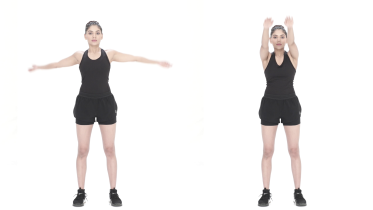
Chest expanders are a standing arm exercise that needs no equipment. You hold both arms straight out at shoulder height, bring them in until they cross in front of your chest, then open them back out as wide as is comfortable, switching which arm goes on top each time. As the arms open, the front of the chest stretches while the upper back and shoulders do the work. Many warm-ups include it.
How to do the chest expanders
- Stand tall with your feet hip width apart and your knees soft.
- Lift both arms straight out to the sides to shoulder height, palms facing down.
- Keeping the arms at shoulder height, bring them in until they cross over each other in front of your chest. Your elbows can bend a little as the arms cross, as in the video.
- Open the arms back out as wide as is comfortable, lifting your chest and drawing your shoulder blades gently together.
- Cross again with the other arm on top this time, and keep alternating at a steady, controlled pace.
What you should feel
Warmth and light work in the shoulders and upper back, and a stretch across the front of the chest each time the arms open wide.
Common mistakes
- Letting the arms sink below shoulder height as you tire.
- Flinging the arms back so hard that momentum carries them past a comfortable range.
- Arching the lower back or poking the chin forward as the arms open.
- Hitching your shoulders up as the arms tire.
How often
Many programs use 1 to 2 sets of 10 to 20 crossings, or 20 to 30 seconds of steady movement, often as a warm-up. Your physio will adjust this.
Stop and check with your physio if
- A sharp or catching pain in the shoulder, or a feeling that it is about to slip out of place.
- Tingling, numbness or pins and needles that runs into your arm or hand.
- Pins and needles in your arm or hand that do not go away after you stop, or part of your arm or hand goes numb. Get medical advice the same day. If one side of your face or body suddenly goes numb or weak, or your speech becomes slurred or muddled, call emergency services, even if it goes away.
- The shoulder feels as if it has slipped out of place, looks a different shape or suddenly locks so you cannot move the arm, or your hand turns cold, pale or blue. Go to an emergency department straight away, without driving yourself, and do not try to put the shoulder back in yourself.
From the clinic
The video moves at a brisk, rhythmic pace. Start slowly for the first few crossings and pick up speed only once your shoulders feel warm and the movement stays smooth. Keep the wide opening inside a range that does not hurt. Arm circles make another easy shoulder warm-up, and band pull-aparts add resistance for the upper back.
The arms swing out wide at shoulder height, so after a shoulder dislocation, shoulder surgery or a recent shoulder injury, ask your physio before you add this.
Written and checked by the PocketPhysio editorial team. Last updated 2026-09-28.
This page is general education, not a diagnosis or a personal treatment plan. If you have pain, an injury or a health condition, see a physiotherapist or doctor before starting new exercises.