Cobra stretch
The cobra stretch is a backward bend done lying face down. You press through your hands to lift your chest while your hips stay on the floor. It often appears in lower back programs built around bending backward. You will also feel it along the front of the stomach and hips.
How to do the cobra stretch
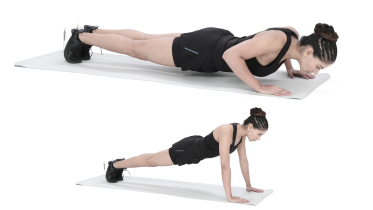
- Lie face down on a mat with your legs straight. Place your palms flat on the floor under your shoulders or slightly in front of them, elbows bent.
- Keep your stomach muscles gently tightened and let your buttocks and legs relax. Your hips stay on the mat the whole time.
- Press through your hands and slowly straighten your arms to lift your chest off the floor. Let your eyes lift a little as you rise, but keep the back of your neck long rather than tipping your head far back.
- Go only as high as you can with your hips still down. Your arms do not need to be fully straight.
- Pause briefly at the top, then lower yourself slowly back to the start and repeat.
What you should feel
A stretch across the front of your stomach and hips, and a gentle pressure in your lower back. Your buttocks and legs should feel relaxed.
Common mistakes
- Lifting your hips off the mat to get higher. Keep them down and go only as far as that allows.
- Throwing your head back. A small upward look is plenty, and it spares your neck.
- Shrugging your shoulders up toward your ears.
How often
Many programs use 8 to 10 slow repetitions with a pause of a few seconds at the top, once or several times a day. Your physio will tell you how many and how often.
Stop and check with your physio if
- Pain spreads into your buttock or down your leg, or you get numbness or tingling.
- You feel sharp or pinching pain in your lower back that gets worse with each repetition.
- Your wrists or shoulders hurt as you push up.
From the clinic
If straightening your arms is too much for now, stay propped on your forearms with your elbows under your shoulders. That smaller backward bend is a common place to start, and it is also the one to use if your wrists are sore.
Expect the first few repetitions to feel stiff, with each one going a little further. What matters more is where you feel it. If pain moves out of your back and into your leg, stop and check in with your physio.
Two diagnoses are worth raising with your physio before you try the cobra: narrowing of the spinal canal (spinal stenosis) and a vertebra that has slipped forward (spondylolisthesis). Backward bends often make both worse. The same goes if you are pregnant, since the cobra is done lying face down.
Reviewed by the PocketPhysio by VirtueLife expert physiotherapy team. Last reviewed 2026-09-25.
This page is general education, not a diagnosis or a personal treatment plan. If you have pain, an injury or a health condition, see a physiotherapist or doctor before starting new exercises.