
Sciatica exercises and physiotherapy
What is sciatica?
Sciatica is pain caused by an irritated or squashed nerve root in the lower back, felt along the path of the sciatic nerve. The NHS describes it as usually affecting your bottom and the back of one leg, often down to the foot and toes. It can feel sharp or burning, and it can come with pins and needles, numbness or weakness in the leg. Physios often call it lumbar radicular pain, because the problem starts at the nerve root (radix) where it leaves the spine.
The NHS names a slipped disc as the most common cause. Narrowing of the spinal canal (spinal stenosis), one vertebra slipping forward on another (spondylolisthesis) and back injuries can also cause it.
"Sciatica" is a loose word, and people use it for many kinds of leg pain. A review of population studies by Konstantinou and Dunn found that the studies defined it in very different ways, and their estimates of how many people have it ranged from 1.2% to 43%. If your pain stays in your back and buttock and does not travel down the leg, the low back pain program is the better starting point.
Do sciatica exercises help?
Exercise is a standard part of care, but the evidence for any single exercise is thin. The NHS lists exercises and stretches among the first treatments, and advises trying regular exercises alongside your normal activities. NICE suggests considering a group exercise program for a flare-up of low back pain with or without sciatica.
The research results are modest. A review by Fernandez and colleagues (2015) found low-quality evidence that structured exercise gave slightly better short-term leg pain relief than advice to stay active, with no difference in disability and no difference at later follow-ups. A larger review of physiotherapy treatments for sciatica (Dove 2023) found no clear overall difference in pain or disability compared with control treatments across 18 trials, and concluded that the evidence was not good enough to make clinical recommendations. All the trials had a high or unclear risk of bias.
The exercises still earn their place. They give you a safe way to keep moving while the nerve settles and help you find positions that ease the leg. Later on they rebuild the strength you need for work and daily life. Staying active matters as much as any specific exercise, so keep walking and doing what you can.
How to use this program
Pick the stage that matches how your leg feels today. If you are not sure, start at stage 1. Move slowly and breathe normally. Stay in a range that feels comfortable or only mildly uncomfortable.
Each exercise page gives a typical starting dose. As a rough guide, many programs start with 1 to 2 sets of 8 to 10 slow repetitions, or 2 to 3 gentle holds of 15 to 30 seconds for the stretches, once or twice a day. Prone lying is often held for 2 to 5 minutes, and the nerve glides often start with 5 to 10 slow, easy movements. The stage 3 strength exercises are often done on 2 to 3 days a week, building up toward 2 to 3 sets. Your physio will adjust this.
With sciatica, your leg tells you more than your back does. After each exercise, notice where the pain, numbness or tingling sits. If it spreads further down your leg, stop that exercise and leave it out for now.
If the leg symptoms ease or pull back toward your buttock or lower back, that is usually a good response. Physios call this centralization: the symptoms pull back toward the spine. In a review of back and neck pain studies, 21 of 23 studies found that centralization went with a better outlook (May 2012).
There is one exception. If the leg pain eases but numbness or weakness in the leg gets worse, that is not a good sign. Stop the exercises and get medical advice the same day.
Move up a stage when the current one feels easy and your leg settles well afterward. The NHS also suggests using heat packs on the painful areas, and some people find a warm pack before exercise makes the first movements easier.
The exercise program
Stage 1: Settle the leg and keep moving
For the first days or weeks, when sitting, bending or getting out of bed sends pain into your buttock or leg. These are small movements and resting positions, done lying down or standing. Some people's leg pain eases when they bend forward (pelvic tilt, knee to chest), and others ease when they lean back (prone lying, standing back extension). Try each one gently. Keep the ones that leave your leg the same or better, and leave out any that push symptoms further down the leg.
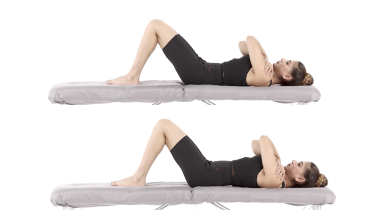 Pelvic tilt
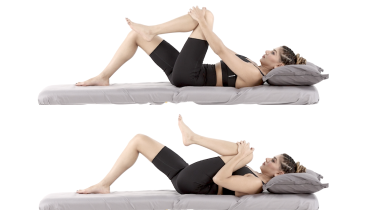 Knee to chest stretch
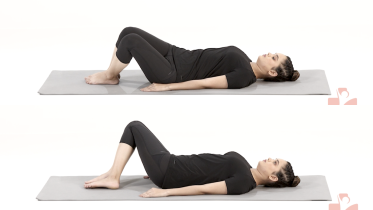 Lower trunk rotation
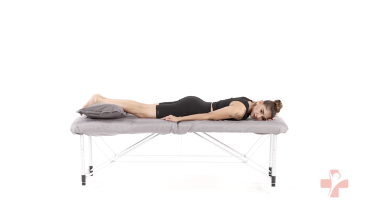 Prone lying
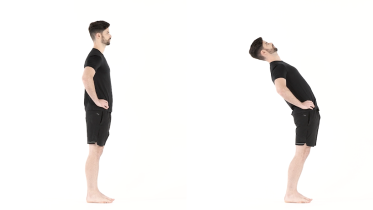 Standing back extension
Stage 2: Build control as the leg calms down
When the leg pain is less constant and moving around the house is easier, which takes days for some people and weeks or longer for others. The first four work your trunk and hip muscles while your back stays fairly still. The two nerve glides move the sciatic nerve gently without stretching it hard, and they stay short of any tingling. Ask a physio to check your leg before you start them. The cobra bends the back further, so add it only if it does not stir up your leg.
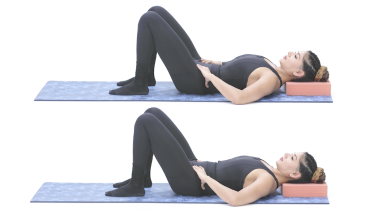 Transverse abdominis activation
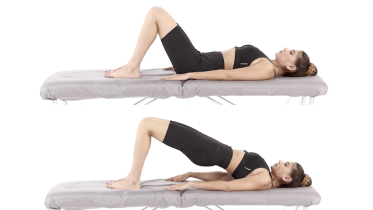 Glute bridge
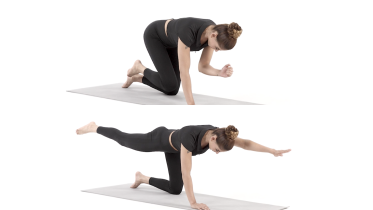 Bird dog
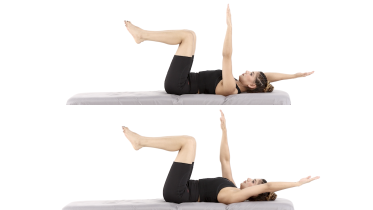 Dead bug
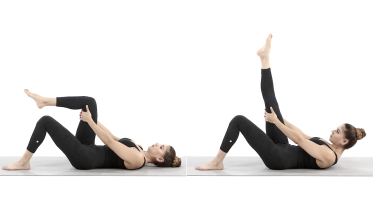 Lying sciatic nerve glide
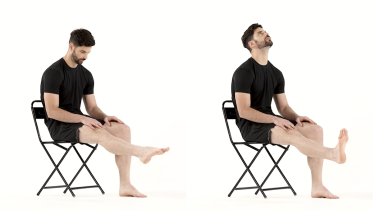 Seated sciatic nerve glide
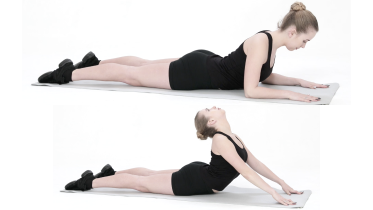 Cobra stretch
Stage 3: Get strong for daily life
For getting back to work, lifting, housework and sport once the leg pain has settled or only comes and goes. Sit to stand and the squat train your thighs and buttocks for getting up, bending down and carrying. The marching bridge and the prone back extension ask more of the hip and back muscles. The two buttock stretches are optional, for a buttock that feels tight, and they work on the muscles, not the nerve. Stop any of these if they bring on pain or tingling down your leg.
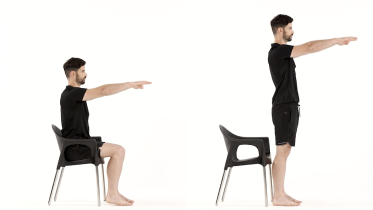 Sit to stand
 Squat
Squat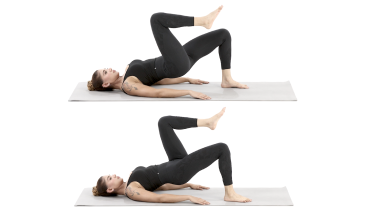 Marching bridge
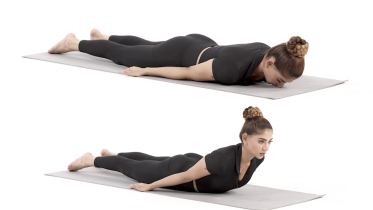 Prone back extension
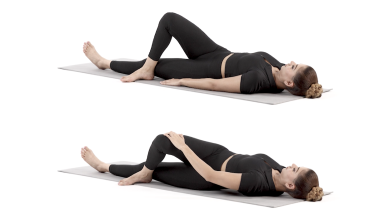 Piriformis stretch
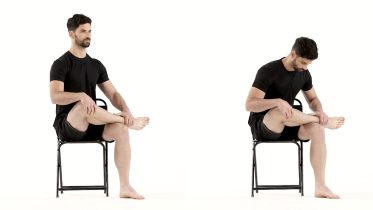 Seated figure 4 stretch
What to avoid or change
Avoid sitting or lying down for long periods, as the NHS advises. If you sit for work, get up regularly, walk a few steps or do a standing back extension, then carry on. On long drives, plan breaks to get out and move.
Go easy on hamstring stretches for now. Lifting a straight leg or reaching for your toes also pulls on the sciatic nerve, and that can flare up the leg pain. Leave strong hamstring stretching until the leg pain has settled, and ask your physio which version suits you.
If you have been told you have spinal stenosis or spondylolisthesis, check with your physio before the backward bending exercises (prone lying, standing back extension, cobra stretch, prone back extension). Bending backward can make both worse. If you have low bone density (osteoporosis), ask your physio before the knee to chest stretch and the trunk rotation, because deep forward bending and twisting to the end of the range are usually limited. Do the standing exercises next to a kitchen counter or a sturdy chair if your balance is not steady, or if your leg feels weak.
This program is not for rehab after spinal surgery. If you have had an operation on your back, follow your surgeon's or physio's plan. If you are pregnant and have leg pain, ask your physio or midwife for a plan made for pregnancy. The program is written for adults. If a child or teenager has pain running down one leg, get them checked by a doctor or physio before they start any of these exercises.
When to see a physio or doctor
See a physio or GP if your sciatica has not improved after trying home treatments for a few weeks, if it is getting worse, or if it stops you doing your normal activities. These timings come from the NHS. Get advice the same day if you feel hot, shivery or generally unwell, or if the pain is severe and came on suddenly or is getting worse quickly. The emergency signs below, including numbness around your genitals or bottom and new bladder or bowel trouble, need help straight away.
For physiotherapists
This page gives patients a starting framework, not a full plan. NICE NG59 advises against gabapentinoids, other antiepileptics, oral corticosteroids and benzodiazepines for managing sciatica, and against opioids for chronic sciatica. It suggests considering epidural injections of local anesthetic and steroid for acute and severe sciatica, and considering spinal decompression when non-surgical treatment has not improved pain or function and imaging matches the symptoms.
In the ATLAS cohort (Konstantinou 2018), longer leg pain duration and the patient's belief that the problem would last a long time were among the strongest factors linked to not improving at 12 months across the whole cohort, and the belief was also linked to a poorer outcome in the sciatica group. Asking early how long the person expects the problem to last can help show who needs more support.
The nerve glides in stage 2 are a form of neural mobilization. A review of neural mobilization for musculoskeletal conditions with a nerve-related component (Basson 2017) found improvements in pain and disability in chronic low back pain, but the evidence was limited and of varying quality, and the authors noted that conclusions may change over time.
In England, the GIRFT national suspected cauda equina syndrome pathway asks for emergency referral, with MRI within four hours of the request, when CES symptoms started or got worse within the last two weeks. New bilateral sciatica without CES symptoms goes to urgent MSK triage within two weeks, with safety netting. Our patient wording follows the NHS pages and sends any sciatica in both legs to the emergency department. The Finucane 2020 red flags framework notes that high-quality evidence for the diagnostic accuracy of most red flags is lacking, so treat them as prompts for clinical reasoning rather than a checklist.
See a doctor promptly if
- Emergency: numbness, tingling or altered feeling around or under your genitals, between your inner thighs, or around your bottom (anus), for example it feels different when you wipe after using the toilet. Call emergency services or go to an emergency department straight away. This can be a sign of pressure on the bundle of nerves at the base of the spine (cauda equina syndrome), which needs emergency treatment.
- Emergency: you find it hard to start peeing, cannot pee, cannot feel yourself peeing or cannot control when you pee, or you do not notice when you need to poo or cannot control when you poo, and this is not normal for you. The same applies to a new change in how your genitals feel during sex, or new trouble getting an erection or ejaculating. Call emergency services or go to an emergency department straight away. These can also be signs of cauda equina syndrome.
- Emergency: sciatica in both legs, or pain, tingling, numbness or weakness in both legs. The same applies if you lose feeling in one leg. Call emergency services or go to an emergency department straight away.
- Emergency: back or leg pain that started after a serious accident, such as a car crash or a fall from a height, or back pain with chest pain. Call emergency services.
- A leg or foot that is getting weaker, for example your foot drags, catches on the ground or slaps down when you walk (foot drop). Get medical advice the same day. If the weakness is getting worse by the hour, go to an emergency department.
- Back or leg pain with a fever, or you feel hot, cold, shivery or generally unwell. Get medical advice the same day, and go to an emergency department if you feel very unwell.
- New back or leg pain and you have had cancer, now or in the past, or you have lost weight without trying. Get medical advice the same day and mention it. If you are being treated for cancer now, contact your cancer team the same day.
- Emergency: you have had cancer, now or in the past, and your back or neck pain feels like a tight band around your body, or comes with pain spreading down an arm or leg, weakness, numbness or pins and needles in your arms or legs, trouble walking, or trouble controlling your bladder or bowels. Call your cancer team's emergency number straight away, or go to an emergency department if you do not have one or cannot get through. This can be cancer pressing on the spinal cord (metastatic spinal cord compression), which needs treatment straight away.
- Emergency: new neck or back pain after a fall, a knock or a jolt, even a minor one such as a trip or a sudden stop in a car, if you have a condition that stiffens the spine, such as ankylosing spondylitis. Call emergency services or go to an emergency department straight away, do not drive yourself, and tell the staff about your spine condition, so they keep your neck and back in their usual position. A stiff spine can break after a small injury, and the break is easy to miss at first. If the pain started straight after the injury, or you also have numbness, tingling or weakness in your arms or legs, keep still and call emergency services.
- Back pain after a minor fall or strain if you are older, have low bone density (osteoporosis) or have taken steroid tablets for a long time. Get medical advice the same day.
- Pain that does not ease at all with rest or changing position, or is worse at night. See your doctor within a few days. Get medical advice the same day if you also feel unwell, have lost weight without trying, or have had cancer, now or in the past. If you are being treated for cancer now, contact your cancer team the same day.
- Severe pain that comes on suddenly or is getting worse quickly. Get medical advice the same day.
Common questions
How long does sciatica last?
The NHS says sciatica usually gets better in a few weeks to a few months, but it can sometimes last longer. In the ATLAS study of 609 adults who saw their family doctor in the UK with back pain spreading into the leg, just over half had improved at 12 months. People who believed their problem would last a long time were less likely to have improved. If your leg pain has not started to ease after a few weeks, see a physio or doctor.
Should I rest or keep moving with sciatica?
Keep moving as much as the pain allows. The NHS advises carrying on with your normal activities as much as possible and not sitting or lying down for long periods. A Cochrane review found little or no difference in pain between advice to rest in bed and advice to stay active for people with sciatica (Dahm 2010), so bed rest brings no advantage. Short rests to ease a bad spell are fine. Then get up and move again.
Should sciatica exercises hurt?
Some ache in your back during or after exercise is common and usually fine if it settles within a day. With sciatica, watch your leg more than your back. If an exercise sends pain, numbness or tingling further down your leg, stop it and tell your physio. If the leg symptoms ease or pull back toward your buttock or back, physios usually count that as a good response, even if the back aches a little more for a while, as long as numbness or weakness in the leg is not getting worse. Your physio will help you find the right level.
Do I need an MRI for sciatica?
Usually not at first. NICE advises against routine imaging for low back pain with or without sciatica outside specialist care, and suggests a scan in specialist care only when the result is likely to change the treatment. An emergency scan is arranged when a doctor suspects cauda equina syndrome, and a scan may also be arranged when another serious cause is suspected.
Will I need surgery for sciatica?
Surgery is usually only considered after other treatment has been tried. NICE suggests considering surgery to take pressure off the nerve (spinal decompression) when non-surgical treatment has not improved pain or function and a scan shows a cause that matches the symptoms. For sciatica from a slipped disc, a review comparing surgery with physical activity found surgery gave better results for pain and disability in the short term, but in the longer term there was no clear difference in leg or back pain (Fernandez 2016). The authors noted that high-quality evidence is lacking. Cauda equina syndrome is different: it needs emergency surgery.
References
- National Institute for Health and Care Excellence. Low back pain and sciatica in over 16s: assessment and management (NG59). Published 2016, last updated July 2026. https://www.nice.org.uk/guidance/ng59
- NHS. Sciatica. https://www.nhs.uk/conditions/sciatica/
- NHS. Back pain. https://www.nhs.uk/conditions/back-pain/
- Getting It Right First Time (GIRFT), NHS England. National suspected cauda equina syndrome (CES) pathway. February 2023, updated March 2026. https://gettingitrightfirsttime.co.uk/wp-content/uploads/2026/04/National-Suspected-Cauda-Equina-Pathway-March-2026.pdf
- Konstantinou K, Dunn KM. Sciatica: review of epidemiological studies and prevalence estimates. Spine. 2008;33(22):2464-2472. https://doi.org/10.1097/BRS.0b013e318183a4a2
- Konstantinou K, Dunn KM, Ogollah R, Lewis M, van der Windt D, Hay EM. Prognosis of sciatica and back-related leg pain in primary care: the ATLAS cohort. The Spine Journal. 2018;18(6):1030-1040. https://doi.org/10.1016/j.spinee.2017.10.071
- Fernandez M, Hartvigsen J, Ferreira ML, et al. Advice to stay active or structured exercise in the management of sciatica: a systematic review and meta-analysis. Spine. 2015;40(18):1457-1466. https://doi.org/10.1097/BRS.0000000000001036
- Fernandez M, Ferreira ML, Refshauge KM, et al. Surgery or physical activity in the management of sciatica: a systematic review and meta-analysis. European Spine Journal. 2016;25(11):3495-3512. https://doi.org/10.1007/s00586-015-4148-y
- Dove L, Jones G, Kelsey LA, Cairns MC, Schmid AB. How effective are physiotherapy interventions in treating people with sciatica? A systematic review and meta-analysis. European Spine Journal. 2023;32(2):517-533. https://doi.org/10.1007/s00586-022-07356-y
- Dahm KT, Brurberg KG, Jamtvedt G, Hagen KB. Advice to rest in bed versus advice to stay active for acute low-back pain and sciatica. Cochrane Database of Systematic Reviews. 2010;(6):CD007612. https://doi.org/10.1002/14651858.CD007612.pub2
- May S, Aina A. Centralization and directional preference: a systematic review. Manual Therapy. 2012;17(6):497-506. https://doi.org/10.1016/j.math.2012.05.003
- Basson A, Olivier B, Ellis R, Coppieters M, Stewart A, Mudzi W. The effectiveness of neural mobilization for neuromusculoskeletal conditions: a systematic review and meta-analysis. Journal of Orthopaedic and Sports Physical Therapy. 2017;47(9):593-615. https://doi.org/10.2519/jospt.2017.7117
- Finucane LM, Downie A, Mercer C, et al. International framework for red flags for potential serious spinal pathologies. Journal of Orthopaedic and Sports Physical Therapy. 2020;50(7):350-372. https://doi.org/10.2519/jospt.2020.9971
Written and checked by the PocketPhysio editorial team. Last updated 2026-09-28.
This page is general education, not a diagnosis or a personal treatment plan. See a physiotherapist or doctor for advice about your own situation.