
Low back pain exercises and physiotherapy
What does non-specific low back pain mean?
Non-specific low back pain is pain in the lower back where no single damaged structure can be pinned down as the cause. That describes most back pain. A review in the Lancet found that for nearly all people with low back pain a specific cause cannot be identified, and only a small proportion have a serious cause such as a fracture, cancer or infection.
It is also very common. The same review names low back pain as the leading cause of disability worldwide. Most people with a new episode recover quickly, but it often comes back, and for a small group it becomes long-lasting.
The label can sound dismissive. It does not mean the pain is imagined or that nothing can be done. It means treatment is about getting you moving and back to your normal life, rather than hunting for one thing on a scan to fix.
Why does exercise help low back pain?
A second Lancet review found that guidelines in many countries recommend starting with treatments that do not involve medicine, such as education, getting back to normal activities, and exercise. Its authors argue that care should focus on activity and function rather than on spinal abnormalities. NICE in the UK advises giving people clear information about back pain and encouraging them to carry on with normal activities. For a specific episode or flare-up, it suggests considering a group exercise program, and it lists several kinds (strength and movement work, aerobic exercise, mind-body exercise, or a mix) without naming one as the standard.
For back pain that has lasted three months or more, a Cochrane review found that exercise probably reduces pain compared with no treatment or usual care. The average benefit was modest, smaller for day-to-day function than for pain, and results varied a lot between studies. So treat exercise as something you keep up over weeks and months. It is not a quick fix.
How to use this program
Pick the stage that matches how your back feels today. If you are not sure, start at stage 1. Move slowly and breathe normally. Stay in a range that feels comfortable or only mildly uncomfortable.
Each exercise page gives a typical starting dose, and as a rough guide, many programs start low: 1 to 2 sets of 8 to 10 slow repetitions, or 2 to 3 gentle holds of 15 to 30 seconds for the stretches, once or twice a day. The stage 3 strength exercises are often done on 2 to 3 days a week, building up toward 2 to 3 sets. Your physio will adjust this. Move up a stage when the current one feels easy and your back settles well afterward.
Backs differ: some people feel easier bending forward, as in the knee to chest stretch, and others feel better leaning back, as in the standing back extension. If one direction clearly stirs your pain up, leave it out for now and tell your physio. That tells them something useful. It does not mean you have failed.
Keep up everyday activity alongside the exercises. Walking is the simplest place to start, and a heat pack before you exercise can take the edge off the stiffness.
The exercise program
Stage 1: Get moving again
For a new episode or a flare-up, when bending, sitting down or getting out of bed feels stiff and guarded. These are small movements done lying down or standing, kept inside a comfortable range.
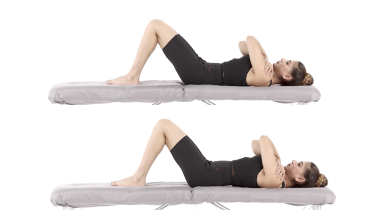 Pelvic tilt
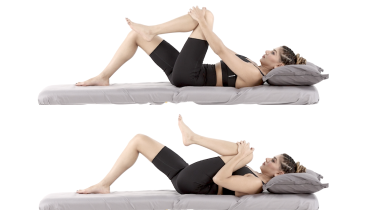 Knee to chest stretch
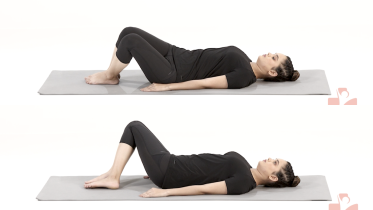 Lower trunk rotation
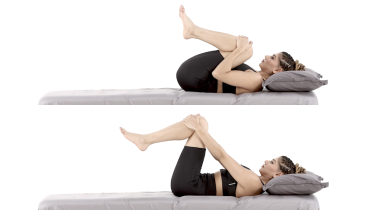 Double knee to chest stretch
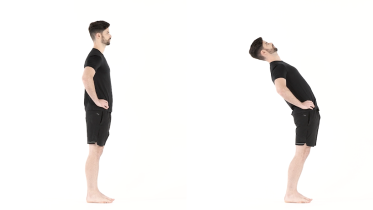 Standing back extension
Stage 2: Build control around your middle
When moving around the house is easier. For some people that is a few days, for others a few weeks. These work your trunk and hip muscles while you keep your back still and move your arms or legs.
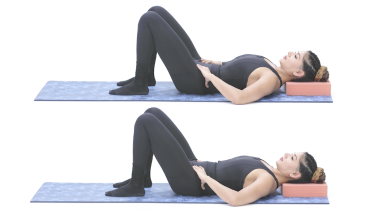 Transverse abdominis activation
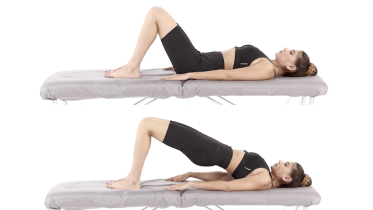 Glute bridge
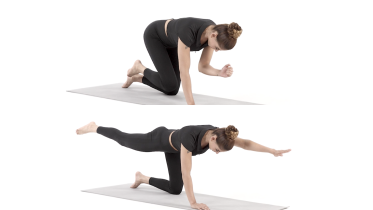 Bird dog
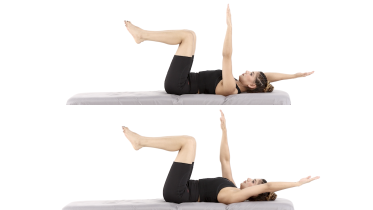 Dead bug
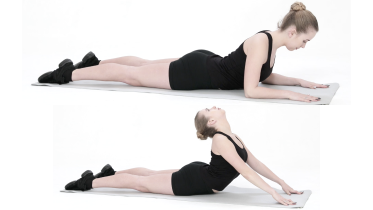 Cobra stretch
Stage 3: Get strong for daily life
For the things that load your back: lifting, housework, sport, long days at work. The superman and the squat put more load through the back and hips, as does side lying hip abduction. Move up to them once stage 2 feels steady. The piriformis stretch is for the buttock, and you can add it at any stage if that area feels tight.
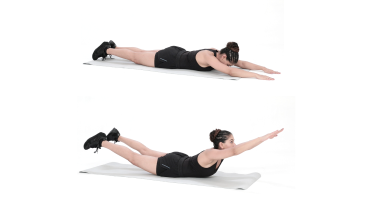 Superman
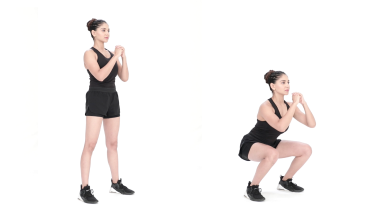 Squat
Squat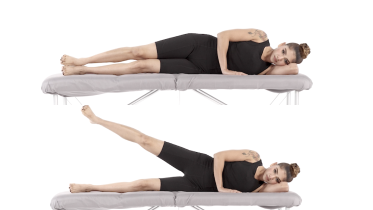 Side lying hip abduction
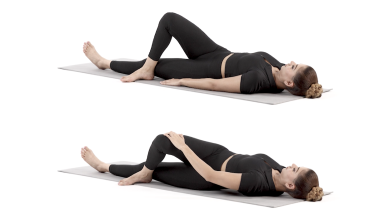 Piriformis stretch
What to avoid or change
You do not need to give up bending or lifting for good. Physios usually advise building up load gradually, in small steps, because a sudden jump can stir up a sore back. Think of a full day of gardening after a quiet month, or heavy lifting while you are still at stage 1. Break big jobs into shorter spells, and get up and move around regularly if you sit for long periods.
If you have been told you have narrowing of the spinal canal (spinal stenosis) or a forward slip of one vertebra on another (spondylolisthesis), check with your physio before the backward bending exercises (standing back extension, cobra stretch, superman). Bending backward can make both worse. If you have low bone density (osteoporosis), ask your physio before the knee to chest stretches and the trunk rotation, because deep forward bending and twisting to the end of the range are usually limited. If your balance is not steady, do the standing exercises next to a kitchen counter or a sturdy chair you can hold.
This program is not meant for the first months after back surgery: follow your surgeon's and physio's plan. If you are pregnant, you need a separate plan for back and pelvic pain. Ask your physio, and ask for versions that avoid lying on your front or flat on your back for long.
When to see a physio or doctor
See a physio or doctor if your back is not improving after a few weeks of looking after it at home, if it stops you doing your day-to-day activities, or if you are worried about it or struggling to cope. Pain that travels below the knee is also worth getting checked, as are pins and needles in one leg. Either can mean a nerve is irritated (sciatica). The urgent warning signs are listed below.
For physiotherapists
This page gives patients a starting framework, not a full plan. NICE suggests risk stratification at first contact for each new episode, for example with the STarT Back tool, to guide how much support a person needs. Its July 2026 update withdrew the recommendations on psychological therapy and on combined physical and psychological programs, so check the current version of NG59 before quoting it. Function scores such as the Oswestry Disability Index or the Roland-Morris questionnaire help show change over the first weeks.
See a doctor promptly if
- Emergency: numbness, tingling or altered feeling around or under your genitals, between your inner thighs, or around your bottom (anus), for example it feels different when you wipe after using the toilet. Call emergency services or go to an emergency department straight away. This can be a sign of pressure on the bundle of nerves at the base of the spine (cauda equina syndrome), which needs emergency treatment.
- Emergency: you find it hard to start peeing, cannot pee, cannot feel yourself peeing or cannot control when you pee, or you do not notice when you need to poo or cannot control when you poo, and this is not normal for you. The same applies to a new change in how your genitals feel during sex, or new trouble getting an erection or ejaculating. Call emergency services or go to an emergency department straight away. These can also be signs of cauda equina syndrome.
- Emergency: sciatica in both legs, or pain, tingling, numbness or weakness in both legs. The same applies if you lose feeling in one leg. Call emergency services or go to an emergency department straight away.
- Emergency: back or leg pain that started after a serious accident, such as a car crash or a fall from a height, or back pain with chest pain. Call emergency services.
- A leg or foot that is getting weaker, for example your foot drags, catches on the ground or slaps down when you walk (foot drop). Get medical advice the same day. If the weakness is getting worse by the hour, go to an emergency department.
- Emergency: new neck or back pain after a fall, a knock or a jolt, even a minor one such as a trip or a sudden stop in a car, if you have a condition that stiffens the spine, such as ankylosing spondylitis. Call emergency services or go to an emergency department straight away, do not drive yourself, and tell the staff about your spine condition, so they keep your neck and back in their usual position. A stiff spine can break after a small injury, and the break is easy to miss at first. If the pain started straight after the injury, or you also have numbness, tingling or weakness in your arms or legs, keep still and call emergency services.
- Back pain after a minor fall or strain if you are older, have low bone density (osteoporosis) or have taken steroid tablets for a long time. Get medical advice the same day.
- Back or leg pain with a fever, or you feel hot, cold, shivery or generally unwell. Get medical advice the same day, and go to an emergency department if you feel very unwell.
- You have back pain and have lost weight without trying. Get medical advice the same day and mention the weight loss.
- New back pain and you have had cancer, now or in the past. Get medical advice the same day and mention your cancer history. If you are being treated for cancer now, contact your cancer team the same day.
- Emergency: you have had cancer, now or in the past, and your back or neck pain feels like a tight band around your body, or comes with pain spreading down an arm or leg, weakness, numbness or pins and needles in your arms or legs, trouble walking, or trouble controlling your bladder or bowels. Call your cancer team's emergency number straight away, or go to an emergency department if you do not have one or cannot get through. This can be cancer pressing on the spinal cord (metastatic spinal cord compression), which needs treatment straight away.
- Pain that is worse at night, or does not ease at all when you rest. See your doctor within a few days. If you have had cancer, now or in the past, or you have lost weight without trying, get medical advice the same day. If you are being treated for cancer now, contact your cancer team the same day.
- Severe pain that comes on suddenly or is getting worse quickly. Get medical advice the same day.
Common questions
Should I rest or keep moving with lower back pain?
Keep moving as much as the pain allows. NICE and the NHS both advise carrying on with your normal activities as far as you can. You may need to do less for a few days, or split jobs into shorter spells, but try not to stop altogether.
Should exercises hurt?
Mild discomfort or a stretching feeling in the back is common and usually acceptable if it settles within a day and is not building up from week to week. Stop and tell your physio if pain spreads into your leg or further down it, if you get new numbness or tingling, or if your back is clearly worse the next day. Those signs mean the load was too much for now. Your physio will help you find the right level.
Do I need an X-ray or MRI for back pain?
Usually not. NICE advises against routine imaging for low back pain outside specialist care, and suggests a scan in specialist care only when the result is likely to change the treatment. Wear and tear changes, such as disc bulges, are common on scans of people with no back pain at all, and they become more common with age (Brinjikji 2015). A scan is arranged when a doctor suspects a serious cause.
How long does lower back pain take to get better?
The NHS says back pain usually improves within a few weeks, but it can last longer or keep coming back. For a small group it lasts for months. So it is worth keeping up some exercise and walking after the pain has gone.
Is walking good for lower back pain?
For most people, yes. The NHS lists walking among the activities that may help ease back pain. In the WalkBack trial of 701 adults who had recently recovered from low back pain, a progressive walking program with education, guided by a physio over 6 months, delayed the next episode of back pain that limited daily activities: the median time to it was 208 days with the program and 112 days with no treatment. Start with a distance you can manage and build up slowly.
References
- National Institute for Health and Care Excellence. Low back pain and sciatica in over 16s: assessment and management (NG59). Published 2016, last updated July 2026. https://www.nice.org.uk/guidance/ng59
- Hartvigsen J, Hancock MJ, Kongsted A, et al. What low back pain is and why we need to pay attention. The Lancet. 2018;391(10137):2356-2367. https://doi.org/10.1016/S0140-6736(18)30480-X
- Foster NE, Anema JR, Cherkin D, et al. Prevention and treatment of low back pain: evidence, challenges, and promising directions. The Lancet. 2018;391(10137):2368-2383. https://doi.org/10.1016/S0140-6736(18)30489-6
- Hayden JA, Ellis J, Ogilvie R, Malmivaara A, van Tulder MW. Exercise therapy for chronic low back pain. Cochrane Database of Systematic Reviews. 2021;(9):CD009790. https://doi.org/10.1002/14651858.CD009790.pub2
- Pocovi NC, Lin CWC, French SD, et al. Effectiveness and cost-effectiveness of an individualised, progressive walking and education intervention for the prevention of low back pain recurrence in Australia (WalkBack): a randomised controlled trial. The Lancet. 2024;404(10448):134-144. https://doi.org/10.1016/S0140-6736(24)00755-4
- Brinjikji W, Luetmer PH, Comstock B, et al. Systematic literature review of imaging features of spinal degeneration in asymptomatic populations. American Journal of Neuroradiology. 2015;36(4):811-816. https://doi.org/10.3174/ajnr.A4173
- Finucane LM, Downie A, Mercer C, et al. International framework for red flags for potential serious spinal pathologies. Journal of Orthopaedic and Sports Physical Therapy. 2020;50(7):350-372. https://doi.org/10.2519/jospt.2020.9971
- NHS. Back pain. https://www.nhs.uk/conditions/back-pain/
Written and checked by the PocketPhysio editorial team. Last updated 2026-09-28.
This page is general education, not a diagnosis or a personal treatment plan. See a physiotherapist or doctor for advice about your own situation.