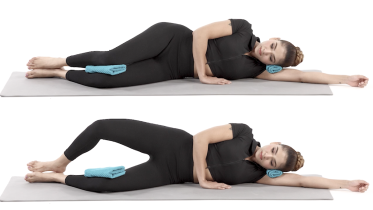
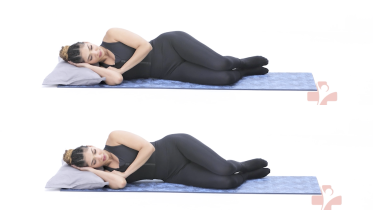
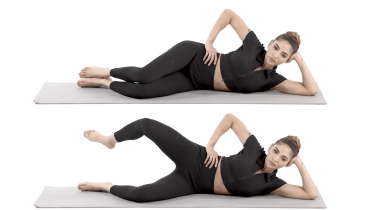
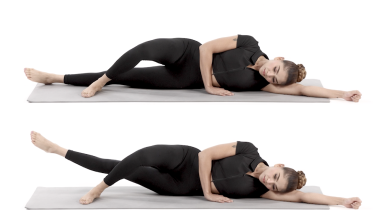
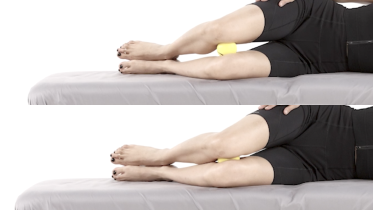
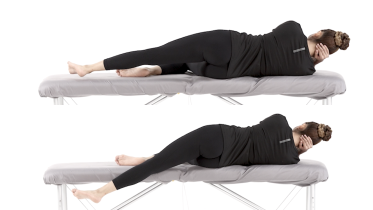
Side lying hip abduction
Side lying hip abduction is a strengthening exercise where you lie on your side and lift your straight top leg toward the ceiling. It works the muscles at the side of your hip (mainly gluteus medius) and is often part of programs for hip, knee and lower back problems.
How to do the side lying hip abduction
- Lie on your side and rest your head on your bottom arm. Put your top hand on the bed or floor in front of your chest for balance.
- Keep both legs straight, one on top of the other, as in the video. If you feel wobbly, bend the bottom knee a little to steady yourself. The top leg always stays straight.
- Line yourself up so your shoulders, hips and top ankle are in one straight line. Let your top hip tip very slightly forward, never back.
- Keep your top knee straight, with the kneecap and toes facing forward, not up at the ceiling.
- Slowly lift the top leg, leading with the heel. Stop before your hip starts to roll back or your waist hitches up toward your ribs.
- Hold the leg up for 2 to 5 seconds (the video holds for about 5), then lower it slowly back to the start.
What you should feel
Work in the side of your hip and buttock on the top leg. Not in the front of the hip and not in the lower back.
Common mistakes
- Rolling the top hip back so the leg swings forward. The muscles at the front of the hip then do the work.
- Hitching the waist to get the leg higher. A lower lift with good form is better.
- Letting the leg drop instead of lowering it with control.
How often
Many programs start with 2 to 3 sets of 10 to 15 on each side, once a day, with a hold of 2 to 5 seconds at the top. Your physio will set the numbers for you.
Stop and check with your physio if
- You feel sharp pain in the side of the hip, the groin or the lower back.
- Pain spreads down the leg or you get numbness or tingling.
From the clinic
Feeling it mostly at the front of the hip? Check your position before adding reps. Most often the top hip has rolled back and the leg is drifting forward. Let the leg travel slightly behind your body line and the work usually shifts to the side of the hip.
Pain right on the bony point at the outside of the hip is worth mentioning to your physio before you start. Lying on that side, or lifting against it, bothers some people, and a gentler version may suit you better at first.
If you have had a hip replacement or other hip surgery, get the go-ahead from your surgeon or physio before you try side-lying hip abduction. Some operations limit this kind of work for the first months, so the timing depends on your surgery. With some surgical approaches, side leg lifts wait until the tissues at the side of the hip have healed.
Once the basic lift is easy and steady, a light ankle weight or band is the usual next step.
Reviewed by the PocketPhysio by VirtueLife expert physiotherapy team. Last reviewed 2026-09-25.
This page is general education, not a diagnosis or a personal treatment plan. If you have pain, an injury or a health condition, see a physiotherapist or doctor before starting new exercises.