
Facet joint pain: exercises and physiotherapy
Warning signs, and when to get help
What is facet joint pain (facet joint syndrome)?
Behind each pair of vertebrae in your lower back sit two small joints, one on the left and one on the right. They are the facet joints (zygapophysial joints), and they guide how far your spine bends backward and twists. They also take more of your weight the further you lean back. That one fact explains most of what makes this kind of pain better or worse.
Facet joint pain, sometimes called facet joint syndrome, is the label used when the pain seems to be coming from these joints. How common that is depends entirely on who is counting and how. One review put facet joint arthropathy at up to 15 percent of people with long-standing low back pain (Cohen and Raja, 2007). A later imaging review quoted a range of 15 to 45 percent of low back pain, although the numbers behind that range come from particular groups with long-standing pain, 15 percent among injured workers and 45 percent in a mixed group, rather than from low back pain in general (Perolat and colleagues, 2018).
So the two figures are not counting the same people. The gap has a second reason, and it is not a mysterious one: the number depends on which numbing injection was used to make the diagnosis, and those injections give a positive answer in people who do not have the condition often enough that both reviews say so out loud. Perolat puts the false positive rate of a single block at 30 to 45 percent.
Set against that, a review in the Lancet found that for nearly all people with low back pain no single structure can be identified as the cause (Hartvigsen and colleagues, 2018). So read "facet joint pain" as a working description of a recognizable pattern, not as something that was proved on a scan. Nothing about that makes the pain less real, and it changes very little about what you do next. The low back pain program is the general version of this plan, and with a facet pattern the difference is mostly where you start.
Is it facet joint pain or a disc?
Usually you cannot be sure, and the two plans overlap more than people expect.
The pattern that makes a physio think of the facet joints is pain that stays local: low in the back, often clearly worse on one side, sometimes spreading into the buttock or the back of the thigh, but stopping there. The pattern that points at a disc irritating a nerve is pain that travels, usually below the knee, often with pins and needles, numbness or weakness in the leg. That one has its own pages, the lumbar disc herniation program and the sciatica program.
The reviews are blunt about the limits here. The literature does not support using the history or the physical examination to diagnose facet joint pain (Cohen and Raja, 2007), and examination findings may suggest it without confirming it (Perolat and colleagues, 2018). What a physio is really doing when they test you is ruling things in and out at the level that matters for treatment: is a nerve involved, is this the pattern of the sacroiliac joint, does walking bring on leg symptoms in the way spinal stenosis does, is there a forward slip of one vertebra as in spondylolisthesis, and is the disc wear seen on scans in degenerative disc disease part of the story. Each of those changes which directions you load early and which you leave alone.
What makes facet joint pain worse
The list people give us is consistent enough to be worth writing down. Standing still, especially on a hard floor. Leaning back to reach a high shelf, or twisting to get something off the back seat of a car.
Turning over in bed is on nearly every list. So is standing up straight after a long sit, where the first two or three steps are the worst of the day, and walking downhill, which arches the back more than walking on the flat does.
What usually helps, at least in the short term, is the opposite: sitting down, leaning forward over a counter, or putting one foot up on a low step while you stand. If one-sided pain is your main complaint, lower back pain on one side runs through the other causes that produce it, and if the first minutes of the day are the problem, lower back pain in the morning has a short routine for them. Readers whose pain is worse the longer they sit are probably looking at a different pattern, and back pain when sitting covers that one.
Be careful how much weight you put on any of this. These are the things patients report and the things reviews describe, not tested diagnostic signs. Plenty of people have a facet pattern on paper and a disc problem underneath, or the other way round.
Does facet joint pain show on a scan?
No, and a scan can mislead you in both directions.
Wear in the facet joints is almost a normal finding with age. In a community sample of 188 adults aged 40 to 80 who had CT scans, facet joint osteoarthritis was present in 59.6 percent of men and 66.7 percent of women. It rose with age, from 44.7 percent in the 40 to 49 group to 89.2 percent in the 60 to 69 group, and it was commonest at the L4 to L5 level. The part that matters most for you is the conclusion: the authors looked for a link between facet joint wear at any level and whether people had low back pain, and they did not find one (Kalichman and colleagues, 2008). The same story holds across spinal imaging generally, where disc and joint changes turn up in large numbers of people with no pain at all and become more common each decade (Brinjikji and colleagues, 2015).
The other direction is just as awkward. A systematic review of 62 diagnostic accuracy studies, 14 of them on the facet joints, found exactly one informative test for them: uptake on a SPECT bone scan, with a positive likelihood ratio of 2.80 and a negative one of 0.44. No clinical test and no cluster of tests reached that bar (Han and colleagues, 2023). NICE advises against routine imaging for low back pain outside specialist care.
So if your scan report mentions facet joint degeneration, it is a description of your age as much as of your pain. It is not a reason to stop loading your back.
Warning signs that need checking first
Read the warning list at the bottom of this page once before you start anything. Most of it will not apply to you, and the lines that do say how fast to act.
Some people need a check before they begin, not after. Anyone whose back pain followed a fall or a strain and who is older, has low bone density or has taken steroid tablets for a long time. Anyone with back pain plus a fever, weight they did not mean to lose, or a history of cancer. And anyone under 45 whose back or buttock pain has lasted more than three months, is worse after rest and in the morning, and eases once they get moving, because that pattern can be inflammatory rather than mechanical and it needs a doctor rather than an exercise plan (Finucane and colleagues, 2020). Our guide to red flags in physiotherapy explains how clinicians use these signs.
Why exercise helps, and which direction to start in
Stronger trunk and hip muscles share the load that the joints would otherwise take on their own, and regular movement is what keeps a guarded back from stiffening into one block. For back pain that has lasted three months or more, a Cochrane review of 249 exercise trials found moderate certainty evidence that exercise reduces pain compared with no treatment, usual care or placebo, by about 15 points on a 0 to 100 scale at the earliest follow-up, which the review counted as a clinically important difference, with wide variation between trials (Hayden and colleagues, 2021). NICE advises keeping up normal activities and considering a group exercise program for an episode of low back pain.
Direction is the one thing this program does differently. Because a facet pattern is usually provoked by leaning backward, stage 1 here contains no backward bending at all. The pelvic tilt, the knee to chest stretch and the cat camel stretch all take the lower back forward or round, and the lower trunk rotation takes it sideways in a controlled, supported way. The general low back pain program offers both directions and asks you to pick; this one picks for you to begin with.
Honesty about that choice: no trial has tested starting a facet program in flexion against starting it anywhere else. It comes from the principle that you load the direction your back tolerates and earn the other one back, which is practice rather than evidence. If leaning back is the thing that eases your pain, this is the wrong starting point and you should say so to your physio.
How to use this program
Pick the stage that matches today. If you are unsure, start at stage 1. Move up when the current stage feels easy and your back settles well afterward. Mild discomfort during an exercise is common and usually fine if it has gone by the next morning and is not building week on week.
Each exercise page gives a typical starting dose. As a rough guide, many programs begin with 1 to 2 sets of 8 to 10 slow repetitions, or 2 to 3 holds of 15 to 30 seconds for the stretches, once or twice a day. The stage 3 strength work is often done on 2 to 3 days a week, building toward 2 to 3 sets. Your physio will adjust this.
If you have high blood pressure, breathe steadily through every hold and never hold your breath. With low bone density (osteoporosis), ask your physio before the knee to chest stretches and the lower trunk rotation, because deep forward bending and twisting to the end of the range are usually limited, and that matters more here than on most pages because this program leans on the forward direction.
If you have had a hip replacement, get the go-ahead from your surgeon or physio before you try the knee to chest stretches, the lower trunk rotation, the clamshell, the side lying hip abduction, the chair squat, the bridges or the standing hip extension. Pulling the knee in bends the hip well past a right angle, and many surgeons ask you to avoid that for the first months after some operations.
If your balance is not steady, keep a hand on a kitchen counter for the standing exercises. After spine surgery, follow the program your surgical team and physio gave you rather than this one.
The exercise program
Stage 1: Movement in the easy direction
For a sore, guarded back that objects to standing up straight and leaning back. Every movement here takes the lower back forward or sideways rather than backward, which is usually the direction that settles a facet pattern. Keep them small and well inside comfort. If any of them clearly stirs the pain up, leave it out for now and tell your physio.
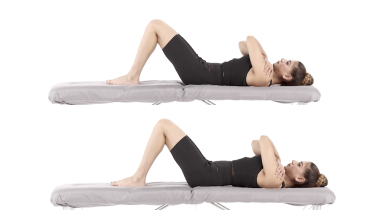 Pelvic tilt
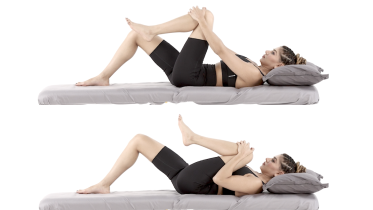 Knee to chest stretch
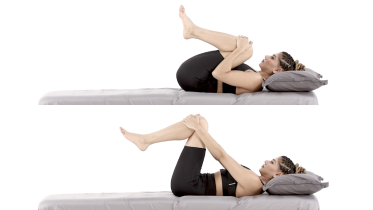 Double knee to chest stretch
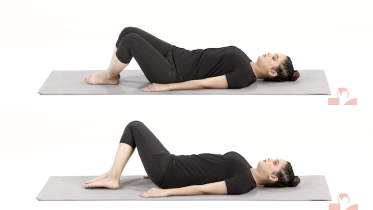 Lower trunk rotation
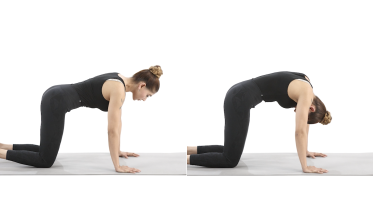 Cat-camel stretch
Stage 2: Hold the middle of the range
When standing and walking are easier, which takes a few days for some people and a few weeks for others. These train your trunk to stay quiet in the middle of its range while your arms and legs do the moving, which is the part that matters when you reach up or turn around carrying something. The effort should be light enough to talk through.
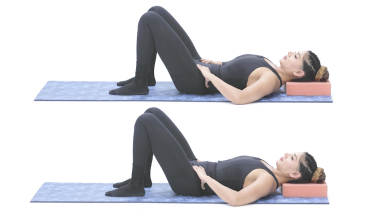 Transverse abdominis activation
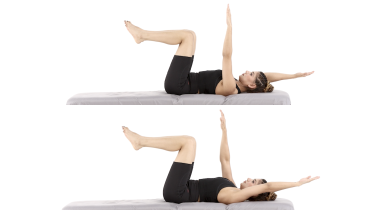 Dead bug
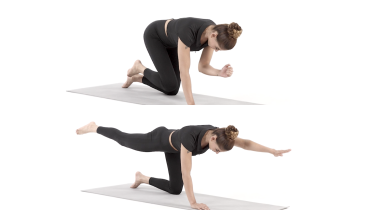 Bird dog
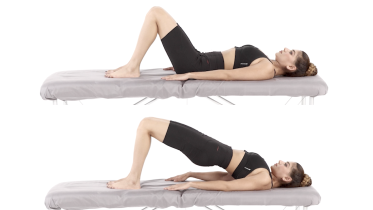 Glute bridge
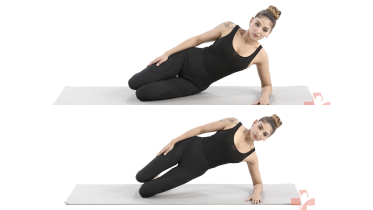 Kneeling side plank
Stage 3: Strength, and the hip
For standing, stairs, lifting and long days on your feet. The hip work is here on purpose: a stiff front of the hip pulls the lower back into the backward direction when you stand or stride out, so the hip flexor stretch and standing hip extension are working on the same problem as the trunk exercises. Hold a counter for the standing ones until they feel steady.
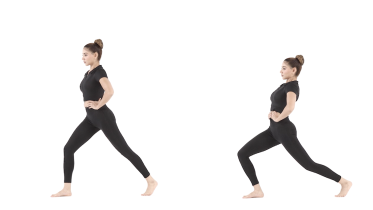 Hip flexor stretch
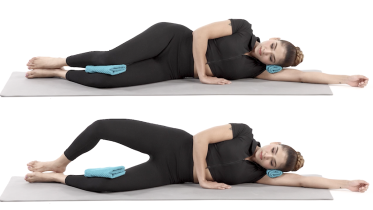 Clamshell
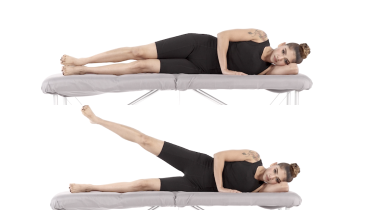 Side lying hip abduction
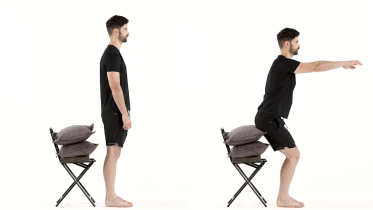 Chair squat
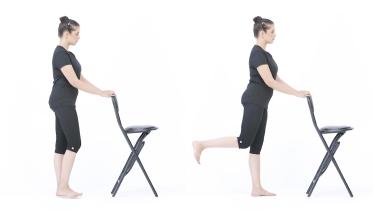 Standing hip extension
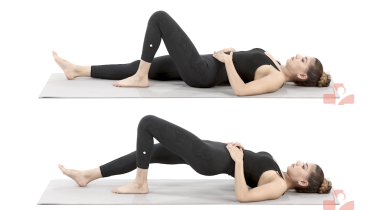 Single leg bridge
Standing, reaching, driving and sleeping
Daily life is full of small amounts of leaning back that nobody notices until their back objects to them. The sink is the usual one: brushing your teeth, washing up and shaving all put you in a shallow arch for several minutes. Open the cupboard door underneath and rest one foot on the frame, or bend one knee, and the arch comes out of it.
Overhead jobs are the bigger problem. Hanging washing on a line, painting a ceiling, putting plates in a high cupboard and pulling a case down from a shelf all reach the same position, and they are often what someone did the day before a flare. The fix is dull and it works: bring the job down to you. Use a step so your hands are nearer chest height, move the everyday plates to a lower shelf for a few weeks, and split a long overhead task into short spells with something else in between.
In the car, set the backrest a little reclined, not bolt upright. Swing both legs out together when you get out, because leading with one leg makes you twist as you stand. On a long drive, stop and walk about for a few minutes. For sleep, most people are comfortable on their side with the knees a little bent or on their back with a pillow under the knees, and sleeping positions for back pain goes through the set-ups in more detail. Turning over at night is the moment this pattern complains about, so keep your knees together and roll your shoulders and hips as one piece instead of twisting the top half first.
Injections, radiofrequency and what the guidelines say
The evidence here has moved a long way from where most people think it still is.
NICE advises against spinal injections for managing low back pain. It does keep a place for radiofrequency denervation, which is a procedure that interrupts the small nerves supplying the facet joints, but only after a positive response to a diagnostic medial branch block, which is a numbing injection used as a test. So it is not a first step, and it is not offered on the strength of a scan report.
Then the trials arrived. The Mint trials randomized 681 adults with chronic low back pain across 16 Dutch multidisciplinary pain clinics. Everybody got a standardized 3 month exercise program, and the intervention groups had radiofrequency denervation on top of it.
In the facet joint trial, the difference in pain intensity at 3 months was 0.18 points on a 0 to 10 scale, against a 2 point difference set in advance as the smallest that would matter to a patient. The authors concluded that their findings do not support the use of radiofrequency denervation for chronic low back pain from these sources (Juch and colleagues, 2017). A Cochrane review of 23 trials and 1,309 people reached a similar place: its authors found no high quality evidence that the procedure relieves pain and no convincing evidence that it improves function, rating the evidence overall as very low to moderate (Maas and colleagues, 2015). To be fair to it, that same review did find moderate quality evidence of a short term pain benefit over a placebo injection for facet denervation specifically, which is the strongest thing anyone can say for it.
None of that is a reason to refuse something your own doctor has offered after examining you. It is a reason to ask what they expect it to do, and to know that the exercise arm of the largest trial did about as well on its own. If your pain has not shifted after several months of steady work, that conversation is worth having.
Facet joint pain in the neck
The neck has facet joints too, and they are often blamed for one sided neck pain that is worse when you turn your head or look up. The research there is a little stronger, because volunteer studies produced recognizable pain maps for each joint. That is a different region with a different program: start with neck pain for the exercises, and neck pain on one side for how the referral patterns work. The exercises on this page are for the lower back and should not be used for a sore neck.
When to see a physio or doctor
See a physio or doctor if your back has not improved after a few weeks of looking after it at home, if it is stopping you working, sleeping or doing your usual activities, or if you are worried about it. Get it looked at sooner if pain travels below the knee or you get pins and needles in the leg, because that suggests a nerve is involved and changes the plan. A physio can also sort out the direction question for you in one appointment, which is worth it if stage 1 here does not suit you.
Check with your doctor before you start if you have a heart or lung condition, or blood pressure that is not under control. If you are pregnant, back and pelvic pain needs its own plan, so ask your midwife, doctor or physio rather than using this page. The urgent warning signs are listed below.
For physiotherapists
Treat the label as a clinical hypothesis and tell the patient so. Han 2023 pooled 14 facet joint studies and found one informative index test, SPECT uptake, at a positive likelihood ratio of 2.80 (95% CI 1.82 to 4.31) and a negative likelihood ratio of 0.44 (95% CI 0.25 to 0.77); no clinical test or cluster came out informative by the review's thresholds, which were a positive likelihood ratio of 2 or more and a negative one of 0.5 or less. Cohen and Raja 2007 note the insidious onset, the association with spondylolisthesis, disc degeneration and older age, and the high false positive rate of both intra-articular and medial branch blocks. Kalichman 2008 remains the cleanest statement of the imaging problem in a community sample.
For management, NG59 lines apply: risk stratification at first contact, self-management support, a graded individualized program, and no spinal injections for low back pain. Its radiofrequency denervation recommendation requires a positive diagnostic medial branch block, and Juch 2017 and Maas 2015 are the two papers to have read before a patient asks about it. The NG59 July 2026 update removed two recommendations, 1.2.13 on psychological therapy and 1.2.14 on combined physical and psychological programs, and gives the same reason for both: a surveillance review found the recommendation may be out of date, and an update was not prioritized in this area. That is a withdrawal for want of a review, not a finding against psychological treatment, so do not read it as one, and check the current version before quoting it. Progress the direction preference by symptom response rather than by protocol, screen the inflammatory pattern early in anyone under 45 with more than three months of symptoms (NG65), and use a function score such as the Oswestry Disability Index or the Roland-Morris questionnaire to track the first 6 to 12 weeks rather than relying on pain alone.
Warning signs
Get emergency help now
- Emergency: numbness, tingling or altered feeling around or under your genitals, between your inner thighs, or around your bottom (anus), for example it feels different when you wipe after using the toilet. Call emergency services or go to an emergency department straight away. This can be a sign of pressure on the bundle of nerves at the base of the spine (cauda equina syndrome), which needs emergency treatment.
- Emergency: you find it hard to start peeing, cannot pee, cannot feel yourself peeing or cannot control when you pee, or you do not notice when you need to poo or cannot control when you poo, and this is not normal for you. The same applies to a new change in how your genitals feel during sex, or new trouble getting an erection or ejaculating. Call emergency services or go to an emergency department straight away. These can also be signs of cauda equina syndrome.
- Emergency: sciatica in both legs, or pain, tingling, numbness or weakness in both legs. The same applies if you lose feeling in one leg. Call emergency services or go to an emergency department straight away.
- Emergency: back or leg pain that started after a serious accident, such as a car crash or a fall from a height, or back pain with chest pain. Call emergency services. If the pain started straight after the accident, keep still while you wait.
- Emergency: sudden, severe pain in your lower back or tummy that is not like your usual back pain, if you have been told you have a swelling of the main blood vessel in your tummy (abdominal aortic aneurysm), you are over 60, you smoke or used to smoke, or you have high blood pressure. The same applies if sudden, severe back or tummy pain comes with feeling faint or passing out, pale, sweaty or clammy skin, a racing heartbeat or being short of breath. Call emergency services straight away. This can be a sign of an aneurysm bursting, which needs treatment in hospital at once.
- Emergency: new neck or back pain after a fall, a knock or a jolt, even a minor one such as a trip or a sudden stop in a car, if you have a condition that stiffens the spine, such as ankylosing spondylitis. Call emergency services or go to an emergency department straight away, do not drive yourself, and tell the staff about your spine condition, so they keep your neck and back in their usual position. A stiff spine can break after a small injury, and the break is easy to miss at first. If the pain started straight after the injury, or you also have numbness, tingling or weakness in your arms or legs, keep still and call emergency services.
- Emergency: back pain with a fever, or you feel hot, shivery or very unwell, and you also have new weakness, numbness or tingling in one or both legs, or new trouble with your bladder or bowels. Call emergency services or go to an emergency department straight away. This can be an infection pressing on the nerves in the spine (spinal epidural abscess), which needs emergency treatment.
- Emergency: you have had cancer, now or in the past, and your back or neck pain feels like a tight band around your body, or comes with pain spreading down an arm or leg, weakness, numbness or pins and needles in your arms or legs, trouble walking, or trouble controlling your bladder or bowels. Call your cancer team's emergency number straight away, or go to an emergency department if you do not have one or cannot get through. This can be cancer pressing on the spinal cord (metastatic spinal cord compression), which needs treatment straight away.
Get help today
- A leg or foot that is getting weaker, for example your foot drags, catches on the ground or slaps down when you walk (foot drop). Get medical advice the same day. If the weakness is getting worse by the hour, go to an emergency department.
- A calf or thigh that is newly swollen or getting more swollen, warm, tender, red or darker than usual, has swollen veins that are sore to touch, or has a throbbing or cramping pain that does not fit your injury or condition, or that feels different from normal muscle soreness after exercise. This can be a sign of a blood clot (deep vein thrombosis), especially after surgery, an injury, time in a cast or boot, a long trip or a spell of being much less mobile than usual. Get medical advice the same day. If you are also short of breath or have chest pain, call emergency services.
- Back pain after a minor fall or strain if you are older, have low bone density (osteoporosis) or have taken steroid tablets for a long time. Get medical advice the same day. Until it has been checked, stop the exercises and keep away from lifting, bending forward and twisting, because those load a bone in the spine that may be broken.
- Back or leg pain with a fever, or you feel hot, cold, shivery or generally unwell. Get medical advice the same day, and go to an emergency department if you feel very unwell.
- You have back pain and have lost weight without trying. Get medical advice the same day and mention the weight loss.
- New back pain and you have had cancer, now or in the past. Get medical advice the same day and mention your cancer history. If you are being treated for cancer now, contact your cancer team the same day.
- Same day: pain that is worse at night, or does not ease at all when you rest. If you have had cancer, now or in the past, or you have lost weight without trying, get medical advice the same day.
- Severe pain that comes on suddenly or is getting worse quickly. Get medical advice the same day.
Book an appointment
- Within a few days: pain that is worse at night, or does not ease at all when you rest. See your doctor within a few days.
- Back or buttock pain that started before the age of 45, has lasted more than three months, is worse after rest and in the morning, and eases when you move. This is not an emergency, but see your doctor in the next week or two and ask whether it could be inflammatory back pain (axial spondyloarthritis).
- Routine: back pain that comes from the top of your back, between your shoulders, rather than your lower back, and has not been checked, or back pain that is worse when you sneeze, cough or poo, or comes with a lump or swelling, or a back that has changed shape. Book an appointment with your doctor, as the NHS advises, and have it checked before you start this program. If the pain came on suddenly, get medical advice the same day.
Common questions
What does facet joint pain feel like?
Most people describe a deep, local ache low in the back, often worse on one side, that bites when they stand up straight after sitting and when they lean backward. It can spread into the buttock and the back of the thigh, but it does not usually run below the knee. Reviews describe that picture, while also saying that the history and the examination may suggest facet joint pain and cannot confirm it (Perolat and colleagues, 2018; Cohen and Raja, 2007). So the pattern is a reason for a physio to think about these joints, not proof.
Is facet joint pain the same as arthritis of the spine?
They overlap and they are not the same thing. Facet joint osteoarthritis is wear in the joint itself, and it is extremely common with age: on CT scans of a community sample aged 40 to 80 it was found in about 60 percent of men and two thirds of women (Kalichman and colleagues, 2008). Facet joint pain is the claim that those joints are producing your symptoms, which is a different and much harder claim, because the same study found no link between facet joint wear at any level and whether people actually had back pain.
What exercises should I avoid with facet joint pain?
There is no tested list. The practical rule is to leave out, for now, whatever clearly brings on your familiar pain and keeps it going into the next day, and for a facet pattern that is usually the backward bending moves: the cobra stretch, the superman, standing back extension, and long holds in a position where the lower back is arched. Overhead work tends to be in the same group, because reaching up arches the back. Most of it comes back as you get stronger, and your physio will adjust this.
Is walking good for facet joint pain?
For most people yes, in the amount their back settles from. The NHS lists walking among the activities that may ease back pain. What catches people out is the slope and the pace. Walking downhill and striding out fast both push the lower back into the arched position, so a flatter route and a slightly shorter step often buy you more minutes. Two short walks usually beat one long one in the first weeks.
How long does facet joint pain take to settle?
Nobody has followed a group of people with facet joint pain specifically, so the honest answer comes from low back pain as a whole: most of the improvement in a new episode arrives in the first 6 weeks, and then the pace slows. Our page on how long back pain lasts sets out those figures. Strength takes longer than pain does, so expect the useful work to run over weeks to months rather than days.
Should I use heat or ice for facet joint pain?
Either, whichever gets you moving. Heat has slightly the better evidence in back pain and cold has very little either way, so treat it as a comfort decision and not a treatment. Heat or ice for back pain covers how long to use each one and who should not use either.
References
- National Institute for Health and Care Excellence. Low back pain and sciatica in over 16s: assessment and management (NG59). Published 2016, last updated July 2026. https://www.nice.org.uk/guidance/ng59
- Cohen SP, Raja SN. Pathogenesis, diagnosis, and treatment of lumbar zygapophysial (facet) joint pain. Anesthesiology. 2007;106(3):591-614. https://doi.org/10.1097/00000542-200703000-00024
- Perolat R, Kastler A, Nicot B, et al. Facet joint syndrome: from diagnosis to interventional management. Insights into Imaging. 2018;9(5):773-789. https://doi.org/10.1007/s13244-018-0638-x
- Kalichman L, Li L, Kim DH, et al. Facet joint osteoarthritis and low back pain in the community-based population. Spine. 2008;33(23):2560-2565. https://doi.org/10.1097/BRS.0b013e318184ef95
- Han CS, Hancock MJ, Sharma S, et al. Low back pain of disc, sacroiliac joint, or facet joint origin: a diagnostic accuracy systematic review. EClinicalMedicine. 2023;59:101960. https://doi.org/10.1016/j.eclinm.2023.101960
- Juch JNS, Maas ET, Ostelo RWJG, et al. Effect of radiofrequency denervation on pain intensity among patients with chronic low back pain: the Mint randomized clinical trials. JAMA. 2017;318(1):68-81. https://doi.org/10.1001/jama.2017.7918
- Maas ET, Ostelo RWJG, Niemisto L, et al. Radiofrequency denervation for chronic low back pain. Cochrane Database of Systematic Reviews. 2015;(10):CD008572. https://doi.org/10.1002/14651858.CD008572.pub2
- Hayden JA, Ellis J, Ogilvie R, Malmivaara A, van Tulder MW. Exercise therapy for chronic low back pain. Cochrane Database of Systematic Reviews. 2021;(9):CD009790. https://doi.org/10.1002/14651858.CD009790.pub2
- Hartvigsen J, Hancock MJ, Kongsted A, et al. What low back pain is and why we need to pay attention. The Lancet. 2018;391(10137):2356-2367. https://doi.org/10.1016/S0140-6736(18)30480-X
- Brinjikji W, Luetmer PH, Comstock B, et al. Systematic literature review of imaging features of spinal degeneration in asymptomatic populations. American Journal of Neuroradiology. 2015;36(4):811-816. https://doi.org/10.3174/ajnr.A4173
- Finucane LM, Downie A, Mercer C, et al. International framework for red flags for potential serious spinal pathologies. Journal of Orthopaedic and Sports Physical Therapy. 2020;50(7):350-372. https://doi.org/10.2519/jospt.2020.9971
- National Institute for Health and Care Excellence. Spondyloarthritis in over 16s: diagnosis and management (NG65). Published February 2017. https://www.nice.org.uk/guidance/ng65
- NHS. Back pain. https://www.nhs.uk/conditions/back-pain/
- NHS. Abdominal aortic aneurysm. https://www.nhs.uk/conditions/abdominal-aortic-aneurysm/
- National Institute for Health and Care Excellence. Abdominal aortic aneurysm: diagnosis and management (NG156). 2020. https://www.nice.org.uk/guidance/ng156
- NHS. Deep vein thrombosis (DVT). https://www.nhs.uk/conditions/deep-vein-thrombosis-dvt/
- Darouiche RO. Spinal epidural abscess. New England Journal of Medicine. 2006;355(19):2012-2020. https://doi.org/10.1056/NEJMra055111
Written and checked by the PocketPhysio editorial team. Last updated 2026-10-24.
This page is general education, not a diagnosis or a personal treatment plan. See a physiotherapist or doctor for advice about your own situation.