
Lumbar disc herniation (slipped disc) exercises and physiotherapy
What is a lumbar disc herniation?
Each disc between the bones of your lower back has a tough outer ring (annulus fibrosus) around a softer, gel-like center (nucleus pulposus). In a herniation, some of that disc material pushes out beyond the normal edge of the disc. The NHS calls this a slipped disc, and notes it is also called a prolapsed or herniated disc. The name is a little misleading: the disc stays where it is, and only part of it pushes outward.
If the pushed-out material presses on or irritates a nerve root, pain can travel into the buttock and down the leg, sometimes with numbness, tingling or weakness. That leg pain is sciatica, and the sciatica program covers it in more detail. This page is about the disc itself. If your pain stays in your back and does not travel down the leg, the low back pain program may suit you better.
Many scan reports use standard words agreed by North American spine and radiology societies (Fardon 2014). A bulge means the edge of the disc spreads out around more than a quarter of its circumference, and it is not counted as a herniation. A herniation is a more local push of disc material, covering less than a quarter of the disc's edge. In a protrusion the pushed-out part is narrower than its base, in an extrusion it is wider than its base, and in a sequestration a piece has broken away from the disc completely.
Do most disc herniations get better without surgery?
Yes, for most people. The NHS says surgery is not usually needed for a slipped disc. The North American Spine Society (NASS) guideline group found no reliable evidence on what happens to disc herniations over time without treatment. Its consensus opinion was that most patients improve whatever the treatment, and that herniations often shrink over time (Kreiner 2014). That is expert opinion rather than proven fact, but scan studies point the same way.
A systematic review included 31 studies of people treated without surgery who had at least two scans (Chiu 2015). In the 9 studies that used the standard scan terms, the herniation shrank in 96% of sequestrations, 70% of extrusions, 41% of protrusions and 13% of bulges. It disappeared completely in 43% of sequestrations and 15% of extrusions. So extrusions and sequestrations, the types that often sound worst on a report, were the most likely to shrink. A meta-analysis of 11 studies put the overall rate of shrinking during non-surgical care at about two thirds (Zhong 2017).
You do not need a repeat scan to track this. How your leg and back feel, and what you can do day to day, tell you and your physio more.
Do scans show disc bulges in people without back pain?
Often, yes. A review of scan studies in people with no back pain found disc bulges in 30% of 20-year-olds, rising to 84% of 80-year-olds (Brinjikji 2015). Disc protrusions were found in 29% at age 20 and 43% at age 80. The authors concluded that these changes are common in people without symptoms and should be read alongside the person's symptoms and examination. So a bulge on your report may have nothing to do with your pain, and a herniation matters when it fits where your pain and other symptoms are.
This is also why scans are not routine. NICE advises against routine imaging for low back pain with or without sciatica outside specialist care.
Does exercise help a herniated disc?
Staying active helps, and exercise is a standard part of care, but the evidence for any specific exercise is thin. The NHS says that if the pain is very bad you may need to rest at first, but you will get better more quickly if you gradually start gentle exercise such as walking, swimming and yoga as soon as you can. NICE advises encouraging people to carry on with their normal activities, and suggests considering a group exercise program for a flare-up of low back pain or sciatica. The NASS guideline found insufficient evidence to recommend for or against physical therapy or structured exercise on their own for a disc herniation with leg pain (Kreiner 2014). Its expert consensus was that a limited course of structured exercise is an option for people with mild to moderate symptoms.
So the case for these exercises is a practical one. Early on they give you safe ways to keep moving and help you find positions that ease the leg. Later they rebuild the strength you need for work and daily life. Keep walking alongside them, and build up to brisk walking as the leg settles.
How to use this program
Pick the stage that matches how your back and leg feel today. If you are not sure, start at stage 1. Move up a stage when the current one feels easy and your leg settles well afterward. Move slowly, breathe normally and stay in a range that feels comfortable or only mildly uncomfortable.
Each exercise page gives a typical starting dose, so follow that page. As a rough guide, many programs start with 1 to 3 sets of 6 to 12 slow repetitions, or 6 to 10 holds of 5 to 10 seconds for the deep trunk exercises, once or twice a day. Prone lying is often held for 2 to 5 minutes, the nerve glides often start with 5 to 10 slow, easy movements, and brisk walking often starts at 10 to 20 minutes on most days. The stage 3 exercises are often done on a few days a week, with plank holds of 10 to 30 seconds and strength work building up toward 2 to 3 sets. Your physio will adjust this.
When a disc causes leg symptoms, your leg tells you more than your back does. If pain, numbness or tingling spreads further down your leg during or after an exercise, stop that exercise and leave it out for now. If the leg symptoms ease or pull back toward your buttock, physios usually count that as a good response, even if your back aches a little more for a while. The sciatica program explains how to read these changes.
There is one exception. If the leg pain eases but numbness or weakness in the leg gets worse, stop the exercises and get medical advice the same day.
The exercise program
Stage 1: Calm things down and keep moving
For the first days or weeks, when sitting, bending or getting out of bed stirs up your back or leg. The log roll gets you out of bed without twisting, and the sitting page shows a supported way to sit between spells of moving. Some people's leg pain eases in positions that arch the back gently (prone lying, standing back extension), others ease with gentle forward bending (pelvic tilt, cat-camel), and some notice no difference either way. Try each one gently. Keep the ones that leave your leg the same or better, and leave out any that push symptoms further down the leg.
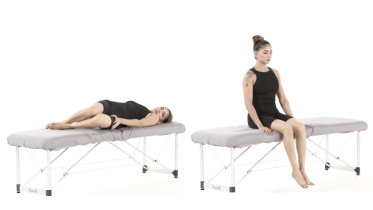 Log roll out of bed
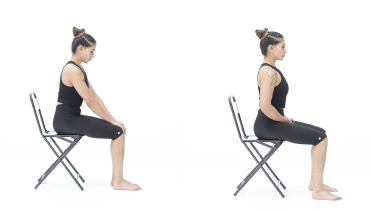 Correct sitting posture
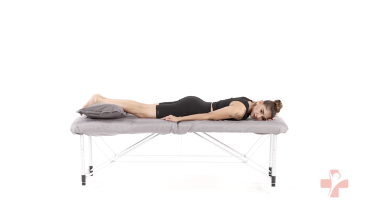 Prone lying
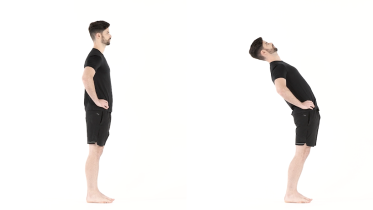 Standing back extension
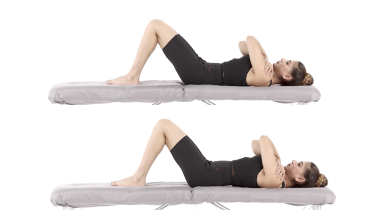 Pelvic tilt
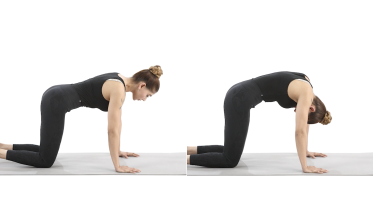 Cat-camel stretch
Stage 2: Build control as the leg settles
When the leg pain is less constant and moving around the house is easier, which takes days for some people and weeks or longer for others. The first five work your deep trunk and hip muscles while your back stays fairly still. The two nerve glides move the sciatic nerve gently without stretching it hard, so ask a physio to check your leg before you start them and stay short of any tingling. Brisk walking builds on the everyday walking you kept up in stage 1.
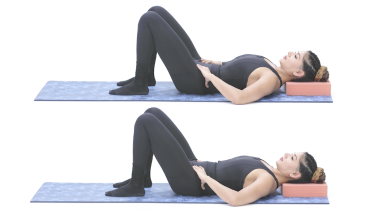 Transverse abdominis activation
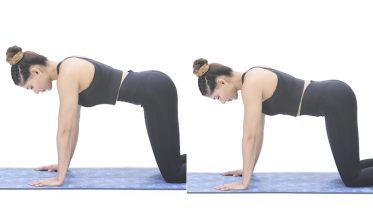 Hands and knees core activation
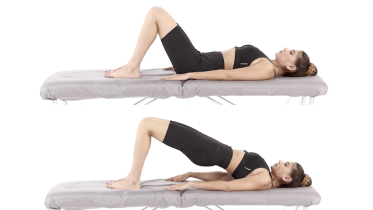 Glute bridge
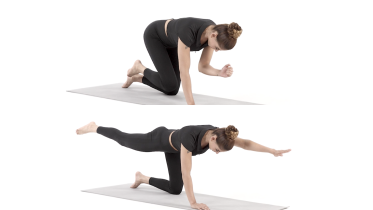 Bird dog
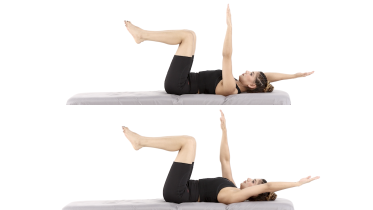 Dead bug
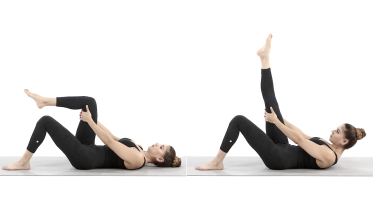 Lying sciatic nerve glide
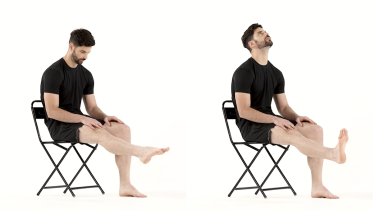 Seated sciatic nerve glide
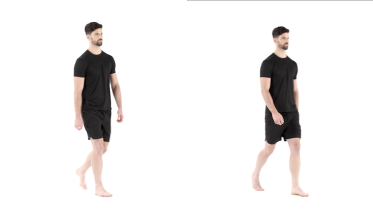 Brisk walking
Stage 3: Get strong for work, lifting and sport
For getting back to heavier jobs and sport once the leg pain has settled or only comes and goes. The three planks run from easiest to hardest, so move on only when the one before feels steady. The alternating superman works the muscles along your back and buttocks, and the band dead bug asks for more trunk control. Sit to stand and the squat train your thighs and buttocks for bending down and getting up. Stop any of them if pain or tingling comes on down your leg.
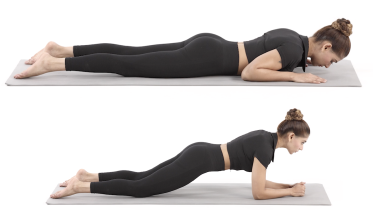 Kneeling plank
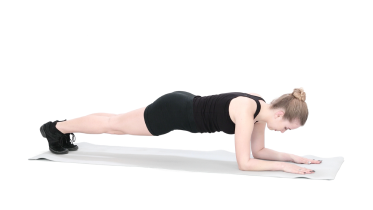 Plank
Plank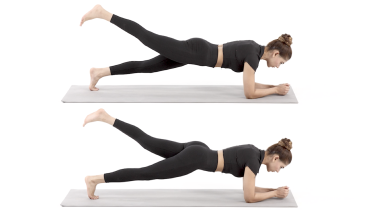 Plank with leg lift
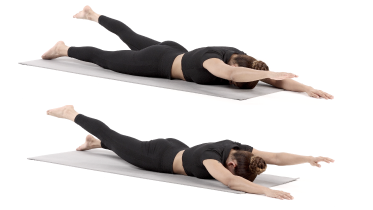 Alternating superman
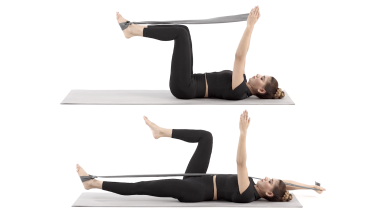 Dead bug with band
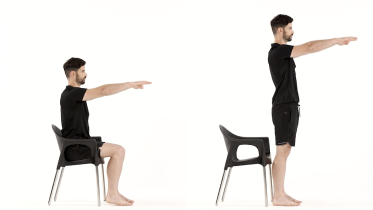 Sit to stand
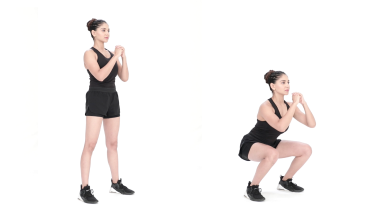 Squat
SquatWhat to avoid or change
Try not to sit or lie down for long spells. The NHS lists sitting or driving for long periods among the things that can lead to a slipped disc. If you sit for work, use the correct sitting posture page as a starting point, then get up regularly for a short walk or a standing back extension. On long drives, plan breaks to get out and move.
You do not need to give up bending or lifting for good. The NHS also names lifting heavy objects the wrong way as a cause, so keep loads close to your body and add weight in small steps. Leave heavy lifting until stage 3 feels steady.
Physios usually suggest holding off on strong hamstring stretches while the leg is sore. Reaching for your toes or lifting a straight leg high also pulls on the sciatic nerve and can stir up leg pain. Ask your physio when and how to bring them back.
If you have been told you have narrowing of the spinal canal (spinal stenosis) or a forward slip of one vertebra on another (spondylolisthesis), check with your physio before the backward bending exercises (prone lying, standing back extension, alternating superman). Bending backward can make both worse. If you have low bone density (osteoporosis), ask your physio before the cat-camel, because deep rounding of the spine is usually limited. Sit-ups and crunches are left out of this program for the same reason, and because repeated bending under load can irritate a sore disc. Do the standing exercises next to a kitchen counter or a sturdy chair if your balance is not steady or your leg feels weak.
This program is not for rehab after back surgery. If you have had an operation on your back, follow your surgeon's program. If you are pregnant, check with your physio or midwife before you start. The program is written for adults, so if a child or teenager has back pain with pain down a leg, get them checked by a doctor or physio first.
When is surgery considered for a herniated disc?
Surgery is usually discussed only when symptoms have not improved with other treatment, or when muscle weakness or numbness is getting worse. Those are the reasons the NHS gives for a GP to refer you to a specialist. NICE suggests considering an operation to take pressure off the nerve (spinal decompression) when non-surgical treatment has not improved pain or function and a scan shows a cause that matches the symptoms. For a disc, the operation removes the part of the disc pressing on the nerve (discectomy or microdiscectomy).
Surgery can speed up recovery for some people, but it is not a race. In a Dutch trial, 283 people who had had severe sciatica for 6 to 12 weeks were assigned to early surgery or to longer non-surgical care with surgery if needed (Peul 2007). Pain relief came faster after early surgery, but results at 1 year were similar, and 39% of the non-surgical group had an operation along the way.
The NASS guideline suggests that when symptoms are bad enough to need surgery, discectomy gives better symptom relief than non-surgical care, and that surgery in that group is done before symptoms have lasted 6 months (Kreiner 2014). That advice is for people who already need an operation. It does not mean you need one because 6 months have passed. The decision depends on how severe your symptoms are and how long they have lasted, and it is made with a spine specialist.
Cauda equina syndrome is different. It is an emergency, and the warning signs are listed below.
When to see a physio or doctor
See a physio or GP if painkillers are not helping or your pain is not getting better after a few weeks. These timings come from the NHS slipped disc page, which also lists a swelling in your back as a reason to see a GP.
The next two timings are stricter than the NHS advice. Get medical advice the same day if you have a high temperature or feel hot, cold or shivery, or if you have lost weight without trying. See your doctor within a few days if the pain is worse at night or does not ease with rest. The NHS page also says to call emergency services or go to an emergency department if you lose feeling in one or both legs. The emergency signs below, including numbness around your genitals or bottom and new bladder or bowel trouble, need help straight away.
For physiotherapists
This page gives patients a starting framework, not a full plan. The NASS guideline (Kreiner 2014) covers literature up to July 2011, so parts of it are dated. It recommends MRI as the appropriate noninvasive test when history and examination fit a disc herniation with radiculopathy, and it found insufficient evidence for or against physical therapy or structured exercise as stand-alone treatments. NICE NG59 suggests considering epidural injections of local anesthetic and steroid for acute and severe sciatica.
Chiu 2015 is useful when a patient is worried by a scan report: extrusions and sequestrations were the herniation types most likely to regress. Brinjikji 2015 gives age-based rates of bulges and protrusions in people without symptoms. The Finucane 2020 red flags framework notes an absence of high-quality evidence for the diagnostic accuracy of most red flags, so treat them as prompts for clinical reasoning rather than a checklist.
See a doctor promptly if
- Emergency: numbness, tingling or altered feeling around or under your genitals, between your inner thighs, or around your bottom (anus), for example it feels different when you wipe after using the toilet. Call emergency services or go to an emergency department straight away. This can be a sign of pressure on the bundle of nerves at the base of the spine (cauda equina syndrome), which needs emergency treatment.
- Emergency: you find it hard to start peeing, cannot pee, cannot feel yourself peeing or cannot control when you pee, or you do not notice when you need to poo or cannot control when you poo, and this is not normal for you. The same applies to a new change in how your genitals feel during sex, or new trouble getting an erection or ejaculating. Call emergency services or go to an emergency department straight away. These can also be signs of cauda equina syndrome.
- Emergency: sciatica in both legs, or pain, tingling, numbness or weakness in both legs. The same applies if you lose feeling in one leg. Call emergency services or go to an emergency department straight away.
- Emergency: back or leg pain that started after a serious accident, such as a car crash or a fall from a height, or back pain with chest pain. Call emergency services.
- A leg or foot that is getting weaker, for example your foot drags, catches on the ground or slaps down when you walk (foot drop). Get medical advice the same day. If the weakness is getting worse by the hour, go to an emergency department.
- Back or leg pain with a fever, or you feel hot, cold, shivery or generally unwell. Get medical advice the same day, and go to an emergency department if you feel very unwell.
- New back or leg pain and you have had cancer, now or in the past, or you have lost weight without trying. Get medical advice the same day and mention it. If you are being treated for cancer now, contact your cancer team the same day.
- Emergency: you have had cancer, now or in the past, and your back or neck pain feels like a tight band around your body, or comes with pain spreading down an arm or leg, weakness, numbness or pins and needles in your arms or legs, trouble walking, or trouble controlling your bladder or bowels. Call your cancer team's emergency number straight away, or go to an emergency department if you do not have one or cannot get through. This can be cancer pressing on the spinal cord (metastatic spinal cord compression), which needs treatment straight away.
- Emergency: new neck or back pain after a fall, a knock or a jolt, even a minor one such as a trip or a sudden stop in a car, if you have a condition that stiffens the spine, such as ankylosing spondylitis. Call emergency services or go to an emergency department straight away, do not drive yourself, and tell the staff about your spine condition, so they keep your neck and back in their usual position. A stiff spine can break after a small injury, and the break is easy to miss at first. If the pain started straight after the injury, or you also have numbness, tingling or weakness in your arms or legs, keep still and call emergency services.
- Back pain after a minor fall or strain if you are older, have low bone density (osteoporosis) or have taken steroid tablets for a long time. Get medical advice the same day.
- Pain that does not ease at all with rest or changing position, or is worse at night. See your doctor within a few days. Get medical advice the same day if you also feel unwell, have lost weight without trying, or have had cancer, now or in the past. If you are being treated for cancer now, contact your cancer team the same day.
- Severe pain that comes on suddenly or is getting worse quickly. Get medical advice the same day.
Common questions
Can a herniated disc heal on its own?
Often, yes. The NHS says surgery is not usually needed for a slipped disc. In scan studies of people treated without surgery, herniations commonly shrank over time, and extrusions and sequestrations, the types that often sound worst on a report, were the most likely to shrink (Chiu 2015). Disc changes also show up on scans of many people with no pain at all (Brinjikji 2015), so how you feel and move matters more than the picture.
How long does a slipped disc take to heal?
There is no fixed time, and the NHS says a slipped disc usually gets better slowly. In a Dutch trial of people who had had severe sciatica for 6 to 12 weeks, the estimated chance of feeling recovered by 1 year was 95%, whether or not they had early surgery (Peul 2007). If your pain is not getting better after a few weeks, see a physio or GP.
Is a bulging disc the same as a herniated disc?
Not quite. On a scan report, a bulge means the edge of the disc spreads out around more than a quarter of its circumference, while a herniation is a more local push of disc material beyond the disc's normal edge (Fardon 2014). Bulges are common in people with no back pain at all, and they become more common with age (Brinjikji 2015). Either finding only matters if it fits your symptoms and examination.
Do I need an MRI for a herniated disc?
Usually not at first. NICE advises against routine imaging for low back pain with or without sciatica outside specialist care, and suggests a scan in specialist care only when the result is likely to change the treatment. That is usually the case when surgery or an injection is being considered. An emergency scan is arranged when a doctor suspects cauda equina syndrome.
Should I rest or keep moving with a slipped disc?
Keep moving as much as the pain allows. The NHS says you may need to rest at first if the pain is very bad, but you will get better more quickly if you gradually start gentle exercise as soon as you can. Walking is the easiest place to start. Short rests to ease a bad spell are fine, then get up and move again.
References
- National Institute for Health and Care Excellence. Low back pain and sciatica in over 16s: assessment and management (NG59). Published 2016, last updated July 2026. https://www.nice.org.uk/guidance/ng59
- NHS. Slipped disc. Last reviewed 24 April 2024. https://www.nhs.uk/conditions/slipped-disc/
- Kreiner DS, Hwang SW, Easa JE, et al. An evidence-based clinical guideline for the diagnosis and treatment of lumbar disc herniation with radiculopathy. The Spine Journal. 2014;14(1):180-191. https://doi.org/10.1016/j.spinee.2013.08.003
- Chiu CC, Chuang TY, Chang KH, Wu CH, Lin PW, Hsu WY. The probability of spontaneous regression of lumbar herniated disc: a systematic review. Clinical Rehabilitation. 2015;29(2):184-195. https://doi.org/10.1177/0269215514540919
- Zhong M, Liu JT, Jiang H, et al. Incidence of spontaneous resorption of lumbar disc herniation: a meta-analysis. Pain Physician. 2017;20(1):E45-E52. https://pubmed.ncbi.nlm.nih.gov/28072796/
- Brinjikji W, Luetmer PH, Comstock B, et al. Systematic literature review of imaging features of spinal degeneration in asymptomatic populations. American Journal of Neuroradiology. 2015;36(4):811-816. https://doi.org/10.3174/ajnr.A4173
- Fardon DF, Williams AL, Dohring EJ, Murtagh FR, Gabriel Rothman SL, Sze GK. Lumbar disc nomenclature: version 2.0. The Spine Journal. 2014;14(11):2525-2545. https://doi.org/10.1016/j.spinee.2014.04.022
- Peul WC, van Houwelingen HC, van den Hout WB, et al. Surgery versus prolonged conservative treatment for sciatica. New England Journal of Medicine. 2007;356(22):2245-2256. https://doi.org/10.1056/NEJMoa064039
- Finucane LM, Downie A, Mercer C, et al. International framework for red flags for potential serious spinal pathologies. Journal of Orthopaedic and Sports Physical Therapy. 2020;50(7):350-372. https://doi.org/10.2519/jospt.2020.9971
Written and checked by the PocketPhysio editorial team. Last updated 2026-09-28.
This page is general education, not a diagnosis or a personal treatment plan. See a physiotherapist or doctor for advice about your own situation.