Hands and knees core activation
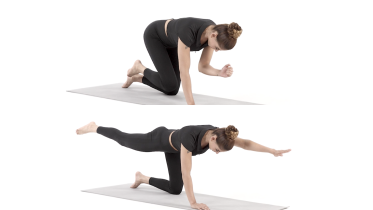
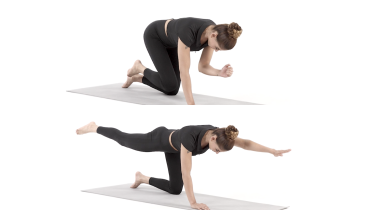
This exercise teaches you to gently tighten your deep stomach muscle and your pelvic floor together while you stay on your hands and knees. Nothing visible moves. You draw your lower stomach up toward your spine, hold it while you breathe, then let go. Many programs use it as a first step before core work that adds movement, such as the bird dog.
How to do the hands and knees core activation
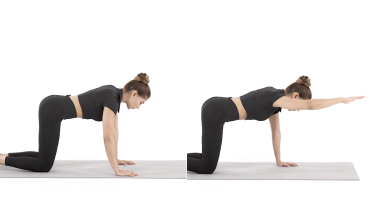
- Kneel on all fours on a mat, with your hands below your shoulders and your knees below your hips. A folded towel under your knees helps if kneeling is uncomfortable.
- Keep your back flat, neither sagging nor rounded, and look at the floor between your hands so your neck stays in line.
- Let your stomach relax and take a normal breath in.
- As you breathe out, gently squeeze and lift your pelvic floor, as if stopping yourself passing wind. At the same time, draw your lower stomach up toward your spine so your belly lifts away from the floor.
- Hold that gentle tension for a few seconds and keep breathing. Your back does not move.
- Let go completely, rest for a few seconds, then repeat.
What you should feel
A light tightening low in your stomach and a gentle lift inside the pelvis. It is a small feeling, and your back and hips stay still.
Common mistakes
- Squeezing with all your strength. Aim for a gentle effort you could keep up while talking.
- Rounding your back up toward the ceiling or tucking your pelvis to make the stomach move.
- Holding your breath, or bearing down and pushing out instead of lifting in.
- Clenching your buttocks or thighs in place of the pelvic floor.
How often
Many programs start with 6 to 10 holds of 5 to 10 seconds, once or twice a day, with a full relax after each one. Your physio will adjust this.
Stop and check with your physio if
- Your back pain gets worse while you practice or afterward.
- Kneeling or leaning on your hands hurts your knees or wrists.
- You feel pain in your pelvis, or heaviness, pressure or bulging in the pelvic floor or stomach wall. Let your physio know.
- You are pregnant and notice bleeding or fluid leaking from your vagina, regular painful tightenings, tummy pain that does not settle when you rest or comes with lower back pain, or a change in your baby's usual movements, such as moving less than usual. Stop and contact your midwife or maternity unit straight away. Do the same for a severe headache, problems with your vision such as blurring or flashing lights, pain just below your ribs, or sudden swelling of your face, hands or feet, which can be signs of pre-eclampsia. Call emergency services if the bleeding is heavy, the tummy pain is severe, bleeding or tummy pain comes with pain in your shoulder or feeling sick, faint or dizzy, or a headache comes on suddenly and is very severe.
From the clinic
Letting go matters as much as the squeeze. After each hold, feel the pelvic floor and stomach drop back to rest before you start the next one. The movement is small, and many people wonder at first whether they are doing anything at all. If you still cannot feel it after a week or two of practice, ask your physio to check it with you.
Check with your physio first if you have pelvic floor symptoms such as leaking, heaviness or pelvic pain, or if you are pregnant or have recently given birth. A physio who works with the pelvic floor can check that you are lifting rather than pushing down, and adapt the exercise for you.
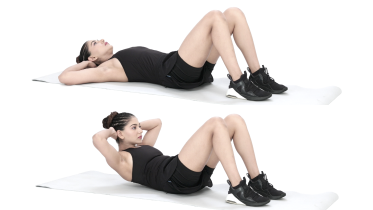
Once this feels easy, the same gentle tension is often held while you move a leg, as in quadruped hip extension, and later an arm and a leg together in the bird dog. The transverse abdominis activation practices the same tightening lying on your back.
Written and checked by the PocketPhysio editorial team. Last updated 2026-09-28.
This page is general education, not a diagnosis or a personal treatment plan. If you have pain, an injury or a health condition, see a physiotherapist or doctor before starting new exercises.