
Urinary incontinence in women: pelvic floor training
Warning signs, and when to get help
What kind of leaking is it, and why does that change the treatment?
Start here, because the answer decides most of what follows. Three patterns cover nearly everyone.
Leaking under pressure happens when something suddenly raises the pressure inside your tummy: a cough, a sneeze, a laugh, picking up a toddler, a jump in a class. That is stress incontinence, and the pelvic floor is the muscle that was meant to hold the pressure.
Leaking with a sudden urge is a different machine. The bladder contracts before you have given it permission, so the story is a need that arrives fast and will not wait, often set off by standing up, cold air, running water or arriving at your own front door. That is urgency incontinence, and squeezing harder is not its main treatment.
A mix of the two is extremely common and is treated as both. One pattern belongs with a doctor instead: leaking all the time, or leaking alongside a weak or stop-start stream and a feeling that you have not emptied, which points to a bladder that is not emptying rather than a muscle that is weak. That is in the warning signs at the foot of this page.
This page is about the symptom. The muscle itself, including what makes it weak and how to tell a weak floor from a tight one, is covered on our pelvic floor weakness program and in tight or weak pelvic floor.
Do pelvic floor exercises stop leaking in women?
For the stress kind, the evidence is as good as physiotherapy evidence gets. A Cochrane review pooled 31 trials and 1,817 women comparing training with no treatment or an inactive control. In the 4 trials that measured women's own report of cure for stress incontinence, 56% of those who trained reported being cured against 6% of the controls, a risk ratio of 8.38, and the review rated that outcome high-quality evidence (Dumoulin 2018).
Now the caveats, because they matter for what you expect. Those 4 trials held only 165 women between them. Most trials in the review followed women for less than a year, so how long the benefit lasts is much less certain than whether it happens. And the authors noted that many of the included trials sat at moderate risk of bias.
The guidelines then say the same thing from different continents. NICE advises a trial of supervised pelvic floor muscle training lasting at least 3 months as the first treatment for women with stress or mixed incontinence, and advises carrying on if it helps. The American College of Physicians recommends pelvic floor muscle training as first-line treatment for stress incontinence, bladder training for urgency incontinence, and both together for mixed incontinence (Qaseem 2014).
How many squeezes, how often, and for how long
There are two kinds of squeeze and you need both. Long holds build the strength that keeps the tube closed as pressure rises. Quick squeezes are what a sneeze actually needs, because a sneeze is over before a long hold has arrived.
NICE sets a floor of at least 8 contractions, 3 times a day. POGP, the UK group of pelvic health physiotherapists, suggests working up toward 10 long squeezes of up to 10 seconds each followed by 10 quick ones, at least 3 times a day, and expects you to notice a difference within 3 to 5 months. It then asks you to keep one set a day going after that, to hold on to what you have gained. Start where you are: if the hold fades after two seconds, two seconds is your starting hold. Your physio will adjust this.
None of what decides whether this works is effort. Rest fully between long holds, so the muscle actually lets go before the next one. Breathe through every squeeze instead of bracing. And keep it going three times a day for months, which is the part that defeats most people. Pin the sets to things you already do, such as the kettle, the bus stop and brushing your teeth.
Pelvic floor exercise lying down is where to learn the squeeze, and if you cannot feel anything happening after a few weeks, that is a reason to be assessed rather than to try harder. NICE recommends that a trained professional confirms you can contract the muscles, usually with a gentle internal examination, before supervised training starts.
Bladder training, for the sudden urge
If the urge is your main problem, this is your treatment and the squeezes are the support act. Bladder training works on the habit loop rather than the muscle: you stretch out the time between visits in small steps, so the bladder relearns how much it can hold before it starts demanding.
In practice that means going to the toilet by the clock rather than at the first flicker, extending the gap by a few minutes at a time, and holding still when an urge arrives instead of running for it, because movement makes the urge worse and arriving at the door is itself a trigger. A quick squeeze or two as the urge peaks helps it pass. NICE advises a trial of bladder training lasting at least 6 weeks for urgency or mixed incontinence, and the ACP guideline recommends it as the first treatment for urgency incontinence (Qaseem 2014).
Do not cut down on drinks to avoid leaks, because the NHS says limiting fluids makes incontinence worse by reducing how much the bladder will hold. Caffeine irritates the bladder, so swapping some of the tea, coffee or cola for decaffeinated versions is a cheap experiment. Constipation and a long-term cough both load the pelvic floor, which is why the NHS advises treating them rather than living with them.
How to use this program
Start at stage 1 whatever your pattern, because every stage after it assumes you can find the squeeze and keep breathing.
Something to be straight about before you begin on your own. The treatment NICE recommends, and the one the trials above tested, is supervised training, and NICE also asks a trained professional to check that you can contract the muscles, usually with a gentle internal examination, before supervised training starts. That check exists because pushing down instead of lifting is easy to do without knowing, and nobody can see the difference from the outside.
Doing the squeezes at home is a sensible way to start and it is not the same as the version that was tested, so treat an appointment with a pelvic health physio as part of this plan rather than as the thing you do if the plan fails. The plain squeezes continue at every stage; the movement exercises are added to them rather than instead of them.
Move up when the current stage is steady and you are not leaking during it. Give the whole thing three months before you judge it, and keep a note of the leaks each week, because progress here is a smaller leak on a bigger effort long before it is no leak at all.
If you are pregnant or have given birth recently, this is not your program: start with your midwife or a pelvic health physio, and see pregnancy back and pelvic pain or postnatal core and pelvic floor instead. If you have had surgery in your pelvis, including an operation for prolapse or for leaking, the timings and the program come from the team that operated.
Stop an exercise and tell your physio if it brings on pain in your pelvis, or a feeling of heaviness or bulging low down. If you have had a hip or knee replacement, or surgery on your knee or back, get the go-ahead from your surgeon or physio before the leg and hip work in stages 2 and 3. Wear flat shoes that grip for the walking, and breathe steadily through every repetition rather than holding your breath.
The exercise program
Stage 1: Find the squeeze, and keep breathing
Start here whatever kind of leaking you have, lying down or sitting. The squeeze itself is the exercise with the evidence behind it, and the other two are here because people lose the lift the moment they hold their breath or pull the tummy in hard. Work up toward 10 slow squeezes and 10 quick ones, at least 3 times a day. If you can only hold for two seconds at first, start there. Your physio will adjust this.
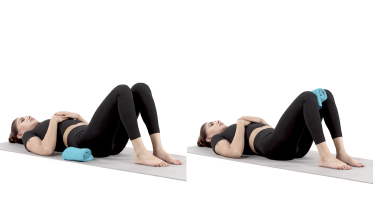 Pelvic floor exercise lying down
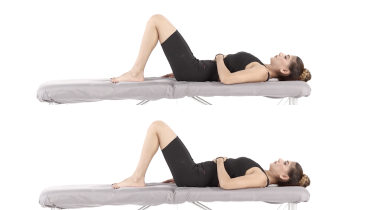 Diaphragmatic breathing
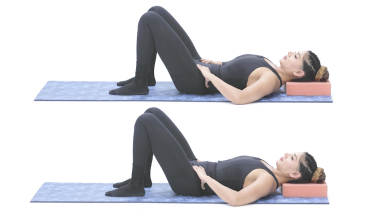 Transverse abdominis activation
Stage 2: Hold it while you move
When the squeeze is easy to find lying and sitting, and you can repeat it without the last few fading. These add a leg or hip movement while you hold a gentle squeeze and keep breathing, which is the step most home programs skip. Keep doing the plain squeezes 3 times a day alongside them. If you leak, bear down or lose the lift, go back to the smaller movement for a week.
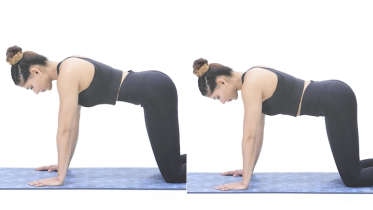 Hands and knees core activation
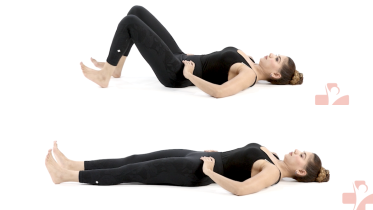 Double heel slide
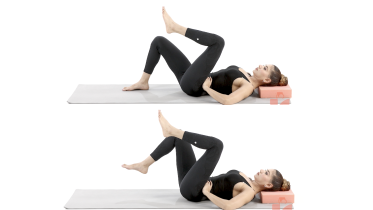 Tabletop leg lift
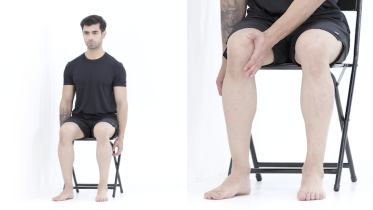 Seated isometric hip adduction
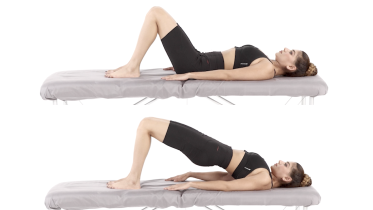 Glute bridge
Stage 3: Hold it under load, and use the knack
For when stage 2 is steady and you are not leaking during it. Standing up and squatting are where leaks actually happen, so they are the useful place to practice squeezing just before the effort. Brisk walking is in here because a bladder behaves differently on the move than it does on a mat. Stay at stage 2 if any of these brings on leaking or a feeling of heaviness low down.
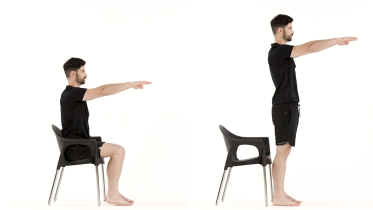 Sit to stand
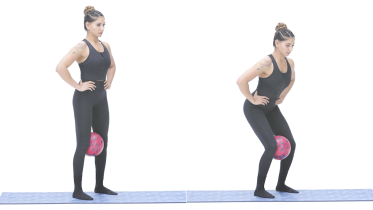 Squat with ball squeeze
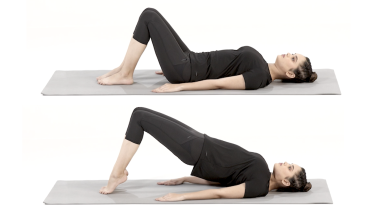 Bridge with heel raise
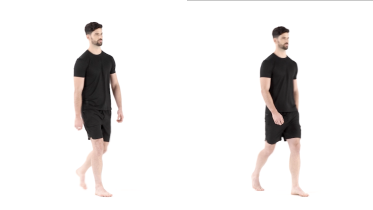 Brisk walking
The knack is the habit worth taking from stage 3 into the rest of your day: tighten the pelvic floor just before you cough, sneeze, laugh or lift, and hold it until the effort is over. In a small study of 27 older women with mild to moderate stress incontinence, leaking during a medium cough was much reduced when they used it, one week after being taught (Miller 1998). It was short and small, so treat it as a useful habit alongside the daily squeezes rather than a treatment on its own. Standing up from a chair is the free rehearsal, dozens of times a day.
Leaking when you run, lift or go to a class
This is the reason many women give up exercise, and giving up is the worst of the available options. The NHS points out that high-impact exercise and sit-ups raise pressure on the pelvic floor and can increase leaks, which is why there is no jumping, running drill, sit-up or crunch in the program above.
What usually works is changing the load before changing the activity: less weight, a shorter range, a slower tempo, and a squeeze set before the effort rather than during it. Leaking, heaviness or a dragging feeling during a lift is information about the dose, not a verdict on your body. Our page on lifting weights with a weak pelvic floor goes through what to change first, and getting back to running or jumping is worth planning with a pelvic health physio rather than testing on a Saturday.
When squeezes are not the answer
A pelvic floor that cannot relax can cause leaking, urgency and pain, and it needs the opposite treatment: see tight or weak pelvic floor. With a prolapse, exercises are often part of the plan, but only after an examination has established what is there: see pelvic floor exercises and prolapse. And a flow or emptying problem has its own causes and belongs with a doctor.
Leaking that begins or worsens around the menopause is common and has its own page, the pelvic floor in menopause, and if joints and strength are changing at the same time the perimenopause program covers that side. Conditions affecting the nerves, such as multiple sclerosis or Parkinson's disease, mean the bladder needs its own assessment first, so ask your doctor before starting.
Getting seen in the USA, UK, Canada, Australia and New Zealand
Route to care is the practical barrier for most women, so here is where the door is in each country.
In the USA, ask your doctor for a referral to a pelvic health physical therapist, or ask your insurer which clinics are covered; the ACP guideline is what many US physicians work from, and it puts training and bladder training ahead of medicine (Qaseem 2014). In the UK, the NHS advises seeing a GP about any leaking, and a GP can refer you to a continence service or a pelvic health physiotherapist, with self-referral available in some areas.
In Canada, the Canadian Continence Foundation keeps a Locate a Professional directory alongside its public information. In Australia, Continence Health Australia runs the National Continence Helpline on 1800 33 00 66. In New Zealand, Continence NZ has a helpline on 0800 650 659.
Wherever you are, the appointment goes better with a few days of notes: how much you drink and when, how often you go, how much comes out when you do, and what you were doing each time you leaked.
When to see a physio or doctor
See your doctor about any leaking, as the NHS advises, and sooner rather than after years of pads. See a pelvic health physio if you cannot feel the muscles working, if nothing has changed after about 3 months of doing the squeezes properly, or if leaking is keeping you out of exercise or away from going out.
Go to a doctor first, rather than starting this program, if the leaking began suddenly, if it comes with pain or burning when you pee, if there is blood in your pee, if you can feel a bulge, or if anything in the warning signs below applies. Those need a diagnosis before they need a program. Our guide to red flags in physiotherapy explains why these lists exist and how clinicians use them.
For physiotherapists
Subtype first, then dose. The treatment split is the whole clinical decision on this page: supervised pelvic floor muscle training for at least 3 months as first line in stress and mixed incontinence under NG123, with programs of at least 8 contractions three times a day and digital confirmation of a contraction before supervised training begins, and bladder training of at least 6 weeks where urgency drives the picture. The ACP guideline reaches the same subtype split and adds weight loss and exercise for women with obesity and incontinence (Qaseem 2014).
Set expectations from the evidence rather than from the best case. The participant-reported cure figure for stress incontinence rests on 4 trials and 165 women, rated high quality for that outcome while most other outcomes in the review were downgraded, and follow-up beyond a year is thin (Dumoulin 2018). Adherence is where these programs are won, so build the three daily sets into existing routines at the first appointment and review them at the second.
Warning signs
Get emergency help now
- Emergency: numbness, tingling or altered feeling around or under your genitals, between your inner thighs, or around your bottom (anus), for example it feels different when you wipe after using the toilet. Call emergency services or go to an emergency department straight away. This can be a sign of pressure on the bundle of nerves at the base of the spine (cauda equina syndrome), which needs emergency treatment.
- Emergency: you suddenly cannot control your bladder or bowels at all. The same applies to new leaking of pee or poo, new trouble starting to pee, not being able to feel yourself peeing, not noticing when you need to poo, a new change in how your genitals feel during sex, or new trouble getting an erection or ejaculating, if it comes with back pain, sciatica, or pain, tingling, numbness or weakness in one or both legs. Call emergency services or go to an emergency department straight away. These can also be signs of cauda equina syndrome.
- Emergency: you cannot pee at all, especially if your lower tummy feels full and painful. Call emergency services or go to an emergency department straight away.
- Emergency: leaking that starts suddenly in an older person who is also newly confused or agitated, very drowsy, or has trouble speaking. Call emergency services or go to an emergency department straight away. This can be a sign of a serious infection or another illness that needs urgent treatment.
- Emergency: since any operation in your pelvis, including an operation for prolapse or for leaking, removal of the womb (hysterectomy) or removal of the prostate gland, you have pain in your tummy or pelvis that is severe or came on suddenly, a wound from the operation that opens up, bleeding that suddenly becomes much heavier or that soaks a pad within an hour, or you feel faint, dizzy or breathless, your heart is pounding, or you feel very unwell. Stop your pelvic floor exercises and call emergency services or go to an emergency department straight away, and do not drive yourself.
Get help today
- Pain or burning when you pee together with a high or very low temperature, feeling hot or cold and shivery, or pain in your back just under the ribs. Get medical advice the same day, as this can be a kidney infection. If you also become confused, very drowsy or have trouble speaking, call emergency services or go to an emergency department straight away.
- Same day: leaking that starts suddenly or gets much worse over a few days in an older person, without any of the signs above. Get medical advice the same day, as this can be caused by a urine infection or a medicine.
- Blood in your pee, which may look pink, red or dark brown, even a small amount, even once, and even with no pain. Get medical advice the same day. It needs checking even if it goes away.
- Same day: since an operation for prolapse or for leaking, you have a fever or feel hot, cold or shivery, heavy bleeding from your vagina or blood clots, discharge that smells, a wound from the operation that is oozing or whose edges are coming apart, or pain in your pelvis that is new or getting worse quickly. Stop your pelvic floor exercises and contact your surgical team, or the ward you went home from, the same day, and if you cannot reach them get medical help the same day anyway, for example at urgent care or an emergency department. These can be signs of an infection or of bleeding from the repair. If the pain becomes severe or comes on suddenly, a wound from the operation opens up, the bleeding suddenly becomes much heavier, or you feel faint, dizzy, breathless or very unwell, call emergency services or go to an emergency department straight away rather than waiting for a call back, and do not drive yourself.
- Same day: since an operation in your pelvis for any other reason, for example removal of the womb (hysterectomy) or removal of the prostate gland, you have a fever or feel hot, cold or shivery, heavy bleeding, discharge that smells, a wound from the operation that is oozing or whose edges are coming apart, or pain in your pelvis that is new or getting worse quickly. Stop your pelvic floor exercises and contact your surgical team, or the ward you went home from, the same day, and if you cannot reach them get medical help the same day anyway, for example at urgent care or an emergency department. These can be signs of an infection or of bleeding. If the pain becomes severe or comes on suddenly, a wound from the operation opens up, the bleeding suddenly becomes much heavier, or you feel faint, dizzy, breathless or very unwell, call emergency services or go to an emergency department straight away rather than waiting for a call back, and do not drive yourself.
- Same day: since any operation in your pelvis, a calf or thigh that is newly swollen, warm, tender, red or darker than usual, has swollen veins that are sore to touch, or has a throbbing or cramping pain that feels different from normal muscle soreness. Stop your pelvic floor exercises and get medical advice the same day, because surgery in the pelvis raises the risk of a blood clot (deep vein thrombosis). If you are also short of breath or have chest pain, call emergency services.
- Same day: a calf or thigh that is newly swollen or getting more swollen, warm, tender, red or darker than usual, has swollen veins that are sore to touch, or has a throbbing or cramping pain that does not fit your injury or condition, or that feels different from normal muscle soreness after exercise. This can be a sign of a blood clot (deep vein thrombosis), especially after surgery, an injury, time in a cast or boot, a long trip or a spell of being much less mobile than usual. Get medical advice the same day. If you are also short of breath or have chest pain, call emergency services.
Book an appointment
- Within a few days: any bleeding from your vagina after your menopause, including spotting or pink or brown discharge, even if it is only a small amount, only happened once, or came on during or after sex. Book an appointment with your doctor within a few days. Bleeding after the menopause is usually not serious, but it has to be checked, because it can be a sign of cancer, and cancer found early is easier to treat.
- A bulge or lump you can feel or see inside or coming out of your vagina, or a feeling of heaviness or pressure in your lower tummy or vagina. Book an appointment with your doctor. This can be a sign of pelvic organ prolapse, and pelvic floor exercises are often part of the treatment once it has been checked.
- Routine: new trouble emptying your bladder or your bowels, a weak or stop-start stream, dribbling after you think you have finished, or a feeling that you have not emptied. Book an appointment with your doctor rather than doing more pelvic floor squeezes, because a flow or emptying problem has its own causes. If you are passing only small amounts and your lower tummy feels full or swollen, or you are leaking all the time without feeling the need to go, get medical advice the same day.
- Routine: since an operation for prolapse or for leaking, the bulge, the heaviness or the leaking you had it done for has come back or is getting worse, or you have new pain, new bleeding or discharge from your vagina, or new trouble peeing or pooing. Stop your pelvic floor exercises and book an appointment with your surgical team rather than waiting for your next routine review. A repair can give way, and after mesh surgery these are also the symptoms a specialist checks the mesh for. Which of those it is takes an examination, and it is not something this page or a physiotherapist can tell you.
Common questions
What is the difference between stress and urge incontinence?
Stress incontinence leaks when the pressure inside your tummy suddenly rises: a cough, a sneeze, a laugh, a lift, a jump. The urge kind leaks because the bladder contracts when you did not ask it to, so the story is a sudden need you cannot put off, often with a trigger such as a key in the door or running water. Many women have both, which is called mixed incontinence. The difference is worth getting right, because pelvic floor training is the first treatment for the stress kind and bladder training is the first treatment for the urge kind (Qaseem 2014).
Can urinary incontinence in women be cured without surgery?
For a good proportion of women with the stress kind, yes. In the Cochrane review, 56% of the women who trained reported being cured at the end of treatment against 6% of those who did not, a risk ratio of 8.38, from 4 trials and 165 women, and that particular outcome was rated high-quality evidence (Dumoulin 2018). Note how small those four trials were, and that most trials in the review followed women for under a year, so nobody can promise you a permanent result. It is still a strong reason to do the exercises properly before anyone discusses an operation.
What if the exercises do not work?
Then you have learned something useful, and there are other treatments. The first question is whether the training was actually done as prescribed and supervised, because an unsupervised three weeks is not a failed trial of anything. After that, the options differ by type: the American College of Physicians recommends medicine for urgency incontinence when bladder training has not worked, recommends against systemic medicine for stress incontinence, and recommends weight loss and exercise for women with incontinence who are obese (Qaseem 2014). Vaginal pessaries, devices and surgery are separate conversations with a specialist.
Is leaking just part of getting older?
It becomes more common with age, and that is not the same as normal or untreatable. The NHS encourages anyone with leaking to see a GP rather than put up with it, and leaking that starts suddenly or gets much worse over a few days in an older person needs checking the same day, because a urine infection or a medicine can cause it. Age is a reason to get assessed sooner rather than to buy larger pads.
References
- National Institute for Health and Care Excellence. Urinary incontinence and pelvic organ prolapse in women: management (NG123). Published 2019. https://www.nice.org.uk/guidance/ng123
- Qaseem A, Dallas P, Forciea MA, Starkey M, Denberg TD, Shekelle P. Nonsurgical management of urinary incontinence in women: a clinical practice guideline from the American College of Physicians. Annals of Internal Medicine. 2014;161(6):429-440. doi:10.7326/M13-2410
- Dumoulin C, Cacciari LP, Hay-Smith EJC. Pelvic floor muscle training versus no treatment, or inactive control treatments, for urinary incontinence in women. Cochrane Database of Systematic Reviews. 2018;(10):CD005654. https://doi.org/10.1002/14651858.CD005654.pub4
- Miller JM, Ashton-Miller JA, DeLancey JO. A pelvic muscle precontraction can reduce cough-related urine loss in selected women with mild SUI. Journal of the American Geriatrics Society. 1998;46(7):870-874. https://doi.org/10.1111/j.1532-5415.1998.tb02721.x
- Pelvic, Obstetric and Gynaecological Physiotherapy (POGP). Pelvic floor muscles. https://thepogp.co.uk/patients/pelvic_health_advice/pelvic_floor_muscles.aspx
- NHS. Urinary incontinence. https://www.nhs.uk/conditions/urinary-incontinence/
- NHS. Urinary incontinence: treatment. https://www.nhs.uk/conditions/urinary-incontinence/treatment/
- NHS. Urinary incontinence: 10 ways to stop leaks. Page last reviewed 15 June 2023. https://www.nhs.uk/conditions/urinary-incontinence/10-ways-to-stop-leaks/
- NHS. Urinary tract infections (UTIs). https://www.nhs.uk/conditions/urinary-tract-infections-utis/
- NHS. Blood in urine. https://www.nhs.uk/conditions/blood-in-urine/
- NHS. Pelvic organ prolapse. https://www.nhs.uk/conditions/pelvic-organ-prolapse/
- NHS. Postmenopausal bleeding. Page last reviewed 24 September 2026. https://www.nhs.uk/conditions/post-menopausal-bleeding/
- NHS. Sudden confusion (delirium). https://www.nhs.uk/symptoms/confusion/
- NHS. Deep vein thrombosis (DVT). Page last reviewed 30 April 2026. https://www.nhs.uk/conditions/deep-vein-thrombosis-dvt/
- Continence Health Australia. National Continence Helpline. https://www.continence.org.au/
- Continence NZ. https://www.continence.org.nz/
- Canadian Continence Foundation. Locate a professional. https://www.canadiancontinence.ca/
- Getting It Right First Time (GIRFT), NHS England. National suspected cauda equina syndrome (CES) pathway. February 2023, updated March 2026. https://gettingitrightfirsttime.co.uk/wp-content/uploads/2026/04/National-Suspected-Cauda-Equina-Pathway-March-2026.pdf
Written and checked by the PocketPhysio editorial team. Last updated 2026-10-24.
This page is general education, not a diagnosis or a personal treatment plan. See a physiotherapist or doctor for advice about your own situation.