
Part of Menopause and joints
The pelvic floor in menopause: what changes and what helps
What changes around the menopause
The bladder and vaginal symptoms come as a group, and they have a name. Genitourinary syndrome of the menopause covers genital symptoms such as dryness, burning or irritation, urinary symptoms such as urgency, pain on peeing and repeated urine infections, and sexual symptoms such as pain and lack of lubrication (Sarmento 2021). Reported prevalence in postmenopausal women ranges widely across studies, from 27% to 84%, and the review's authors note that most women do not seek help, because they take it to be a natural part of getting older.
The NHS lists the bladder side of that among the symptoms of menopause and perimenopause: needing to pee more or not being able to control when you pee, more urine infections or symptoms that feel like one, and pain or burning when you pee with a need to go more often, including at night. POGP names the same two complaints women bring to a pelvic health appointment: needing to go more often and more urgently, and leaking when you cough, sneeze, laugh or move suddenly.
They arrive together but they are not treated together. Muscle training is one lever. The tissue changes are another, and those belong to your doctor.
What pelvic floor muscle training does
It improves the muscle and it reduces leaking, in most of the trials that have looked. A review of 8 randomized controlled trials in 376 postmenopausal women, 196 of them in the exercise groups, found that all 8 reported a significant difference in favor of pelvic floor muscle exercise in at least one of muscle strength, the severity of incontinence or quality of life (Lopez-Perez 2023). The trials covered stress incontinence as well as urgency-related patterns.
A larger review took in 15 trials with 895 postmenopausal women, all but one of them randomized, and found statistically significant improvement in pelvic floor muscle function in 14 of the 15 (Piernicka 2025). Programs ran from 2 to 7 sessions a week, averaging about 3, over 2 to 24 weeks, averaging about 10.
Both reviews come with limits, and their authors state them plainly. Neither could run a meta-analysis, because the programs and measurement tools varied too much to pool. Lopez-Perez found no European population among the 8 trials, which the authors call a geographic bias. Piernicka included only studies published in English, which the authors say may have left out good work in other languages. So the direction of the evidence is consistent, and the precise dose is not settled.
What it does not do
Squeezing the pelvic floor works on the muscle layer. It is not a treatment for the tissue changes behind dryness, burning, soreness or repeated urine infections. Those are what your doctor or menopause clinic is for, and this page gives no advice about any treatment or medicine for them, including whether one would suit you.
It is also not a substitute for an assessment. If you cannot feel the muscles working, if the effort feels like a downward push instead of a lift, or if nothing has shifted after a few months of honest practice, the answer is an appointment rather than more repetitions. A pelvic health physiotherapist has specialist training to treat pelvic floor dysfunction associated with the menopause (POGP), and that includes checking whether the muscles tighten and whether they let go again, which matters just as much.
And it is not instant. POGP asks people to expect an improvement in 3 to 5 months and then to carry on once a day to keep it. The NHS puts it as a few months before you see any benefit. Plenty of people decide the exercises have failed while they are still only a few weeks in.
How do you do pelvic floor exercises?
There are two kinds, and both belong in a program. Slow ones: tighten, hold, then let go completely. Fast ones: tighten quickly and release straight away. POGP sets the target as working up to 10 slow squeezes held for 10 seconds each, followed by 10 short squeezes, at least 3 times each day.
Starting numbers are lower than that for almost everyone. The NHS describes beginning with a 2 second hold, relaxing, repeating 10 times, and gradually building the hold toward 10 seconds. Your physio will adjust this, and if the hold collapses at 3 seconds then 3 seconds is your starting point.
The relax matters as much as the squeeze. A muscle that never fully lets go between efforts gets tired rather than stronger, and the exercises below are built around that rhythm.
Exercises that can help
A starting set of four, each with a video, its own dose and its own stop signs. The pelvic floor exercise lying down often begins at 8 to 10 slow breaths three times a day, the tummy hold at 8 to 10 holds of 5 to 10 seconds once or twice a day, the heel slides at 1 to 3 sets of 6 to 10, and the bridge at 2 to 3 sets of 10 to 12. Your physio will adjust this.
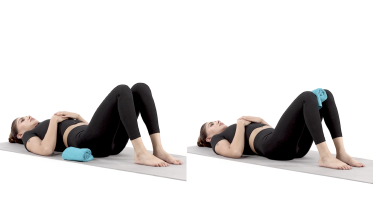 Pelvic floor exercise lying down
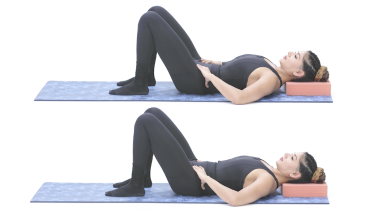 Transverse abdominis activation
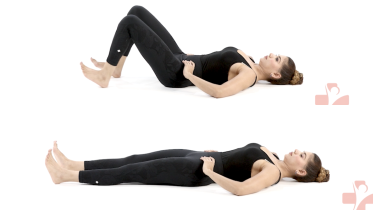 Double heel slide
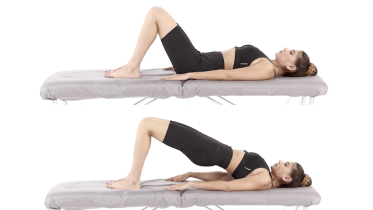 Glute bridge
Before you start
Get your doctor or physio to look first if you already leak, if the pelvis feels heavy or dragging, or if anything down there hurts. Blood in your pee, or burning when you pee, goes to a doctor before any exercise program begins. After an operation on your bladder, womb or pelvic floor, including surgery for incontinence or prolapse, the start date is your surgical team's to give.
If you are pregnant or have given birth in the last few months, check with your physio or midwife first, so the squeezes can be checked and adapted for you. If you are pregnant and past the first three months, check with your physio before exercising flat on your back. The same lift can be practiced sitting or lying on your side instead. Ask your physio before starting the heel slides if you have a hernia, a gap down the middle of your stomach muscles after pregnancy (diastasis recti), or have had stomach or back surgery recently, and after hip, knee or back surgery your surgeon's protocol decides when bridges can begin.
Stop and tell your physio if an exercise brings on pain in your pelvis or pelvic floor, or a feeling of heaviness, dragging or bulging low down.
Everyday load on the pelvic floor
Some of the useful changes have nothing to do with squeezing. The NHS advice for leaking is mostly about what the bladder is asked to cope with: 6 to 8 glasses of fluid a day and no more, less caffeine (it irritates the bladder, and coffee has the biggest effect), and constipation treated so that you are not straining. It also asks you to stop smoking and to lose any excess weight.
Cutting your fluids to avoid leaks backfires. The NHS explains that limiting fluids reduces how much the bladder can hold, which makes the problem worse rather than better.
For exercise itself, the NHS suggests swapping high-impact activity for strengthening exercise such as pilates while you build the muscles up. POGP puts the cost of that plainly: some women stop going out, or drop things they enjoy, in case they cannot reach a toilet in time. That is worth solving rather than working around.
Where the medicine questions go
Vaginal estrogen, hormone replacement therapy and every other prescription for menopausal symptoms are decisions for a prescriber who knows your history. Nothing here tells you to start one, stop one, choose between them or change a dose, and nothing here is a reason to delay asking about them. Never stop or change a prescribed medicine on your own.
Take the tissue side to your doctor, your menopause clinic or a pelvic health physiotherapist who works alongside them: the dryness and burning, the repeated urine infections, any question about hormones. Take the muscle training questions to a physio. Tell each one what the other is doing.
When to see a pelvic health physio
See one when leaking, urgency or heaviness is changing what you do: the route you take, the exercise you skip, the pads in the bag. See one sooner if you cannot feel the muscles working, if the squeeze does not feel like a lift, or if practicing has brought on pelvic pain.
In the UK you can ask your GP to refer you to a pelvic health physiotherapist or a continence service, and some areas take self-referrals. In the USA, ask for a physical therapist with pelvic health training. Elsewhere, look for the pelvic health or women's health title rather than a general listing, because the internal assessment needs specific training.
Before the appointment, keep a simple record for 3 days of what you drank and what you were doing each time you leaked. That single sheet of paper usually tells the physio more than the first 10 minutes of questions would. One thing comes ahead of all of it, though: the warning signs below. Bleeding after the menopause, blood in your pee and the bladder and bowel changes listed there all need a medical check before any exercise program starts.
Related exercise programs
See a doctor promptly if
- Emergency: numbness, tingling or altered feeling around or under your genitals, between your inner thighs, or around your bottom (anus), for example it feels different when you wipe after using the toilet. Call emergency services or go to an emergency department straight away. This can be a sign of pressure on the bundle of nerves at the base of the spine (cauda equina syndrome), which needs emergency treatment.
- Emergency: you suddenly cannot control your bladder or bowels at all. The same applies to new leaking of pee or poo, new trouble starting to pee, not being able to feel yourself peeing, not noticing when you need to poo, a new change in how your genitals feel during sex, or new trouble getting an erection or ejaculating, if it comes with back pain, sciatica, or pain, tingling, numbness or weakness in one or both legs. Call emergency services or go to an emergency department straight away. These can also be signs of cauda equina syndrome.
- Emergency: you cannot pee at all, especially if your lower tummy feels full and painful. Call emergency services or go to an emergency department straight away.
- Emergency: leaking that starts suddenly in an older person who is also newly confused or agitated, very drowsy, or has trouble speaking. Call emergency services or go to an emergency department straight away. This can be a sign of a serious infection or another illness that needs urgent treatment.
- Same day: pain or burning when you pee together with a high or very low temperature, feeling hot or cold and shivery, or pain in your back just under the ribs. Get medical advice the same day, as this can be a kidney infection. If you also become confused, very drowsy or have trouble speaking, call emergency services or go to an emergency department straight away.
- Same day: leaking that starts suddenly or gets much worse over a few days in an older person, without any of the signs above. Get medical advice the same day, as this can be caused by a urine infection or a medicine.
- Same day: blood in your pee, which may look pink, red or dark brown, even a small amount, even once, and even with no pain. Get medical advice the same day. It needs checking even if it goes away.
- Within a few days: any bleeding from your vagina after your menopause, including spotting or pink or brown discharge, even if it is only a small amount, only happened once, or came on during or after sex. Book an appointment with your doctor within a few days. Bleeding after the menopause is usually not serious, but it has to be checked, because it can be a sign of cancer, and cancer found early is easier to treat.
- Routine: a bulge or lump you can feel or see inside or coming out of your vagina, or a feeling of heaviness or pressure in your lower tummy or vagina. Book an appointment with your doctor. This can be a sign of pelvic organ prolapse, and pelvic floor exercises are often part of the treatment once it has been checked.
Common questions
Does the menopause weaken your pelvic floor?
Bladder symptoms certainly become more common around it. The NHS lists needing to pee more often, not being able to control when you pee, and more urine infections or symptoms that feel like one among menopause and perimenopause symptoms, alongside vaginal dryness, burning, irritation or itching. POGP, the UK group of pelvic health physiotherapists, describes the same picture: increased frequency and urgency, and leaking when you cough, sneeze, laugh or move suddenly. Whether the muscle itself weakens, or the tissues around it change, or both, is not something a page can settle for your own body. That is what an assessment is for.
Do pelvic floor exercises work after the menopause?
Most of the trial evidence points that way. A review of 8 randomized trials in 376 postmenopausal women found that every one of them reported a significant difference in favor of pelvic floor muscle exercise in at least one of muscle strength, the severity of leaking or quality of life (Lopez-Perez 2023). A second review of 15 trials in 895 postmenopausal women, all but one of them randomized, found significant improvement in 14 of the 15 (Piernicka 2025). Both sets of authors say the same thing about the catch: the programs varied so much that neither could pool the results or name a best dose.
How long do pelvic floor exercises take to work?
Months. POGP tells people to expect an improvement in 3 to 5 months and then to keep doing the exercises once a day to hold on to it. The NHS says the same in plainer terms, that you may have to do them for a few months before you see any benefit. The reviews of pelvic floor muscle training used programs running from 2 to 24 weeks, averaging about 10 (Piernicka 2025), so give it a season before you judge it.
Will pelvic floor exercises help vaginal dryness?
Dryness sits in a different category. It is one of the genital symptoms of what clinicians call genitourinary syndrome of the menopause, which also covers burning and irritation, urinary urgency, pain on peeing and repeated urine infections, and pain or lack of lubrication with sex (Sarmento 2021). Pelvic floor muscle training works on the muscle layer, and the trials behind it measured how the muscle works, how much you leak and how you rate your quality of life, not dryness, so it is not something this page can promise. Take dryness, burning or repeated urine infections to your doctor or menopause clinic instead. This page gives no advice about any medicine or treatment for them.
Should I stop running or lifting weights if I leak?
Not permanently, and not without asking. POGP describes women giving up activities they have always enjoyed because they are afraid they will leak, which is the real cost. The NHS suggests replacing high-impact activity with strengthening exercise such as pilates while you work on the muscles. A pelvic health physio can tell you which parts to keep now and how to build back to the rest, which is a better answer than giving up running.
References
- Lopez-Perez MP, Afanador-Restrepo DF, Rivas-Campo Y, et al. Pelvic floor muscle exercises as a treatment for urinary incontinence in postmenopausal women: a systematic review of randomized controlled trials. Healthcare (Basel). 2023;11(2):216. https://doi.org/10.3390/healthcare11020216
- Piernicka M, Labun J, Szumilewicz A. Training interventions used in postmenopausal women to improve pelvic floor muscle function related to urinary continence: a systematic review. Journal of Clinical Medicine. 2025;14(13):4800. https://doi.org/10.3390/jcm14134800
- Sarmento ACA, Costa APF, Vieira-Baptista P, Giraldo PC, Eleuterio J, Goncalves AK. Genitourinary syndrome of menopause: epidemiology, physiopathology, clinical manifestation and diagnostic. Frontiers in Reproductive Health. 2021;3:779398. https://doi.org/10.3389/frph.2021.779398
- Pelvic, Obstetric and Gynaecological Physiotherapy (POGP). The menopause. https://thepogp.co.uk/patient_information/womens_health/menopause.aspx
- Pelvic, Obstetric and Gynaecological Physiotherapy (POGP). Pelvic floor muscles. https://thepogp.co.uk/patients/pelvic_health_advice/pelvic_floor_muscles.aspx
- Pelvic, Obstetric and Gynaecological Physiotherapy (POGP). Later years. https://thepogp.co.uk/patient_information/womens_health/later_years.aspx
- NHS. Menopause and perimenopause: symptoms. Page last reviewed 19 May 2026. https://www.nhs.uk/conditions/menopause-and-perimenopause/symptoms/
- NHS. Urinary incontinence: 10 ways to stop leaks. Page last reviewed 15 June 2023. https://www.nhs.uk/conditions/urinary-incontinence/10-ways-to-stop-leaks/
- NHS. Pelvic organ prolapse. Page last reviewed 3 July 2025. https://www.nhs.uk/conditions/pelvic-organ-prolapse/
- NHS. Postmenopausal bleeding. Page last reviewed 24 September 2026. https://www.nhs.uk/conditions/post-menopausal-bleeding/
- NHS. Cervical cancer: symptoms. Page last reviewed 4 September 2024. https://www.nhs.uk/conditions/cervical-cancer/symptoms/
- NHS. Blood in urine. Page last reviewed 25 September 2026. https://www.nhs.uk/conditions/blood-in-urine/
Written and checked by the PocketPhysio editorial team. Last updated 2026-09-30.
This page is general education, not a diagnosis or a personal treatment plan. See a physiotherapist or doctor for advice about your own situation.