
Part of Menopause and joints
Muscle and bone loss around the menopause
Two different clocks
Bone and muscle both change around the menopause, but they do not change at the same speed, and treating them as one problem leads people to train for the wrong thing. Bone has a short, sharp phase. Muscle has a long, quiet slide that starts earlier and carries on afterward.
The trigger for the bone phase is hormonal. Karlamangla and colleagues describe a chain in which the hormone changes come first, the breakdown side of bone turnover speeds up next, and the drop in density follows (Karlamangla 2018). In SWAN, each doubling of the pituitary hormone that drives the ovaries (follicle stimulating hormone) during that phase went with an extra 0.3 percent of density lost per year.
The NHS lists weakening bones, along with muscle aches and joint pains, among the effects of menopause and perimenopause. What it does not do is tell you how fast, which is where the cohort studies earn their place. The rest of this page is what those studies measured, and what has been shown to change the numbers.
How fast do you lose bone around the menopause?
SWAN followed 862 women of African American, white, Chinese and Japanese background from before the menopause until after their final period. Density began falling roughly 1 year before that last period and slowed down, without stopping, about 2 years after it. Over the 10 years, the lower spine lost 10.6 percent and the hip (femoral neck) lost 9.1 percent (Greendale 2012).
The concentration is the part worth remembering. Of that spine loss, 7.38 percent went during the three-year window the authors named the transmenopause, and 5.8 percent of the hip loss did the same. Put another way, average yearly loss in white women during that phase ran at 2.5 percent at the spine and 1.8 percent at the femoral neck, against no appreciable change before it and a slower rate afterward (Karlamangla 2018).
Rates were not the same for everyone. A higher body mass index went with slower loss, as did African American heritage, while Japanese and Chinese ancestry went with faster loss (Greendale 2012). None of that tells you your own figure, which needs a scan, and whether a scan is right for you is your doctor's call.
Muscle: force falls before size does
The mass numbers are smaller than most people expect. Across 1,246 women in SWAN, lean mass declined by about 0.2 percent a year during the transition, and the authors put the total at 0.5 percent, an average of 0.2 kg (0.4 lb), across the 3.5 year window. Fat mass did the dramatic part: the rate of gain nearly doubled, from 1 percent to 1.7 percent a year, so the scale often stays still while the makeup underneath it shifts (Greendale 2019).
Strength is where the change shows. Bondarev and colleagues followed 232 Finnish women from perimenopause into postmenopause and measured them twice. Grip force fell 2.1 percent, knee extension torque 2.6 percent and vertical jumping height 2.6 percent, while the distance they covered in a 6 minute walk rose 2.1 percent (Bondarev 2021). Those are modest figures over a short follow-up, and they are still the reason a jar lid or a low sofa can feel different from one year to the next.
Two honest limits belong here. These are observational cohorts, so they describe what happened rather than proving the menopause caused all of it, and aging carries on regardless of hormones. The same authors found that activity level changed the picture but concluded that proving the benefit needs trials rather than cohorts.
What has been shown to slow it
Loading the tissue is the part with numbers attached to it. The Cochrane review of exercise in postmenopausal women pooled 43 trials and 4,320 participants: combination programs left 3.2 percent less bone loss at the spine, and progressive resistance training left 1.03 percent less at the hip, with 7 fractures per 100 exercising women against 11 per 100 who did not exercise (Howe 2011). That fracture difference was not statistically significant, so it could have arisen by chance. The review's verdict on density is a small effect that did reach statistical significance and may still matter, drawn from trials whose reporting quality it rated as low.
The UK consensus statement reaches a practical version of the same conclusion. It recommends resistance and impact exercise to maximize bone strength, strength and balance work to reduce falls, and spinal extension exercise to improve posture and possibly reduce the risk of falls and vertebral fractures (Brooke-Wavell 2022). It also states that there is little evidence that physical activity is associated with significant harm, and that the benefits in general outweigh the risks.
At the harder end, the LIFTMOR trial put 101 postmenopausal women with low bone mass through either supervised heavy lifting and jumping twice a week for 8 months or a gentle home program, and the trained group came out ahead at both the spine and the femoral neck (Watson 2018). Read the conditions before you read the result. The lifting was 5 sets of 5 repetitions at more than 85 percent of a one repetition maximum, every session was supervised, and the women had been screened for the conditions and medicines that affect bone. That makes the trial a reason to go and find a physio who works this way, rather than a plan to copy from a video.
If you have been told your bones are thin
This is the part to read twice before you add anything springy. If a doctor has told you that you have osteoporosis, or you have had a fracture in a bone of your spine, work from the osteoporosis program and speak to your own physio or doctor before you add impact or any lifting that bends your spine forward under load. If you have had a fracture in your spine, check with your physio before you begin.
The consensus statement is specific on both counts. For safety it advises avoiding postures that involve a high degree of spinal flexion during exercise or daily life, and it states that people with vertebral fracture or multiple low trauma fractures should usually only exercise up to an impact equivalent to brisk walking (Brooke-Wavell 2022). Anyone at risk of falls is told to start with targeted strength and balance training.
The Royal Osteoporosis Society puts amounts on that, for people whose own doctor or physio has cleared them for impact. Without a spinal fracture or a run of broken bones, it suggests building up to 50 moderate-impact exercises on most days of the week, and those jumps, skips, jogs or hops can be spread through the day. With a spinal fracture or several broken bones, the target becomes 20 minutes of low-impact exercise on most days, where one foot stays on the ground. If you are unsteady on your feet or have not exercised in a while, it asks you to work on balance before you add impact, which the balance and falls prevention program covers.
Exercises that can help
Leg strength first, then a push, a pull, the calf, and some low-impact work for bone. Common starting doses are 2 to 3 sets of 5 to 10 for sit to stand, 2 to 3 sets of 10 to 15 for wall push-ups, 2 to 3 sets of 10 to 15 pulls for the seated band row, 2 to 3 sets of 10 to 15 on both legs for calf raises, and 10 to 20 minutes of brisk walking on most days. Each page carries its own technique notes, precautions and stop signs. Your physio will set the numbers that suit you.
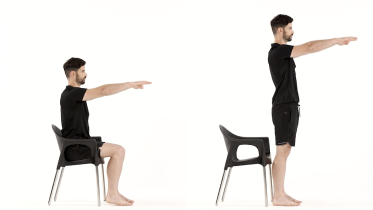 Sit to stand
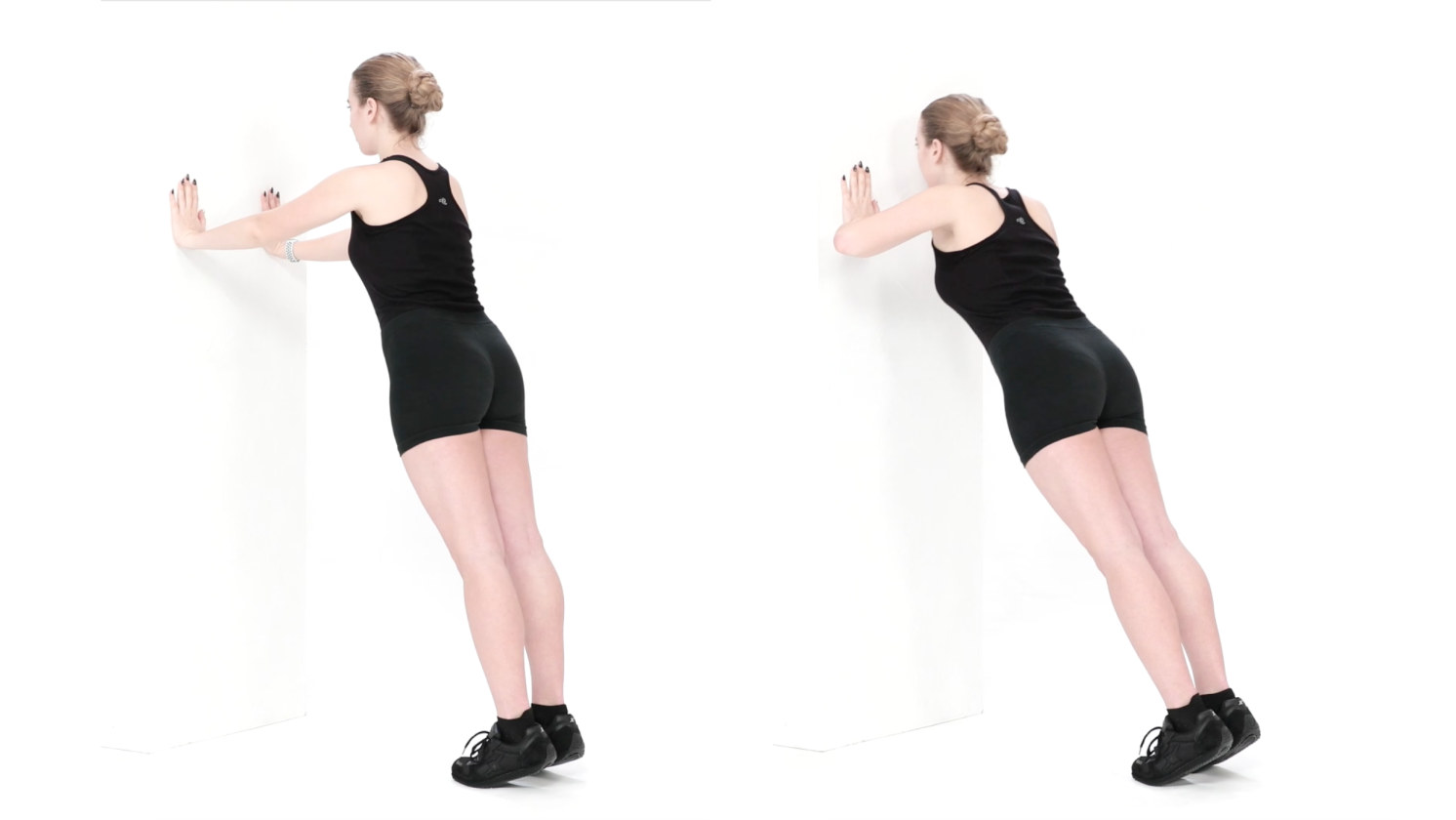 Wall push-ups
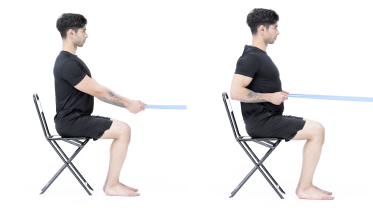 Seated row with band
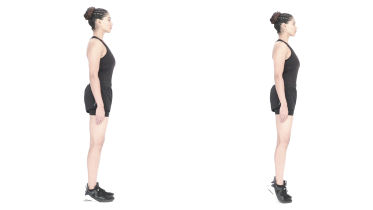 Calf raises
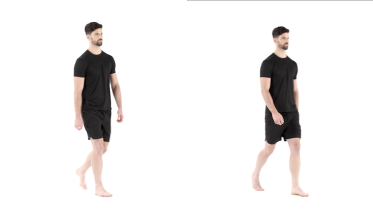 Brisk walking
Use these as a starting layer rather than a finished program. How the week fits together, and how to build it up, is set out on the strength plan page in this topic.
If you have high blood pressure, breathe steadily through every repetition and never hold your breath. With a heart condition or high blood pressure, check with your doctor before you start.
If you have had a hip replacement, get the go-ahead from your surgeon or physio before you try sit to stand. Standing up from a low seat bends the hip past a right angle, and many surgeons ask you to avoid that for the first months after some operations. For wall push-ups, stand on a mat or wear shoes with grip so your feet cannot slide, and after any shoulder surgery, fracture or dislocation, work only within the range your surgeon or physio has cleared. Look the band over for small splits and tug the anchor before each seated row. After an Achilles tendon repair or ankle surgery, calf raises come in at a set stage of the surgeon's protocol, so check with your physio before you start them.
Brisk walking counts as low-impact work for bone, and it is the level the consensus keeps people at after a spinal fracture. Wear flat shoes that fit well and grip the floor, not socks, tights or bare feet. With a heart or lung condition, high blood pressure, or after a recent operation, ask your doctor or physio how far and how fast to walk before you start.
Stop straight away for chest pain or pressure, dizziness or feeling faint, a racing or irregular heartbeat, or being far more out of breath than the effort should cause. If chest pain, pressure or tightness does not ease quickly when you rest, spreads to your arm, neck, jaw, stomach or back, or comes with sweating, feeling sick, feeling light-headed or being short of breath, call emergency services straight away, as this can be a heart attack. If it eases quickly and none of these happen, get medical advice the same day, and do not exercise again until you have been checked.
One stop sign belongs with the calf and walking work. Your calf or thigh becomes swollen, warm, tender, red or darker than usual, or has a throbbing or cramping pain that feels different from normal muscle ache. Stop and get medical advice the same day, as this can be a blood clot. If you are also short of breath or have chest pain, call emergency services.
Hormone treatment, calcium and vitamin D
None of these are decisions for a web page, and no dose for any of them appears here. Starting, stopping, changing or staying on hormone treatment or a bone medicine is a prescribing decision, and it belongs with a clinician who can see your history, not with a web page. The NHS route for that conversation is a GP.
Take the same route for calcium, vitamin D and any bone medicine. Your doctor or menopause clinic holds your history, your scan result if you have had one, and everything else you take, and those are what the decision turns on. Never stop or change a prescribed medicine on your own.
When to see a physio (physical therapist)
Get seen before you start if you have been told you have osteoporosis or osteopenia, if you have broken a bone from a minor fall, if you have had a fracture in your spine, or if you have fallen in the past year. Any one of those changes which exercises suit you and when each should appear. A physio can also measure grip strength and a timed chair stand now, so that in two years you are comparing numbers rather than memories.
Come in sooner if an old knee, hip, back or shoulder problem flares as soon as you add load, or if you are not sure how to bend and lift without loading your spine forward. For the weekly plan itself, the strength plan page gives the sessions, and the strength training for older adults program covers the same ground for anyone over 65. Any warning sign below is a reason to stop and get checked rather than push on.
Related exercise programs
See a doctor promptly if
- Emergency: if chest pain, pressure or tightness does not ease quickly when you rest, spreads to your arm, neck, jaw, stomach or back, or comes with sweating, feeling sick, feeling light-headed or being short of breath, call emergency services straight away, as this can be a heart attack. If it eases quickly and none of these happen, get medical advice the same day, and do not exercise again until you have been checked.
- Emergency: you have just fallen and cannot get up, or you think you may have hurt your head, neck, back or hip. Stay where you are, keep warm and call emergency services, or get someone to call for you. If you got up and walked without trouble and only notice pain later, use the lines below.
- Emergency: you fell and cannot remember the fall or how it happened. Go to an emergency department straight away, and do not drive yourself. You may have blacked out or hit your head without knowing it.
- Emergency: after a knock to the head, being very drowsy or finding it hard to keep your eyes open, confusion, a fit (seizure), new weakness or numbness anywhere in your body, new trouble understanding, speaking, walking or keeping your balance, new problems seeing or hearing, clear fluid coming from your ears or nose, bleeding from your ears or bruising behind them, a black eye when your eye was not hit, a dent in your head or a wound with something stuck in it, or a change in behavior. Call emergency services straight away. These can be signs of an injury to the brain.
- Emergency: after a knock to the head, you were knocked out, even for a moment, you cannot remember what happened just before or after, you have had a headache ever since, or you are being sick (vomiting). The same applies, even if you feel fine, if you take medicine that thins your blood, other than aspirin on its own, have a bleeding or clotting condition, have had brain surgery in the past, or had been drinking alcohol or taking drugs when it happened. Go to an emergency department straight away, and do not drive yourself.
- Emergency: any sign of a stroke, even if it goes away. That means a face that droops on one side, an arm you cannot lift or keep up, slurred or muddled speech, weakness or numbness on one side of your body or face, sudden blurred vision, double vision or loss of sight, trouble swallowing, sudden dizziness with unsteadiness or falling over, a sudden severe headache, or a sudden fall where your legs give way but you do not black out (a drop attack). Call emergency services straight away.
- Emergency: you have had a fall or an injury and now have severe hip pain, or you cannot walk or put weight on the leg. Call emergency services or go to an emergency department. This can be a sign of a broken hip (hip fracture).
- Same day: dizziness or feeling faint during or after exercise, without any of the emergency signs above. Stop the exercises and get medical advice the same day. If you faint, it does not settle within a few minutes of sitting still, or you cannot stand or walk steadily, call emergency services.
- Same day: a calf or thigh that is newly swollen, warm, tender, red or darker than usual, has swollen veins that are sore to touch, or has a throbbing or cramping pain that does not fit your injury or condition, or that feels different from normal muscle soreness after exercise. This can be a sign of a blood clot (deep vein thrombosis), especially after surgery, an injury, time in a cast or boot, a long trip or a spell of being much less mobile than usual. Get medical advice the same day. If you are also short of breath or have chest pain, call emergency services.
- Same day: new hip or groin pain after a fall, even a small one, if you are older, have low bone density (osteoporosis) or have taken steroid tablets for a long time, even if you can still walk. Get medical advice the same day. A broken hip is not always obvious at first.
- Same day: back pain after a minor fall or strain if you are older, have low bone density (osteoporosis) or have taken steroid tablets for a long time. Get medical advice the same day.
- Same day: back pain that comes on suddenly after lifting, bending, a cough or a sneeze, even without a fall, if you have low bone density (osteoporosis). Get medical advice the same day. This can be a sign of a broken bone in the spine (vertebral fracture). Stop the exercises until you have been checked.
- Same day: severe pain that comes on suddenly or is getting worse quickly. Get medical advice the same day.
- Routine: you have lost height, or your upper back has become more rounded and you are starting to stoop, or you have back pain, or pain that wraps around to your ribs, with no clear cause. Book an appointment with your doctor. A broken bone in the spine can cause this, and it does not always cause the pain you would expect. If the pain came on suddenly, get medical advice the same day.
Common questions
Does the menopause cause muscle loss?
Some, though far less than the internet implies if you are counting kilograms. Across 1,246 women in SWAN, lean mass fell by about 0.2 percent a year during the transition, which the authors put at a total loss of 0.5 percent, an average of 0.2 kg (0.4 lb), over the 3.5 year window (Greendale 2019). What people notice is a different measure. In a Finnish study that followed 232 women through to postmenopause, grip force fell 2.1 percent, knee extension torque 2.6 percent and jumping height 2.6 percent (Bondarev 2021), so the loss shows up in force and power sooner than on a body scan.
How much bone density do you lose after the menopause?
In SWAN, the 10-year total around the last period was 10.6 percent at the lower spine and 9.1 percent at the hip (femoral neck), and most of it went during a short phase called the transmenopause: 7.38 percent at the spine and 5.8 percent at the hip (Greendale 2012). During that phase, average yearly loss in white women reached 2.5 percent at the spine and 1.8 percent at the femoral neck (Karlamangla 2018). Loss was slower in women with a higher body mass index and in African American women, and faster in Japanese and Chinese women. Your own number needs a scan, and whether you need one is a question for your doctor.
Can exercise reverse bone loss after the menopause?
It can slow it and add a little back, but the size of the effect is modest. Pooling 43 trials in 4,320 postmenopausal women, the Cochrane review found combination programs left 3.2 percent less bone loss at the spine and progressive resistance training 1.03 percent less at the hip, with 7 fractures per 100 women who exercised against 11 per 100 who did not (Howe 2011). The fracture difference did not reach statistical significance, so it could have arisen by chance, and the review rated the reporting quality of the trials it pooled as low. Exercise is worth doing on its own merits, and it is not a substitute for anything your doctor prescribes.
Why do I feel weaker than I did five years ago?
Force and power drop before muscle size does, which is why the change turns up first in the jobs that need speed or grip: lids, heavy doors, getting off a low sofa, the last flight of stairs. The Finnish cohort measured exactly that pattern through the transition (Bondarev 2021). Activity level, sleep, an aching joint that has quietly changed how you move, and the plain effect of getting older all sit on top of it. A physio can measure grip and a timed chair stand so you have numbers rather than an impression.
Does HRT protect your bones?
The NHS states that HRT helps to prevent osteoporosis by increasing your level of estrogen, and that it is particularly important for that purpose if your periods stop before the age of 45, an early or premature menopause. That is as far as this page will go, because whether it suits you depends on your history, your other medicines and your own risks. The NHS answer on that is to talk to a GP, who will help you decide. Keep the exercise side and the prescribing side in separate conversations, and take the second one to the clinician who knows your history.
References
- Greendale GA, Sowers M, Han W, et al. Bone mineral density loss in relation to the final menstrual period in a multiethnic cohort: results from the Study of Women's Health Across the Nation (SWAN). Journal of Bone and Mineral Research. 2012;27(1):111-118. doi:10.1002/jbmr.534
- Greendale GA, Sternfeld B, Huang MH, et al. Changes in body composition and weight during the menopause transition. JCI Insight. 2019;4(5):e124865. doi:10.1172/jci.insight.124865
- Karlamangla AS, Burnett-Bowie SM, Crandall CJ. Bone health during the menopause transition and beyond. Obstetrics and Gynecology Clinics of North America. 2018;45(4):695-708. doi:10.1016/j.ogc.2018.07.012
- Bondarev D, Finni T, Kokko K, et al. Physical performance during the menopausal transition and the role of physical activity. Journals of Gerontology Series A. 2021;76(9):1587-1590. doi:10.1093/gerona/glaa292
- Brooke-Wavell K, Skelton DA, Barker KL, et al. Strong, steady and straight: UK consensus statement on physical activity and exercise for osteoporosis. British Journal of Sports Medicine. 2022;56(15):837-846. doi:10.1136/bjsports-2021-104634
- Howe TE, Shea B, Dawson LJ, et al. Exercise for preventing and treating osteoporosis in postmenopausal women. Cochrane Database of Systematic Reviews. 2011;(7):CD000333. doi:10.1002/14651858.CD000333.pub2
- Watson SL, Weeks BK, Weis LJ, et al. High-intensity resistance and impact training improves bone mineral density and physical function in postmenopausal women with osteopenia and osteoporosis: the LIFTMOR randomized controlled trial. Journal of Bone and Mineral Research. 2018;33(2):211-220. doi:10.1002/jbmr.3284
- Bull FC, Al-Ansari SS, Biddle S, et al. World Health Organization 2020 guidelines on physical activity and sedentary behaviour. British Journal of Sports Medicine. 2020;54(24):1451-1462. doi:10.1136/bjsports-2020-102955
- Royal Osteoporosis Society. Impact exercise to help make your bones stronger. https://theros.org.uk/information-and-support/exercise/exercise-for-bones/impact-exercise-to-help-make-your-bones-stronger/
- Royal Osteoporosis Society. Exercise for bones. https://theros.org.uk/information-and-support/exercise/exercise-for-bones/
- NHS. Menopause and perimenopause symptoms. Page last reviewed 19 May 2026. https://www.nhs.uk/conditions/menopause-and-perimenopause/symptoms/
- NHS. Benefits and risks of hormone replacement therapy (HRT). Page last reviewed 8 February 2023. https://www.nhs.uk/medicines/hormone-replacement-therapy-hrt/benefits-and-risks-of-hormone-replacement-therapy-hrt/
- NHS. Osteoporosis. https://www.nhs.uk/conditions/osteoporosis/
- NHS. Deep vein thrombosis (DVT). https://www.nhs.uk/conditions/deep-vein-thrombosis-dvt/
- NHS. Symptoms of a stroke. https://www.nhs.uk/conditions/stroke/symptoms/
Written and checked by the PocketPhysio editorial team. Last updated 2026-10-01.
This page is general education, not a diagnosis or a personal treatment plan. See a physiotherapist or doctor for advice about your own situation.