
Osteoporosis exercises and physiotherapy
What is osteoporosis?
Osteoporosis is a condition that makes bones weaker and more likely to break. The NHS points out that it does not usually hurt until a bone breaks. The wrist and hip are common places for a break, and so are the bones of the spine.
A break in a bone of the spine (a vertebral fracture) usually means the bone squashes down on itself rather than snapping. Several of them can lead to loss of height and a stooped posture. They are not always obvious. The Royal Osteoporosis Society says you may not know a spinal fracture has happened, and the pain can be mistaken for something else, such as arthritis.
Why does exercise help with osteoporosis?
Bone responds to load. The UK consensus statement on exercise for osteoporosis (Brooke-Wavell 2022) found that strength exercise that gets harder over time, combined with impact exercise, works best for bone strength. Even so, the benefit for bone is much smaller than what osteoporosis medicine can do. So exercise is used alongside medicine where it is needed, not instead of it.
Falls are the other half of the picture. A Cochrane review of older people living at home found, with high certainty, that exercise programs reduce the rate of falls by about 23%, and the programs shown to work are built mainly on balance and functional exercises (Sherrington 2019). The Too Fit To Fracture recommendations also rate the evidence for falls prevention as the strongest, and advise a mix of strength and balance training rather than aerobic exercise alone (Giangregorio 2014). The UK consensus found little evidence that exercise causes fractures and concluded that the benefits generally outweigh the risks.
There are few trials in people who have already had a spinal fracture, so much of the advice for that group comes from expert agreement rather than from trials. The Too Fit To Fracture authors describe their recommendations as conditional.
How to use this program
Start at stage 1 unless your physio has already set you a level. Move up when a stage feels easy and your back is no worse for it.
Each exercise page gives a typical starting dose, and some start with lighter work on most days. For bone, the UK consensus aims higher over time: a weight or band you can lift 8 to 12 times, working up to 3 sets. Once the load is that heavy, the usual pattern is 2 to 3 days a week with a rest day in between. The consensus also recommends back strengthening at least twice a week. Your physio will adjust this.
For impact, the Royal Osteoporosis Society suggests building up to 50 moderate-impact movements, such as jogs or skips, on most days if you have not had a fracture in your spine. If you have had a spinal fracture or several broken bones, low impact such as brisk walking is the level to aim for, building up to 20 minutes on most days. Jogging on the spot in stage 3 is the only moderate-impact exercise here. Each jog counts as one impact and you can spread the 50 through the day, so for your bones short rounds are enough, even though the jogging page gives longer ones for fitness. The Royal Osteoporosis Society advises feeling steady on your feet before you build up impact, so start it only with your physio's go-ahead.
Sources differ on how often to do balance work. The UK consensus and Osteoporosis Canada's Too Fit To Fracture advice both say at least twice a week. The Too Fit To Fracture expert panel went further and recommended balance training every day (Giangregorio 2015), and most of the balance exercise pages here suggest short practice once or twice a day. Take twice a week as the least to aim for. More often is fine if it feels steady.
Do every balance exercise next to a kitchen counter or a sturdy chair, on a clear floor that is not slippery. Wear flat shoes that fit well and grip the floor, not socks, tights or bare feet.
Working muscles should feel tired, and some muscle soreness the next day is normal. Back pain is different. Stop if an exercise gives you sharp or sudden back pain, and check the warning signs below. If you have high blood pressure, breathe steadily through every repetition and never hold your breath.
The exercise program
Stage 1: Posture, balance and everyday strength
For anyone new to exercise or less active than usual, and for people who have had a fracture in the spine once a doctor or physio has cleared them. The seated exercises work the upper back muscles while your spine stays upright. Sit to stand and calf raises build leg strength, and semi-tandem stance starts your balance work beside a counter. Brisk walking is the first step of impact exercise for your bones.
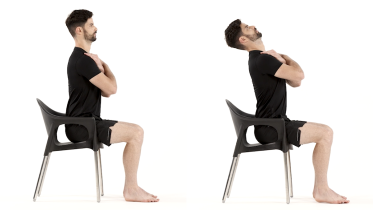 Seated thoracic extension
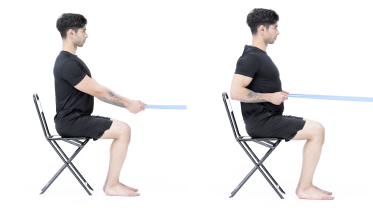 Seated row with band
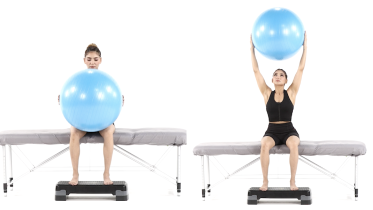 Seated overhead ball lift
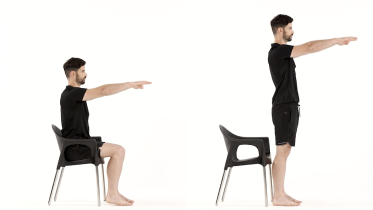 Sit to stand
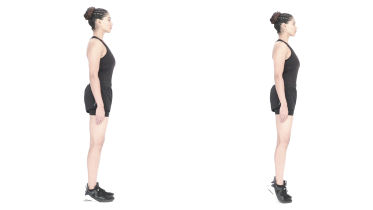 Calf raises
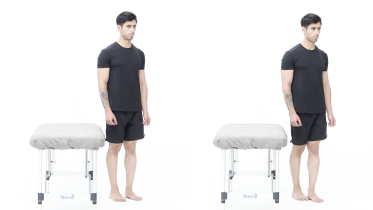 Semi-tandem stance
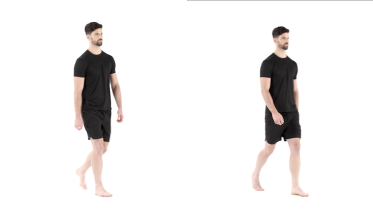 Brisk walking
Stage 2: Build strength standing up
When stage 1 feels easy, often after a few weeks. The chair squat and supported lunge load the hips and thighs, and stair climbing adds low impact. The back extension on elbows strengthens the muscles along your spine while you lie face down, and tandem stance narrows your base further. Keep a hand on a counter or chair for anything that tests your balance. If getting down to the floor is hard, you can do the face-down exercises on a firm bed.
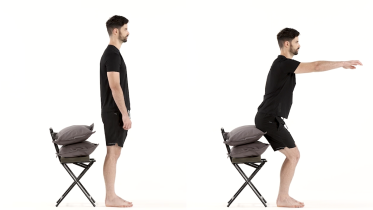 Chair squat
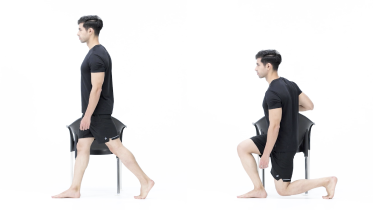 Supported lunge
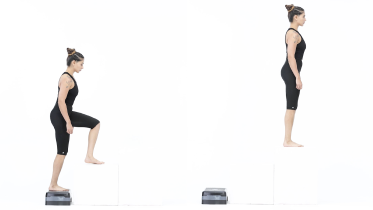 Stair climbing
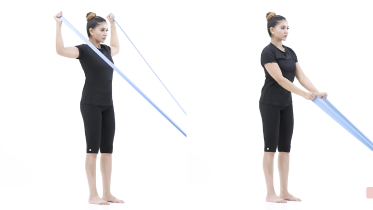 Band row with external rotation
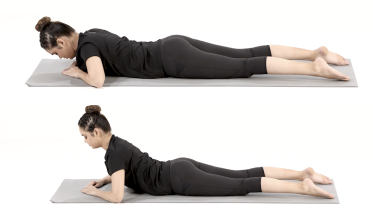 Back extension on elbows
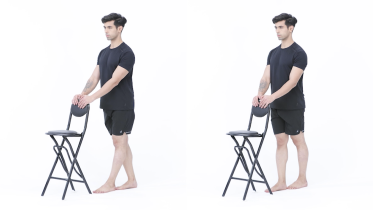 Tandem stance
Stage 3: Heavier strength, harder balance and more impact
When stage 2 feels steady and your back is no worse for it. The step-up with knee drive and press works your legs and shoulders while it tests your balance, but leave out the weights until your physio says you are ready. The prone back extension is harder back strengthening, and the superman is harder again. If you have had a fracture in your spine, stay with the back extension on elbows and the prone back extension unless your physio adds the superman. Jogging on the spot is moderate impact: leave it out if you have had a fracture in your spine or several broken bones, and start it only once you feel steady on your feet and your physio agrees.
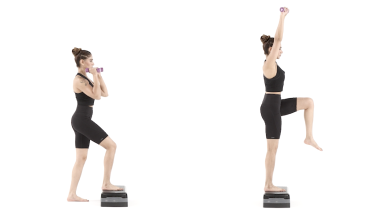 Step-up with knee drive and press
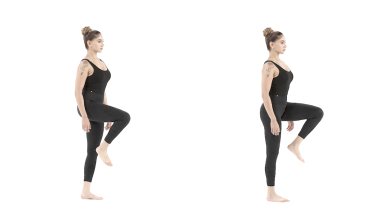 Single leg stance
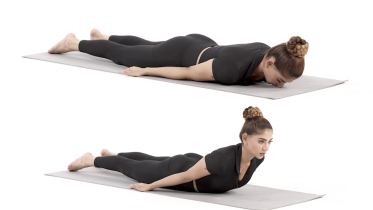 Prone back extension
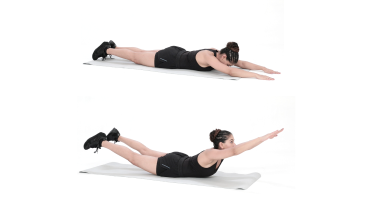 Superman
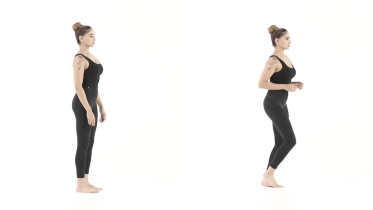 Jogging on the spot
What to avoid or change: bending, twisting and lifting
You do not need to stop bending. The Royal Osteoporosis Society points out that bending forward and curving your back is a normal part of everyday life. What the UK consensus advises is to change or avoid movements that keep the spine bent forward for long spells, repeat the bend over and over, or take it as far as it will go. That is why this program leaves out sit-ups and toe touches, along with exercises that twist while you hold a weight.
The hip hinge is what physios teach instead. Bend forward from your hips with your knees soft and your back straight, as if you were pushing a drawer shut with your bottom. The consensus sums it up as "think straight": keep your upper back straight and your neck in line with it whenever you bend or lift. Twisting is usually fine if it is smooth and within a comfortable range, but avoid bending and twisting at once while you hold something heavy.
For lifting, the advice is to learn how rather than to stop. Keep the load close to your body, bend at your hips and knees, and put it down if you feel the strain in your back. To pick something up from the floor, kneel or squat down to it, and split heavy shopping between two bags. When you get out of bed or up from the floor, roll onto your side first and push up with your arms rather than curling straight up.
After a fracture in the spine
If you have had a fracture in a bone of your spine, or think you might have, check with your doctor or physio before you start this program. The Royal Osteoporosis Society says most spinal fractures take 6 to 12 weeks to heal, and that staying active does not interfere with healing. It advises waiting until the fracture has healed, which can take up to three months, before you build up strength exercises, and keeping gently on the move until then.
The UK consensus recommends early advice on moving and lifting after a painful spinal fracture, with daily exercises to strengthen the back muscles. It keeps impact to the level of brisk walking and recommends a referral to a physio for advice that suits you. Sudden new back pain at any point is a reason to stop and get checked the same day.
Medicines, calcium and vitamin D
Decisions about osteoporosis medicine, calcium and vitamin D belong with your doctor, so this page does not give advice on them. The Royal Osteoporosis Society is clear that exercise is not a replacement for an osteoporosis medicine. If you have questions about a medicine you take, or wonder whether you need one, ask your doctor or pharmacist.
When to see a physio or doctor
See a physio if you have osteoporosis and are not sure where to start. The same goes if you have had a fracture in your spine or a fall in the past year. A physio can set your level and check how you bend and lift. See your doctor if you have lost height or your back has started to curve, because a spinal fracture can cause this. The urgent warning signs are listed below.
Check with your doctor before you start if you have a heart or lung condition, or blood pressure that is not under control. The Royal Osteoporosis Society also advises talking to your doctor or physio first if you have broken several bones or are still recovering from a broken bone. After a hip or knee replacement, a broken hip or any other operation, follow the program from your surgical team and physio instead of this one. If you feel unsteady or have fallen before, practice the balance exercises when someone else is at home. If you have fallen more than once, or have started to avoid activity because you are afraid of falling, ask your doctor to refer you to a falls service, as the UK consensus recommends.
For physiotherapists
The UK consensus (Brooke-Wavell 2022) sets out its doses: progressive resistance training on 2 to 3 days a week at about an 8 to 12 repetition maximum, building to 3 sets; at least 50 moderate impacts per session (for example 5 sets of 10) on most days for people without vertebral fracture; and back extensor work of 3 to 5 repetitions held for 3 to 5 seconds, at least twice a week. For people with vertebral fractures or multiple low-trauma fractures, it recommends impact up to the level of brisk walking, aiming for 150 minutes a week, with individual physio advice at the start of a new program. For people who are already falling, it recommends highly challenging balance and strength training, such as Otago or FaME, for 3 hours a week over at least 4 months.
The Too Fit To Fracture Delphi (Giangregorio 2015) found current activity guidelines appropriate for people without a spine fracture but not for those with one, preferred moderate over vigorous activity after a spine fracture, and recommends daily balance training and spinal extensor endurance training for all. NICE NG259 (2026) lists back pain or radiating rib pain with no identified cause, height loss over 4 cm, and rounded shoulders or exaggerated kyphosis as signs of vertebral fracture, and notes that people with vertebral fractures often have no symptoms, so the fractures can go undiagnosed; its exercise recommendations are due in a later update. Fracture risk assessment and drug treatment sit with the medical team.
See a doctor promptly if
- Emergency: you have just fallen and cannot get up, or you think you may have hurt your head, neck, back or hip. Stay where you are, keep warm and call emergency services, or get someone to call for you. If you got up and walked without trouble and only notice pain later, use the lines below.
- Emergency: you fell and cannot remember the fall or how it happened. Go to an emergency department straight away, and do not drive yourself. You may have blacked out or hit your head without knowing it.
- Emergency: after a knock to the head, being very drowsy or finding it hard to keep your eyes open, confusion, a fit (seizure), new weakness or numbness anywhere in your body, new trouble understanding, speaking, walking or keeping your balance, new problems seeing or hearing, clear fluid coming from your ears or nose, bleeding from your ears or bruising behind them, a black eye when your eye was not hit, a dent in your head or a wound with something stuck in it, or a change in behavior. Call emergency services straight away. These can be signs of an injury to the brain.
- Emergency: after a knock to the head, you were knocked out, even for a moment, you cannot remember what happened just before or after, you have had a headache ever since, or you are being sick (vomiting). The same applies, even if you feel fine, if you take medicine that thins your blood, other than aspirin on its own, have a bleeding or clotting condition, have had brain surgery in the past, or had been drinking alcohol or taking drugs when it happened. Go to an emergency department straight away, and do not drive yourself.
- Emergency: you have had a fall or an injury and now have severe hip pain, or you cannot walk or put weight on the leg. Call emergency services or go to an emergency department. This can be a sign of a broken hip (hip fracture).
- Emergency: numbness, tingling or altered feeling around or under your genitals, between your inner thighs, or around your bottom (anus), for example it feels different when you wipe after using the toilet. Call emergency services or go to an emergency department straight away. This can be a sign of pressure on the bundle of nerves at the base of the spine (cauda equina syndrome), which needs emergency treatment.
- Emergency: you find it hard to start peeing, cannot pee, cannot feel yourself peeing or cannot control when you pee, or you do not notice when you need to poo or cannot control when you poo, and this is not normal for you. The same applies to a new change in how your genitals feel during sex, or new trouble getting an erection or ejaculating. Call emergency services or go to an emergency department straight away. These can also be signs of cauda equina syndrome.
- Emergency: sciatica in both legs, or pain, tingling, numbness or weakness in both legs. The same applies if you lose feeling in one leg. Call emergency services or go to an emergency department straight away.
- Emergency: back or leg pain that started after a serious accident, such as a car crash or a fall from a height, or back pain with chest pain. Call emergency services.
- Emergency: new neck or back pain after a fall, a knock or a jolt, even a minor one such as a trip or a sudden stop in a car, if you have a condition that stiffens the spine, such as ankylosing spondylitis. Call emergency services or go to an emergency department straight away, do not drive yourself, and tell the staff about your spine condition, so they keep your neck and back in their usual position. A stiff spine can break after a small injury, and the break is easy to miss at first. If the pain started straight after the injury, or you also have numbness, tingling or weakness in your arms or legs, keep still and call emergency services.
- Back pain after a minor fall or strain if you are older, have low bone density (osteoporosis) or have taken steroid tablets for a long time. Get medical advice the same day.
- Back pain that comes on suddenly after lifting, bending, a cough or a sneeze, even without a fall, if you have low bone density (osteoporosis). Get medical advice the same day. This can be a sign of a broken bone in the spine (vertebral fracture). Stop the exercises until you have been checked.
- Severe pain that comes on suddenly or is getting worse quickly. Get medical advice the same day.
- Back or leg pain with a fever, or you feel hot, cold, shivery or generally unwell. Get medical advice the same day, and go to an emergency department if you feel very unwell.
- Same day: new hip or groin pain after a fall, even a small one, if you are older, have low bone density (osteoporosis) or have taken steroid tablets for a long time, even if you can still walk. Get medical advice the same day. A broken hip is not always obvious at first.
- A leg or foot that is getting weaker, for example your foot drags, catches on the ground or slaps down when you walk (foot drop). Get medical advice the same day. If the weakness is getting worse by the hour, go to an emergency department.
- You have back pain and have lost weight without trying. Get medical advice the same day and mention the weight loss.
- New back pain and you have had cancer, now or in the past. Get medical advice the same day and mention your cancer history. If you are being treated for cancer now, contact your cancer team the same day.
- Emergency: you have had cancer, now or in the past, and your back or neck pain feels like a tight band around your body, or comes with pain spreading down an arm or leg, weakness, numbness or pins and needles in your arms or legs, trouble walking, or trouble controlling your bladder or bowels. Call your cancer team's emergency number straight away, or go to an emergency department if you do not have one or cannot get through. This can be cancer pressing on the spinal cord (metastatic spinal cord compression), which needs treatment straight away.
- Pain that is worse at night, or does not ease at all when you rest. See your doctor within a few days. If you have had cancer, now or in the past, or you have lost weight without trying, get medical advice the same day. If you are being treated for cancer now, contact your cancer team the same day.
- Routine: you have lost height, or your upper back has become more rounded and you are starting to stoop, or you have back pain, or pain that wraps around to your ribs, with no clear cause. Book an appointment with your doctor. A broken bone in the spine can cause this, and it does not always cause the pain you would expect. If the pain came on suddenly, get medical advice the same day.
Common questions
What exercises are good for osteoporosis?
Two kinds matter most for bone: strength exercise against a resistance, and impact exercise where your feet meet the ground with some force. The UK consensus statement found that a mix of the two appears to work best for bone strength (Brooke-Wavell 2022). Balance exercises count too, because they lower the chance of a fall. Back strengthening is recommended to help posture.
What exercises should you avoid with osteoporosis?
You do not need to avoid exercise, but some movements are usually changed. The Royal Osteoporosis Society names sit-ups, touching your toes and the Pilates roll-down and curl-up, because they can put pressure on the spine. The UK consensus says twisting should be safe if it is smooth and comfortable. If your fracture risk is high, Osteoporosis Canada's Too Fit To Fracture advice is to limit bending or twisting while you hold a weight.
Is walking enough for osteoporosis?
Walking is good for you and counts as low-impact exercise, but on its own it does less for bone than a mix of impact and strength work. The Royal Osteoporosis Society says low-impact exercise can help reduce the loss of bone, while moderate impact, such as jogging or skipping, can help improve bone strength. Add strength exercise on 2 to 3 days a week as well. After a fracture in the spine or several broken bones, brisk walking is the usual level of impact, building up to 20 minutes on most days.
Can exercise reverse osteoporosis?
Exercise can help bone a little, but it is not expected to undo osteoporosis on its own, and it does not replace medicine. In the LIFTMOR trial, 101 women after the menopause with low bone mass were split into two groups for 8 months: one did supervised high-intensity strength and impact training twice a week, the other gentle exercise at home. In the trained group, bone density in the lower spine rose and at the hip (femoral neck) it held steady, while the home group lost a little at both sites. Only one adverse event was reported (Watson 2018), but the program was closely supervised, so do not copy it at home without a physio. The UK consensus describes the benefit of exercise for bone as much smaller than that of osteoporosis medicine.
Is it safe to lift weights with osteoporosis?
For most people, yes, with good technique and a gradual build-up. The UK consensus found little evidence of fractures happening during exercise and advises strength training on 2 to 3 days a week, working up to a weight you can lift 8 to 12 times. If you have had a fracture in your spine, it recommends individual advice from a physio at the start of a new program. In the Royal Osteoporosis Society's words, it is how you lift rather than how much you lift that matters.
Can I exercise after a spinal fracture?
Usually yes, and staying active is encouraged, but check with your doctor or physio first. The Royal Osteoporosis Society says most spinal fractures take 6 to 12 weeks to heal and that staying active does not interfere with healing. The UK consensus recommends early advice on moving and lifting after a painful spinal fracture, along with gentle back strengthening exercises every day and a referral to a physio. A physio can set the right level for you.
References
- Brooke-Wavell K, Skelton DA, Barker KL, et al. Strong, steady and straight: UK consensus statement on physical activity and exercise for osteoporosis. British Journal of Sports Medicine. 2022;56(15):837-846. https://doi.org/10.1136/bjsports-2021-104634
- Giangregorio LM, Papaioannou A, MacIntyre NJ, et al. Too Fit To Fracture: exercise recommendations for individuals with osteoporosis or osteoporotic vertebral fracture. Osteoporosis International. 2014;25(3):821-835. https://doi.org/10.1007/s00198-013-2523-2
- Giangregorio LM, McGill S, Wark JD, et al. Too Fit To Fracture: outcomes of a Delphi consensus process on physical activity and exercise recommendations for adults with osteoporosis with or without vertebral fractures. Osteoporosis International. 2015;26(3):891-910. https://doi.org/10.1007/s00198-014-2881-4
- Watson SL, Weeks BK, Weis LJ, et al. High-intensity resistance and impact training improves bone mineral density and physical function in postmenopausal women with osteopenia and osteoporosis: the LIFTMOR randomized controlled trial. Journal of Bone and Mineral Research. 2018;33(2):211-220. https://doi.org/10.1002/jbmr.3284
- Sherrington C, Fairhall NJ, Wallbank GK, et al. Exercise for preventing falls in older people living in the community. Cochrane Database of Systematic Reviews. 2019;(1):CD012424. https://doi.org/10.1002/14651858.CD012424.pub2
- Osteoporosis Canada. Too Fit To Fracture. https://osteoporosis.ca/too-fit-to-fracture/
- Royal Osteoporosis Society. Exercise for bones. https://theros.org.uk/information-and-support/exercise/exercise-for-bones/
- Royal Osteoporosis Society. Impact exercise to help make your bones stronger. https://theros.org.uk/information-and-support/exercise/exercise-for-bones/impact-exercise-to-help-make-your-bones-stronger/
- Royal Osteoporosis Society. How to exercise safely for bones. https://theros.org.uk/information-and-support/exercise/how-to-exercise-safely-for-bones/
- Royal Osteoporosis Society. Spinal fractures (vertebral fractures). https://theros.org.uk/information-and-support/living-with-osteoporosis-and-broken-bones/spinal-fractures-vertebral-fractures/
- Royal Osteoporosis Society. Symptoms of osteoporosis. https://theros.org.uk/information-and-support/about-osteoporosis-and-osteopenia/osteoporosis-symptoms/
- NHS. Osteoporosis. https://www.nhs.uk/conditions/osteoporosis/
- NHS. Back pain. https://www.nhs.uk/conditions/back-pain/
- National Institute for Health and Care Excellence. Osteoporosis: risk assessment. NICE guideline NG259. 2026. https://www.nice.org.uk/guidance/ng259
Written and checked by the PocketPhysio editorial team. Last updated 2026-09-28.
This page is general education, not a diagnosis or a personal treatment plan. See a physiotherapist or doctor for advice about your own situation.