
Part of Osteoporosis
Exercises to avoid with osteoporosis, and where that list actually came from
Warning signs, and when to get help
What movements should you avoid with osteoporosis?
Movements, not exercises. That distinction is the one that saves people from giving up things they could keep.
The movement the guidance is actually about is forward bending of the spine, in four particular forms: taken to the end of its range, held there for long spells, repeated many times over, or combined with a twist while you are holding a load. Everything else on the internet's list is either a version of one of those, or it is somebody's guess.
So the commonly named exercises come out for a reason rather than by name, and once you know the reason you can judge a movement nobody has written about. Toe touches take the spine to its end range. A long curl-up off the floor repeats a deep bend many times over. Swinging a heavy bag from the floor into the back of a car does both at once, with a load in your hands and a twist on the end of it.
The named list, where the bodies agree, is short. The Royal Osteoporosis Society names sit-ups, touching your toes, and the Pilates roll-down and curl-up as the ones to adapt. The Australian position statement puts the principle in six words: loaded spine flexion is not recommended (Beck 2017).
What that is not is an instruction to stop bending. Nobody gets dressed, loads a dishwasher or picks up a cat without bending. The osteoporosis program teaches the hip hinge, which is the replacement, and osteoporosis posture and spine protection covers the daily version: the cough, the sneeze, the high shelf, getting out of bed.
Where the forward bending advice actually came from
A reader who has been told to stop bending for the rest of her life deserves to know what that instruction rests on, and almost nothing written on the subject says where it came from.
The UK consensus statement sources its safety position to a systematic review of adverse events in people with osteoporosis and osteopenia (Kunutsor 2018). That review says, in its own discussion, that the evidence suggesting spinal flexion may be associated with vertebral fractures is based on two papers only. It then adds that forward flexion is mechanically plausible as a way of loading the front of the vertebral bodies, and the citation it gives for that mechanical argument is a conference symposium presentation rather than a published paper.
The two papers are both worth knowing by name. The first is from 1984: 59 postmenopausal women with spinal osteoporosis and back pain, aged 49 to 60, followed for one to six years, allocated to extension exercises, flexion exercises, both or neither. Further wedging or compression fractures appeared in 89 percent of the flexion group against 16 percent of the extension group. The flexion group had nine people in it, and the study was not randomized (Sinaki 1984).
Two more figures from the same table belong here, because they cut the other way, and each rests on a small group of its own. Further fractures appeared in 67 percent of the group given no exercises at all, which was six women, and in 53 percent of the group given both directions, which was nineteen. So the comparison that looks dramatic is nine women against twenty-five, in a group younger than most people reading this, and the women given nothing sat closer to the flexion group than to the extension group. Four women out of six will not carry a conclusion either way, so the fair reading is that this study points toward doing the extension work and is too small to tell you what a forward bend on its own does.
The second is from 2013: three people, all three with osteopenia rather than osteoporosis, all healthy and pain-free until they took up flexion yoga positions. Its own conclusion is phrased as an inference rather than a finding, saying the complications in people with osteopenia lead to concern that fracture risk would increase further in osteoporosis (Sinaki 2013).
That is the whole evidential base: nine people in one arm of a 1984 study, three people in a 2013 case series, and a mechanical argument. The same review that traced it reached two conclusions in the same breath, and both belong here. Activities involving spinal flexion were associated with a greater risk of vertebral fracture, and those events were rare. And people with osteoporosis or osteopenia can safely take part in structured exercise programs, at home or in supervised facilities (Kunutsor 2018).
So should you ignore the precaution?
No. Tracing the evidence this far can do real harm if it stops there and leaves you feeling clever.
Thin evidence is not the same as evidence of safety. Nobody has run the trial that would settle this, because the trial would need thousands of people followed for years, and the one Cochrane review that looked specifically at exercise after a vertebral fracture concluded there was not enough evidence to determine effects on new fractures or adverse events at all (Gibbs 2019). An absence of proof points in both directions, and the cost of being wrong is not symmetrical: a few forward folds you did not need to give up against a crushed vertebra.
The national bone bodies in the USA, the UK and Canada all recommend some form of this precaution, and so does the Australian exercise science position statement (Beck 2017). The 2024 UK clinical guideline on osteoporosis, written by a different group and published two years after the consensus statement, lands in the same place: repetitive forced forward bending exercises should be undertaken with care, because that specific movement may be associated with an increased risk of new vertebral fractures, and in the same paragraph, that people with osteoporosis can in general take part in exercise safely because the risk of serious adverse events is very low (Gregson 2025). Five organizations reading much the same thin evidence and arriving at the same caution is itself a reason to follow it. Where that leaves you is clear enough: a sensible precaution on modest evidence, which is a very different thing from a proven danger, and it means you can stop treating a forward bend as a near miss every time one happens by accident.
One argument for keeping it does not come from a trial at all, and it is the one a surgeon would put first. An osteoporotic vertebra does not snap across the way a wrist does. It collapses, and usually at the front, which is why the Royal Osteoporosis Society says these bones do not go back to the shape they were but heal in their new compressed shape, and why several of them cost you height and round your upper back. Forward bending loads the part that gives way, which is what the US foundation means about the front of the spine.
The rounding then feeds back into the loading. A study using a validated computer model of the spine found that compressive load on the vertebrae rose as thoracic kyphosis increased, and rose most in the lower back and the bottom of the upper back rather than in the middle of it (Bruno 2012). A first fracture therefore leaves the spine shaped in a way that puts more load through the bones that have not broken yet.
Which answers a question this page would otherwise leave hanging: does the restriction end once a fracture has healed? No, because it was never timed off healing in the first place. It is timed off your fracture risk, and a previous fracture keeps you in the high risk group after the bone has mended. The 2024 UK clinical guideline puts fracture risk at roughly double in anyone with a prior fracture, including a vertebral fracture that never caused any symptoms, higher again with more than one, and highest in the year straight after a fracture (Gregson 2025). So a healed fracture is not a licence to go back to loaded forward bends. What has changed, and what you can add, comes from the clinician tracking your risk rather than from a calendar.
Why the UK, US and Canadian advice does not match
Read the three national bodies side by side and they give three different instructions for the same movement.
The Royal Osteoporosis Society, in the UK, says bending forward and curving your back is normal movement, both in everyday life and when you are keeping active, and then names the handful of exercises to adapt.
The Bone Health and Osteoporosis Foundation, in the USA, is the strictest. It states that people with bone loss in the spine should not bend forward from the waist, and its list of six things runs from twisting and bending the torso to an extreme, through carrying packages that are too heavy, to bending forward when coughing and sneezing and reaching for objects on a high shelf. It also says that for some people with a lot of bone loss, a hug, or picking up a grandchild, is enough to break a bone in the spine.
Osteoporosis Canada splits the difference by naming a group. Its own wording is that everyday life involves bending and twisting of your spine, and that the movements people at high risk of fracture may need to limit are these: repetitive bending and twisting, where the repetition is the point; bending all the way forward, or all the way to the side; twisting as well, all the way to the side; holding a bent or twisted position for a long spell; and bending or twisting while you hold something heavy.
If you have been told not to bend at all and you are reading a British page that says bending is normal, that is not a mistake by either of them. It is a difference in how cautious each organization has chosen to be, and the Canadian framing is the one that tells you how to decide: the stricter end of the advice is written for people at high risk of fracture, which usually means a previous fracture from a minor injury, several broken bones, or a very low bone density reading. Ask your own doctor or physio which group you are in, because that single answer changes which of the three sets of advice applies to you.
Which leaves the obvious question: what do you do between now and that appointment? Use the strict version, the American one, until somebody who has seen your scan tells you otherwise. Not knowing which group you are in is not the same as being in the safer one, and the cost of guessing runs only one way. Take four things to the conversation: whether you have ever broken a bone in a fall or a knock that should not have broken one, whether you have broken more than one, what your last bone density reading was, and whether you take steroid tablets long term. Osteoporosis Canada says to get advice on which exercises to do, how hard, and how to build them up from a physical therapist, a kinesiologist or an exercise physiologist, and it names a recent fracture or a high fracture risk as the situations where that matters most. So a recent break is a reason to ask somebody rather than to work it out from a page.
Is there a weight limit with osteoporosis?
No, and the 10 lb (4.5 kg) figure that circulates in patient forums is named in the literature as an example of what clinicians should stop saying.
The Too Fit To Fracture expert panel recommends giving guidance on spine-sparing technique during daily activities and leisure, taking account of impairments, fracture risk, activity history and preference, rather than providing generic restrictions, and the generic restrictions it names as examples are lifting less than 10 lb (4.5 kg) and no twisting (Giangregorio 2015). The UK consensus takes the same line from the other side, recommending safe lifting technique rather than instructions such as do not lift or only lift up to a specific weight, and marking that as expert consensus (Brooke-Wavell 2022). The Royal Osteoporosis Society says the same thing in plainer words: there is not a specific weight that is safe or unsafe, it depends on your own body and on what feels right for you, and it is how you lift rather than how much you lift that matters.
We went looking for a sourced weight limit for this page and did not find one. What we found instead was a patient forum thread in which members pass the number around between themselves. Strength training for osteoporosis sets out the dose that is actually published, and it is a proportion of your own strength, which goes up as you get stronger, rather than a fixed number of pounds, which does not.
Things on the internet's avoid list that the guidance recommends
Four of these come up often enough to be worth naming, because being frightened off them costs you something.
Back extension. Arching backward is the opposite direction to the one that is restricted. Back strengthening is the third of the UK consensus's three groups, the one it calls Straight, aimed at posture and spine support, although every recommendation in that group is marked as expert consensus rather than evidence. The US foundation puts the mechanics plainly: bending forward compresses the front of the spine, while leaning or bending backward separates it and reduces the chance of a broken bone. Our kyphosis program covers it as a condition, and the two back extensions listed further down this page are the usual versions of it.
Planks and bird dog. Osteoporosis Canada's own basic program names planks, side planks and bird dog by name, to work the abdominal and back extensor muscles and improve posture. Those are often on internet avoid lists under the heading of core work, alongside the curl-ups that genuinely are restricted.
Squats and deadlifts. The UK consensus names squats and deadlifts among acceptable compound exercises, and Osteoporosis Canada's basic program includes a squat, a lunge and a hinge, with push, pull and press work alongside them. The hinge is the movement the whole precaution is built around, done properly.
Stairs, shopping and housework. The consensus encourages stair climbing, sit to stands and heavy housework or gardening by name. Those are three of the first things families take away from somebody after a diagnosis, and bone responds to load, so being waited on is not a neutral choice.
What actually changes if you have had a fracture in your spine
This is the group for whom the restrictions genuinely tighten, in every source we read, and it is also the group most likely to be reading a general avoid list that was not written for them.
Start with the gate rather than the exercises. If you have had a fracture in a bone of your spine, or several broken bones from minor injuries, get your own doctor or physio to set your starting point before you follow any program, including ours. The UK consensus recommends individual physiotherapy advice at the start of a new program for people with vertebral fractures or multiple low-trauma fractures, for both impact and resistance work, and that recommendation is one it marks as expert consensus rather than evidence.
Three things change in the published advice for that group. Impact comes down: the Royal Osteoporosis Society says to stay with low-impact exercise if you have had spinal fractures or many broken bones, building up toward 20 minutes on most days, rather than the 50 moderate impacts suggested for everyone else. Intensity comes down: the Delphi panel preferred moderate intensity over vigorous after a spine fracture, and found that the general physical activity guidelines are appropriate for people with osteoporosis without a spine fracture but not for those with one. And the balance of risk changes: the same panel states that for people with vertebral fracture, especially where there is pain, more than one fracture, or a marked rounding of the upper back, the risks of many activities may outweigh the benefits, and recommends seeing a physical therapist (Giangregorio 2015).
Healing has its own clock before any of that applies. The Royal Osteoporosis Society puts spinal fracture healing at 6 to 12 weeks, says movement does not affect the healing process, and advises waiting until the bone has healed, which can take up to three months, before building up strength exercises. The osteoporosis program has the after-a-fracture section in full, and we do not rebuild it here.
Waiting is not the same as resting, and that difference matters more than the three months does. The same society says to aim to stay as active as possible after a spinal fracture, because that lowers the risk of chest infections, constipation and blood clots and helps you hold on to your muscle strength, and that general exercises in the meantime can ease tension and muscle spasm in the back. The 2024 UK clinical guideline goes further and makes a strong recommendation that exercise programs after a vertebral fracture include progressive back muscle strengthening or endurance work, adding that while the fracture is still painful that work may be better done in an unloaded position, such as lying down (Gregson 2025). The UK consensus is blunt about this direction too: inactivity should be avoided, and prompt advice on moving and lifting is recommended soon after a painful vertebral fracture (Brooke-Wavell 2022). So the three months is the clock on building up loaded strength work, not a three month gap with nothing in it, and what fills it is set by your own physio rather than by this page.
One thing that clock takes for granted is a fracture that is settling. Pain from a spinal fracture that is getting worse, or that is no better as those weeks go by, is a reason to go back to your doctor before you load the spine at all rather than something to push through: the Royal Osteoporosis Society notes that a spinal fracture sometimes carries on causing severe pain, and that is the point at which a procedure gets discussed. New leg weakness, numbness, or trouble with your bladder or bowels at any stage is in the warning signs below, and it is not part of a healing fracture.
The harder version of this is the reader who has had one and does not know it. The Royal Osteoporosis Society says you may not always be aware a spinal fracture has occurred, and that the pain can be mistaken for something else, such as arthritis. So the gate above is not only for people with a diagnosis. If you have lost height, your upper back has become more rounded, or you have back pain or pain that wraps around to your ribs with no clear cause, see your doctor before you start. A broken bone in the spine can cause any of them, and it does not always announce itself. If the pain came on suddenly, get medical advice the same day. Osteoporosis posture and spine protection sets out those signs in full.
Two more triggers belong on that list, and they are the ones nobody guesses, because neither has a symptom attached to it. The 2024 UK clinical guideline makes a strong recommendation that the spine is checked for a fracture in any woman past the menopause, or any man of 50 or over, who has lost 4 cm of height or more, has a rounded upper back, is taking or has recently taken steroid tablets long term, has a bone density T score of minus 2.5 or lower at the spine or the hip, or has back pain that came on suddenly alongside risk factors for osteoporosis (Gregson 2025). The steroid tablets and the T score each count on their own, with no pain and no height loss needed. Most vertebral fractures never come to medical attention at all, the same guideline says, so if you have a diagnosis from a scan and nobody has looked at your spine for a fracture, asking about it is reasonable rather than pushy.
One group should take none of its limits from this page, and it is the group most likely to come looking for a list of them. If you have had screws, rods or a fusion in your spine, or an operation to take pressure off the nerves, your limits on bending, lifting, twisting and arching backward come from the team that operated, along with the date each one lifts. They differ between operations and between surgeons, and they can be tighter or looser than anything written here, so a general osteoporosis list is the wrong document for you. Ask your surgical team, or the physio they refer you to, and keep your post-operative appointments, which nothing on this page replaces. The same goes after a cement procedure on a vertebra, a vertebroplasty or a balloon kyphoplasty: normal daily activity is usually encouraged early, but the level for strengthening work still comes from your own team.
Both exercises below are done lying face down on the floor. Getting down there and back up is the part that puts most readers of this page at risk, not the lift itself, so if the floor is hard or unsafe for you, do not start with these. The seated version that needs no floor is on osteoporosis posture and spine protection, and your physio can tell you whether the floor ones are for you and show you a safe way down and up.
Exercises that can help
Two exercises rather than a program, and they are here because they are the two most often put on an avoid list by mistake. Both bend the upper back backward, which is the opposite direction to the one the guidance restricts. Back extension on elbows is the easier one and often starts at 1 to 3 sets of 5 to 10 lifts, each held for about 5 seconds, building toward 10 seconds as it gets easier. The prone back extension is the harder one and often starts at 1 to 3 sets of 8 to 12 slow lifts with a pause of a second or two at the top. Each carries its own check-first line for anyone who has had a fracture in the spine or spine surgery, and both carry one for a narrowed spinal canal or a slipped vertebra, because bending backward often aggravates either, so open the line under an exercise and read it before you try it. Where this paragraph and an exercise page differ, the exercise page wins. Your physio will adjust this.
The exercises below carry their own stop signs and precautions. Open the line under an exercise and read them before you try it.
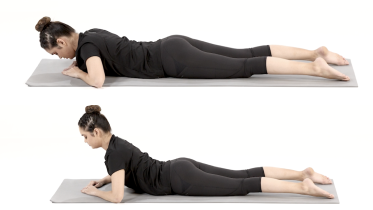 Back extension on elbows
Stop signs and precautions for the back extension on elbows
Before you start
- After recent back surgery, follow your surgeon's plan. If you have had heart or chest surgery in the last few months, check with your surgeon or surgical team before lying face down and pushing up through your arms, as both put pressure on the healing breastbone, and only the team that wired it can say when it will take that. If the breastbone clicks, grinds, shifts or feels as if it is moving while you do it, stop, and contact your surgical team the same day.
- If you have had a fracture in your spine, check with your physio before you begin.
- If you have been told you have narrowing of the spinal canal (spinal stenosis) or a forward-slipped vertebra (spondylolisthesis), ask your physio before you start, because bending backward often aggravates both.
- Lying face down is one to clear with your physio if you are pregnant.
- If you have high blood pressure, breathe steadily through every hold and never hold your breath.
When to stop and get help
- Pain spreads into your buttock or down a leg, or you get numbness or tingling in a leg.
- A sharp or pinching pain in your lower back that does not ease once you lie flat again.
- Neck pain during the lift, or pain, numbness or tingling spreading into an arm.
- Numbness around your genitals or bottom, new trouble with your bladder or bowels, pain, tingling, numbness or weakness in both legs, or loss of feeling in one leg. Call emergency services or go to an emergency department straight away, and do not drive yourself.
- Your leg or foot gets weaker, for example your foot drags, catches on the ground or slaps down when you walk (foot drop). Get medical advice the same day. If the weakness is getting worse by the hour, go to an emergency department.
- Pins and needles in your arm or hand that do not go away after you stop, or part of your arm or hand goes numb. Get medical advice the same day. If one side of your face or body suddenly goes numb or weak, or your speech becomes slurred or muddled, call emergency services, even if it goes away.
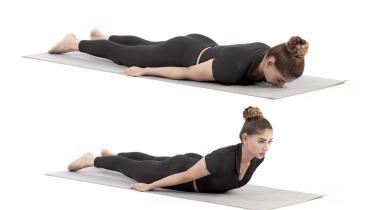 Prone back extension
Stop signs and precautions for the prone back extension
Before you start
- If you have had surgery on your spine in recent months, get the go-ahead from your surgical team or physio first.
- After recent heart or chest surgery, get your surgeon's or surgical team's okay first, because lifting your head and chest off the mat loads the healing breastbone and the front of the chest. If the breastbone clicks, grinds, shifts or feels as if it is moving while you do it, stop, and contact your surgical team the same day.
- If you have been told you have narrowing of the spinal canal (spinal stenosis) or a forward-slipped vertebra (spondylolisthesis), ask your physio before you start, because bending backward often aggravates both.
- If you have had a fracture in your spine, check with your physio before you begin.
- If you are pregnant, check with your physio before you start.
When to stop and get help
- Pain moves into your buttock or down a leg, or you notice numbness or tingling.
- You feel a sharp or pinching pain in your lower back as you lift.
- Your neck starts to hurt during the lift.
- Numbness around your genitals or bottom, new trouble with your bladder or bowels, pain, tingling, numbness or weakness in both legs, or loss of feeling in one leg. Call emergency services or go to an emergency department straight away, and do not drive yourself.
- Your leg or foot gets weaker, for example your foot drags, catches on the ground or slaps down when you walk (foot drop). Get medical advice the same day. If the weakness is getting worse by the hour, go to an emergency department.
What to do instead
Almost nothing here is taken away for good. Where to go instead is the useful half.
For what to do rather than what to drop, the best exercises for osteoporosis sorts the three kinds and says what each is for. For the daily movements, osteoporosis posture and spine protection has the bending, lifting and reaching instructions. If your question is about age rather than bone, exercises seniors should avoid answers that one, and the answer is similarly short.
One practical note on classes, because it is where this comes up most. Tell the instructor before the class rather than halfway through it, ask what they will give you instead of the long forward curls and the deep twists, and ask them not to press or pull you further into a stretch than you can reach on your own. An instructor with no alternative to offer is the wrong instructor for you, not a reason to stop going to classes.
Related exercise programs
Warning signs
Get emergency help now
- Emergency: if chest pain, pressure or tightness does not ease quickly when you rest, spreads to your arm, neck, jaw, stomach or back, or comes with sweating, feeling sick, feeling light-headed or being short of breath, call emergency services straight away, as this can be a heart attack. If it eases quickly and none of these happen, get medical advice the same day, and do not exercise again until you have been checked.
- Emergency: any sign of a stroke, even if it goes away. That means a face that droops on one side, an arm you cannot lift or keep up, slurred or muddled speech, weakness or numbness on one side of your body or face, sudden blurred vision, double vision or loss of sight, trouble swallowing, sudden dizziness with unsteadiness or falling over, a sudden severe headache, or a sudden fall where your legs give way but you do not black out (a drop attack). Call emergency services straight away.
- Emergency: a racing, pounding, fluttering or irregular heartbeat that does not settle when you rest, or that comes with dizziness, feeling faint or fainting, chest pain or shortness of breath. Call emergency services straight away. If it has already stopped, get medical advice the same day.
- Emergency: you have just fallen and cannot get up, or you think you may have hurt your head, neck, back or hip. Stay where you are, keep warm and call emergency services, or get someone to call for you. Nobody should try to lift you off the floor, and nobody should pull you up by the arms: being hauled upright can move a broken bone that has not slipped yet and can make an injured neck or back worse. Someone helping should call for help, keep you warm and stay with you. If you got up and walked without trouble and only notice pain later, without any of the emergency signs in this list, use the same-day lines in it instead.
- Emergency: you fell and cannot remember the fall or how it happened. Go to an emergency department straight away, and do not drive yourself. You may have blacked out or hit your head without knowing it.
- Emergency: you have had a fall or an injury and now have severe hip pain, or you cannot walk or put weight on the leg. Call emergency services or go to an emergency department. This can be a sign of a broken hip (hip fracture).
- Emergency: numbness, tingling or altered feeling around or under your genitals, between your inner thighs, or around your bottom (anus), for example it feels different when you wipe after using the toilet. Call emergency services or go to an emergency department straight away, and do not drive yourself. This can be a sign of pressure on the bundle of nerves at the base of the spine (cauda equina syndrome), which needs emergency treatment.
- Emergency: you find it hard to start peeing, cannot pee, cannot feel yourself peeing or cannot control when you pee, or you do not notice when you need to poo or cannot control when you poo, and this is not normal for you. The same applies to a new change in how your genitals feel during sex, new trouble getting or keeping an erection, new trouble ejaculating, or new trouble reaching orgasm. Call emergency services or go to an emergency department straight away, and do not drive yourself. These can also be signs of cauda equina syndrome.
- Emergency: sciatica in both legs, or pain, tingling, numbness or weakness in both legs. The same applies if you lose feeling in one leg. Call emergency services or go to an emergency department straight away, and do not drive yourself.
- Emergency: new problems walking, for example your legs feel stiff, heavy or weak or you have become unsteady on your feet, new trouble controlling your bladder or bowels, or new numbness or pins and needles in a band around your chest or tummy, or below it. Call emergency services or go to an emergency department straight away. These can be signs of pressure on the spinal cord in the upper back.
- Emergency: back or leg pain that started after a serious accident, such as a car crash or a fall from a height, or back pain with chest pain. Call emergency services. If the pain started straight after the accident, keep still while you wait.
- Emergency: sudden, severe pain in your lower back or tummy that is not like your usual back pain, if you have been told you have a swelling of the main blood vessel in your tummy (abdominal aortic aneurysm), you are over 60, you smoke or used to smoke, or you have high blood pressure. The same applies if sudden, severe back or tummy pain comes with feeling faint or passing out, pale, sweaty or clammy skin (on brown or black skin this can be easier to see on the palms of the hands or soles of the feet), a racing heartbeat or being short of breath. Call emergency services straight away. This can be a sign of an aneurysm bursting, which needs treatment in hospital at once.
- Emergency: new neck or back pain after a fall, a knock or a jolt, even a minor one such as a trip or a sudden stop in a car, if you have a condition that stiffens the spine, such as ankylosing spondylitis. Call emergency services or go to an emergency department straight away, do not drive yourself, and tell the staff about your spine condition, so they keep your neck and back in their usual position. A stiff spine can break after a small injury, and the break is easy to miss at first. If the pain started straight after the injury, or you also have numbness, tingling or weakness in your arms or legs, keep still and call emergency services.
- Emergency: back pain with a fever, or you feel hot, shivery or very unwell, and you also have new weakness, numbness or tingling in one or both legs, or new trouble with your bladder or bowels. Call emergency services or go to an emergency department straight away, and do not drive yourself. This can be an infection pressing on the nerves in the spine (spinal epidural abscess), which needs emergency treatment.
- Emergency: you have had cancer, now or in the past, and your back or neck pain feels like a tight band around your body, or you have new or worsening pain spreading down an arm or leg, weakness, numbness, pins and needles or a loss of feeling in your arms or legs, trouble walking, or trouble controlling your bladder or bowels. Those symptoms count on their own, with or without back or neck pain. Call your cancer team's emergency number straight away, or go to an emergency department if you do not have one or cannot get through, and do not drive yourself. This can be cancer pressing on the spinal cord (metastatic spinal cord compression), which needs treatment straight away.
Get help today
- Same day: back pain after a minor fall or strain if you are older, have low bone density (osteoporosis) or have taken steroid tablets for a long time. Get medical advice the same day. Until it has been checked, stop the exercises and keep away from lifting, bending forward and twisting, because those load a bone in the spine that may be broken.
- Back pain that comes on suddenly after lifting, bending, a cough or a sneeze, even without a fall, if you have low bone density (osteoporosis). Get medical advice the same day. This can be a sign of a broken bone in the spine (vertebral fracture). Stop the exercises until you have been checked, and keep away from lifting, bending forward and twisting in the meantime, because those load a broken vertebra whether you are exercising or not.
- Severe pain that comes on suddenly or is getting worse quickly. Get medical advice the same day.
- Back or leg pain with a fever, or you feel hot, cold, shivery or generally unwell. Get medical advice the same day, and go to an emergency department if you feel very unwell. If you have a very high or very low temperature, shivering you cannot control, you are breathing very fast or finding it hard to breathe, you are confused or your speech is slurred, your skin, lips or tongue look blue, gray, pale or blotchy (on brown or black skin this can be easier to see on the palms of the hands or soles of the feet), or you have a rash that does not fade when you press it, call emergency services, as this can be sepsis.
- Same day: new hip or groin pain after a fall, even a small one, if you are older, have low bone density (osteoporosis) or have taken steroid tablets for a long time, even if you can still walk. Get medical advice the same day, and say that you fell and that your bones are thin. Until it has been checked, stop the exercises and keep as much weight off that leg as you can, using your stick, frame or crutches if you have them and asking someone for help to move about, because a crack in the hip that has not slipped yet can slip when you walk on it, and a hip that has slipped usually needs a bigger operation than one that has not. A broken hip is not always obvious at first, and a first X-ray does not always show it, so if you have been checked and sent home and you still cannot walk on that leg, or the pain is getting worse, go back and say so.
- A leg or foot that is getting weaker, for example your foot drags, catches on the ground or slaps down when you walk (foot drop). Get medical advice the same day. If the weakness is getting worse by the hour, go to an emergency department.
- Same day: a calf or thigh that is newly swollen or getting more swollen, warm, tender, red or darker than usual, has swollen veins that are sore to touch, or has a throbbing or cramping pain that does not fit your injury or condition, or that feels different from normal muscle soreness after exercise. This can be a sign of a blood clot (deep vein thrombosis), especially after surgery, an injury, time in a cast or boot, a long trip or a spell of being much less mobile than usual. Get medical advice the same day. If you are also short of breath or have chest pain, call emergency services.
- You have back pain and have lost weight without trying. Get medical advice the same day and mention the weight loss.
- New back pain and you have had cancer, now or in the past. Get medical advice the same day and mention your cancer history. If you are being treated for cancer now, contact your cancer team the same day.
- Same day: you blacked out or fainted, even for a moment. Get medical advice the same day. Call emergency services instead if the person is not breathing, cannot be woken within 1 minute, has not fully recovered or has trouble speaking or moving, has chest pain or a pounding, fluttering or irregular heartbeat, fainted while exercising or lying down, is shaking or jerking, or was badly hurt.
- Same day: dizziness, lightheadedness, blurred vision or feeling faint when you stand up that is new for you, does not pass within a minute or two, keeps happening, or has made you fall. Sit or lie down, and get medical advice the same day. This can be a drop in blood pressure on standing (postural hypotension), a type of low blood pressure, which the NHS lists among the causes of falls, and your doctor can check it. Tell them about your medicines, because some can cause it. If it does not settle within a few minutes of sitting or lying still, call emergency services. If you faint, use the fainting line above.
- Same day: dizziness or feeling faint during or after exercise, other than the brief lightheadedness as you stand up covered in the line above, without any of the emergency signs above. Stop the exercises and get medical advice the same day. If you faint, it does not settle within a few minutes of sitting still, or you cannot stand or walk steadily, call emergency services.
- Same day: pain that is worse at night, or does not ease at all when you rest. If you have had cancer, now or in the past, or you have lost weight without trying, get medical advice the same day.
Book an appointment
- Within a few days: pain that is worse at night, or does not ease at all when you rest. See your doctor within a few days.
- Routine: back pain after a fracture in your spine that is no better as the weeks go by, or that is getting worse rather than easing. Book an appointment with your doctor, and say when the fracture happened. Most spinal fractures settle as the bone heals over 6 to 12 weeks, so pain that does not follow that pattern needs checking before you load the spine again. If the pain is severe or is getting worse quickly, get medical advice the same day.
- Routine: you have lost height, or your upper back has become more rounded and you are starting to stoop, or you have back pain, or pain that wraps around to your ribs, with no clear cause. Book an appointment with your doctor. A broken bone in the spine can cause this, and it does not always cause the pain you would expect. If the pain came on suddenly, get medical advice the same day.
Common questions
Can you do sit-ups with osteoporosis?
The Royal Osteoporosis Society names sit-ups among the exercises to adapt, along with touching your toes and the Pilates roll-down and curl-up, because of the pressure they put through the front of the spine. That is the advice from every body we read and it is the advice we follow, and the osteoporosis program leaves them out for that reason. Worth knowing where it came from: the systematic review of adverse events that the UK consensus relies on for safety found that activities involving spinal flexion, certain yoga moves and sit-ups among them, were associated with a greater risk of vertebral fracture, and that these events were rare (Kunutsor 2018). Rare is the word to hold on to. Nobody is telling you a single sit-up breaks a spine, and you are not short of better exercises anyway: the sit-ups page explains the movement and what it trains, and it carries the same instruction this one does, which is to skip sit-ups unless your physio has cleared them.
What yoga poses should you avoid with osteoporosis?
The long forward folds and the deep twists, rather than yoga itself. The published basis for this is a case series of three people, all of whom had osteopenia rather than osteoporosis, who developed pain or a vertebral compression fracture after taking up flexion yoga positions, and whose author concluded that the finding leads to concern about fracture risk in osteoporosis (Sinaki 2013). Three people is three people, and the author stated it as a concern rather than a finding. What that supports in practice is adapting the poses and telling the teacher before the class, which is also the UK consensus position. Ask the teacher not to press or pull you further into a stretch or a twist than you can reach on your own.
Is there a weight limit for lifting with osteoporosis?
No, and the number you have probably been given is one the guidance explicitly tells clinicians to stop handing out. The Too Fit To Fracture expert panel recommends teaching spine-sparing technique during daily life and leisure rather than giving generic restrictions, and the example of a generic restriction it names is lifting less than 10 lb (4.5 kg) with no twisting (Giangregorio 2015). That recommendation has a second half which usually gets dropped: for people with a vertebral fracture, especially where there is pain, more than one fracture or a marked rounding of the upper back, the same panel says the risks of many activities may outweigh the benefits, and recommends a physical therapist consultation. If that is you, your own clinician sets your limits rather than this page. The Royal Osteoporosis Society says there is not a specific weight that is safe or unsafe, and that it is how you lift rather than how much you lift that matters. Strength training for osteoporosis covers the dose that is actually published, which is a proportion of your own strength rather than a number of pounds.
Is bending forward really dangerous with osteoporosis?
The three national bone bodies in our markets answer that question three different ways, which is itself the most useful thing anyone can tell you. The Royal Osteoporosis Society in the UK says bending forward and curving your back is normal movement, both in everyday life and when you are keeping active, and then says that if you have osteoporosis, some exercises may need adapting to care for your back, which reduces the chance of spinal fractures. The Bone Health and Osteoporosis Foundation in the US says people with bone loss in the spine should not bend forward from the waist. Osteoporosis Canada applies its limits to people at high risk of fracture rather than to everyone with a diagnosis. All three are respectable organizations reading much the same evidence, and the difference is in how cautious each has chosen to be, not in a new study one of them has seen. The Canadian framing tells you which one to use: if you are at high risk of fracture, which usually means a previous fracture from a minor injury, several broken bones, or a very low bone density reading, the strict version is the one written for you. Ask your own doctor or physio which group you are in before you decide this from a page, and until you have that answer, use the strict version. Not knowing which group you are in is not the same as being in the safer one.
Should I stop twisting with osteoporosis?
Not as a rule. The UK consensus position is that rotation should be safe if it is performed smoothly and comfortably, and the movement it singles out is any exercise that makes the back curve a long way, especially with a load added (Brooke-Wavell 2022). The bending-and-twisting-together version comes from Osteoporosis Canada, which lists twisting all the way to the side, holding a bent or twisted position for a long spell, and bending or twisting while holding something heavy among the things people at high risk of fracture may need to limit. Reaching into the back seat of a car with a bag in your hand is the sort of movement worth changing. Turning to see who came into the room is not.
References
- Brooke-Wavell K, Skelton DA, Barker KL, et al. Strong, steady and straight: UK consensus statement on physical activity and exercise for osteoporosis. British Journal of Sports Medicine. 2022;56(15):837-846. https://doi.org/10.1136/bjsports-2021-104634
- Kunutsor SK, Leyland S, Skelton DA, et al. Adverse events and safety issues associated with physical activity and exercise for adults with osteoporosis and osteopenia: a systematic review of observational studies and an updated review of interventional studies. Journal of Frailty, Sarcopenia and Falls. 2018;3(4):155-178. https://doi.org/10.22540/JFSF-03-155
- Sinaki M, Mikkelsen BA. Postmenopausal spinal osteoporosis: flexion versus extension exercises. Archives of Physical Medicine and Rehabilitation. 1984;65(10):593-596. https://pubmed.ncbi.nlm.nih.gov/6487063/
- Sinaki M. Yoga spinal flexion positions and vertebral compression fracture in osteopenia or osteoporosis of spine: case series. Pain Practice. 2013;13(1):68-75. https://doi.org/10.1111/j.1533-2500.2012.00545.x
- Giangregorio LM, McGill S, Wark JD, et al. Too Fit To Fracture: outcomes of a Delphi consensus process on physical activity and exercise recommendations for adults with osteoporosis with or without vertebral fractures. Osteoporosis International. 2015;26(3):891-910. https://doi.org/10.1007/s00198-014-2881-4
- Giangregorio LM, Papaioannou A, MacIntyre NJ, et al. Too Fit To Fracture: exercise recommendations for individuals with osteoporosis or osteoporotic vertebral fracture. Osteoporosis International. 2014;25(3):821-835. https://doi.org/10.1007/s00198-013-2523-2
- Beck BR, Daly RM, Singh MA, Taaffe DR. Exercise and Sports Science Australia (ESSA) position statement on exercise prescription for the prevention and management of osteoporosis. Journal of Science and Medicine in Sport. 2017;20(5):438-445. https://doi.org/10.1016/j.jsams.2016.10.001
- Gibbs JC, MacIntyre NJ, Ponzano M, et al. Exercise for improving outcomes after osteoporotic vertebral fracture. Cochrane Database of Systematic Reviews. 2019;7(7):CD008618. https://doi.org/10.1002/14651858.CD008618.pub3
- Gregson CL, Armstrong DJ, Avgerinou C, et al. The 2024 UK clinical guideline for the prevention and treatment of osteoporosis. Archives of Osteoporosis. 2025;20(1):119. https://doi.org/10.1007/s11657-025-01588-3
- Bruno AG, Anderson DE, D'Agostino J, Bouxsein ML. The effect of thoracic kyphosis and sagittal plane alignment on vertebral compressive loading. Journal of Bone and Mineral Research. 2012;27(10):2144-2151. https://doi.org/10.1002/jbmr.1658
- Royal Osteoporosis Society. How to exercise safely for bones. https://theros.org.uk/information-and-support/exercise/how-to-exercise-safely-for-bones/
- Royal Osteoporosis Society. Impact exercise to help make your bones stronger. https://theros.org.uk/information-and-support/exercise/exercise-for-bones/impact-exercise-to-help-make-your-bones-stronger/
- Royal Osteoporosis Society. Spinal fractures (vertebral fractures). https://theros.org.uk/information-and-support/living-with-osteoporosis-and-broken-bones/spinal-fractures-vertebral-fractures/
- Bone Health and Osteoporosis Foundation. Protecting your spine. https://www.bonehealthandosteoporosis.org/patients/treatment/exercisesafe-movement/protecting-your-spine/
- Bone Health and Osteoporosis Foundation. Exercise and safe movement. https://www.bonehealthandosteoporosis.org/patients/treatment/exercisesafe-movement/
- Osteoporosis Canada. Too Fit To Fracture. https://osteoporosis.ca/too-fit-to-fracture/
- NHS. Osteoporosis. https://www.nhs.uk/conditions/osteoporosis/
- NHS. Back pain. https://www.nhs.uk/conditions/back-pain/
- NHS. Symptoms of a stroke. https://www.nhs.uk/conditions/stroke/symptoms/
- NHS. Heart attack. https://www.nhs.uk/conditions/heart-attack/
- NHS. Fainting. https://www.nhs.uk/symptoms/fainting/
- NHS. Low blood pressure (hypotension). Page last reviewed 11 July 2023. https://www.nhs.uk/conditions/low-blood-pressure-hypotension/
- NHS. Deep vein thrombosis (DVT). Page last reviewed 30 April 2026. https://www.nhs.uk/conditions/deep-vein-thrombosis-dvt/
- NHS. Sepsis. Page last reviewed 14 May 2026. https://www.nhs.uk/conditions/sepsis/
- NHS. Falls. https://www.nhs.uk/conditions/falls/
- NHS. Abdominal aortic aneurysm. https://www.nhs.uk/conditions/abdominal-aortic-aneurysm/
- Darouiche RO. Spinal epidural abscess. New England Journal of Medicine. 2006;355(19):2012-2020. https://doi.org/10.1056/NEJMra055111
- Cancer Research UK. Spinal cord compression. https://www.cancerresearchuk.org/about-cancer/coping/physically/spinal-cord-compression
Written and checked by the PocketPhysio editorial team. Last updated 2026-11-06.
This page is general education, not a diagnosis or a personal treatment plan. See a physiotherapist or doctor for advice about your own situation.