
Part of Osteoporosis
Preventing falls at home with osteoporosis, room by room
Warning signs, and when to get help
Does changing your home actually reduce falls?
Most pages on this subject hand you a list and never answer the question. It has a good answer, with a condition attached.
The Cochrane review of environmental interventions pooled 22 studies in 8,463 older people living at home, average age 78, across 10 countries. Work on home fall hazards reduced the overall rate of falls by 26 percent, from 12 of those studies and 5,293 people, on moderate-certainty evidence. Then it split the trials by who had been recruited, and the split is the finding (Clemson 2023).
In people who had been selected for being at higher risk of falling, the reduction was 38 percent, from 9 studies and 1,513 people, and the evidence was rated high certainty. In people not selected for fall risk, there was no reduction at all, from 6 studies and 3,780 people, and that too was rated high certainty. The review names the sort of thing that puts somebody in the first group: having had a fall in the past year, having been in hospital recently, or needing support with daily activities.
So the advice works, for some people, and those people can be picked out in advance. A reader with osteoporosis who has fallen in the last year, or who has already broken a bone in a minor tumble, is squarely in the group where the evidence is strongest. A fit 60 year old who has never been near the floor is in the group where it showed nothing, and there is no point in pretending otherwise.
One limit belongs here too, because it concerns the outcome you care about most. The same review found that home hazard work may make little or no difference to fall-related fractures, on low-certainty evidence from only two studies. Fewer falls is what has been measured well. Fewer broken bones has not.
Why this reader, in particular
Osteoporosis does not make you trip. It changes what a trip costs.
The NHS points out that you can have osteoporosis without any symptoms, and that the first symptom is often a bone breaking after a minor fall or injury. The Royal Osteoporosis Society names the wrist, the hip and the bones of the spine as the common places for that break. So the condition is not a balance problem. It is a consequence multiplier, and the things it often travels with, being older, taking medicines that cause dizziness, having lost muscle over a few quiet years, are balance problems.
If you have already broken a bone in a fall that should not have broken anything, that is not just history. It is the clearest signal there is that another break may follow, and the risk is at its highest soon after the first one. In the Reykjavik study of 18,872 people, among those who went on to break a second bone after a first fracture of the hip, spine, wrist or upper arm, between 31 and 45 percent did so within a year of it, and the raised risk was highest immediately afterwards and fell away over the ten years that followed (Kanis 2018). The authors' argument from that is that bone treatment started promptly after a fracture prevents more of the next ones than the same treatment started later. So if nobody has reviewed your bone health since that break, ask. Clearing the hallway is worth doing and it is not a substitute for that conversation.
That is why this page is organized around the house rather than around your legs. The legs matter more, and they have their own evidence and their own page. But the house is the part you can change this afternoon, and for somebody already at higher risk it has high-certainty evidence behind it, which is more than most self-help advice can claim.
A note on language, taken from the UK consensus statement, because it explains why this page is not called fall prevention for the frail elderly. The consensus observes that most people do not see themselves as fallers or as frail, and recommends talking about maintaining independence instead (Brooke-Wavell 2022). Nobody changes their hallway because a leaflet called them frail.
The hallway, the stairs and the floor
Start where you walk most and look at it with a stranger's eyes. The NHS advice is not to have too much clutter at home, or anything you could trip on such as loose wires or rugs. Lighting belongs in the same job: a route you can see is a route you can walk.
Rugs are the one people argue about. A rug with a curled corner in a doorway is the single commonest thing we move at a home visit, and a rug on top of carpet is worse than one on a hard floor because it slides. Age UK suggests moving rugs and mats away from the top and the bottom of the stairs, which is where a slip turns into a long fall rather than a short one.
On the stairs themselves, three things earn their keep: a handrail you can actually reach the whole way up, a light switch at both ends, and nothing stored on the steps. Trailing wires belong behind furniture or taped down, and the extension lead across a doorway is worth the twenty minutes it takes to reroute.
Carrying is the hidden hazard and no checklist mentions it. If both hands are full you have no hand for the rail and no hand to catch yourself. Make two trips, or use a bag over your shoulder, or a trolley. This is also the one that matters most with fragile bones, because the bend and twist of hauling a basket is its own separate risk, which osteoporosis posture and spine protection covers.
The bathroom
Wet, hard and small, which is the worst combination in the house. The NHS advice here is non-slip mats and grab rails where you need them.
A grab rail is not a towel rail and a towel rail is not a grab rail. One is bolted into a stud or a masonry wall and will take your whole body weight; the other will come off in your hand along with a section of plaster. If you are not sure which yours is, do not test it by leaning on it. The same goes for the basin and the toilet roll holder, which are what people grab in practice.
Getting out of the bath is where more falls happen than getting in. If the bath is the problem rather than the balance, a shower over it with a non-slip mat, a bath board or a seat changes the task rather than asking you to get better at it. An occupational therapist is the right person to pick which one, and the NICE falls guideline suggests an occupational therapist does the home check where possible.
Night-time is covered below, because the trip to the toilet in the dark deserves its own paragraph.
The kitchen
The high shelf is the headline. Reaching overhead on tiptoe, or standing on a chair, is how people fall in kitchens, and for somebody with fragile bones there is a second reason to stop doing it: the US bone health foundation lists reaching for objects on a high shelf among the movements people with bone loss in the spine should not do.
So move the things you use daily to between hip and shoulder height, and accept help for the top cupboard. That is a specific, useful job to give a visiting family member, rather than letting them carry everything for you, which does your skeleton no favors at all.
Spills get wiped straight away, not after the kettle. A wet kitchen floor in socks is the fastest fall in the house. Keep a flashlight where you can reach it, and if a bulb goes in the kitchen, treat it as urgent rather than as something for the weekend.
The bedroom and the trip to the toilet at night
The walk to the toilet in the dark is the one most worth preparing for, and the preparation is tiny. Age UK suggests a night light near the bed for trips to the toilet. A light already on beats a lamp you have to find in the dark, and a clear route beats a tidy one, so the laundry basket does not live between the bed and the door.
Getting out of bed has its own method with fragile bones, and it is the same one the osteoporosis program teaches: roll onto your side first and push up with your arms, rather than curling straight up from flat on your back. Then sit on the edge for a few seconds before you stand, which is also the answer to the brief wooze that catches people when they get up too fast.
Keep your phone within reach of the bed and within reach of the floor. A personal alarm worn as a pendant or wristband does the same job better, and the NHS lists one among its falls advice. The reason is not drama: time on the floor is itself a problem, and the warning signs on this page treat an hour or more on the floor as a same-day matter even if you got up in the end.
What a fall means when a bone is fragile
Read this part before you need it.
If you fall and cannot get up, or you think you may have hurt your head, neck, back or hip, stay where you are, keep warm and call emergency services, or get someone to call for you. Do not let anybody haul you to your feet first. The same applies if you cannot remember the fall, because that means you may have blacked out or hit your head without knowing.
Two injuries deserve naming because they are easy to miss. A broken hip is not always obvious: new hip or groin pain after even a small fall, in someone older or with low bone density, is a same-day matter even if you can still walk on it, and until it has been checked, keep as much weight off that leg as you can, because a crack that has not slipped yet can slip when you walk on it. A first X-ray does not always show one either, so if you were checked, sent home and still cannot walk on that leg, go back and say so. And a broken bone in the spine can follow a minor fall or strain with nothing dramatic about it, which is why new back pain after a knock, in someone with osteoporosis, is also same day, with lifting, bending forward and twisting left alone until it has been checked.
One more thing if you have had hip surgery. In the first months after a hip replacement, or after a broken hip has been fixed with screws, a nail or a plate, your own surgical team's instructions come first: how much weight you may put through that leg, which movements you have been told to keep away from, and when each of those changes. Those instructions differ between operations and between surgeons, because what is safe depends on how the hip was opened and what was done inside it, so follow the list you were given rather than a general one. Nothing on this page replaces your post-operative appointments. A fall onto a new hip, or onto metalwork left in the bone, also means something different from a fall onto your own bone, which is what the two hip replacement lines in the warning signs are for, and the full set of signs after a hip replacement, infection and loosening included, is on our hip replacement warning signs page.
Head injuries have their own set of rules and they are stricter than most people expect, particularly if you take a blood thinner. If you have hit your head and you take a blood thinner other than aspirin on its own, go to an emergency department even if you feel completely well, and do not drive yourself. Every one of those routes is in the warning signs at the end of this page, in full, and they are worth reading now rather than at the time. The Australian health service's falls page opens with an emergency instruction for a severe fall, which is the right order of priority.
One part of the head injury advice is easy to miss because it is not a warning sign, it is a plan for the night. The NHS asks that an adult stays with you for at least the first 24 hours after a minor head injury, and that you do not drive until you have fully recovered. The reason matters more than the rule: the signs that something is wrong after a knock to the head are drowsiness, confusion, muddled speech and a change in behavior, and those are the ones you cannot judge in yourself. Somebody else notices them. So if you live alone and you have hit your head, phone somebody and arrange it before you settle down, and if nobody can come, say so when you ring for advice, because being on your own overnight changes what you will be told to do. Do not simply go to bed and see how you feel.
What to do in the minutes after a fall you can get up from, including how to get yourself off the floor safely, is set out on our balance and falls prevention page and in how to get up from a fall, and we have not rewritten it here. Getting up off the floor is also a thing you can train in advance, with somebody beside you, and the exercise below is how it is practiced.
One check before you practice it, because the practice bends and loads your back. If you have lost height, your upper back has become more rounded, or you have back pain or pain that wraps around to your ribs with no clear cause, see your doctor before you start. A broken bone in the spine can cause any of them, and it does not always announce itself. The same goes if you have already had a fracture in your spine: get your own physio to decide whether this one is for you yet, and to show you a route down and up, rather than working it out on the floor on your own.
Exercises that can help
One exercise rather than a program, because the balance and leg strength work itself lives on our balance and falls program page. Getting up from the floor is usually practiced 1 to 3 times in a session, on 1 or 2 days a week, with a rest between each go, and early on you might practice only part of it, such as kneeling down and getting back up. Practice it with a physio the first time, and after that only with somebody else at home. It puts your weight through your arms as well as your legs and it bends and loads the back, so it carries its own check-first lines after a hip or knee replacement, a broken hip, spine surgery in recent months, or recent heart or chest surgery. Open the line under the exercise and read them before you try it. Because you push up through your hands and arms, ask your surgeon or physio first if you have had an operation on a shoulder, arm or wrist. Where this paragraph and the exercise page differ, the exercise page wins. Your physio will adjust this.
The exercises below carry their own stop signs and precautions. Open the line under an exercise and read them before you try it.
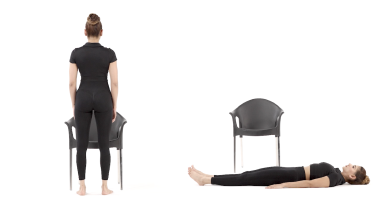 Getting up from the floor
Stop signs and precautions for the getting up from the floor
Before you start
- If you have just fallen and cannot get up, this page is not where to start. Stay where you are, keep warm and call emergency services, or get someone to call for you. Nobody should try to lift you off the floor. The practice on this page is for another day.
- Practice with a family member, friend or caregiver in the room, on a day when you feel well, and keep a phone or a personal alarm on you, because the one time you need this skill you may be alone. If you have fallen in the past year or feel unsteady, ask your physio to go through it with you the first time.
- If you have had surgery on your spine in recent months, get the go-ahead from your surgical team or physio first. Getting down to the floor, kneeling and pushing back up bend and load the back, and after some spine operations your team will not want you down there yet.
- After recent heart or chest surgery, get your surgeon's or surgical team's okay first, because getting down to the floor and back up takes your weight through your hands and arms, including time on your hands and knees. If the breastbone clicks, grinds, shifts or feels as if it is moving while you do it, stop, and contact your surgical team the same day.
- If you have had surgery on a shoulder, elbow, wrist or hand in recent months, or are still healing from a broken wrist, arm or collarbone, get the go-ahead from your surgeon or physio before you try getting up from the floor. Getting down and back up takes your weight through your hands, wrists, elbows and shoulders, including time on your hands and knees and a push up from one forearm, and some operations and fractures limit that for the first months. Your physio can teach you a route up that keeps the weight off the healing side.
- If you have had a hip replacement, get the go-ahead from your surgeon or physio before you try getting up from the floor. Kneeling down and pushing up from half kneeling bend the hip well past a right angle, and many surgeons ask you to avoid that for the first months after some operations. Your physio can teach you a way to get up that fits your surgery. After a knee replacement, do not kneel on the new knee until your doctor says you can, which is what the NHS advises after that operation, and ask your surgeon or physio for a route up that does not need kneeling in the meantime. Once you have been cleared to kneel, pad the floor well.
- If you have had a broken hip fixed with screws, a nail or a plate, or had part or all of the hip replaced, get the go-ahead from your surgeon or physio before you try getting up from the floor. Some operations limit this kind of work for the first months, so the timing depends on your surgery.
When to stop and get help
- Sharp pain in your hip, knee or back, or pain that stays after you rest.
- You feel dizzy, lightheaded or faint as you get up. Stay down or sit on the chair and wait for it to pass. If it does not pass within a minute or two, or it keeps happening, get medical advice the same day before you practice again. If you faint, or it does not settle within a few minutes of keeping still, call emergency services. Even if it passes quickly, tell your physio before you practice again.
- Chest pain or pressure, dizziness or feeling faint, a racing or irregular heartbeat, or being far more out of breath than the effort should cause.
- You cannot get back up, even with the chair, or you think you may have hurt your head, neck, back or hip. Stay where you are, keep warm and call emergency services, or get someone to call for you. If you got up and walked without trouble and only notice pain later, without any of the emergency signs above, use the same-day lines in this list instead. Nobody should try to lift you.
- After a fall, you are in pain, have hurt yourself or feel unwell, or you were on the floor for an hour or more, without any of the emergency signs above. Get medical advice the same day, even if you managed to get up.
- You have had a hip replacement, or a broken hip fixed with screws, a nail or a plate, and after a fall or a knock, even a small one, your hip, groin or thigh is newly painful, bruised or swollen, even if you can still walk and your leg looks normal. Stop the exercises and keep your full weight off that leg, using your stick, frame or crutches if you have them and asking someone for help to move about, then contact your surgical team or get medical advice the same day. A break in the bone around a new hip, or around metalwork left in the bone, is not always obvious at first, and walking normally on one can move the broken ends apart.
- A calf or thigh that is newly swollen or getting more swollen, warm, tender, red or darker than usual, has swollen veins that are sore to touch, or has a throbbing or cramping pain that does not fit your injury or condition, or that feels different from normal muscle soreness after exercise. This can be a sign of a blood clot (deep vein thrombosis), especially after surgery, an injury, time in a cast or boot, a long trip or a spell of being much less mobile than usual. Get medical advice the same day. If you are also short of breath or have chest pain, call emergency services.
What about eyesight?
The trial answer and the checklist answer point in different directions here, and saying so is better than quietly picking one.
Every falls checklist, including the NHS one, recommends regular eye tests. The Cochrane review found that vision improvement interventions may make little or no difference to the rate of falls, or to the number of people falling, both on low-certainty evidence from a small number of studies, and measured falls occurring while people switched between glasses as an adverse event, where it also found little or no difference, on low-certainty evidence from a single study (Clemson 2023).
Read that carefully, because it is not what it first looks like. It is a finding about trials that set out to improve vision in order to prevent falls. It is not a reason to skip an eye test, leave a cataract undiagnosed or ignore a change in your sight. What it does suggest is that the weeks after a new prescription deserve extra care on the stairs, which is a question the review itself raises. Your medicines, hearing and feet belong in the same conversation, and the balance and falls prevention page has that review in full.
The half of this with the stronger evidence
The house is the half you can fix today. Your legs are the half with the better numbers.
A Cochrane review of 108 trials in 23,407 older people living at home found that exercise reduced the rate of falls by about 23 percent, from 59 of those trials and 12,981 people, and the number of people falling by about 15 percent, from 63 trials and 13,518 people, both at high certainty, and the clearest of those results came from programs built mainly on balance and functional exercise, where a 24 percent cut in the rate of falls was rated high certainty (Sherrington 2019). The Too Fit To Fracture Delphi panel recommends daily balance training for everyone with osteoporosis rather than only for people who already wobble (Giangregorio 2015). The World Falls Guidelines ask for three or more sessions a week, individualized, made harder as you improve, continuing for at least 12 weeks and longer for more effect (Montero-Odasso 2022).
So do both, and if you can only start one thing this month, start the legs. The staged program is on our balance and falls prevention page, the best exercises for osteoporosis explains where the balance work sits among the three kinds, and balance tests for seniors explains what a test result does and does not mean.
Two house rules for practicing at home, because they belong with any page about your own floor. Work beside a kitchen counter or a sturdy chair that cannot slide, on a clear floor, in flat shoes that fit and grip. And if you have fallen in the past year or feel unsteady, keep a hand on the support for the whole exercise and practice only when somebody else is at home. If you live alone, do the standing work at your physio appointments or in a class, and ask which of it you may do by yourself.
Related exercise programs
Warning signs
Get emergency help now
- Emergency: you have just fallen and cannot get up, or you think you may have hurt your head, neck, back or hip. Stay where you are, keep warm and call emergency services, or get someone to call for you. Nobody should try to lift you off the floor, and nobody should pull you up by the arms: being hauled upright can move a broken bone that has not slipped yet and can make an injured neck or back worse. Someone helping should call for help, keep you warm and stay with you. If you got up and walked without trouble and only notice pain later, without any of the emergency signs in this list, use the same-day lines in it instead.
- Emergency: you fell and cannot remember the fall or how it happened. Go to an emergency department straight away, and do not drive yourself. You may have blacked out or hit your head without knowing it.
- Emergency: you have had a fall or an injury and now have severe hip pain, or you cannot walk or put weight on the leg. Call emergency services or go to an emergency department. This can be a sign of a broken hip (hip fracture). Do not try to walk on that leg to test it, and do not eat or drink while you wait, because a broken hip is usually fixed with an operation and a recent meal delays it.
- Emergency: you have had a hip replacement and have sudden severe pain in your hip or groin, sometimes with a clunk or pop, and you cannot move the leg or put weight on it, or the leg suddenly looks shorter or turned in or out. Do not try to walk on it or push it back into place. Keep still and call emergency services or go to an emergency department, and do not drive yourself. Tell them you have a hip replacement, and do not eat or drink while you wait, because putting a hip back in its socket usually needs sedation or an anesthetic and a recent meal delays it. Your new hip may have come out of its socket (dislocated), and a medical team needs to put it back.
- Emergency: after a knock to the head, being very drowsy or finding it hard to keep your eyes open, confusion, a fit (seizure), new weakness or numbness anywhere in your body, new trouble understanding, speaking, walking or keeping your balance, new problems seeing or hearing, clear fluid coming from your ears or nose, bleeding from your ears or bruising behind them, a black eye when your eye was not hit, a dent in your head or a wound with something stuck in it, or a change in behavior. Call emergency services straight away. These can be signs of an injury to the brain.
- Emergency: a knock to the head in a high-energy accident, even if you feel completely well. That means a fall from a height of more than 1 meter (about 3 feet) or more than 5 stairs, a crash at high speed, a car that rolled over, being thrown from a vehicle, being hit by a vehicle while walking or cycling, a bike crash, an accident on a quad bike or similar motorized vehicle, a fall from a horse, a diving accident, or any other heavy, fast impact to the head. Call emergency services straight away, without waiting to see how you feel. A high-energy head injury is a reason for emergency assessment on its own, with no symptoms needed.
- Emergency: after a knock to the head, you were knocked out, even for a moment, you cannot remember what happened just before or after, you have had a headache ever since, or you are being sick (vomiting). The same applies, even if you feel fine, if you take medicine that thins your blood, other than aspirin on its own, have a bleeding or clotting condition, have had brain surgery in the past, or had been drinking alcohol or taking drugs when it happened. Go to an emergency department straight away, and do not drive yourself.
- Emergency: severe neck pain after a knock to the head, whatever the fall or the knock was like. Keep still and call emergency services, and do not let anyone move you until someone trained has checked your neck. If the neck pain only starts later and nobody has checked your neck since, go to an emergency department straight away, and do not drive yourself.
- Emergency: after a knock to the head, swelling, a deep cut or severe pain at the exact spot that was hit. Call emergency services or go to an emergency department straight away, and do not drive yourself. These can be signs of a broken skull.
- Emergency: any sign of a stroke, even if it goes away. That means a face that droops on one side, an arm you cannot lift or keep up, slurred or muddled speech, weakness or numbness on one side of your body or face, sudden blurred vision, double vision or loss of sight, trouble swallowing, sudden dizziness with unsteadiness or falling over, a sudden severe headache, or a sudden fall where your legs give way but you do not black out (a drop attack). Call emergency services straight away.
- Emergency: if chest pain, pressure or tightness does not ease quickly when you rest, spreads to your arm, neck, jaw, stomach or back, or comes with sweating, feeling sick, feeling light-headed or being short of breath, call emergency services straight away, as this can be a heart attack. If it eases quickly and none of these happen, get medical advice the same day, and do not exercise again until you have been checked.
- Emergency: a racing, pounding, fluttering or irregular heartbeat that does not settle when you rest, or that comes with dizziness, feeling faint or fainting, chest pain or shortness of breath. Call emergency services straight away. If it has already stopped, get medical advice the same day.
- Emergency: you, or the person you care for, suddenly collapse, faint or nearly faint, and any of these is still there after a few minutes of lying down: feeling faint, looking pale or gray, cold, sweaty or clammy skin, a racing heartbeat, shortness of breath, or being muddled or much drowsier than usual. Call emergency services straight away, even if there is no pain. Conditions that affect the nerves or the brain can make pain in the chest, back or tummy hard to feel or to describe, so a heart attack, a burst blood vessel or bleeding inside the body may show only in this way.
- Emergency: numbness, tingling or altered feeling around or under your genitals, between your inner thighs, or around your bottom (anus), for example it feels different when you wipe after using the toilet. Call emergency services or go to an emergency department straight away, and do not drive yourself. This can be a sign of pressure on the bundle of nerves at the base of the spine (cauda equina syndrome), which needs emergency treatment.
- Emergency: you find it hard to start peeing, cannot pee, cannot feel yourself peeing or cannot control when you pee, or you do not notice when you need to poo or cannot control when you poo, and this is not normal for you. The same applies to a new change in how your genitals feel during sex, new trouble getting or keeping an erection, new trouble ejaculating, or new trouble reaching orgasm. Call emergency services or go to an emergency department straight away, and do not drive yourself. These can also be signs of cauda equina syndrome.
- Emergency: sciatica in both legs, or pain, tingling, numbness or weakness in both legs. The same applies if you lose feeling in one leg. Call emergency services or go to an emergency department straight away, and do not drive yourself.
- Emergency: new problems walking, for example your legs feel stiff, heavy or weak or you have become unsteady on your feet, new trouble controlling your bladder or bowels, or new numbness or pins and needles in a band around your chest or tummy, or below it. Call emergency services or go to an emergency department straight away. These can be signs of pressure on the spinal cord in the upper back.
- Emergency: back or leg pain that started after a serious accident, such as a car crash or a fall from a height, or back pain with chest pain. Call emergency services. If the pain started straight after the accident, keep still while you wait.
- Emergency: new neck or back pain after a fall, a knock or a jolt, even a minor one such as a trip or a sudden stop in a car, if you have a condition that stiffens the spine, such as ankylosing spondylitis. Call emergency services or go to an emergency department straight away, do not drive yourself, and tell the staff about your spine condition, so they keep your neck and back in their usual position. A stiff spine can break after a small injury, and the break is easy to miss at first. If the pain started straight after the injury, or you also have numbness, tingling or weakness in your arms or legs, keep still and call emergency services.
- Emergency: back pain with a fever, or you feel hot, shivery or very unwell, and you also have new weakness, numbness or tingling in one or both legs, or new trouble with your bladder or bowels. Call emergency services or go to an emergency department straight away, and do not drive yourself. This can be an infection pressing on the nerves in the spine (spinal epidural abscess), which needs emergency treatment.
Get help today
- Same day: you have had a knock to the head and you take aspirin on its own, without any of the emergency signs above. Get medical advice the same day. Aspirin on its own is the only blood thinning medicine left out of the emergency line above, and the NHS still asks anybody taking a medicine that thins the blood to get urgent advice after a head injury.
- Same day: after a fall, you are in pain, have hurt yourself or feel unwell, or you were on the floor for an hour or more, without any of the emergency signs above. Get medical advice the same day, even if you managed to get up.
- Same day: back pain after a minor fall or strain if you are older, have low bone density (osteoporosis) or have taken steroid tablets for a long time. Get medical advice the same day. Until it has been checked, stop the exercises and keep away from lifting, bending forward and twisting, because those load a bone in the spine that may be broken.
- Back pain that comes on suddenly after lifting, bending, a cough or a sneeze, even without a fall, if you have low bone density (osteoporosis). Get medical advice the same day. This can be a sign of a broken bone in the spine (vertebral fracture). Stop the exercises until you have been checked, and keep away from lifting, bending forward and twisting in the meantime, because those load a broken vertebra whether you are exercising or not.
- Severe pain that comes on suddenly or is getting worse quickly. Get medical advice the same day.
- Neck pain after a car accident or a fall, even a minor one, if you are 65 or older, have low bone density (osteoporosis) or have taken steroid tablets for a long time. Get your neck checked by a doctor the same day, for example at an emergency department, before you start these exercises. At 65 or older, doctors usually want an X-ray or scan of the neck after an accident.
- Same day: new hip or groin pain after a fall, even a small one, if you are older, have low bone density (osteoporosis) or have taken steroid tablets for a long time, even if you can still walk. Get medical advice the same day, and say that you fell and that your bones are thin. Until it has been checked, stop the exercises and keep as much weight off that leg as you can, using your stick, frame or crutches if you have them and asking someone for help to move about, because a crack in the hip that has not slipped yet can slip when you walk on it, and a hip that has slipped usually needs a bigger operation than one that has not. A broken hip is not always obvious at first, and a first X-ray does not always show it, so if you have been checked and sent home and you still cannot walk on that leg, or the pain is getting worse, go back and say so.
- Same day: you have had a hip replacement, or a broken hip fixed with screws, a nail or a plate, and after a fall or a knock, even a small one, your hip, groin or thigh is newly painful, bruised or swollen, even if you can still walk and your leg looks normal. Stop the exercises and keep your full weight off that leg, using your stick, frame or crutches if you have them and asking someone for help to move about, then contact your surgical team or get medical advice the same day. A break in the bone around a new hip, or around metalwork left in the bone, is not always obvious at first, and walking normally on one can move the broken ends apart.
- Same day: you have had a hip replacement and your hip clunks and feels as if it partly slipped out of place and went back, even if it settles straight away and your leg looks normal. Stop the exercises, avoid the movement that brought it on, go back to your crutches or frame, and keep away from deep bending, crossing your legs and twisting on that leg until you have been seen. Contact your surgical team or get medical advice the same day. If the leg then looks shorter or turned, or you cannot move it or put weight on it, call emergency services.
- Same day: you blacked out or fainted, even for a moment. Get medical advice the same day. Call emergency services instead if the person is not breathing, cannot be woken within 1 minute, has not fully recovered or has trouble speaking or moving, has chest pain or a pounding, fluttering or irregular heartbeat, fainted while exercising or lying down, is shaking or jerking, or was badly hurt.
- Same day: dizziness, lightheadedness, blurred vision or feeling faint when you stand up that is new for you, does not pass within a minute or two, keeps happening, or has made you fall. Sit or lie down, and get medical advice the same day. This can be a drop in blood pressure on standing (postural hypotension), a type of low blood pressure, which the NHS lists among the causes of falls, and your doctor can check it. Tell them about your medicines, because some can cause it. If it does not settle within a few minutes of sitting or lying still, call emergency services. If you faint, use the fainting line above.
- Same day: dizziness or feeling faint during or after exercise, other than the brief lightheadedness as you stand up covered in the line above, without any of the emergency signs above. Stop the exercises and get medical advice the same day. If you faint, it does not settle within a few minutes of sitting still, or you cannot stand or walk steadily, call emergency services.
- Same day: a calf or thigh that is newly swollen or getting more swollen, warm, tender, red or darker than usual, has swollen veins that are sore to touch, or has a throbbing or cramping pain that does not fit your injury or condition, or that feels different from normal muscle soreness after exercise. This can be a sign of a blood clot (deep vein thrombosis), especially after surgery, an injury, time in a cast or boot, a long trip or a spell of being much less mobile than usual. Get medical advice the same day. If you are also short of breath or have chest pain, call emergency services.
- A leg or foot that is getting weaker, for example your foot drags, catches on the ground or slaps down when you walk (foot drop). Get medical advice the same day. If the weakness is getting worse by the hour, go to an emergency department.
Book an appointment
- Within a few days: you have had a fall, even if you were not hurt, or you keep tripping, stumbling or feeling that your legs might give way. Book an appointment with your doctor within a few days and ask about a falls assessment. Tell them about every fall, even the ones where you were not hurt.
- Routine: you have already broken a bone in a fall or a minor knock, at any time, and nobody has reviewed your bone health since. Book an appointment with your doctor, or contact the team that treated that fracture, and ask for a bone health review: whether you need treatment to strengthen your bones, and whether anyone has looked at why you fell. A bone that breaks in a minor fall is the clearest sign that another break may follow, and that risk is at its highest in the first year or two after it. If the fracture was in the last few weeks and nobody has discussed your bones with you, ask now rather than waiting for a routine review.
- Routine: you have lost height, or your upper back has become more rounded and you are starting to stoop, or you have back pain, or pain that wraps around to your ribs, with no clear cause. Book an appointment with your doctor. A broken bone in the spine can cause this, and it does not always cause the pain you would expect. If the pain came on suddenly, get medical advice the same day.
Common questions
Does changing your home actually reduce falls?
For the right person, yes, and the evidence for that is unusually good. The Cochrane review of environmental interventions found that work on home fall hazards reduced the rate of falls by 26 percent overall at moderate certainty, and by 38 percent at high certainty in people selected for being at higher risk of falling. In people not selected for fall risk it found no reduction, also at high certainty (Clemson 2023). So the honest answer depends on who you are: if you have fallen in the past year, have been in hospital recently or need help with daily tasks, this is one of the better-evidenced things you can do. If you are fit and have never fallen, tidying the hallway is sensible housekeeping rather than a measured intervention.
Does osteoporosis increase the risk of falls?
Osteoporosis itself is about what happens when you land rather than about whether you trip, and that is the distinction worth holding on to. The bone condition is usually painless until something breaks (NHS), so it does not make you unsteady on its own. What often travels with it does: being older, taking medicines that cause dizziness, having lost muscle, and in some people a rounded upper back that shifts where your weight sits. The practical consequence is that the same fall costs you more, which is why a fall in the past year puts you in the group the home hazard evidence works for.
Should I get a home assessment, and who does it?
If you have fallen, it is worth asking for, because the trials that worked were not people reading a checklist alone. The NHS suggests asking your doctor about a falls service, which can check your home, and in England you can also request a free care needs assessment from your local council. The NICE falls guideline goes further than suggesting it: for people who need full falls management it says a home hazard assessment and intervention should be offered, using a validated tool, and that an occupational therapist should be considered as the person who does it, and the World Falls Guidelines ask for a trained clinician to do it as part of a wider plan, both of which are set out on our balance and falls prevention page. The reason the professional matters is that the trials with the strongest results involved somebody looking at your actual home and your actual walking, rather than handing over a leaflet.
What footwear should I wear indoors?
Something that fits, stays on and grips. The NHS advises shoes or slippers that fit well, do not slip off and have a good grip. Age UK suggests avoiding high heels, and not walking around the house in bare feet, socks or tights. The World Falls Guidelines include foot problems and unsuitable footwear, including going barefoot, in a falls assessment. In practice the two things we see most are backless slippers that come off on the stairs and socks on a wooden floor, and both are cheap to fix.
Do I still need an eye test if the trials did not show a benefit?
Yes. The Cochrane review found that vision improvement interventions may make little or no difference to the rate of falls or to the number of people falling, both on low-certainty evidence, and it measured falls that happened while people were switching glasses as an adverse event, finding little or no difference there either, on low-certainty evidence from a single study (Clemson 2023). That is a finding about one type of intervention trial, not a reason to leave an eye condition undiagnosed, and the NHS advises regular eye tests as part of its falls advice. The one practical point the review raises is a question about extra care when a prescription changes, so if you have new glasses, take the stairs with more attention than usual for a while.
References
- Clemson L, Stark S, Pighills AC, et al. Environmental interventions for preventing falls in older people living in the community. Cochrane Database of Systematic Reviews. 2023;3(3):CD013258. https://doi.org/10.1002/14651858.CD013258.pub2
- Sherrington C, Fairhall NJ, Wallbank GK, et al. Exercise for preventing falls in older people living in the community. Cochrane Database of Systematic Reviews. 2019;1(1):CD012424. https://doi.org/10.1002/14651858.CD012424.pub2
- Brooke-Wavell K, Skelton DA, Barker KL, et al. Strong, steady and straight: UK consensus statement on physical activity and exercise for osteoporosis. British Journal of Sports Medicine. 2022;56(15):837-846. https://doi.org/10.1136/bjsports-2021-104634
- Giangregorio LM, McGill S, Wark JD, et al. Too Fit To Fracture: outcomes of a Delphi consensus process on physical activity and exercise recommendations for adults with osteoporosis with or without vertebral fractures. Osteoporosis International. 2015;26(3):891-910. https://doi.org/10.1007/s00198-014-2881-4
- Kanis JA, Johansson H, Oden A, et al. Characteristics of recurrent fractures. Osteoporosis International. 2018;29(8):1747-1757. https://doi.org/10.1007/s00198-018-4502-0
- Montero-Odasso M, van der Velde N, Martin FC, et al. World guidelines for falls prevention and management for older adults: a global initiative. Age and Ageing. 2022;51(9):afac205. https://doi.org/10.1093/ageing/afac205
- National Institute for Health and Care Excellence. Falls: assessment and prevention in older people and in people 50 and over at higher risk (NG249). 2025. https://www.nice.org.uk/guidance/ng249
- NHS. Falls. Page last reviewed 6 March 2025. https://www.nhs.uk/conditions/falls/
- NHS. Osteoporosis. https://www.nhs.uk/conditions/osteoporosis/
- healthdirect. Older people and falls. https://www.healthdirect.gov.au/falls
- Age UK. Fall prevention for the elderly. https://www.ageuk.org.uk/information-advice/health-wellbeing/exercise/falls-prevention/
- Bone Health and Osteoporosis Foundation. Protecting your spine. https://www.bonehealthandosteoporosis.org/patients/treatment/exercisesafe-movement/protecting-your-spine/
- Royal Osteoporosis Society. Exercise to help your balance. https://theros.org.uk/information-and-support/exercise/exercise-to-help-your-balance/
- Royal Osteoporosis Society. Symptoms of osteoporosis. Page last reviewed 17 September 2026. https://theros.org.uk/information-and-support/about-osteoporosis-and-osteopenia/osteoporosis-symptoms/
- Royal Osteoporosis Society. Spinal fractures (vertebral fractures). https://theros.org.uk/information-and-support/living-with-osteoporosis-and-broken-bones/spinal-fractures-vertebral-fractures/
- NHS. Symptoms of a stroke. https://www.nhs.uk/conditions/stroke/symptoms/
- NHS. Heart attack. https://www.nhs.uk/conditions/heart-attack/
- NHS. Fainting. https://www.nhs.uk/symptoms/fainting/
- NHS. Low blood pressure (hypotension). Page last reviewed 11 July 2023. https://www.nhs.uk/conditions/low-blood-pressure-hypotension/
- NHS. Head injury and concussion. Page last reviewed 29 May 2025. https://www.nhs.uk/conditions/head-injury-and-concussion/
- National Institute for Health and Care Excellence. Head injury: assessment and early management. NICE guideline NG232. 2023. https://www.nice.org.uk/guidance/ng232
- NHS. Complications of a hip replacement. Page last reviewed 6 March 2024. https://www.nhs.uk/tests-and-treatments/hip-replacement/complications-of-a-hip-replacement/
- NHS. Deep vein thrombosis (DVT). Page last reviewed 30 April 2026. https://www.nhs.uk/conditions/deep-vein-thrombosis-dvt/
- NHS. Back pain. https://www.nhs.uk/conditions/back-pain/
- Darouiche RO. Spinal epidural abscess. New England Journal of Medicine. 2006;355(19):2012-2020. https://doi.org/10.1056/NEJMra055111
- Sport and Recreation Alliance and UK Government. UK concussion guidelines for non-elite (grassroots) sport. Published 2023, updated November 2024. https://sportandrecreation.org.uk/campaigns-and-policy/concussion/concussion-guidelines-for-grassroots-sport-html-version
Written and checked by the PocketPhysio editorial team. Last updated 2026-11-06.
This page is general education, not a diagnosis or a personal treatment plan. See a physiotherapist or doctor for advice about your own situation.