Getting up from the floor
Getting up from the floor is a skill physios teach so that, if you ever fall, you already have a practiced way back onto your feet. You roll onto your side, come up onto your hands and knees, hold a sturdy chair, bring one foot forward and push up to standing. You practice it with someone nearby, starting by getting safely down to the floor. This page also covers what to do if you fall and cannot get up.
How to do the getting up from the floor
- Set up first: a sturdy chair that will not slide, ideally with its back against a wall, a carpet or mat to kneel on, and someone nearby. Stand facing the chair and hold both sides of the seat.
- Keeping hold of the chair, lower one knee to the floor, then the other, so you are kneeling upright facing the seat. Move your hands down to the floor one at a time and lower your hips to sit to one side, with your legs tucked beside you.
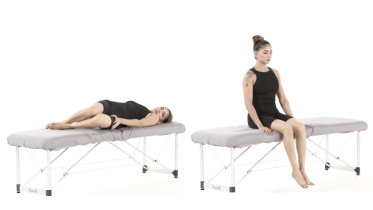
- Straighten your legs out in front of you. Lean onto one forearm, lower yourself onto your side and roll onto your back. Rest here for a moment and take a few easy breaths.
- To get up, bend your knees and roll onto your side. Push through your arms to come up onto your hands and knees. If the chair is not right in front of you, crawl slowly to it and place both hands on the seat.
- Bring one foot forward and put it flat on the floor, using whichever leg feels stronger, so you are half kneeling. Lean forward over that knee, press down through your hands and front foot, and rise, bringing the back foot up beside the front one as you straighten.
- Stand tall, still holding the chair, until you feel steady, as in the video. Then turn slowly, sit on the chair and rest for a few minutes before you walk anywhere.
What you should feel
Slow, deliberate work in your thighs, buttocks and arms, with the chair taking some of your weight. Your knees will feel the pressure of kneeling. Going slowly is the point, so take as long as you need.
Common mistakes
- Trying to sit or stand straight up from lying on your back, instead of going through side lying and hands and knees.
- Using a light chair, or one on wheels, that can slide or tip as you push on it.
- Pushing up in one quick movement and standing before you feel steady.
- Practicing alone before you have done it several times with someone beside you.
How often
Many programs practice this 1 to 3 times in a session, on 1 or 2 days a week, with a rest between each go. Early on you might only practice part of it, such as kneeling down and getting back up, and add the rest as it gets easier. Your physio will adjust this.
Stop and check with your physio if
- Sharp pain in your hip, knee or back, or pain that stays after you rest.
- You feel dizzy, lightheaded or faint as you get up. Stay down or sit on the chair and wait for it to pass. If it does not pass within a minute or two, or it keeps happening, get medical advice the same day before you practice again. If you faint, or it does not settle within a few minutes of keeping still, call emergency services. Even if it passes quickly, tell your physio before you practice again.
- Chest pain or pressure, dizziness or feeling faint, a racing or irregular heartbeat, or being far more out of breath than the effort should cause.
- You cannot get back up, even with the chair. Stay where you are, keep warm, and have your helper call for help rather than trying to lift you, as described below.
From the clinic
Practice this with a family member, friend or caregiver close by, on a day when you feel well. Use a heavy chair or a firm sofa that will not slide or tip, and put a folded towel or cushion down where your knees will go. Wear flat shoes that fit well and grip the floor, not socks, tights or bare feet. If you have fallen in the past year or feel unsteady, ask your physio to go through it with you the first time. The sit to stand exercise builds the leg strength you need for the last part of the climb up.
If chest pain, pressure or tightness does not ease quickly when you rest, spreads to your arm, neck, jaw, stomach or back, or comes with sweating, feeling sick, feeling light-headed or being short of breath, call emergency services straight away, as this can be a heart attack. If it eases quickly and none of these happen, get medical advice the same day, and do not exercise again until you have been checked.
After a real fall, do not rush. Stay still for a moment, check whether you are hurt, and only get up if you feel able, using the same route: onto your side, onto your hands and knees, then up with the help of something heavy and stable, and sit down to rest once you are up. If you cannot get up, or you may have hurt your head, neck, back or hip, stay down and get help. Use your phone or personal alarm, or shout or bang on the wall or floor to get someone's attention. Call emergency services: the NHS advises this whenever someone cannot get up after a fall.
While you wait, cover yourself with anything you can reach, such as a coat, towel or blanket. If you can move without pain, shift onto a soft surface such as a rug or carpet, and away from drafts. Roll gently from side to side or move your arms and legs, and change position about every 30 minutes to help protect your skin. After any fall, or if you are worried about your balance, see your doctor.
A sudden loss of balance is different. Call emergency services straight away for any sign of a stroke, even if it goes away: sudden dizziness with unsteadiness or falling over, a face that droops on one side, an arm you cannot lift or keep up, slurred or muddled speech, weakness or numbness on one side of your body or face, sudden blurred vision, double vision or loss of sight, or a sudden severe headache.
If you have had a hip replacement, get the go-ahead from your surgeon or physio before you try getting up from the floor. Kneeling down and pushing up from half kneeling bend the hip well past a right angle, and many surgeons ask you to avoid that for the first months after some operations. Your physio can teach you a way to get up that fits your surgery. After a knee replacement, or with a sore knee, kneeling can be uncomfortable, so pad the floor well and ask your surgeon or physio when you can start kneeling.
Written and checked by the PocketPhysio editorial team. Last updated 2026-09-28.
This page is general education, not a diagnosis or a personal treatment plan. If you have pain, an injury or a health condition, see a physiotherapist or doctor before starting new exercises.