
Parkinson's disease exercises and physiotherapy
What Parkinson's does to movement
Parkinson's disease is a condition in which parts of the brain become progressively damaged over many years (NHS). The main movement symptoms are shaking (tremor), slow movement and stiff muscles, and the slowness can turn your walk into a shuffle with small steps. The NHS also lists balance problems that make a fall more likely, dizziness or fainting when you stand up because your blood pressure drops, and trouble swallowing. Parkinson's UK adds freezing, where your feet suddenly feel stuck to the floor, and a more stooped posture.
Everyone's Parkinson's is different, and it changes over time. If your specialist, Parkinson's nurse or physio has given you exercises, follow their plan first. Use the program below as a starting point to take to a physio who knows Parkinson's. It does not replace one.
Does exercise help Parkinson's disease?
Yes. A Cochrane review of 154 trials with 7,837 people, most of them with mild to moderate Parkinson's, found that most types of exercise improved the severity of movement symptoms and quality of life compared with no exercise (Ernst 2024). Dance probably had a moderate benefit on movement symptoms, and so did training that combines walking (gait), balance and everyday tasks (functional training). There was little evidence that any one type beats the others. So the best exercise is the one you will keep doing. Falls were the problem the trials reported most often during exercise, which is why every standing exercise below starts with support close by.
Physiotherapy has been tested on its own too. A Cochrane review of 39 trials with 1,827 people found short-term benefits, under 3 months, in walking speed and distance, and in balance and freezing (Tomlinson 2013). Most differences were small, and many trials were not of high quality. It made no difference to how worried people felt about falling. A later Cochrane review of 25 exercise trials with 2,700 people found that exercise probably reduces the rate of falls by 26% in mild to moderate Parkinson's (Allen 2022).
Why moving big matters
Parkinson's tends to make your movements smaller and slower, often without you noticing. Some physio programs train the opposite on purpose: big, effortful movements such as long steps, wide arm swings and high reaches. LSVT BIG is one of these. Its developers describe three parts: making movements bigger, getting used to the fact that a normal-sized movement can feel too big, and learning to cue yourself to move big in daily life (Fox 2012).
In one trial of 60 people with mild to moderate Parkinson's, 16 hours of one-to-one LSVT BIG training over 4 weeks improved movement scores, the timed up and go test and 10 meter walking time more than Nordic walking or unsupervised home exercise, measured at 16 weeks (Ebersbach 2010). Quality of life did not differ between the groups, and this is one small trial. The 2024 Cochrane review rated the evidence for LSVT BIG as very uncertain (Ernst 2024), so treat it as promising rather than proven. The program below borrows the idea. Make every step, reach or turn as big as you safely can.
See a physio who knows Parkinson's
NICE advises considering an early referral to a physiotherapist with experience of Parkinson's, who can assess you and give you education and advice, including on physical activity. For people who have balance or movement problems, it recommends Parkinson's-specific physiotherapy (NICE NG71). A specialist physio can spot small changes in how you move and treat them before they become harder to manage (Parkinson's UK). In the UK your specialist, Parkinson's nurse or GP can refer you, and some areas let you refer yourself.
The European Physiotherapy Guideline for Parkinson's Disease, written with physiotherapy associations from 19 European countries, is still the main reference for this work (Keus 2014). It dates from 2014 and has not been updated, so some of it has been superseded, but Parkinson's UK notes that its principles still apply. Its authors stress referral to physios who specialize in Parkinson's (Domingos 2018).
Exercise when your medicines are working
Parkinson's medicines can work in waves, especially after some years of taking levodopa. Parkinson's UK describes an "on" period as a time when your symptoms are controlled and your medicine is working well, and an "off" or "wearing off" period as a time when symptoms come back and are harder to manage. The Parkinson's Foundation recommends exercising during "on" periods, when your medication is working. Plan your sessions around your usual medicine times, and leave anything about the medicines themselves to your specialist or Parkinson's nurse.
How much exercise do you need?
Parkinson's UK suggests being active for 2.5 hours a week, and says the right activity is different for everyone. Its gentler advice includes 30 minutes of aerobic activity twice a week and 10 to 20 minutes of stretching and movement every day. Once you are fitter, its harder advice is 30 minutes of aerobic activity 5 times a week, enough to build up a sweat. The American physical therapy guideline found benefit in many studies of aerobic exercise done at least 3 days a week for 30 to 40 minutes at moderate to high intensity (Osborne 2022). For strength work, the Parkinson's Foundation suggests 2 to 3 days a week, with a rest day in between, working the main muscle groups for 10 to 15 repetitions.
The NHS suggests that people with mild symptoms may manage vigorous activities such as team sports, cycling or running, and that people with more complex symptoms may do better with walking and simple stretching and strengthening. Parkinson's UK also mentions classes such as dance, tai chi or Pilates, and cycling. Your physio will adjust this to you.
How to use this program
Start at stage 1 if you are not sure, or if you have fallen in the past year. Move up a stage when the current one feels steady and you need less help from the counter. Make each movement as big and deliberate as you can, and count a rhythm out loud if it helps you keep your steps even. These exercises go alongside your walking or other aerobic activity, not instead of it.
Each exercise page gives its own starting range. As a rough guide, sit to stand often starts at 2 to 3 sets of 5 to 10, step-ups and calf raises at 2 to 3 sets of 8 to 15, with fewer at first if that is too hard, and balance holds at 10 to 30 seconds, repeated a few times with each foot in front. The stepping and walking drills are usually a few lengths of a room or hallway, and brisk walking often starts at 10 to 20 minutes on most days. Your physio will adjust this.
Practice next to a kitchen counter or a sturdy chair that cannot slide, on a firm floor with rugs moved out of the way. Wear flat shoes that fit well and grip the floor, not socks, tights or bare feet. If you have fallen in the past year, freeze when you walk or feel unsteady, keep one hand on the support for the whole exercise and practice only when someone else is at home. For aerobic exercise, the American physical therapy guideline suggests cycling may be safer than treadmill walking if you are at high risk of falling or you freeze (Osborne 2022).
A sudden loss of balance is different. Call emergency services straight away for any sign of a stroke, even if it goes away: sudden dizziness with unsteadiness or falling over, a face that droops on one side, an arm you cannot lift or keep up, slurred or muddled speech, weakness or numbness on one side of your body or face, sudden blurred vision, double vision or loss of sight, or a sudden severe headache.
Stop at once if you get chest pain or pressure, dizziness or feeling faint, a racing or irregular heartbeat, or being far more out of breath than the effort should cause. If chest pain, pressure or tightness does not ease quickly when you rest, spreads to your arm, neck, jaw, stomach or back, or comes with sweating, feeling sick, feeling light-headed or being short of breath, call emergency services straight away, as this can be a heart attack. If it eases quickly and none of these happen, get medical advice the same day, and do not exercise again until you have been checked. If you have high blood pressure, breathe steadily through every repetition and never hold your breath.
During the balance and walking exercises, use this stop rule. You feel dizzy, lightheaded, faint or sick, or the room seems to spin. Hold your support, sit down and get medical advice the same day before you practice again. If you faint, it does not settle within a few minutes of sitting still, your vision suddenly blurs or goes double, or you cannot stand or walk steadily, call emergency services.
Getting up from a chair or the bed has its own rule, because Parkinson's can make your blood pressure drop as you rise (NHS). You feel dizzy, lightheaded or faint as you get up. Sit back down and wait for it to pass. If it does not pass within a minute or two, or it keeps happening, get medical advice the same day before you practice again. If you faint, or it does not settle within a few minutes of keeping still, call emergency services.
Moving in bed has a similar rule. You feel dizzy, lightheaded or faint, or the room seems to spin, as you move in bed or sit on its edge. Stop, lie back down on the bed if you can, and keep still until it passes. If it does not pass within a minute or two, or it keeps happening, get medical advice the same day before you practice again. If you faint, it does not settle within a few minutes of keeping still, or your vision suddenly blurs or goes double, call emergency services.
The exercise program
Stage 1: Standing up, standing tall and first big movements
For anyone starting out, or for days when moving feels slow and stiff. Standing up with the armrests practices the lean forward and push that gets you out of a chair, and marching on the spot asks for big, deliberate knee lifts. The two weight shifts train the rocking from foot to foot that can help you start walking again after a freeze. Keep the sway back toward your heels small, as Parkinson's can make it harder to catch yourself if you tip backward. The seated upper back exercises are aimed at the stooped posture Parkinson's can bring, so sit tall and make each movement as large as is comfortable. Keep a kitchen counter or a sturdy chair within reach for every standing exercise.
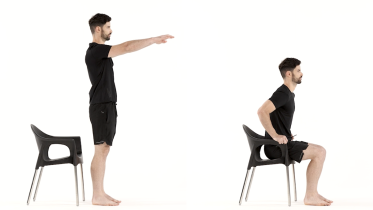 Sit to stand using armrests
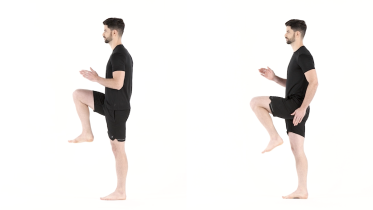 Marching on the spot
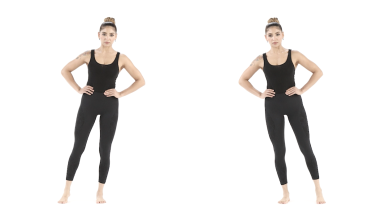 Side to side weight shift
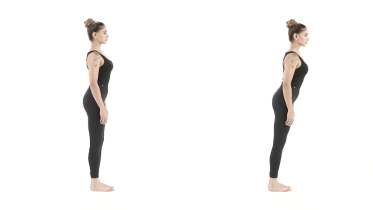 Forward and backward weight shift
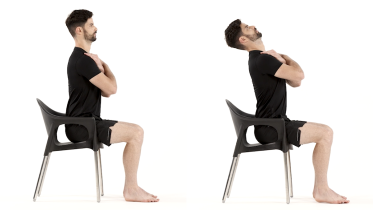 Seated thoracic extension
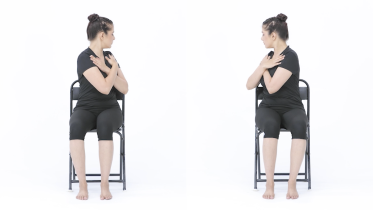 Seated trunk rotation
Stage 2: Bigger steps, turning and walking further
When stage 1 feels steady, often after a few weeks. Walking with longer steps uses markers on the floor as a target, the same idea physios use for freezing, while side stepping and the turn to look behind practice shifting your weight and turning your trunk. The forward reach trains how far you can lean before you need to step. Sit to stand without your hands, calf raises and wall angels build leg strength and an upright posture, and brisk walking starts your aerobic exercise. If you freeze or have fallen in the past year, take your brisk walks with someone beside you until your physio says you can go alone. At the end of the markers, and whenever you need to turn, walk round in a wide half circle rather than turning on the spot.
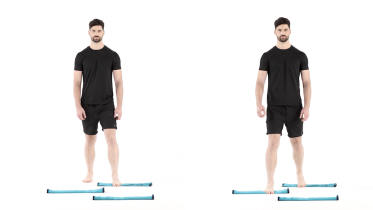 Walking with longer steps
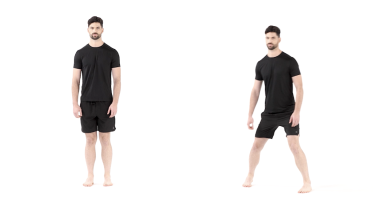 Side stepping
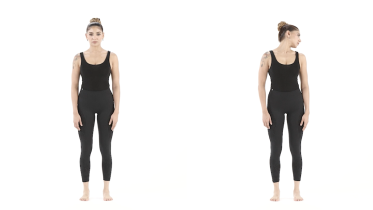 Standing turn to look behind
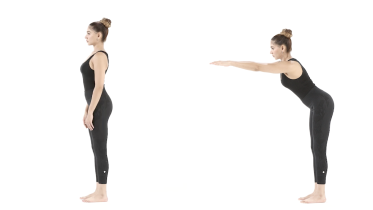 Standing forward reach
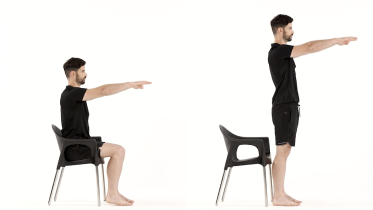 Sit to stand
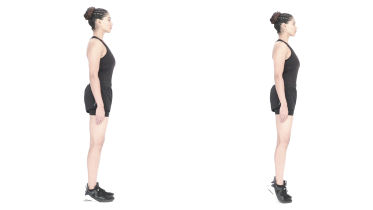 Calf raises
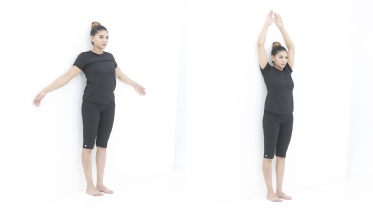 Wall angels
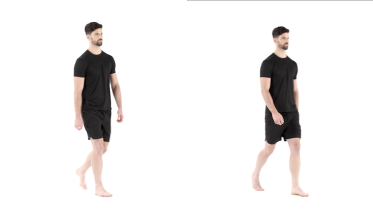 Brisk walking
Stage 3: Narrower balance, quick steps and stairs
When stage 2 feels easy and you walk steadily without holding on. Semi-tandem and tandem stance narrow your base, and clock stepping practices quick steps in different directions, the kind of step that can catch a stumble. Figure 8 walking turns you both ways while you keep moving, and the timed up and go joins standing up, walking, turning and sitting down. Step-ups and stair practice build strength for stairs, always with a rail or counter to hold. Do these with someone nearby until your physio says you can practice alone.
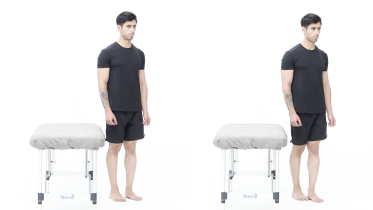 Semi-tandem stance
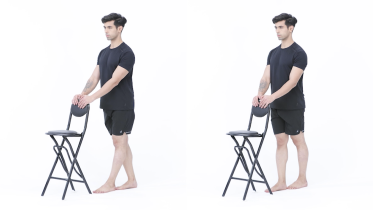 Tandem stance
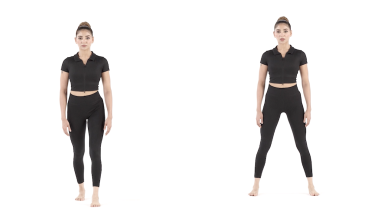 Clock stepping
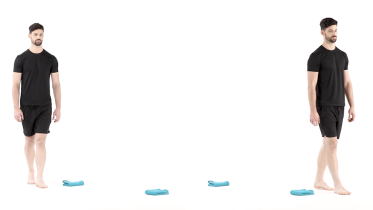 Figure 8 walking
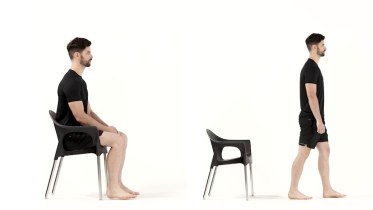 Timed up and go
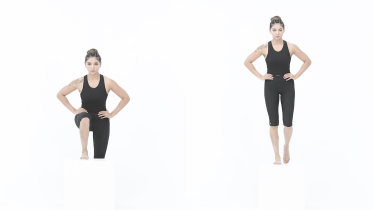 Step up
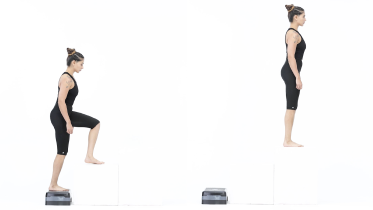 Stair climbing
Alongside any stage: getting up from the floor and out of bed
Practice getting up from the floor with a physio the first time, and after that only with someone at home. It teaches the route back onto your feet after a fall: onto your side, onto your hands and knees, then up with the help of a sturdy chair. The log roll breaks getting out of bed into steps: bend your knees, roll onto your side in one piece, then lower your legs as your arms push you up to sitting. Sit on the edge of the bed for a few minutes before you stand, as Parkinson's can make your blood pressure drop when you get up. If you have had a hip replacement, get the go-ahead from your surgeon or physio before you try either one, and after a knee replacement ask them when you can kneel.
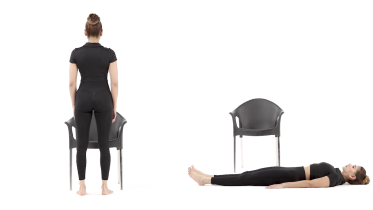 Getting up from the floor
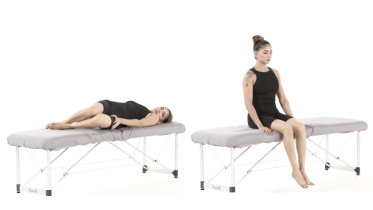 Log roll out of bed
Freezing: cues that help you get moving again
Freezing is when you suddenly cannot step forward, even though you want to. Parkinson's UK says it often happens when you start to walk or turn, walk toward or through a doorway, move onto a different kind of floor, or when you are distracted, rushed or in a crowd. It can last a few seconds or minutes, and it can leave you unsteady enough to fall.
When you freeze, do not try to push forward straight away. Stop or slow down, and get your balance first (Parkinson's UK). Then use a cue, a signal that tells your body to take the next step. The American physical therapy guideline gives external cueing a strong recommendation for freezing and walking (Osborne 2022).
Parkinson's UK describes several cues. You can move most of your weight onto one leg so the other one is free to step, or rock gently from side to side. You can count out loud, "one, two, three, step", or say "ready, steady, go". A metronome or music with a steady beat can set the rhythm. Strips of tape on the floor, or the line of light from a laser cue fitted to a stick, frame or shoe, give your feet a target to step over.
Different cues work for different people and in different places, so try a few with your physio and keep the ones that work for you. The side to side weight shift and walking with longer steps in the program practice the same skills. If freezing gets worse when your medicine seems to wear off before the next dose, tell your specialist or Parkinson's nurse (Parkinson's UK).
Walking, turning and falls at home
Parkinson's UK lists many reasons falls become more likely with Parkinson's, including small or slow steps, walking or turning too fast, less arm swing, involuntary movements, freezing, a stooped posture, stiff or weaker muscles, and drops in blood pressure. Its walking tips start with bigger steps, which also help your arms swing, and a gentle swing of both arms to help your balance. When you change direction, avoid turning quickly or on the spot, and take a few extra steps to walk round in a half circle. Try not to walk and talk at the same time: stop and hold something solid when you want to talk. Take your time, especially when you are carrying something.
Shoes with low heels or flat soles may be easier to walk in, and floppy slippers are best avoided (Parkinson's UK). Clear rugs and trailing cables off the floor, keep your home well lit, and keep a torch or phone light by your bed for night-time trips. An occupational therapist can suggest changes around the home and equipment such as rails beside the bed (NHS; Parkinson's UK).
People with Parkinson's are more likely to have bone problems, which can make a fall more harmful, and weight-bearing and strength exercise help keep bones and muscles strong (Parkinson's UK). The balance and falls prevention program covers falls in more detail, and the osteoporosis program covers bone health.
Dizziness when you stand up
A sudden drop in blood pressure when you stand up (postural or orthostatic hypotension) can cause dizziness, blurred vision or fainting, and the NHS lists it among the symptoms of Parkinson's. Some Parkinson's medicines can also affect blood pressure, so tell your specialist or Parkinson's nurse if you get dizzy when you stand, and do not stop or change a medicine on your own (Parkinson's UK). Before you get out of bed, sit with your feet on the floor for a few minutes, then stand up slowly, and do not walk until you feel steady (Parkinson's UK). Gentle marching on the spot, or moving your ankles up and down before you stand, can help stop your blood pressure dropping (Parkinson's UK).
The NHS also advises getting up slowly from sitting, not bending down or changing position suddenly, and not sitting or standing for long periods. If you have felt dizzy, or fallen because of dizziness, ask your GP practice to check whether your blood pressure is too low (Parkinson's UK). The warning signs below say when dizziness needs help the same day.
If you fall
Do not rush. Stay still for a moment and check whether you are hurt. If you cannot get up, or you think you may have hurt your head, neck, back or hip, stay where you are and call emergency services, as the NHS advises. Parkinson's UK gives the same advice: if someone has fallen and cannot get up, call for help.
If you feel able to get up, roll onto your side, push up onto your hands and knees, crawl to something stable such as a heavy chair, and stand up slowly while holding on (NHS). The getting up from the floor exercise lets you practice this route in advance, and a physio can teach you to get down to the floor and back up safely (Parkinson's UK). If you cannot get up, cover yourself with anything you can reach to keep warm, and change position about every 30 minutes to help protect your skin (NHS).
After any fall, see your GP, even if you do not seem hurt. Parkinson's UK advises this for everyone with Parkinson's, so the GP can look into why you fell and how to prevent another fall. You may then be referred to a falls clinic or a falls prevention service.
Swallowing, speech and other help
Parkinson's can make the muscles you use to chew and swallow slower and stiffer (Parkinson's UK). Signs to look out for include coughing when you eat or drink, food sticking in your throat or chest, bringing food back up after you swallow, a gurgly voice, and drooling. Food or drink can also slip into the lungs without making you cough, which Parkinson's UK calls silent aspiration, and this can lead to a chest infection (aspiration pneumonia). A speech and language therapist can teach speaking and swallowing exercises (NHS), and your GP or Parkinson's nurse can refer you, or in some areas you can refer yourself (Parkinson's UK). The warning signs below say when swallowing trouble needs help the same day or straight away.
An occupational therapist helps with everyday tasks such as dressing or getting to the shops, and with making your home safer (NHS). Turning over in bed and getting in and out of bed can become harder, and a physio or occupational therapist can show you techniques and equipment for it (Parkinson's UK).
When to see a physio, GP or specialist
Ask for a referral to a physio with experience of Parkinson's soon after diagnosis, as NICE suggests, and again whenever walking, balance, getting up or turning over in bed becomes harder. Book an appointment after any fall, or if you are freezing, tripping or nearly falling more often (Parkinson's UK). Speak to your specialist or Parkinson's nurse if your medicines do not seem to work as well as they did, or their side effects seem to be making you fall (Parkinson's UK).
Parkinson's usually changes over months and years. When symptoms get much worse over a few days, something else may be going on, and in people with Parkinson's a urine infection is a common cause of this kind of sudden decline (Hogg 2022). The warning signs below say how quickly to get help.
Check with your doctor before starting if you have a heart or lung condition, or blood pressure that is not under control. If you have had a hip or knee replacement or other recent surgery, follow the program from your surgeon and physio instead of this one. With low bone density (osteoporosis) or a past fracture in your spine or ribs, ask your physio how far to turn and lean before you start the seated upper back exercises and the turn to look behind.
For physiotherapists
NICE NG71 (2017) recommends considering early referral to a physiotherapist with experience of Parkinson's for assessment plus education and advice, including physical activity, and offering Parkinson's-specific physiotherapy to people with balance or motor function problems. The European Physiotherapy Guideline (Keus 2014) remains the main reference point, and Domingos 2018 summarizes its referral criteria for neurologists. The 2022 APTA guideline (Osborne 2022) gives strong recommendations for moderate to high intensity aerobic exercise, resistance training, balance training, external cueing, gait training, task-specific training, community-based exercise and integrated care, a moderate one for behavior change approaches, and weak ones for flexibility exercise and telerehabilitation for balance.
Tomlinson 2013 pooled 39 trials (1,827 participants) against placebo or no intervention and found short-term (under 3 months) gains in gait speed (0.04 m/s), 2- or 6-minute walk (13.37 m), Timed Up and Go (-0.63 s), Functional Reach (2.16 cm), Berg Balance Scale (3.71 points), the Freezing of Gait questionnaire and UPDRS, with no difference on the Falls Efficacy Scale or patient-rated quality of life and no evidence of differences between physiotherapy approaches. Allen 2022 (25 exercise trials, 2,700 participants) found that exercise compared with control probably reduces the rate of falls (rate ratio 0.74, 95% CI 0.63 to 0.87, 12 trials) and probably slightly reduces the number of fallers (risk ratio 0.90, 95% CI 0.80 to 1.00), both moderate certainty, in mild to moderate PD. Ernst 2024 (network meta-analysis, 154 trials, 7,837 participants) found benefits on motor sign severity and quality of life for most exercise types. Dance and gait/balance/functional training were probably moderately beneficial for motor signs, with little evidence of differences between types.
For dosing, Osborne 2022 reports benefit in many aerobic studies at 3 or more days a week for 30 to 40 minutes at moderate to high intensity, and in supervised multimodal balance programs at 2 to 3 sessions a week for 5 to 10 weeks, 16 to 30 hours in total. For resistance training it reports benefit at 1 to 2 days a week for 30 to 60 minutes, at about 80% of the repetition maximum for strength and 40% for power; Keus 2014 advises 1 to 3 sets of 8 to 15 repetitions at 60 to 80% of 1RM, and the Parkinson's Foundation recommendations, developed with ACSM, give 2 to 3 non-consecutive days a week. Because autonomic dysfunction can blunt the heart rate response, Osborne 2022 advises using rating of perceived exertion as well as heart rate, and suggests cycling rather than treadmill walking for people at high falls risk or with freezing of gait.
Screen for orthostatic hypotension, with a sitting or lying blood pressure and a second reading after 2 to 3 minutes standing (Parkinson's UK). Also check freezing triggers and swallowing, and ask about bone health.
The home program leaves out turning on the spot, backward walking and dual-task walking. Parkinson's UK advises against turning on the spot and walking while talking in daily life, Keus 2014 advises wide-arc rather than pivot turns for people at fall risk, and Osborne 2022 rates dual-task training only as an option to consider, with mixed results. Keus 2014 lists walking backward and dual tasking among balance training options, so add them in supervised sessions where they suit the person. Clock stepping keeps its backward step short and next to a support.
See a doctor promptly if
- Emergency: call emergency services straight away for any sign of a stroke, even if it goes away: sudden dizziness with unsteadiness or falling over, a face that droops on one side, an arm you cannot lift or keep up, slurred or muddled speech, weakness or numbness on one side of your body or face, sudden blurred vision, double vision or loss of sight, or a sudden severe headache.
- Emergency: swallowing suddenly becomes hard, over minutes or hours rather than slowly over months. Call emergency services straight away, even if it goes away, as this can be a sign of a stroke.
- Emergency: sudden confusion, for example you, or the person you care for, suddenly become muddled, much drowsier than usual or unable to follow what is said. Call emergency services or go to an emergency department straight away, without driving yourself. Sudden confusion can come from an infection, a stroke, a head injury or other causes that need treating quickly.
- Emergency: severe choking, where you cannot breathe, cough or speak. If the airway is still blocked after trying to clear it, someone should call emergency services straight away and follow the operator's instructions.
- Emergency: you have just fallen and cannot get up, or you think you may have hurt your head, neck, back or hip. Stay where you are, keep warm and call emergency services, or get someone to call for you. If you got up and walked without trouble and only notice pain later, use the lines below.
- Emergency: you fell and cannot remember the fall or how it happened. Go to an emergency department straight away, and do not drive yourself. You may have blacked out or hit your head without knowing it.
- Emergency: you have had a fall or an injury and now have severe hip pain, or you cannot walk or put weight on the leg. Call emergency services or go to an emergency department. This can be a sign of a broken hip (hip fracture).
- Emergency: after a knock to the head, being very drowsy or finding it hard to keep your eyes open, confusion, a fit (seizure), new weakness or numbness anywhere in your body, new trouble understanding, speaking, walking or keeping your balance, new problems seeing or hearing, clear fluid coming from your ears or nose, bleeding from your ears or bruising behind them, a black eye when your eye was not hit, a dent in your head or a wound with something stuck in it, or a change in behavior. Call emergency services straight away. These can be signs of an injury to the brain.
- Emergency: after a knock to the head, you were knocked out, even for a moment, you cannot remember what happened just before or after, you have had a headache ever since, or you are being sick (vomiting). The same applies, even if you feel fine, if you take medicine that thins your blood, other than aspirin on its own, have a bleeding or clotting condition, have had brain surgery in the past, or had been drinking alcohol or taking drugs when it happened. Go to an emergency department straight away, and do not drive yourself.
- Emergency: you suddenly become short of breath, you get chest pain or pain in your upper back that may be worse when you breathe in, you cough up blood, your heart is beating very fast, or you faint. Call emergency services straight away, even if your leg looks normal. These can be signs of a blood clot in the lungs (pulmonary embolism).
- If chest pain, pressure or tightness does not ease quickly when you rest, spreads to your arm, neck, jaw, stomach or back, or comes with sweating, feeling sick, feeling light-headed or being short of breath, call emergency services straight away, as this can be a heart attack. If it eases quickly and none of these happen, get medical advice the same day, and do not exercise again until you have been checked.
- Same day: after a fall, you are in pain, have hurt yourself or feel unwell, or you were on the floor for an hour or more, without any of the emergency signs above. Get medical advice the same day, even if you managed to get up.
- Same day: new hip or groin pain after a fall, even a small one, if you are older, have low bone density (osteoporosis) or have taken steroid tablets for a long time, even if you can still walk. Get medical advice the same day. A broken hip is not always obvious at first.
- Emergency: new neck or back pain after a fall, a knock or a jolt, even a minor one such as a trip or a sudden stop in a car, if you have a condition that stiffens the spine, such as ankylosing spondylitis. Call emergency services or go to an emergency department straight away, do not drive yourself, and tell the staff about your spine condition, so they keep your neck and back in their usual position. A stiff spine can break after a small injury, and the break is easy to miss at first. If the pain started straight after the injury, or you also have numbness, tingling or weakness in your arms or legs, keep still and call emergency services.
- Back pain after a minor fall or strain if you are older, have low bone density (osteoporosis) or have taken steroid tablets for a long time. Get medical advice the same day.
- Neck pain after a car accident or a fall, even a minor one, if you are 65 or older, have low bone density (osteoporosis) or have taken steroid tablets for a long time. Get your neck checked by a doctor the same day, for example at an emergency department, before you start these exercises. At 65 or older, doctors usually want an X-ray or scan of the neck after an accident.
- Same day: you blacked out or fainted, even for a moment. Get medical advice the same day. Call emergency services instead if the person cannot be woken within 1 minute, has not fully recovered or has trouble speaking or moving, has chest pain or a pounding, fluttering or irregular heartbeat, fainted while exercising or lying down, is shaking or jerking, or was badly hurt.
- Same day: sudden new dizziness, or feeling faint or unsteady, without any of the stroke signs above. Stop, sit down and get medical advice the same day. If you faint, it does not settle within a few minutes of sitting still, or you cannot stand or walk steadily, call emergency services.
- Same day: dizziness, lightheadedness, blurred vision or feeling faint when you stand up that is new for you, does not pass within a minute or two, keeps happening, or has made you fall. Sit or lie down, and get medical advice the same day. This can be a drop in blood pressure on standing (postural hypotension), which the NHS lists among the symptoms of Parkinson's, and your GP or specialist can check it. If it does not settle within a few minutes of sitting or lying still, call emergency services. If you faint, use the fainting line above.
- Same day: a calf or thigh that is newly swollen, warm, tender, red or darker than usual, has swollen veins that are sore to touch, or has a throbbing or cramping pain that does not fit your injury or condition, or that feels different from normal muscle soreness after exercise. This can be a sign of a blood clot (deep vein thrombosis), especially after surgery, an injury, time in a cast or boot, a long trip or a spell of being much less mobile than usual. Get medical advice the same day. If you are also short of breath or have chest pain, call emergency services.
- Same day: your Parkinson's symptoms get much worse over a few hours or days, for example you suddenly move far more slowly, freeze or fall much more than usual, or can no longer do things you managed last week. Get medical advice the same day. Parkinson's usually changes slowly, and a sudden change can come from another illness, such as a urine infection. If there is also sudden confusion, treat it as an emergency, as above.
- Same day: a cough that brings up phlegm, a high temperature, chest pain when you breathe or cough, or feeling short of breath. Get medical advice the same day, or straight away if you have any trouble swallowing, as food or drink can slip into the lungs without making you cough and cause a chest infection (aspiration pneumonia). If you are struggling to breathe, your lips or skin turn pale, blue or blotchy, you cough up blood, your heart is beating very fast or you suddenly feel confused, call emergency services. If you have a very high or very low temperature, shivering you cannot control, you are breathing very fast or finding it hard to breathe, you are confused or your speech is slurred, your skin, lips or tongue look blue, gray, pale or blotchy (on brown or black skin this can be easier to see on the palms of the hands or soles of the feet), or you have a rash that does not fade when you press it, call emergency services, as this can be sepsis.
- Same day: swallowing problems that are new or getting worse, such as coughing or choking when you eat or drink, food sticking in your throat or chest, a wet or gurgly voice after you swallow, or trouble swallowing your tablets. Get medical advice the same day, and ask your GP, specialist or Parkinson's nurse about a speech and language therapist. If you cannot swallow your Parkinson's tablets at all, or you keep being sick and cannot keep them down, get medical advice straight away, as these medicines should not stop suddenly and missing them can quickly make you very stiff and unwell. If you also have a cough with phlegm, a high temperature or shortness of breath, use the line above.
- Within a few days: you have had a fall, even if you were not hurt, or you are freezing, tripping or nearly falling more often than before. Book an appointment with your GP, specialist or Parkinson's nurse within a few days. Parkinson's UK advises that everyone with Parkinson's sees their GP after a fall, so the reasons for it can be looked into.
Common questions
What are the best exercises for Parkinson's disease?
There is no single best one. A Cochrane review of 154 trials found that most types of exercise helped movement symptoms and quality of life, with little evidence that one type beats another, although dance and gait, balance and functional training had the strongest support for movement symptoms (Ernst 2024). The American physical therapy guideline recommends aerobic exercise, strength training, balance training, walking practice and cues for freezing (Osborne 2022). Choose activities you enjoy and will keep doing, and ask a physio who knows Parkinson's to fit them to you.
How much exercise should someone with Parkinson's do?
Parkinson's UK suggests being active for 2.5 hours a week. Its gentler advice includes 30 minutes of aerobic activity twice a week and 10 to 20 minutes of stretching and movement every day, and once you are fitter, 30 minutes of aerobic activity 5 times a week. The American physical therapy guideline notes benefits in many studies of aerobic exercise done at least 3 days a week for 30 to 40 minutes (Osborne 2022). Build up slowly from where you are now. Your physio will adjust this.
Is walking good for Parkinson's?
Yes, as part of a wider program. The NHS suggests walking and simple stretching and strengthening for people whose symptoms are more complex, and the American physical therapy guideline recommends aerobic exercise and walking practice (Osborne 2022). Take big, deliberate steps and let your arms swing, and add balance and strength work, since walking alone does not train everything. In one trial, a Nordic walking group did not improve movement scores the way a big-movement program did (Ebersbach 2010).
How do you get unstuck when freezing with Parkinson's?
Do not try to push forward straight away. Stop or slow down and get your balance first, then use a cue: move most of your weight onto one leg, rock gently from side to side, count 'one, two, three, step', or step over a strip of tape on the floor (Parkinson's UK). A steady beat from a metronome or music can help too. Different cues work for different people, so practice a few with your physio.
Should I exercise when my Parkinson's medication is on?
Where you can, yes. The Parkinson's Foundation recommends exercising during 'on' periods, when your medication is working. Your physio can help you plan sessions around your usual medicine times. Anything about the medicines themselves is a question for your specialist or Parkinson's nurse.
Can exercise slow down Parkinson's?
Nobody knows yet. The trials show that exercise improves movement symptoms and quality of life (Ernst 2024). Some researchers think it may also slow the progression of movement symptoms, but that has not been proven (Fox 2012). Either way, it helps you move better now.
References
- National Institute for Health and Care Excellence. Parkinson's disease in adults. NICE guideline NG71. Published 19 July 2017. https://www.nice.org.uk/guidance/ng71
- Chartered Society of Physiotherapy. NICE recommends specialist physio for early-stage Parkinson's. 19 July 2017. https://www.csp.org.uk/news/2017-07-19-nice-recommends-specialist-physio-early-stage-parkinsons
- Keus S, Munneke M, Graziano M, et al. European Physiotherapy Guideline for Parkinson's Disease. KNGF and ParkinsonNet. 2014. https://www.parkinsonnet.nl/app/uploads/sites/3/2019/11/eu_guideline_parkinson_guideline_for_pt_s1.pdf
- Parkinson's UK. European Physiotherapy Guideline for Parkinson's Disease. https://www.parkinsons.org.uk/professionals/resources/european-physiotherapy-guideline-parkinsons-disease
- Domingos J, Keus SHJ, Dean J, de Vries NM, Ferreira JJ, Bloem BR. The European Physiotherapy Guideline for Parkinson's Disease: implications for neurologists. Journal of Parkinson's Disease. 2018;8(4):499-502. https://doi.org/10.3233/JPD-181383
- Osborne JA, Botkin R, Colon-Semenza C, et al. Physical therapist management of Parkinson disease: a clinical practice guideline from the American Physical Therapy Association. Physical Therapy. 2022;102(4):pzab302. https://doi.org/10.1093/ptj/pzab302
- Tomlinson CL, Patel S, Meek C, et al. Physiotherapy versus placebo or no intervention in Parkinson's disease. Cochrane Database of Systematic Reviews. 2013;(9):CD002817. https://doi.org/10.1002/14651858.CD002817.pub4
- Allen NE, Canning CG, Almeida LRS, et al. Interventions for preventing falls in Parkinson's disease. Cochrane Database of Systematic Reviews. 2022;(6):CD011574. https://doi.org/10.1002/14651858.CD011574.pub2
- Ernst M, Folkerts AK, Gollan R, et al. Physical exercise for people with Parkinson's disease: a systematic review and network meta-analysis. Cochrane Database of Systematic Reviews. 2024;(4):CD013856. https://doi.org/10.1002/14651858.CD013856.pub3
- Ebersbach G, Ebersbach A, Edler D, et al. Comparing exercise in Parkinson's disease: the Berlin LSVT BIG study. Movement Disorders. 2010;25(12):1902-1908. https://doi.org/10.1002/mds.23212
- Fox C, Ebersbach G, Ramig L, Sapir S. LSVT LOUD and LSVT BIG: behavioral treatment programs for speech and body movement in Parkinson disease. Parkinson's Disease. 2012;2012:391946. https://doi.org/10.1155/2012/391946
- Hogg E, Frank S, Oft J, Benway B, Rashid MH, Lahiri S. Urinary tract infection in Parkinson's disease. Journal of Parkinson's Disease. 2022;12(3):743-757. https://doi.org/10.3233/JPD-213103
- Parkinson's Foundation. New exercise recommendations for the Parkinson's community and exercise professionals. 25 May 2021. https://www.parkinson.org/blog/awareness/exercise-recommendations
- Parkinson's UK. Physiotherapy. https://www.parkinsons.org.uk/information/treatments/physiotherapy
- Parkinson's UK. Physical activity and exercise. https://www.parkinsons.org.uk/information/treatments/physical-activity-and-exercise
- Parkinson's UK. Low-intensity physical activity. https://www.parkinsons.org.uk/information/treatments/physical-activity-and-exercise/low-intensity-activity
- Parkinson's UK. High-intensity physical activity. https://www.parkinsons.org.uk/information/treatments/physical-activity-and-exercise/high-intensity
- Parkinson's UK. Falls and dizziness. Last updated 8 August 2025. https://www.parkinsons.org.uk/information/symptoms/motor/falls-and-dizziness
- Parkinson's UK. Freezing. Last updated 4 November 2024. https://www.parkinsons.org.uk/information/symptoms/motor/freezing
- Parkinson's UK. Eating, swallowing and managing saliva. Last updated 22 November 2024. https://www.parkinsons.org.uk/information/symptoms/non-motor/eating-swallowing-managing-saliva
- Parkinson's UK. Managing low blood pressure and Parkinson's. 12 June 2019. https://www.parkinsons.org.uk/magazine/experts/managing-low-blood-pressure-and-parkinsons
- Parkinson's UK. Bedroom equipment. Last updated 10 July 2026. https://www.parkinsons.org.uk/information/equipment-technology/bedroom
- NHS. Parkinson's disease. https://www.nhs.uk/conditions/parkinsons-disease/
- NHS. Parkinson's disease: symptoms. https://www.nhs.uk/conditions/parkinsons-disease/symptoms/
- NHS. Parkinson's disease: treatment. https://www.nhs.uk/conditions/parkinsons-disease/treatment/
- NHS. Parkinson's disease: living with. https://www.nhs.uk/conditions/parkinsons-disease/living-with/
- NHS. Low blood pressure (hypotension). https://www.nhs.uk/conditions/low-blood-pressure-hypotension/
- NHS. Fainting. https://www.nhs.uk/symptoms/fainting/
- NHS. Falls. https://www.nhs.uk/conditions/falls/
- Montero-Odasso M, van der Velde N, Martin FC, et al. World guidelines for falls prevention and management for older adults: a global initiative. Age and Ageing. 2022;51(9):afac205. doi:10.1093/ageing/afac205
- NHS. Stroke: symptoms. https://www.nhs.uk/conditions/stroke/symptoms/
- nidirect. Stroke. https://www.nidirect.gov.uk/conditions/strokes
- NHS. Dysphagia (swallowing problems). https://www.nhs.uk/symptoms/swallowing-problems-dysphagia/
- NHS. Sudden confusion (delirium). https://www.nhs.uk/symptoms/confusion/
- NHS. Pneumonia. https://www.nhs.uk/conditions/pneumonia/
- NHS. Deep vein thrombosis (DVT). https://www.nhs.uk/conditions/deep-vein-thrombosis-dvt/
- NHS. Pulmonary embolism. https://www.nhs.uk/conditions/pulmonary-embolism/
- NHS. Head injury and concussion. https://www.nhs.uk/conditions/head-injury-and-concussion/
- National Institute for Health and Care Excellence (NICE). Head injury: assessment and early management. NICE guideline NG232. Published 18 May 2023. https://www.nice.org.uk/guidance/ng232
Written and checked by the PocketPhysio editorial team. Last updated 2026-09-29.
This page is general education, not a diagnosis or a personal treatment plan. See a physiotherapist or doctor for advice about your own situation.