Seated thoracic extension
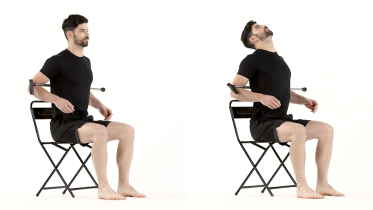
The seated thoracic extension is a mobility exercise for a stiff upper back. Sitting upright with your arms crossed on your chest, you lift your elbows and lean your upper back backward so your gaze moves up toward the ceiling, then return to upright. All you need is a chair, which makes it an easy one to do in a break from desk work.
How to do the seated thoracic extension
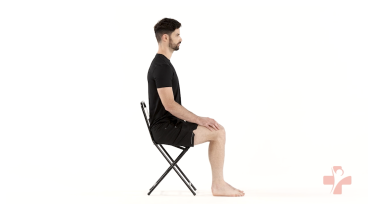
- Sit up straight on a sturdy chair with your feet flat on the floor. Your upper back should be free to move, above or away from the backrest.
- Cross your arms over your chest and rest each hand on the opposite shoulder.
- Lift your elbows a little and lean your upper back backward, so your chest rises and your eyes move up toward the ceiling. The bend should come from between your shoulder blades.
- Your head comes along with your upper back. Do not throw it back by itself, and stop where your neck is comfortable.
- Pause for a breath, then slowly return to sitting upright.
What you should feel
A gentle opening across the front of your chest and effort between your shoulder blades as you lean back. Your neck and lower back should stay comfortable.
Common mistakes
- Dropping the head back fast to look higher. The neck ends up doing the bending instead of the upper back.
- Arching the lower back and pushing the stomach forward instead of lifting the chest.
- Moving quickly. Lean back and come up at the same slow pace.
- Holding your breath at the back of the movement.
How often
Many programs use 5 to 10 slow repetitions with a pause of a few seconds, once or several times a day, for example during breaks from sitting. Your physio will adjust this.
Stop and check with your physio if
- Sharp pain in your back or around your ribs, neck pain that builds as you lean back, or pain, numbness or tingling spreading into your arms.
- You feel dizzy, faint or unsteady. Stop and get medical advice the same day. If you faint, it does not settle within a few minutes of sitting still, or you cannot stand or walk steadily, call emergency services.
- Things look double, your vision suddenly blurs or goes, your speech slurs or becomes muddled, swallowing becomes hard, your face or lips go numb, one side of your face droops or one side of your body goes weak or numb, you suddenly become so dizzy or unsteady that you fall or cannot stand or walk, your legs suddenly give way but you do not black out (a drop attack), or you get a sudden severe headache. Stop and call emergency services, even if it goes away.
From the clinic
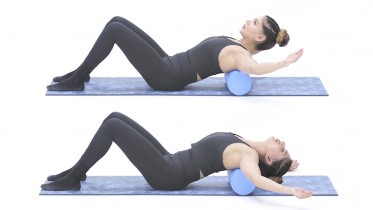
In the video the head tips well back at the end of each lean. The voice guide describes it as looking up gently, and that is the better way to start. If your neck is sore or stiff, tuck your chin in slightly and let the movement come from between your shoulder blades. The voice guide also offers a version with your hands behind the lower part of your neck, which supports your head as you lean. For the same area with more support, try thoracic extension over a chair or wall angels.
Bending the upper back backward is generally encouraged in exercise for low bone density (osteoporosis), and this version keeps the spine upright with no weight to hold. Lean straight back with no twist to either side, and do not round forward hard between repetitions. If you have had a fracture in your spine, check with your physio before you start. The same goes after an operation on your heart or chest in the last few months, as leaning back stretches across the front of the chest.
Written and checked by the PocketPhysio editorial team. Last updated 2026-09-26.
This page is general education, not a diagnosis or a personal treatment plan. If you have pain, an injury or a health condition, see a physiotherapist or doctor before starting new exercises.