
Shoulder impingement exercises and physiotherapy
What is shoulder impingement?
Shoulder impingement is the name many people are given for pain around the top and side of the shoulder that gets worse when they use the arm, especially when reaching up or out to the side. The NHS lists impingement, along with tendonitis and bursitis, as a likely cause of shoulder pain that is often worse while you use the arm. Putting on a jacket, reaching to a high shelf or lying on that side are the usual complaints.
The old idea behind the name was simple. The tendons of the rotator cuff, the four small muscles that turn and steady the shoulder, were thought to be squeezed under the bony tip of the shoulder (the acromion) each time the arm lifted. That picture led to an operation to shave the bone and make more room.
What is shoulder impingement called now?
Most guidance has moved away from the word. The Dutch Orthopaedic Association guideline (Diercks 2014) says the idea of the tendon being pinched is not enough to explain the problem, and that subacromial pain syndrome describes it better. Lewis (2016) groups subacromial pain, rotator cuff tendinopathy and partial and full-thickness cuff tears under one name, rotator cuff related shoulder pain. UK shoulder surgeons treat subacromial shoulder pain, rotator cuff tendinopathy and impingement as essentially the same diagnosis (Kulkarni 2015).
So if your letter says impingement, subacromial pain or rotator cuff tendinopathy, you are most likely reading about the same shoulder. Our rotator cuff tendinopathy page goes deeper into the tendon itself. Scans and steroid injections are covered there, along with a staged tendon program. This page deals with what people want to know once they hear the word impingement: is it my posture, what should I avoid, and do I need the bone shaved? The program here leans more on the muscles that control the shoulder blade.
Does exercise help shoulder impingement?
Yes, and it comes first. The Dutch guideline found no convincing evidence that surgery works better than nonsurgical care, and advises exercise that is specific, low in intensity and done often, combining slow lowering work (eccentric training) with attention to relaxation and posture. Lewis (2016) concludes that a graduated, well-built exercise program gives at least the same benefit as surgery.
A Swedish trial shows what this can look like. Holmgren and colleagues (2012) took 102 people with persistent impingement pain at a hospital orthopedic department in Sweden. One group did 12 weeks of specific exercise, with slow lowering work for the rotator cuff and exercises for the shoulder blade muscles, plus hands-on treatment. The other group did general neck and shoulder movements. After 3 months, about 1 in 5 of the specific exercise group chose surgery, against about 3 in 5 of the general group.
Surgery to make more space does not beat a placebo. In the CSAW trial in the UK (Beard 2018) and the FIMPACT trial in Finland (Paavola 2018), shaving the bone did no better than an operation in which the surgeon only looked inside the joint. A BMJ guideline panel (Vandvik 2019) now makes a strong recommendation against it for long-lasting shoulder pain that did not start with an injury.
Is shoulder impingement caused by posture?
Many people ask this. The honest answer: posture seems to matter less than people think. A review by Ratcliffe and colleagues (2014) found that people with impingement do not share one typical shoulder blade position; some studies found one pattern, others the opposite. Barrett and colleagues (2016) found that the rounding of the upper back is much the same in people with and without shoulder pain. Sitting tall does let people lift the arm higher in the moment, although the studies behind that tested a single session only.
Shoulder blade exercises still earn their place. A review of six trials by Saito and colleagues (2018) found that treatment aimed at the shoulder blade improved pain during activity and shoulder function in the short term. Those programs did not change posture or chest muscle length, though. By a 4-week follow-up, the extra benefit was no longer seen. So the shoulder blade work below is there to help the arm move with control and share the load, not to fix a posture that is wrong.
The NHS still suggests good posture and not slouching. Sitting tall costs nothing and may make reaching easier, so it is worth doing. Just do not expect it to fix the pain on its own.
How to use this program
Start with the stage that fits how your shoulder is right now, or with stage 1 if you cannot tell. Move up when the current stage feels easy and the shoulder is no worse the next morning.
Each exercise page gives a typical starting dose. As a rough guide, many programs use 2 to 3 sets of 8 to 15 slow repetitions for the band and shoulder blade exercises, 1 to 3 sets for the wall reaching exercises in stage 3, and 5 to 10 holds of 5 to 10 seconds for the static holds. The lighter exercises are often done once or twice a day and the band work once a day or every other day.
In the Holmgren trial, people did their home exercises once or twice a day. The Dutch guideline favors low intensity and high frequency, so the aim is a light load done well and often, rather than a heavy one done now and then. Your physio will adjust this, both the exercises and the numbers, to your shoulder and the job, sport or daily task you want back.
Some discomfort during these exercises is common. Many programs accept mild discomfort that eases soon after you finish, as long as the shoulder is no worse the next morning. Stop an exercise if it gives you sharp or catching pain, or pain that builds with each repetition. If the shoulder is clearly worse the next day or the night pain comes back, drop back a step rather than stopping altogether.
The exercise program
Stage 1: Settle the pain and find your shoulder blade
For a shoulder that hurts with small reaches, catches as you lift the arm or aches at night. Everything here keeps the arms low, by your side or folded across your chest, which is usually the least painful position. The two static holds work the rotator cuff without the arm moving, and the lying press teaches you to draw the shoulder blades back gently without lifting the arms. For the two static holds, many programs use 5 to 10 holds of 5 to 10 seconds, once or twice a day, pressing well short of your hardest. The seated upper back extension is optional, for people who feel stiff between the shoulder blades.
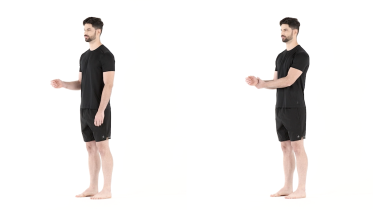 Isometric shoulder external rotation
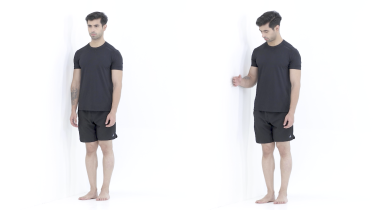 Isometric shoulder abduction
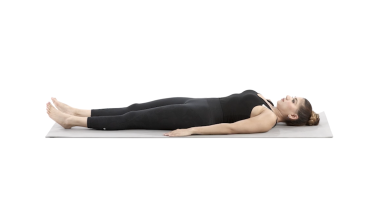 Lying shoulder blade press
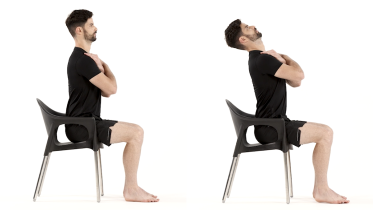 Seated thoracic extension
Stage 2: Train the shoulder blade and rotator cuff up to shoulder height
When the holds feel easy and everyday reaching to chest height hurts less. Prone scapular retraction and the wall push up plus train the muscles that move and steady the shoulder blade, and the band row adds some load to them. The side-lying turn and the band turn work the muscles that turn the arm outward, with the elbow kept at your side. Bring each movement back slowly, taking a little longer on the way back than on the way out. That slow return (eccentric work) is the kind of exercise the Dutch guideline and the Holmgren trial used.
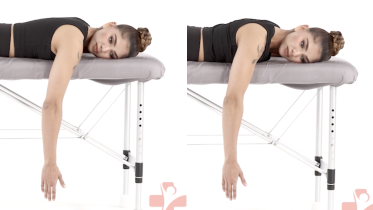 Prone scapular retraction
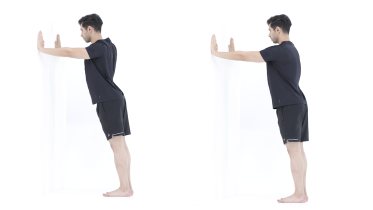 Wall push up plus
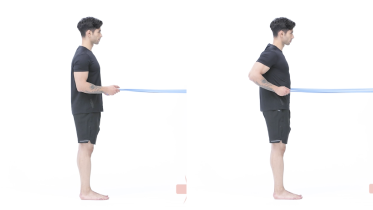 Resistance band row
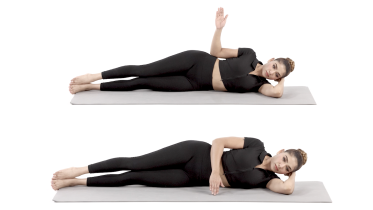 Side-lying external rotation
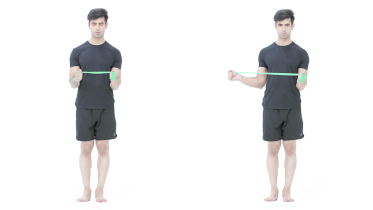 Shoulder external rotation with band
Stage 3: Reach up with control
When 3 sets of the stage 2 exercises feel easy and the shoulder is no worse the next morning, keep those going and add these. Rolling a ball up the wall takes the arm a little above shoulder height with the wall taking some of its weight, and wall angels practice lifting both arms while the shoulder blades stay low and back. The prone Y raise and the band row with a turn load the same muscles with the arm higher. Wall angels and the Y raise take the arms up beside your head, so stop below any height where the shoulder catches or pinches. Go higher over the weeks rather than in one session.
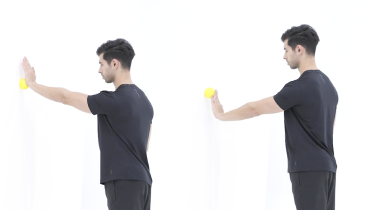 Wall ball shoulder flexion
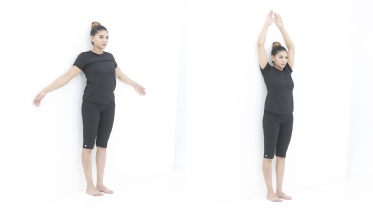 Wall angels
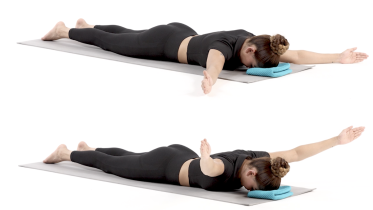 Prone Y raise
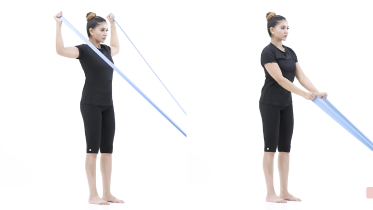 Band row with external rotation
What to avoid with shoulder impingement
The NHS advice is to keep gently moving the shoulder and not to stop using it completely, because that can slow recovery. Avoid the things that clearly make the pain worse, and do not make up your own strenuous exercises or use heavy gym equipment for now. Painkillers such as paracetamol or ibuprofen, or a heat or cold pack, can make it easier to keep moving. If you are not sure a medicine suits you, a pharmacist can tell you.
UK shoulder surgeons list rest alongside exercise in the first treatment (Kulkarni 2015). In practice that is usually relative rest, not stopping everything: cut back for a while on heavy lifting, heavy overhead pressing and long spells of work with the arms above your head, and keep up the lighter activity your shoulder copes with. Build the heavier work up again in small steps as the shoulder copes with the program. The rotator cuff tendinopathy page has more on sleeping and working with a sore shoulder, and on sport.
When to see a physio or doctor
The NHS advises seeing a physio or doctor if the pain is getting worse, has not improved after 2 weeks, or makes it very hard to move your arm. It is worth being assessed anyway, because other problems can feel like impingement. Pain on top of the shoulder where the collarbone meets it, a shoulder that clicks, locks or feels loose, a frozen shoulder and pain that spreads from the neck (see the neck pain program) each need a different plan.
If your shoulder has come out of joint before, the shoulder dislocation program is the better starting point. After any shoulder operation, follow the plan from your surgeon and physio instead of this one. Check the warning signs below as well. All of them need medical attention, and some need it straight away.
For physiotherapists
This page uses impingement as the search term patients arrive with and frames the condition as subacromial pain, or rotator cuff related shoulder pain in the sense of Lewis (2016). The rotator cuff tendinopathy page carries the fuller tendon-loading program and the imaging and injection discussion. This program adds scapular work, in line with the specific exercise arm in Holmgren and colleagues (2012), which combined eccentric rotator cuff exercise, concentric and eccentric scapular stabilizer exercise and manual mobilization.
The evidence on the scapula is mixed. Ratcliffe and colleagues (2014) found no consistent scapular orientation in subacromial impingement. Saito and colleagues (2018) reported short-term gains in pain and function from scapular-focused interventions without changes in forward shoulder posture or pectoralis minor length. Symptom modification with scapular or thoracic cues may guide exercise choice for an individual, but it is best not presented to patients as a fix for faulty posture. Progress on the 24-hour response, not on a set number of weeks.
See a doctor promptly if
- Chest pain or tightness, which may spread to your arm, neck or jaw, or shoulder or arm pain that comes with shortness of breath, sweating or feeling sick. This can be a heart attack. Call emergency services straight away.
- The shoulder is hot, red and swollen, or you have a fever or feel unwell. This can be a joint infection. Go to an emergency department the same day.
- The shoulder feels as if it has slipped out of place, looks a different shape or suddenly locks so you cannot move the arm, or the pain is severe after a fall or an injury. Go to an emergency department straight away, without driving yourself, and do not try to put the shoulder back in yourself.
- Your arm, hand or fingers turn cold, pale, blue or gray compared with the other side. Call emergency services or go to an emergency department straight away, and do not drive yourself. The blood supply to the arm may be blocked.
- Sudden, very bad shoulder pain, or you suddenly cannot lift or move your arm at all. Get medical help the same day.
- The pain started after a fall, a pull or another injury, especially if the arm has been weak since, for example you cannot lift it out to the side or hold it up. This can be a broken bone or a torn tendon. Ask for an urgent appointment with your doctor, within days rather than weeks, because UK shoulder surgeons advise urgent referral for a rotator cuff tear caused by an injury.
- Pins and needles or numbness in the arm that does not go away, no feeling in part of the arm, or weakness that is getting worse. Get medical advice the same day. For pain spreading down the arm from your neck, ask for an urgent appointment with your doctor. If one side of your face or body suddenly goes numb or weak, or your speech becomes slurred or muddled, call emergency services, even if it goes away.
- Severe pain in both shoulders that has come on recently. Ask for an urgent appointment with your doctor.
- You are over 50 and have aching and stiffness in both shoulders, often in the neck or hips too, that is worst in the morning and lasts more than 45 minutes after you get up. See your doctor within a few days, as this can be an inflammatory condition (polymyalgia rheumatica) rather than impingement. If you also get a new headache, pain or tenderness at your temples or on your scalp, or jaw pain when you eat or talk, get medical advice the same day, and if your vision changes, call emergency services.
- New shoulder pain and you have had cancer, now or in the past, or you are losing weight without trying. See your doctor within a day or two and mention it. If you are being treated for cancer now, contact your cancer team the same day.
- Night pain is common with this condition, but get checked within a few days if the pain is constant, no rest or change of position eases it at all, and it keeps getting worse. If you have had cancer, now or in the past, or are losing weight without trying, see your doctor sooner, within a day or two, and mention it. If you are being treated for cancer now, contact your cancer team the same day.
Common questions
Is shoulder impingement the same as rotator cuff tendinopathy?
Near enough. UK shoulder surgeons treat subacromial shoulder pain, rotator cuff tendinopathy and impingement as essentially the same diagnosis (Kulkarni 2015), and Lewis (2016) puts them together under one name, rotator cuff related shoulder pain. The Dutch guideline replaced impingement with subacromial pain syndrome because pinching of the tendon does not explain the problem well. Whatever name is on your letter, the exercise approach is much the same.
Does bad posture cause shoulder impingement?
Probably not on its own. A review by Barrett and colleagues (2016) found the rounding of the upper back was much the same in people with and without shoulder pain, and a review by Ratcliffe and colleagues (2014) found no single shoulder blade position that people with impingement share. Sitting tall does let people lift the arm a little higher in the moment, although the studies only tested a single session. So posture is worth a look, but a shoulder does not have to be held perfectly to get better.
What exercises should I avoid with shoulder impingement?
There is no fixed list. The NHS advice is to avoid the things that make the pain worse, not to stop using the shoulder, and not to make up your own strenuous exercises or use heavy gym equipment for now. In practice that usually means cutting back on heavy lifting, heavy overhead pressing and long spells of overhead work for a while, then building them up again as the shoulder settles. Your physio will help you decide what to trim and for how long.
How long does shoulder impingement take to get better?
It is usually slow. The NHS says it can take 6 months or longer to recover from shoulder pain, and suggests keeping up shoulder exercises for 6 to 8 weeks to help stop the pain returning. UK shoulder surgeons advise about 6 weeks of physiotherapy at first, and a further 6 weeks if it is helping (Kulkarni 2015). The exercise program in the Holmgren trial also ran for 12 weeks, so that is a fair time to give a program before you judge it. Some people find the pain comes back or never fully clears (Lewis 2016).
Do I need surgery to make more space in the shoulder?
For most people, no. The usual operation shaves bone and soft tissue from under the top of the shoulder (arthroscopic subacromial decompression). In two trials, CSAW in the UK and FIMPACT in Finland, it did no better than a placebo operation in which the surgeon only looked inside the joint. A BMJ guideline panel (Vandvik 2019) made a strong recommendation against this surgery for shoulder pain lasting over 3 months that did not start with an injury.
References
- Diercks R, Bron C, Dorrestijn O, et al. Guideline for diagnosis and treatment of subacromial pain syndrome: a multidisciplinary review by the Dutch Orthopaedic Association. Acta Orthopaedica. 2014;85(3):314-322. https://doi.org/10.3109/17453674.2014.920991
- Lewis J. Rotator cuff related shoulder pain: assessment, management and uncertainties. Manual Therapy. 2016;23:57-68. https://doi.org/10.1016/j.math.2016.03.009
- Kulkarni R, Gibson J, Brownson P, Thomas M, Rangan A, Carr AJ, Rees JL. Subacromial shoulder pain. BESS/BOA Patient Care Pathways. Shoulder and Elbow. 2015;7(2):135-143. https://doi.org/10.1177/1758573215576456
- Holmgren T, Björnsson Hallgren H, Öberg B, Adolfsson L, Johansson K. Effect of specific exercise strategy on need for surgery in patients with subacromial impingement syndrome: randomised controlled study. BMJ. 2012;344:e787. https://doi.org/10.1136/bmj.e787
- Saito H, Harrold ME, Cavalheri V, McKenna L. Scapular focused interventions to improve shoulder pain and function in adults with subacromial pain: a systematic review and meta-analysis. Physiotherapy Theory and Practice. 2018;34(9):653-670. https://doi.org/10.1080/09593985.2018.1423656
- Ratcliffe E, Pickering S, McLean S, Lewis J. Is there a relationship between subacromial impingement syndrome and scapular orientation? A systematic review. British Journal of Sports Medicine. 2014;48(16):1251-1256. https://doi.org/10.1136/bjsports-2013-092389
- Barrett E, O'Keeffe M, O'Sullivan K, Lewis J, McCreesh K. Is thoracic spine posture associated with shoulder pain, range of motion and function? A systematic review. Manual Therapy. 2016;26:38-46. https://doi.org/10.1016/j.math.2016.07.008
- Beard DJ, Rees JL, Cook JA, et al. Arthroscopic subacromial decompression for subacromial shoulder pain (CSAW): a multicentre, pragmatic, parallel group, placebo-controlled, three-group, randomised surgical trial. The Lancet. 2018;391(10118):329-338. https://doi.org/10.1016/S0140-6736(17)32457-1
- Paavola M, Malmivaara A, Taimela S, et al. Subacromial decompression versus diagnostic arthroscopy for shoulder impingement: randomised, placebo surgery controlled clinical trial. BMJ. 2018;362:k2860. https://doi.org/10.1136/bmj.k2860
- Vandvik PO, Lähdeoja T, Ardern C, et al. Subacromial decompression surgery for adults with shoulder pain: a clinical practice guideline. BMJ. 2019;364:l294. https://doi.org/10.1136/bmj.l294
- NHS. Shoulder pain. Page last reviewed 22 May 2023. https://www.nhs.uk/symptoms/shoulder-pain/
- NHS. Heart attack. Page last reviewed 31 March 2026. https://www.nhs.uk/conditions/heart-attack/
- NHS. Polymyalgia rheumatica. Page last reviewed 23 April 2023. https://www.nhs.uk/conditions/polymyalgia-rheumatica/
- NHS. Temporal arteritis. Page last reviewed 14 August 2023. https://www.nhs.uk/conditions/temporal-arteritis/
Written and checked by the PocketPhysio editorial team. Last updated 2026-09-28.
This page is general education, not a diagnosis or a personal treatment plan. See a physiotherapist or doctor for advice about your own situation.