Prone scapular retraction
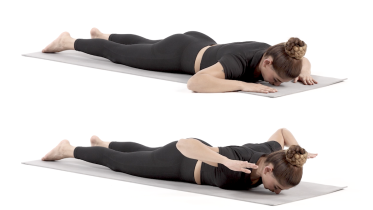
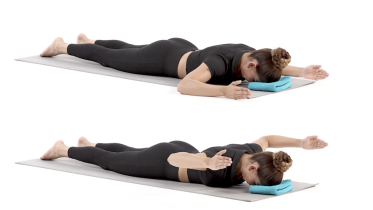
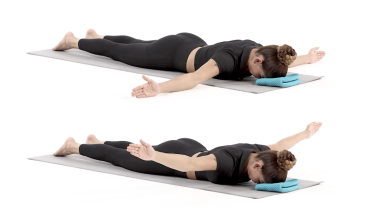
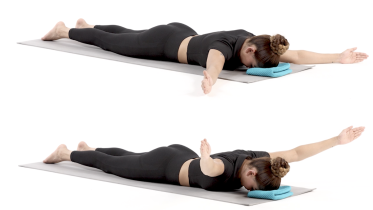
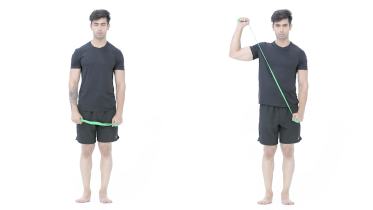
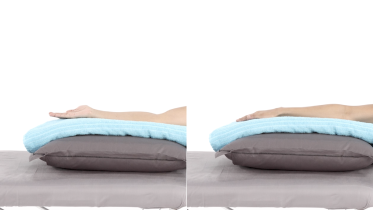
Prone scapular retraction is a small exercise for the muscles that pull your shoulder blade in toward your spine (middle trapezius and rhomboids). You lie face down with one arm hanging over the edge of a bed, then draw that shoulder blade back so the arm rises a little. Physios often give it early in shoulder rehab, before you lift the whole arm against gravity.
How to do the prone scapular retraction
- Lie face down on a firm bed or treatment table, near enough to the edge that one arm can hang straight down toward the floor. Rest your head on the bed, turned to whichever side is comfortable.
- Let the hanging arm go completely loose, with the elbow straight and the fingers relaxed.
- Draw that shoulder blade back and in toward your spine. The shoulder stays well away from your ear.
- Let the arm rise only as far as the shoulder blade carries it. This is a few centimeters at most, and the elbow stays straight.
- Hold for a moment, then let the shoulder blade slide slowly back out until the arm hangs freely again.
What you should feel
A small, focused effort between the shoulder blade and the spine on the side of the hanging arm. The top of the shoulder and the neck stay relaxed.
Common mistakes
- Lifting the arm with the shoulder muscle, as if raising it forward or out to the side. The shoulder blade leads and the arm simply follows.
- Shrugging that shoulder up.
- Bending the elbow to make the movement look bigger.
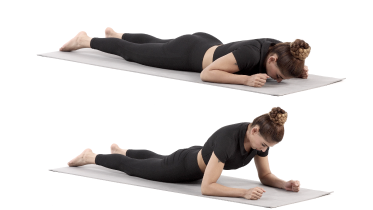
- Lifting your chest or twisting your body off the bed.
How often
Many programs start with 2 to 3 sets of 10 to 15, holding each squeeze for 3 to 5 seconds, once or twice a day. Your physio will adjust this.
Stop and check with your physio if
- A sharp pain or a catch in the shoulder as the blade moves.
- Tingling, numbness or pain running down the hanging arm.
- Pins and needles in your arm or hand that do not go away after you stop, or part of your arm or hand goes numb. Get medical advice the same day. If one side of your face or body suddenly goes numb or weak, or your speech becomes slurred or muddled, call emergency services, even if it goes away.
- The shoulder feels loose or as if it might slip while the arm hangs.
- The shoulder feels as if it has slipped out of place, looks a different shape or suddenly locks so you cannot move the arm, or your hand turns cold, pale or blue. Go to an emergency department straight away, without driving yourself, and do not try to put the shoulder back in yourself.
From the clinic
The movement is tiny. In the video you can hardly see it, and yours will look much the same. What matters is that the shoulder blade moves toward your spine and takes the arm with it. The arm should not lift on its own. The voice guide suggests lying diagonally across the bed if that gives your body more support, and it tells you to start with your weaker arm.
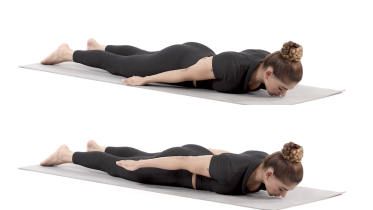
Once this feels easy, a common next step is lifting the whole arm, as in the prone T raise. The seated scapular squeeze trains the same shoulder blade movement sitting up.
After shoulder surgery, or if your shoulder has ever dislocated, get your surgeon's or physio's okay before you let the arm hang, because its weight pulls on the joint. If you are pregnant, ask your physio for a version that does not need you to lie on your stomach.
Written and checked by the PocketPhysio editorial team. Last updated 2026-09-28.
This page is general education, not a diagnosis or a personal treatment plan. If you have pain, an injury or a health condition, see a physiotherapist or doctor before starting new exercises.