
Rotator cuff tear exercises, and the decision about surgery
Warning signs, and when to get help
What a rotator cuff tear is, and why a tear on a scan is not the same as a painful shoulder
Four small muscles wrap around the ball of your shoulder and blend into a single sheet of tendon, the rotator cuff. They turn the arm in and out and keep the ball centered in its socket while the big muscles do the lifting. A tear means part of that sheet has come away from the bone or split through its thickness. A partial-thickness tear goes part of the way through, a full-thickness tear goes all the way through, and the size is usually described in centimeters across.
A tear can come from one event or from years of load. The sudden kind has a story attached: a fall onto the arm, a hard pull from a dog lead, catching yourself on a handrail, with immediate weakness and sometimes a snapping sensation. The gradual kind has no moment, builds over months, and is far more common after about 50.
Here is the part that confuses almost everybody. The words on a scan report do not tell you how much trouble your shoulder is in. Plenty of people have a full-thickness tear and a shoulder that works, and plenty of people have a small tear and cannot sleep. So the question that counts is what your arm does, not what the radiologist wrote, which is also why your surgeon examines the shoulder instead of reading the report alone.
This page is for adults who have been told they have a tear and are not having surgery, or not yet. If you have had a repair, go to rotator cuff repair rehab and follow your surgeon's protocol, because the early limits after an operation are completely different from anything here. If nobody has examined your shoulder, start with shoulder pain when lifting your arm and get it looked at first.
Can a rotator cuff tear get better without surgery?
Two statements get run together constantly. Keep them apart.
The first: the tendon is not expected to knit back onto the bone. Nothing in a home program reattaches a torn cuff. OrthoInfo, the patient site of the American Academy of Orthopaedic Surgeons, says a rotator cuff tear can get larger over time, and that pushing on through increasing pain may cause further damage.
The second: a great many shoulders with a torn cuff become much less painful and much more useful with guided exercise. OrthoInfo puts it at about 80 to 85% of patients getting pain relief and improved function from nonsurgical treatment. The page gives no study for it, which is worth knowing before someone quotes it at you as settled fact. The wider versions on clinic websites, usually 60 to 90%, have no source either.
The measured version is better. In a multicenter US cohort, 452 people with atraumatic full-thickness tears started a structured physical therapy program and were reviewed at 6 and 12 weeks. Patient-reported outcomes improved significantly, fewer than a quarter elected surgery, and the authors concluded the treatment was effective in approximately 75% of patients followed for 2 years (Kuhn and colleagues, 2013). Median age in the companion analysis of the same group was 62, and the single strongest predictor of ending up in theater was not tear size or age, but what the patient expected physical therapy to do for them (Dunn and colleagues, 2016).
So: often a much better shoulder, not a healed tendon. Anybody who blurs those two together is doing you no favors.
What the research found when exercise was compared with surgery
The one trial that randomized people and then followed them for long enough to matter is Norwegian, and it does not say what most pages about avoiding surgery say.
It took 103 patients with a full-thickness tear no bigger than 3 cm and randomized them to tendon repair or to physiotherapy with the option of surgery later. Assessors were blinded, and people came back at 6 months and at 1, 2, 5, 10 and 15 years.
At 10 years, repair was ahead on every outcome that reached significance: the Constant score by 9.6 points, the ASES score by 15.7, pain by 1.8 cm on a 10 cm scale, and pain-free movement in both directions. The people who had crossed over from physiotherapy to late surgery scored 10.0 points lower on the Constant score than those repaired at the start (Moosmayer and colleagues, 2019).
At 15 years, with 83 of the 103 still attending, the gap had widened rather than closed: Constant by 11.8 points, ASES by 13.9, pain by 1.8 cm again, pain-free flexion by 22.4 degrees. General health on the SF-36 showed no difference between the groups. In the 26 tears managed by physiotherapy alone and measured by ultrasound, mean front to back tear size had gone from 16.2 mm to 31.6 mm (Moosmayer and colleagues, 2024).
None of that makes a repair a safe bet, and the same trial is where the other half of the honesty lives. At the 10 year review a retear was found in 34% of the shoulders that had been repaired at the start, and those 16 shoulders scored 76.9 on the Constant score against 82.9 for the 31 whose repair was still intact, a difference of 6.0 points. In the physiotherapy group the tear growth was not evenly spread either: by 10 years it had grown by more than 5 mm in 19 of 32 shoulders and by more than 10 mm in 13, and the ones that grew by more than 10 mm scored 63.9 against 78 for the ones that grew less, which is 14.0 points worse. Both figures are set out in the AAOS guideline's own reading of the trial (AAOS, 2025). So a third of repairs do not hold, and the tears that run away are the ones that cost you most.
Alongside the trial sits the same surgeon's look at what simply happens to tears nobody repairs. In 49 small to medium full-thickness tears treated with physiotherapy and re-examined after a mean of 8.8 years, the tear had grown by an average of 8.3 mm front to back. Of the 37 who had an MRI, muscle wasting had progressed in 18 and fatty change in 15. And the size of the growth was what tracked with the shoulder: the Constant score was 81 points where the tear had grown by less than 20 mm, against 58.5 points where it had grown by 20 mm or more. The authors' own summary is the fair one, in both directions: anatomical deterioration was found in the majority, but it was often moderate (Moosmayer and colleagues, 2017). Neither path comes with a guarantee.
Two limits sit on all of this. Everything above is about a full-thickness tear, so if your scan says partial thickness, this comparison is not about your shoulder. And every tear in the Norwegian trial was 3 cm or smaller. Nothing in it describes a large or a massive tear, and nothing in it describes a tear that cannot be repaired. For those shoulders the AAOS has no reliable evidence at all: its recommendations there are the workgroup's opinion, listing physical therapy, partial repair, tendon transfer, a biceps procedure, superior capsular reconstruction, debridement, a balloon spacer or a graft as things that can improve outcomes, and reverse shoulder replacement where the joint has also worn out and other treatments have failed (AAOS, 2025). If a surgeon has used the words large, massive or irreparable about your tear, you are in that group, and the numbers on this page are not yours.
Hold the US cohort against the Norwegian trial for a moment, because the two are not actually arguing. One asked what happens to a group of mostly older people with gradual tears who are offered a program, and found that three quarters of them did well enough not to want an operation. The other asked which of two paths produces the better shoulder in people willing to be randomized to either, and found it was repair, by a margin that grew. If you have only been shown the first of those two, you have been shown half the decision.
The AAOS published an updated clinical practice guideline on the management of rotator cuff injuries on 18 August 2025, covering adults, with 21 recommendations and 8 options. Three of those recommendations cover most of the ground here, and they are worth reading close to the AAOS's own words.
On strong evidence, in symptomatic small to medium full-thickness tears, both physical therapy and surgery produce significant improvement in patient-reported outcomes. Also on strong evidence, patient-reported outcomes improve with physical therapy in symptomatic full-thickness tears, but the tear size, the muscle wasting and the fat that replaces muscle may all progress over 5 to 10 years without surgery. On moderate evidence, repairs that heal give better patient-reported and functional outcomes than physical therapy does, and better than repairs that do not heal (AAOS, 2025).
Put them side by side and the shape of the decision shows. Exercise is a real treatment for this, with a strong recommendation behind it. It does not stop the tendon, the muscle or the fat from changing, and those changes are what later decide whether a repair is still worth attempting. And an operation is only ahead of exercise if the repair holds.
One guideline that does not apply here, although it gets borrowed often: the 2025 physical therapy guideline on rotator cuff problems says in its own summary that it covers rotator cuff tendinopathy, with or without calcifications, and partial-thickness tears (Desmeules and colleagues, 2025). That is its scope. Its recommendations live on rotator cuff tendinopathy where they belong, and they are not evidence about a full-thickness tear. Carrying a recommendation across from one population to another is how advice ends up sounding more certain than the research underneath it.
If your own tear is partial thickness, the AAOS deals with you separately, and more cautiously than you might hope. For a low or intermediate grade partial tear its position is the workgroup's opinion in the absence of reliable evidence: physical therapy can improve outcomes, and surgery can improve outcomes in people whose pain and loss of function persist after proper non-surgical treatment. For a high grade partial tear that has not responded to physiotherapy it is firmer, saying on strong evidence that debridement or repair can be performed and that repair can improve outcomes (AAOS, 2025).
When is surgery recommended for a rotator cuff tear?
No web page can make that call, and the phrasing people search for invites a verdict nobody should give you online.
Three situations push toward a surgical opinion early, before a trial of exercise. A tear caused by a definite injury, particularly in a younger shoulder. An arm that cannot be lifted at all after a fall or a sudden pull, which is a same day problem and is in the warning signs below. And a tear in the working arm of someone whose job or sport depends on overhead strength, where months spent finding out is a cost in itself.
The reason they do is easy to misread. It is not that the research favors surgery for them. It is that the research has barely looked at them. Both long trials above studied gradual tears in shoulders around 60. The one randomized trial in acute traumatic tears found no significant difference between early repair and physiotherapy at 12 months, and its patients had a mean age of 59.7 years and a median tear of about 10 mm, so it does not describe a 35 year old either (Ranebo and colleagues, 2020).
That trial is also less reassuring than its headline. Within the first year, the tear had enlarged by more than 5 mm in 29.2% of the patients who were not repaired, against a retear in 6.5% of those who were (Ranebo and colleagues, 2020). Equal scores at a year do not mean equal shoulders underneath. The AAOS guideline names the gap itself, listing younger patients, traumatic tears, acute tears on top of chronic ones and larger tears as the comparisons still needing studies (AAOS, 2025).
So for a traumatic tear in a young arm there is no trial to hand you an answer. Instead there is a window: a recently torn tendon that has not yet pulled back and filled with fat is the most repairable it will ever be, and that window closes on its own schedule. The hardest number behind that comes from 147 isolated supraspinatus repairs followed for 10 years, where the retear rate tracked how much fat had already worked its way into the torn muscle before the operation: 10% where there was none, 22% at stage 1 and 31% at stage 2. The authors' own recommendation was that rapid surgery be considered before fat accumulates, particularly in young, active patients (Godenèche and colleagues, 2017). That is a reason to be seen early, not a reason to assume you need an operation.
Against that sits the commonest picture by a long way: a gradual, non-traumatic tear in a shoulder over 50, with pain and a reaching problem rather than an arm that will not work. That is the shoulder the US cohort studied, and guided exercise is a reasonable first step for it.
OrthoInfo adds the clinical markers a surgeon weighs, and the list is worth having whole, because the items usually left off it are the ones that would send you to a surgeon. Continued pain is the main reason for having surgery, it says, and a doctor may also suggest it if you are very active or use your arms for overhead work or sports. The other signs it lists that surgery may be a good option are symptoms that have lasted 6 to 12 months, a large tear of more than 3 cm where the quality of the surrounding tissue is good, significant weakness and loss of function in the shoulder, and a tear caused by a recent, acute injury. That last one is the item that changes what you should do today rather than at your next appointment: UK shoulder surgeons advise urgent referral for a cuff tear caused by an injury, which is why it also sits in the warning signs below.
Take these into the appointment written down, because the consultation is short and this decision is not.
- Is my tear partial or full thickness, how big is it, and which tendons are involved?
- When you examine my shoulder, is the weakness in proportion to the tear?
- Was this a sudden injury or a gradual tear, and does that change what you would advise?
- If I try rehab first, for how long, who reviews it, and what would make you change to surgery?
- Would a repair be likely to heal in a shoulder like mine, and what would make it less likely?
- What would each path mean for my job and the sport I want back?
Then ask the same questions of whoever runs your rehab. The surgical decision and the exercise plan are made by two different people, and both of them should know what the other has said.
Warning signs that need urgent assessment
Some of the lines below matter more than the rest when you already know there is a tear, and they are the ones to act on instead of training through.
An arm that suddenly cannot be lifted or moved at all needs help the same day. So does new shoulder pain that started with a fall, a pull or another injury, especially if the arm has been weak since, because UK shoulder surgeons ask for urgent referral in exactly that situation. The same goes for lift that has dropped away since a fall or a jolt even when the shoulder is not especially painful, which is easy to write off precisely because it does not hurt much.
A sudden pop or tearing feeling with sharp pain, new weakness or trouble lifting the arm needs medical advice the same day. A tear can extend, and the sign people notice is almost never the pop. It is lift that was coming back and has gone again.
One of them is quiet, and it is the one people train through for months. Lift that has gone backwards over a week or two, with no injury and no pop, means asking for a review within a few days rather than adding repetitions. A tear that is extending does it without an event to point at, and strength that is going the wrong way is the only thing telling you.
And chest or arm pain with breathlessness, sweating or feeling sick is not a shoulder problem. Shoulder and arm pain is one of the ways a heart attack presents, which is why that line comes first below.
What a non-surgical program involves, and how long it takes
It is not a gentler version of the post-surgical program. It is most of the same work without the operation at the front of it, and it runs for months.
A program is not treatment for the tendon either. It builds everything around the tear: the muscles that turn the arm, the muscles that position the shoulder blade, and the control that lets the remaining cuff keep the ball centered while you reach. Some shoulders do very well on that, and the ones that do not are usually the ones that cannot hold the arm up, not the ones that hurt.
On timing, the US cohort gives the most useful signal anybody has. Most of the people who chose surgery did so between 6 and 12 weeks, and very few had surgery between 3 and 24 months (Kuhn and colleagues, 2013). So about three months of properly supervised work is roughly when the answer becomes clear, which is a reasonable thing to agree with your physio at the start, so the months do not simply drift.
The same group has since published the 10 year follow up, and it cuts both ways. Physical therapy was still effective for over 70% of the cohort at 10 years, and the patient-reported scores that improved by 12 weeks had not declined over the decade, so a shoulder that does well on a program tends to go on feeling and working well. Be exact about what that study followed. It reports how 452 patients rated their own shoulders across the decade, not what their tears were doing. A stable score is not a stable tear.
But of the people who did end up having surgery, 56.7% had it in the first 6 months and 43.3% had it somewhere between 6 months and 10 years, so the decision is not always settled at three months. The figure that will reassure most people: across the whole cohort, one patient went on to a reverse shoulder replacement, which is 0.2% (Kuhn and colleagues, 2024).
There is one thing that reassurance does not cover. A shoulder that feels fine is not the same as a tear that has stayed the same size, and those two can part company for years. The AAOS guideline says both halves of that out loud. Anyone choosing physical therapy, it says, should be told that over a 10 year period their tear size may progress and that this could lead to a substantial decline in their perceived and measurable outcomes. That decline is usually not pain. The guideline's own account of the harms is that people treated without surgery are at risk of losing strength as the tear grows, and in the Norwegian trial the shoulders whose tear had grown by more than 5 mm were measurably weaker at five years than the shoulders whose tear had grown less, by 4.2 kg (9 lb) on the strength measure (AAOS, 2025, reading Moosmayer and colleagues, 2014). A growing tear costs you lift, and lift is the thing to keep watching.
Then the guideline adds the part patients are almost never told: where surgical repair remains a viable option, keeping the shoulder under review, with examination and imaging over time, may be considered (AAOS, 2025). Turn that into a question and ask it, in roughly these words. Is a repair still an option for my shoulder, and if it is, who is keeping an eye on it, what would they be looking for, and should it be scanned again? Ask at your next appointment. If you do not have one, ring the physiotherapist or the doctor who set the program up and ask for one, and if nobody is following the shoulder at all, which is where most people are a year into a home program, start with your own doctor and ask to be sent back to whoever gave you the diagnosis. Keep your own record in the meantime, because the thing they will ask about is what the arm does rather than how much it hurts: once a month, note how high it goes, whether you can hold it at shoulder height, and whether anything you managed last month has gone. Feeling better is not the same as the question being closed, and nobody will set that up unless you ask.
Supervision is the variable people underestimate, although not in the way you might expect. In the GRASP trial of over 700 UK adults with rotator cuff disorders, one best practice advice session with a physiotherapist, plus a booklet, a resistance band and a home exercise program with videos, did as well at 12 months as up to 6 sessions of progressive exercise (Hopewell and colleagues, 2021). That trial was not about full-thickness tears, so read it as encouragement that a well-set-up home program is a real treatment, not as permission to skip the assessment that sets it up.
How to use this program
Pick the stage that matches your shoulder this week. If you are not sure, start at stage 1. Move up when the current stage feels easy and the shoulder is no worse the next morning.
One check before you settle into this, because it is the only thing on this page with a clock on it. If your tear followed a definite injury, a fall, a hard pull or a shoulder that came out of joint, and no surgeon has given you an opinion yet, get that opinion before you start counting weeks. The same goes if you are a good deal younger than the people in the trials above, who averaged around 60, and if you cannot lift the arm out to the side and keep it there after someone has lifted it for you. That last one is the finding a surgeon most wants to see for themselves, so ask for that opinion within days rather than starting the program and reviewing it in three months. If the injury also left you with a numb patch on the outer side of the upper arm, say so when you ring, because a nerve can be stretched by the same event and the warning signs below put that at the same day. None of that means you need an operation. It means the decision is better made now than discovered in three months, and the exercises will still be here either way.
As a rough guide, the stage 1 holds are often 5 to 10 holds of 5 to 10 seconds, once or twice a day, at well under maximum effort. The stage 2 and stage 3 exercises are commonly 2 to 3 sets of 8 to 15 slow repetitions. How often depends on what the exercise is for. The movement work, meaning the two stick exercises and the wall slides, is usually done daily. The exercises that build strength without a band suit once a day or every other day, and the band work 2 to 3 days a week. Build repetitions and sets before you reach for a stronger band. Your physio or physical therapist will adjust the exercises and the numbers to your shoulder and to what you need to get back to, and with a tear that adjustment matters more than usual.
One fault is worth knowing about before you start, because nearly everyone makes it and almost nobody feels it: the shoulder hitches up toward the ear and the body leans away as the arm goes up, which gets the hand higher and leaves the cuff doing less. You can catch it on yourself two ways. Stand side on to a mirror or a dark window and watch the top of the shoulder instead of the hand. And in the wall slides, rest your free hand flat on top of the working shoulder: if it rises under your hand, stop just below that point, because height you reach by shrugging is not height the shoulder has earned. Working lower and honestly is worth more here than working high.
Mild discomfort during these exercises is common and usually fine if it eases soon after you finish and the shoulder is no worse the next morning. Sharp or catching pain, pain that builds with each repetition, or night pain that has come back means the load was too much. Drop back a step rather than stopping.
Weakness is the signal to take more seriously than pain. An arm that will not hold a position it held last week is a reason to be reviewed within a few days, not a reason to do more repetitions. If the strength went after a fall, a jolt or a sudden pull, that is the same day rather than within a few days, and it is in the warning signs on this page.
If you have high blood pressure, breathe steadily through every hold and never hold your breath. If chest pain, pressure or tightness does not ease quickly when you rest, spreads to your arm, neck, jaw, stomach or back, or comes with sweating, feeling sick, feeling light-headed or being short of breath, call emergency services straight away, as this can be a heart attack. If it eases quickly and none of these happen, get medical advice the same day, and do not exercise again until you have been checked. After shoulder surgery, including a rotator cuff repair, or after a shoulder fracture or dislocation, follow your surgeon's or physio's plan, and do only the movements and range they have cleared. Many plans allow only passive movement at first, where the arm is moved for you and its muscles stay relaxed.
The exercise program
Stage 1: Settle it and keep the shoulder moving
For a shoulder that is painful at rest, sore at night, or struggling with small reaches. Nothing here lifts the arm with its own cuff muscles. The pendulum lets the shoulder joint itself move while the arm hangs loose, with your good hand staying on a table the whole time rather than leaning forward unsupported, and the shoulder circles are a warm-up for the shoulder blades, rolling them up, back and down with the arms hanging at your sides. In the lying assisted lift your good arm carries the sore one, and in the seated passive lift somebody else lifts it for you while your own muscles do nothing, so the torn tendon is not pulling either way. The seated one needs a second person, so if you are on your own, do the lying version. The two isometric holds work the muscles that turn the arm out and lift it to the side while the arm stays still, which many people can manage even when lifting hurts. Push gently into your hand or the wall, well short of your hardest, and keep breathing. Many programs use 5 to 10 holds of 5 to 10 seconds, once or twice a day, and 30 to 60 seconds in each direction for the pendulum. If the shoulder is sorer the next morning, push more gently or hold for less time. Your physio will adjust this.
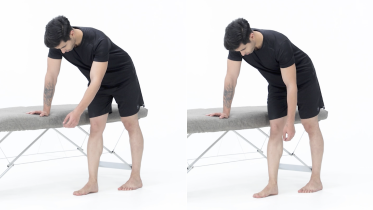 Pendulum exercise for the shoulder
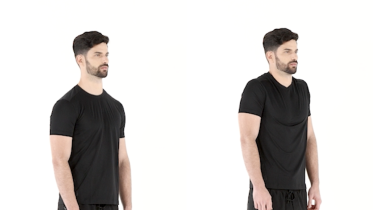 Shoulder circles
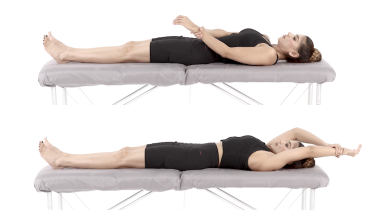 Lying assisted shoulder flexion
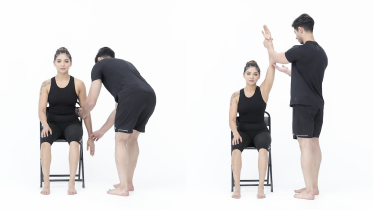 Seated passive shoulder flexion
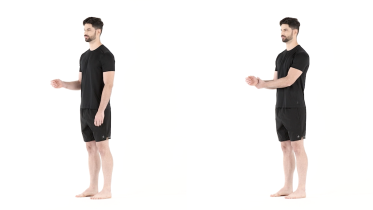 Isometric shoulder external rotation
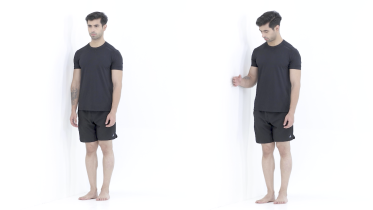 Isometric shoulder abduction
Stage 2: Movement back, shoulder blade working
When the holds feel easy and reaching to chest height hurts less, often after two to four weeks. The two stick exercises use your good arm to take the weight while the shoulder goes further, in a comfortable range rather than stretching into pain. Wall slides rebuild reaching upward with the wall supporting part of the arm, and if there is a painful spot partway up, stop just below it for now. Seated scapular retraction and prone scapular retraction train the muscles that steady the shoulder blade, which is where a torn cuff needs the most help, because the blade has to position the socket for every reach. The prone one is done face down on a bed with the arm hanging over the edge, so roll onto your front from your side rather than lowering yourself onto your hands, which sends your weight through the sore arm. If getting down there and back up again is hard, or lying on your front is uncomfortable, do the seated version on its own for now. Side lying external rotation with no weight in the hand is the first movement the cuff itself makes against gravity. Lie on the side that does not hurt, so the torn shoulder is the one on top. The effort peaks halfway up, where the forearm is level with the floor, and eases as the hand nears upright, so the middle of the range is where to slow down, and the lowering is done just as slowly. Many programs use 2 to 3 sets of 8 to 15 slow repetitions. The two stick exercises and the wall slides are movement work rather than strength work, so they are usually done daily, while the three that build strength do better with a day off in between.
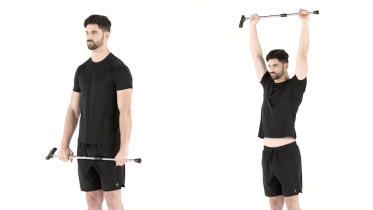 Shoulder flexion with a stick
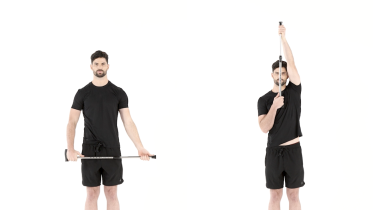 Shoulder abduction with a stick
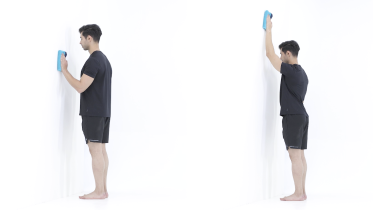 Wall slides with a towel
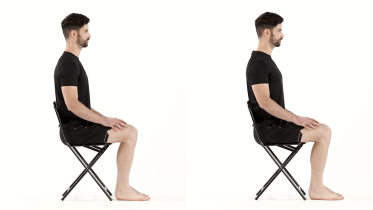 Scapular squeeze
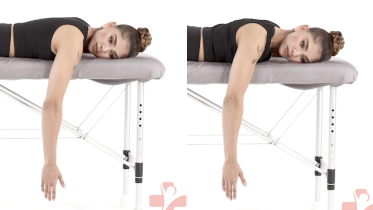 Prone scapular retraction
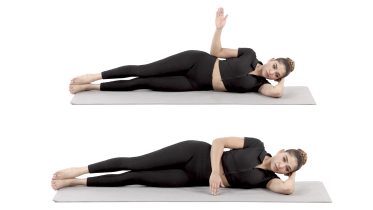 Side-lying external rotation
Stage 3: Strengthen the cuff and the arm
When 3 sets of the stage 2 exercises feel easy and the shoulder settles well by the next day. Keep the stage 2 work going and add these. The two band turns strengthen the muscles that rotate the arm with the elbow tucked at your side, which loads the cuff without lifting the arm. The band row and the serratus punch train the muscles around the shoulder blade under more load. The full can raise is the only exercise here that can end up with a weight in your hand, which is why it comes last and why it has three conditions in front of it. First: if you cannot raise the arm out to shoulder height on its own and hold it there, do not do this one at all, and tell your physio that is where you are, because an arm that will not hold its own height is something to be examined rather than something to add weight to. Second: sit on a firm chair without arms, with both feet flat on the floor. The video shows this on an exercise ball, and the ball stays out of it until your own physio has watched your balance and said otherwise, because it adds a balance task that does nothing whatever for the shoulder and gives you somewhere to fall from; if you have fallen in the past year, often feel unsteady or dizzy, or have low bone density (osteoporosis), the ball is not one to try at home at all. Third: start with nothing in your hands. Sit tall with your arms by your sides and your thumbs pointing forward, then raise both arms up and out, keeping the thumbs turned up as if you were holding a full can, to shoulder height and no higher. Many physios set the angle a little forward of straight out to the side, which usually feels more comfortable on a torn cuff. Stay with the empty-handed version until it leaves the shoulder no worse the next morning. Only then add a weight, and it is smaller than most people reach for: a 500 ml bottle of water or a small can of food in each hand, about 0.5 kg (1 lb), and no more than 1 kg (2 lb) in each hand unless your physio has said so. If the lightest dumbbell in the house is heavier than that, use the bottles rather than the dumbbell. The exercise page for it is written around the ball, because that is what the video shows, so read a firm chair in place of the ball in every step. Its weights run higher than this program does too, because it is written for any shoulder rather than for a torn one. The chair and the 1 kg (2 lb) ceiling above are the ones that apply to you. Thumbs up and stopping at shoulder height is what separates it from the lateral raise this program leaves out, where palms turn down and the arm goes higher, which is the position that loads a torn cuff through its sorest range. If the arm hurts with any weight in it, put the weight down and go back to the empty-handed version rather than working through it. The wall push up plus adds a pushing load and works the muscle that holds the blade flat against the ribs. Many programs use 2 to 3 sets of 8 to 15 slow repetitions, 2 to 3 days a week, with a light band to begin with. Build the repetitions and sets before you move to a stronger band. A deliberate omission: there is no free weight lateral raise in this program, because it loads a torn cuff through the range that usually hurts most, and that decision belongs with your physio rather than with you.
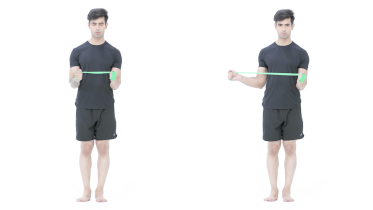 Shoulder external rotation with band
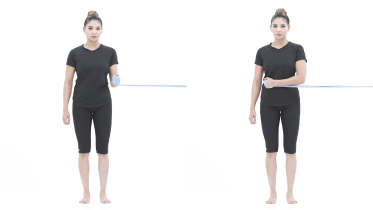 Shoulder internal rotation with band
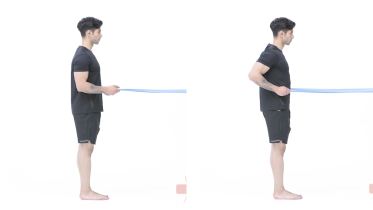 Resistance band row
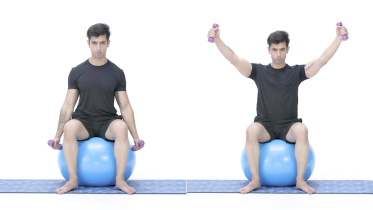 Full can raise on a ball
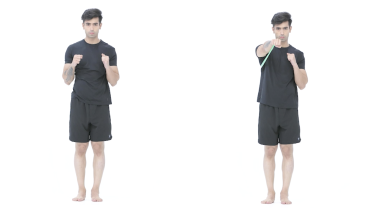 Band serratus punch
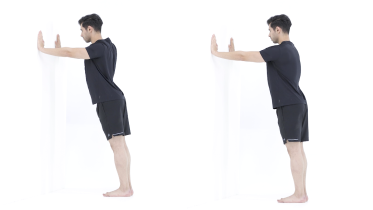 Wall push up plus
Sleeping, dressing, driving and work
Night pain is usually the first thing to improve and the first thing to come back when the week has been too heavy, so treat it as your own personal load monitor. Most people sleep better on the good side hugging a pillow, or on their back with a pillow under the sore arm so it rests slightly forward rather than dropping back behind the line of the body. Shoulder pain at night goes through the night in more detail.
Dressing has a running order that saves a lot of pain: sore arm into the sleeve first, sore arm out of the sleeve last. A front-fastening top beats anything you have to pull over your head while the shoulder is at its worst, and a long-handled shoe horn and a back brush are not an admission of defeat.
Driving is mostly about reaching rather than steering. Set the mirrors so you turn your head instead of your trunk, keep both hands low on the wheel, and do not reach into the back seat for a bag with the sore arm. If you cannot control the car safely one-handed in an emergency, you are not ready to drive, and your insurer will take the same view.
At work, the changes that help are the dull ones. Move what you use often down to waist or chest height. Carry loads close to your body with the elbow bent, and split a heavy bag into two. Break long spells of overhead work into short blocks with the arms down in between. Pressing at the gym is the thing to park rather than drop: shoulder pain on the bench press covers how to change a pressing session.
Do injections help a rotator cuff tear?
For pain, sometimes, and briefly. In the GRASP trial a subacromial corticosteroid injection gave slightly better pain and function at 8 weeks and no difference at 12 months (Hopewell and colleagues, 2021). That is the honest size of the effect, in a trial of rotator cuff disorders rather than of full-thickness tears specifically.
The useful way to think about it is as a window rather than a treatment. If pain is stopping you doing the program at all, an injection may let you start it, and that is a reasonable thing to discuss with your doctor. It does nothing to the tear, and UK shoulder surgeons put a limit on how many you should have as part of nonsurgical care.
The AAOS guideline gives the reason behind that limit, and it is a reason worth knowing before you agree to a third or a fourth. Repeated steroid injections may weaken what is left of the cuff, which may then affect an attempt to repair it later, and a single injection given close to the date of an operation may make the result of that operation worse (AAOS, 2025).
Where each of those sits matters, because the honest answer is not that they are weak. The statement about repeated injections rests on what the guideline calls high quality evidence, and is set out as a limited option rather than as a recommendation. The point about an injection given close to an operation is not graded on its own at all: it sits in the risks and harms attached to the guideline's recommendation on single corticosteroid injections, which is itself a moderate recommendation on high quality evidence. They are still the two things to raise with whoever is holding the needle, particularly if an operation is a live possibility for you, because the doctor offering the injection is often not the surgeon who would do the repair.
An injection is not a substitute for the decision. If the reason your shoulder is not working is that the arm cannot hold itself up, numbing it does not change that, and the months spent finding out are months a surgeon might have wanted.
What to do if it is not improving
Go back for review rather than adding repetitions, and be specific about who and when. The signs that a program has run out of road are a shoulder that is no better over 6 to 12 weeks of regular work, strength that is not building, an arm you still cannot hold up after someone else has lifted it there, or pain that is stopping you doing the exercises at all.
Who: the physiotherapist or the doctor running the program, and if nobody was named, your own doctor, asking to be sent back to whoever gave you the diagnosis. When: book it at the 6 to 12 week mark rather than waiting for a routine appointment that may be months off. Sooner than that, within a few days, if strength is going backwards rather than merely standing still. And the same day if the arm stopped lifting after a fall, a jolt or a sudden pull, which is in the warning signs on this page. A shoulder that is getting worse is not a dose problem to be solved at home.
A few things are worth re-checking at that point, and the nerve one below is the easiest of them to miss.
Whether the diagnosis is complete, because a stiff, truly restricted shoulder points toward frozen shoulder instead, a sudden hot, intensely painful shoulder can be calcific tendinitis, and pain spreading below the elbow with pins and needles usually comes from the neck.
Whether a nerve, rather than the tendon, is the reason the arm will not work. This is the mix-up that matters most here, because a torn cuff and an injured nerve both give you a painful shoulder and an arm that will not lift, and cuff exercises are the right answer to only one of them. A scan showing a tear does not settle it either, since tears are common in shoulders that work fine. Three patterns are worth naming to whoever examines you. A numb patch on the outer side of the upper arm together with trouble lifting the arm out to the side points at the nerve to the muscle over the outside of the shoulder, the axillary nerve, which can be stretched when a shoulder dislocates or when the top of the arm bone breaks. Weakness turning the arm outward, with hollowing in the muscle below the shoulder blade, points at the nerve that supplies the cuff muscles themselves, the suprascapular nerve. And a bout of rapidly starting, severe shoulder and arm pain that then fades and leaves disabling weakness and early muscle wasting behind is the pattern of an inflammation of the nerves to the shoulder (Parsonage-Turner syndrome, also called neuralgic amyotrophy), which is often set off by an infection, a vaccination, an injury, an operation or childbirth, and which takes nerve testing or scans to tell apart from the conditions it mimics (Meiling and colleagues, 2024). Every part of that sounds like a cuff tear, which is the problem. None of these is a reason to be frightened and all of them recover differently from a tear, which is exactly why it is worth having the right name on it rather than another six weeks of band work.
Whether the shoulder blade is doing its job, which is what scapular dyskinesis is about. And whether something else in the shoulder is contributing, which is what impingement, bursitis or a rotator cuff tear sets out, alongside shoulder impingement and biceps tendinopathy.
The other thing to do is take the timeline back to the surgeon. A shoulder that has not responded to three months of supervised work is a different conversation from the one you had at diagnosis, and the AAOS guideline's moderate-evidence statement about healed repairs is part of why: the result of a repair depends on whether it heals, and that is something a surgeon assesses in your particular shoulder.
If you do decide on surgery
Nothing you have done so far is wasted. Most of stage 1 and stage 2 is also what a surgical team wants in the weeks before an operation, because a shoulder that goes into surgery stiff and weak comes out of it slower.
One thing people are told that is not quite right: that they are too old for this operation. The AAOS's companion summary on what predicts the result is blunt about it. Older age does go with higher failure to heal and poorer scores, but age on its own should not rule a repair out, because whether a repair heals depends on several things at once. It does say that an older patient should be told they are at higher risk of the repair not healing (AAOS, 2025). Ask to be given that risk for your own shoulder rather than for your birth year.
Afterward, everything changes. A repaired tendon has a healing timetable that has to be respected whatever the shoulder feels like, which is the opposite of the rule on this page, where progression is governed by swelling, strength and control alone. Sling time, when the arm may move itself, and when resistance is allowed are all set by your surgeon and not by how good you feel. Rotator cuff repair rehab sets out what those stages look like, and your own protocol overrides it.
One finding from the Norwegian trial belongs here. The people who crossed over to late surgery did less well than those repaired at the start (Moosmayer and colleagues, 2019). That is not a reason to rush into an operation, and it is a reason not to let an agreed date drift quietly. If you have been listed and the wait is growing, or the shoulder has changed since you were booked, tell the surgical team rather than saving it for the next appointment.
When to see a physio or doctor
See a physio or doctor if your shoulder is getting worse, if it has not improved after about 2 weeks as the NHS advises, if it is very hard to move the arm, or if you have not had the shoulder examined since the scan. Get seen the same day for the urgent signs in the list below, and straight away for the emergency ones.
It is worth an assessment at the start too, even if you are confident the program suits you. Someone needs to watch you lift the arm, because the compensation almost everybody makes, hitching the shoulder toward the ear and leaning the trunk away, gets the hand higher while training the cuff less. A physio who sees it on day one saves you six weeks of doing the exercises badly. If you have had a shoulder out of its socket, shoulder dislocation is a different program and a different set of precautions.
This page is education rather than advice about your shoulder. Nothing here overrides what your surgeon or physiotherapist has told you about your own tear, and no page can examine a shoulder or read a scan.
For physiotherapists
Set expectations with the comparative evidence in front of the patient rather than behind it. Kuhn and colleagues (2013) is the strongest argument for a trial of nonoperative care in atraumatic full-thickness tears: 452 patients, significant improvement at 6 and 12 weeks, under 25% electing surgery, effective in approximately 75% at 2 years, with most crossovers occurring between 6 and 12 weeks. Dunn and colleagues (2016) found patient expectation of physical therapy to be the strongest predictor of surgery (P < .0001), ahead of activity level and smoking status, which puts the first consultation squarely in the therapeutic frame. The MOON group's 10 year report (Kuhn and colleagues, 2024) adds durability to that case: effective for over 70% at 10 years, PROM gains present by 12 weeks and not declining across the decade, tear severity not correlating with pain, symptom duration or activity level, 56.7% of surgeries inside 6 months against 43.3% from 6 months to 10 years, late surgery predicted by workers' compensation status, activity level and expectations, and a single reverse arthroplasty in the whole cohort (0.2%). Quote the 0.2% when a patient has been told that waiting costs them the joint.
Moosmayer and colleagues (2019, 2024) is the counterweight and should not be omitted from a consent conversation. In tears up to 3 cm, primary repair was superior at 10 and 15 years across Constant, ASES, VAS and pain-free range, the difference widened, crossover patients underperformed primary repair by 10.0 Constant points, and sonographic tear size in the physiotherapy-only subgroup progressed from 16.2 mm to 31.6 mm. SF-36 showed no between-group difference at 15 years. Two further figures from the same trial belong in that conversation, because neither arm is risk free: a retear was found in 34% of primary repairs by 10 years, scoring 76.9 against 82.9 on the Constant score for intact repairs, and in the physiotherapy-only group the shoulders whose tear progressed by more than 10 mm scored 63.9 against 78, a 14.0 point penalty. Ranebo and colleagues (2020) is the only randomized trial in acute traumatic tears and found no significant difference at 12 months, but its mean age was 59.7 years and its median tear 9.7 mm, so it does not transfer to a traumatic tear in a young shoulder, which the AAOS names as an open question. Quote its imaging alongside its PROMs: tear progression greater than 5 mm in 29.2% of unrepaired patients inside 12 months against a 6.5% retear rate in the repaired arm.
Scope notes. The 2025 JOSPT guideline (Desmeules and colleagues, 2025) covers tendinopathy, with or without calcifications, and partial-thickness tears, and is not evidence for full-thickness tears; do not transfer its grades to this population. The 2025 AAOS guideline is the document to work from for surgical and comparative questions, and its full text is free at aaos.org/rccpg2025. Note what its two strong recommendations do and do not say: both physical therapy and surgery significantly improve patient-reported outcomes in symptomatic small to medium full-thickness tears, and physical therapy improves patient-reported outcomes in full-thickness tears while tear size, muscle atrophy and fatty infiltration may progress over 5 to 10 years. The superiority claim for repair is the separate moderate recommendation and is conditional on healing. Nothing in either applies to large, massive or irreparable tears, where the guideline has only consensus options.
Surveillance and reparability. The guideline's own risks and harms text under the long-term non-operative recommendation is the line to act on: patients selecting physical therapy should be informed that tear size may progress over 10 years with a substantial decline in perceived and measurable outcomes, and serial clinical evaluation and imaging may be considered where surgical repair remains a viable option (AAOS, 2025). The same risks and harms text names the mechanism in terms a patient can act on: non-operative patients are at risk of reduced strength with tear progression, the >5 mm progression subgroup being 4.2 kg weaker at 5 years than the subgroup progressing less (p=0.02), from the 5 year report of the same Norwegian trial (AAOS, 2025, citing Moosmayer and colleagues, 2014). Symptomatic success is not anatomical stability, and the page turns that into a scripted question for the patient, a named route when nobody is following the shoulder, and a monthly self-record of active elevation rather than of pain. The natural course data are Moosmayer and colleagues (2017): 49 unrepaired small-to-medium full-thickness tears at a mean 8.8 years, mean AP increase 8.3 mm, atrophy progressing in 18 of 37 and fatty degeneration in 15 of 37 on MRI, Constant 81 for growth under 20 mm against 58.5 at 20 mm or more, with the authors' conclusion that deterioration occurred in the majority but was often moderate. For why fat matters to the surgical option, Godenèche and colleagues (2017) found 10-year retear rates of 10%, 22% and 31% at supraspinatus fatty infiltration stages 0, 1 and 2 across 147 isolated supraspinatus repairs, and recommended rapid surgery before fat accumulates in young active patients. What is not established, and should not be implied to a patient, is the point at which progression precludes repair: the AAOS lists that as an open research question.
Mimics with a different management pathway. A painful shoulder with an arm that will not elevate has a wider differential than a cuff tear. Screen for axillary nerve involvement (lateral upper arm sensory patch with loss of abduction, after dislocation or proximal humeral fracture), suprascapular neuropathy (external rotation weakness with infraspinatus wasting) and Parsonage-Turner syndrome, which presents with rapid-onset severe shoulder and arm pain followed by disabling weakness and early atrophy, is triggered by infection, immunization, trauma, surgery or childbirth, and needs electrodiagnostic or imaging confirmation to separate it from its mimics (Meiling and colleagues, 2024). A tear on imaging does not exclude any of the three, since tears are prevalent in asymptomatic shoulders, and a nerve lesion will not respond to progressive cuff loading.
Programming. Stage against the 24-hour response and against active elevation rather than against weeks. Treat loss of active elevation or a new inability to sustain a previously held position as a referral trigger, not a progression problem. Scapular control work carries more of the load here than in tendinopathy, because the remaining cuff needs an optimally positioned glenoid for every reach. Lateral raise is deliberately excluded from the patient-facing program and is a clinician's decision; add it under supervision if you judge the mid-range tolerable. The one loaded elevation in the program, the full can raise, is written for a firm chair rather than for the ball the video uses, capped at shoulder height, gated behind an unloaded repetition that leaves the shoulder no worse at 24 hours, and set slightly anterior of the coronal plane; the ball is a balance progression that adds nothing to the cuff and is yours to add, not the patient's. Three further gates are written in front of it for the unsupervised reader: intact active elevation to 90 degrees held against gravity as a precondition, a named load of a 500 ml bottle or a small can at roughly 0.5 kg (1 lb), and a ceiling of 1 kg (2 lb) per hand without you saying otherwise, because the instruction it replaced, the lightest weight in the house, has no ceiling in a house that owns a 5 kg dumbbell. Traumatic tears, pseudoparalysis and dominant-arm tears in manual workers go to a surgeon early under the BESS/BOA pathway (Kulkarni and colleagues, 2015), and post-surgical rehabilitation is out of scope here.
Warning signs
Get emergency help now
- Chest pain or tightness, which may spread to your arm, neck or jaw, or shoulder or arm pain that comes with shortness of breath, sweating or feeling sick. This can be a heart attack. Call emergency services straight away.
- The shoulder feels as if it has slipped out of place, looks a different shape or suddenly locks so you cannot move the arm, or the pain is severe after a fall or an injury. Go to an emergency department straight away, without driving yourself, and do not try to put the shoulder back in yourself.
- Your arm, hand or fingers turn cold, pale, blue or gray compared with the other side. Call emergency services or go to an emergency department straight away, and do not drive yourself. The blood supply to the arm may be blocked.
- The shoulder is hot, red and swollen, or you have a fever or feel unwell. This can be a joint infection, which needs treatment quickly. Go to an emergency department the same day, and call emergency services if you feel very unwell.
Get help today
- Sudden, very bad shoulder pain, or you suddenly cannot lift or move your arm at all. Get medical help the same day.
- The pain started after a fall, a pull or another injury, especially if the arm has been weak since, for example you cannot lift it out to the side or hold it up. This can be a broken bone or a torn tendon. Get medical advice the same day, and say how it happened and that the arm has been weak since, because UK shoulder surgeons advise urgent referral for a rotator cuff tear caused by an injury.
- A sudden pop or tearing feeling in the shoulder that brings sharp pain, new weakness or trouble lifting the arm. Stop and get medical advice the same day, or contact your surgical team the same day if you have had a repair.
- Lifting the arm or holding it up has got weaker since a fall, a jolt or a sudden pull, even if the shoulder is not especially painful. Get medical advice the same day and say what happened.
- Pins and needles or numbness in the arm that does not go away, no feeling in part of the arm, or weakness that is getting worse. Get medical advice the same day. For pain spreading down the arm from your neck, ask for an urgent appointment with your doctor. If one side of your face or body suddenly goes numb or weak, or your speech becomes slurred or muddled, call emergency services, even if it goes away.
- Severe pain in both shoulders that has come on recently. Get medical advice the same day.
- You are over 50 and have aching and stiffness in both shoulders, often in the neck or hips too, that is worst in the morning and lasts more than 45 minutes after you get up. This can be an inflammatory condition (polymyalgia rheumatica) rather than a rotator cuff problem. If you also get a new headache, pain or tenderness at your temples or on your scalp, or jaw pain when you eat or talk, get medical advice the same day, and if your vision changes, call emergency services. Even without those extra signs, see your doctor within a few days about the aching and stiffness.
- Pain at night or at rest that is constant, that no rest or change of position eases at all, and that keeps getting worse. If you are being treated for cancer now, contact your cancer team the same day.
Book an appointment
- Lifting the arm or holding it up has got weaker over a week or two, so you can no longer do what you could, with no new injury and no pop. Ask for a review within a few days rather than pushing on with the exercises, because a tear can extend quietly and the sign is almost never pain: it is lift that was coming back and has gone again.
- New shoulder pain and you have had cancer, now or in the past, or you are losing weight without trying. See your doctor within a day or two and mention it.
- Pain at night or at rest that is constant, that no rest or change of position eases at all, and that keeps getting worse. If you have had cancer, now or in the past, or are losing weight without trying, see your doctor sooner, within a day or two, and mention it. This applies even if the pain is not getting worse.
- Night pain is common with this condition, but get checked within a few days if the pain is constant, no rest or change of position eases it at all, and it keeps getting worse.
Common questions
Can a rotator cuff tear heal without surgery?
The tendon is not expected to reattach itself, and nothing on this page should be read as saying otherwise. What can change is the shoulder. OrthoInfo, the patient site of the American Academy of Orthopaedic Surgeons, says a rotator cuff tear can get larger over time, and that continuing to use the shoulder through increasing pain may cause further damage. What it does say about symptoms is that in about 80 to 85% of patients, nonsurgical treatment relieves pain and improves function. That figure is given without a study behind it, which is worth knowing when you meet it quoted as fact on clinic websites. The nearest measured version comes from a US cohort of 452 people with atraumatic full-thickness tears: patient-reported outcomes improved, fewer than a quarter elected surgery, and the authors concluded physical therapy was effective in roughly 75% of those followed for 2 years (Kuhn and colleagues, 2013). So a torn cuff often becomes much less painful and far more useful. That is not the same as healed. And read this answer with the one further down about whether a tear gets bigger, because how the shoulder feels tells you nothing about what the tear is doing, and the two can part company for years.
How long do rotator cuff tear exercises take to work?
Months rather than weeks, and the useful marker is not a date. In the US cohort, most of the people who ended up choosing surgery decided between 6 and 12 weeks, and very few had surgery between 3 and 24 months (Kuhn and colleagues, 2013). That tells you roughly when the picture becomes clear: if a program is going to work for your shoulder, you usually have a reasonable idea inside about three months. The same group's 10 year follow up adds to that. The gains made by 12 weeks did not fade over the decade, and of the people who did have surgery in the end, 43.3% had it later than 6 months, so an early good result is worth having and is not a guarantee for life (Kuhn and colleagues, 2024). Night pain tends to settle first, then reaching to chest height, then lifting out to the side, with reaching overhead holding something lagging well behind. Your physio or physical therapist will set the stages against what your shoulder can do rather than against the calendar.
Which exercises should I avoid with a rotator cuff tear?
There is no universal banned list, and your shoulder's response the next morning is the real test. In practice the moves that cause trouble early are the ones that load the arm away from the body or above shoulder height: free weight lateral raises, overhead pressing, dips, upright rows and bench press at full range. That is why there is no lateral raise in the program on this page. Behind the back reaching, for a seatbelt or a jacket sleeve, is often sore without being harmful. The thing to watch for is not pain but failure: an arm that will not hold a position it could hold last week is a reason to be reviewed rather than to push harder, and the warning signs on this page say how fast.
Do I need an operation on a rotator cuff tear?
That is your surgeon's call with you, and this page is deliberately not going to answer it. What we can set out is what pushes the decision. The cases where an early surgical opinion matters most are a tear caused by a definite injury, particularly in a younger person, a shoulder that cannot be lifted at all after a fall or a sudden pull, and a tear in the working arm of someone whose job or sport depends on it. A gradual, non-traumatic tear in an older shoulder is where guided exercise is most reasonable as a first step. OrthoInfo says continued pain is the main reason for having surgery, and that a doctor may also suggest it if you are very active or use your arms for overhead work or sports. The other signs it lists as favoring surgery are symptoms lasting 6 to 12 months, a large tear of more than 3 cm where the surrounding tissue is of good quality, significant weakness and loss of function, and a tear caused by a recent, acute injury. Take the question to a surgeon with your own sport, your own job and your own scan in front of them.
Will a steroid injection help a rotator cuff tear?
It may ease pain for a while, and it is not a treatment for the tear. The best evidence in this area comes from the GRASP trial of over 700 UK adults with rotator cuff disorders, where a subacromial corticosteroid injection gave slightly better pain and function at 8 weeks with no difference by 12 months (Hopewell and colleagues, 2021). The sensible use of that is as a window: if pain is stopping you doing the exercises at all, an injection may let you start. Whether it suits you is a decision for your doctor, and the number of injections is something UK shoulder surgeons put limits on. The AAOS guideline explains why they do: repeated steroid injections may weaken what is left of the cuff and may affect a later attempt to repair it, and an injection given close to an operation may make that operation's result worse (AAOS, 2025). Say so if a repair is still on the table for you.
Does a rotator cuff tear get bigger if I leave it?
Sometimes, and the best measurement of it is uncomfortable reading. In the Norwegian trial, the tears that stayed in the physiotherapy arm were followed with ultrasound, and the mean front to back tear size grew from 16.2 mm to 31.6 mm over 15 years (Moosmayer and colleagues, 2024). OrthoInfo says the same thing in plainer terms: a tear can get larger over time. The AAOS guideline says it with more in it, on strong evidence, and the extra words are the ones to notice: the tear size, the muscle wasting and the fat that replaces muscle may all progress over 5 to 10 years without surgery (AAOS, 2025). Those last two are not cosmetic. Once a cuff muscle has thinned and filled with fat, a repair is harder to do and less likely to hold: in 147 isolated supraspinatus repairs followed for 10 years, the retear rate ran at 10%, 22% and 31% as the fat already in the torn muscle went from none to stage 1 to stage 2 (Godenèche and colleagues, 2017). Now the part nobody knows. How far that has to go before a repair stops being worth attempting is a question the AAOS guideline says is still unanswered (AAOS, 2025), so no surgeon can hand you a deadline, and anybody who gives you one is guessing. One qualifier belongs with the numbers: those were tears no bigger than 3 cm in people who had agreed to be randomized. What does not belong with them is the usual reassurance that a scan getting worse need not mean a shoulder getting worse. In this trial it did. The shoulders whose tear grew by more than 10 mm scored 14.0 points worse on the Constant score than the shoulders whose tear grew less (AAOS, 2025). Waiting is a choice with a cost attached, and it is a choice to make in front of a surgeon rather than at home.
Can I go back to the gym or to sport with a rotator cuff tear?
Usually some of it, with the load and the range changed rather than the whole session dropped. Keep the pushing and pulling you can do without sharp pain, work at or below shoulder height until stage 3 feels comfortable, and cut the number of sets before you cut the exercise. Overhead sports are the ones to plan rather than resume: build the volume back in small steps and judge each week by whether night pain has returned. Judge each month by something else, because night pain only tells you the week was too heavy. Ask whether the arm still holds the positions it held a month ago. Strength that is going backwards is the one to stop for and be reviewed over, not to train through, because losing lift is the sign a tear is extending and it usually arrives without much pain. If your sport or your job involves hard overhead work, that is one of the situations where a surgical opinion is worth having before you commit to months of rehab.
References
- Kuhn JE, Dunn WR, Sanders R, et al. Effectiveness of physical therapy in treating atraumatic full-thickness rotator cuff tears: a multicenter prospective cohort study. Journal of Shoulder and Elbow Surgery. 2013;22(10):1371-1379. https://doi.org/10.1016/j.jse.2013.01.026
- Kuhn JE, Dunn WR, Sanders R, et al. 2024 Kappa Delta Ann Doner Vaughan Award: nonsurgical treatment of symptomatic, atraumatic full-thickness rotator cuff tears, a prospective multicenter cohort study with 10-year follow-up. Journal of the American Academy of Orthopaedic Surgeons. 2024;32(23):1061-1073. https://doi.org/10.5435/JAAOS-D-24-00841
- Dunn WR, Kuhn JE, Sanders R, et al. 2013 Neer Award: predictors of failure of nonoperative treatment of chronic, symptomatic, full-thickness rotator cuff tears. Journal of Shoulder and Elbow Surgery. 2016;25(8):1303-1311. https://doi.org/10.1016/j.jse.2016.04.030
- Moosmayer S, Lund G, Seljom US, et al. Tendon repair compared with physiotherapy in the treatment of rotator cuff tears: a randomized controlled study in 103 cases with a five-year follow-up. Journal of Bone and Joint Surgery (American Volume). 2014;96(18):1504-1514. https://doi.org/10.2106/JBJS.M.01393
- Moosmayer S, Lund G, Seljom US, et al. At a 10-year follow-up, tendon repair is superior to physiotherapy in the treatment of small and medium-sized rotator cuff tears. Journal of Bone and Joint Surgery (American Volume). 2019;101(12):1050-1060. https://doi.org/10.2106/JBJS.18.01373
- Moosmayer S, Lund G, Seljom US, et al. Fifteen-year results of a comparative analysis of tendon repair versus physiotherapy for small-to-medium-sized rotator cuff tears: a concise follow-up of previous reports. Journal of Bone and Joint Surgery (American Volume). 2024;106(19):1785-1796. https://doi.org/10.2106/JBJS.24.00065
- American Academy of Orthopaedic Surgeons. Management of rotator cuff injuries: evidence-based clinical practice guideline. Published 18 August 2025. https://www.aaos.org/rccpg2025
- Moosmayer S, Gärtner AV, Tariq R. The natural course of nonoperatively treated rotator cuff tears: an 8.8-year follow-up of tear anatomy and clinical outcome in 49 patients. Journal of Shoulder and Elbow Surgery. 2017;26(4):627-634. https://doi.org/10.1016/j.jse.2016.10.002
- Godenèche A, Elia F, Kempf JF, Nich C, Berhouet J, Saffarini M, Collin P. Fatty infiltration of stage 1 or higher significantly compromises long-term healing of supraspinatus repairs. Journal of Shoulder and Elbow Surgery. 2017;26(10):1818-1825. https://doi.org/10.1016/j.jse.2017.03.024
- Meiling JB, Boon AJ, Niu Z, Howe BM, Hoskote SS, Spinner RJ, Klein CJ. Parsonage-Turner syndrome and hereditary brachial plexus neuropathy. Mayo Clinic Proceedings. 2024;99(1):124-140. https://doi.org/10.1016/j.mayocp.2023.06.011
- Ranebo MC, Bjornsson Hallgren HC, Holmgren T, Adolfsson LE. Surgery and physiotherapy were both successful in the treatment of small, acute, traumatic rotator cuff tears: a prospective randomized trial. Journal of Shoulder and Elbow Surgery. 2020;29(3):459-470. https://doi.org/10.1016/j.jse.2019.10.013
- American Academy of Orthopaedic Surgeons. AAOS updates clinical practice guideline for the management of rotator cuff injuries. Press release, 28 August 2025. https://www.aaos.org/aaos-home/newsroom/press-releases/aaos-updates-clinical-practice-guideline-for-the-management-of-rotator-cuff-injuries/
- American Academy of Orthopaedic Surgeons. Management of rotator cuff injuries: prognostic factor evidence summary. Published 18 August 2025. https://www.aaos.org/globalassets/quality-and-practice-resources/rotator-cuff/rotator-cuff-2025/rc-cpg-prognostic-evidence-summary-final.pdf
- Ye Y, Lu B, Li J, Zhang K. Interpretation of the 2025 American Academy of Orthopaedic Surgeons (AAOS) on Management of Rotator Cuff Injuries evidence-based clinical practice guideline. Chinese Journal of Reparative and Reconstructive Surgery. 2026;40(2):197-203. https://doi.org/10.7507/1002-1892.202511084
- American Academy of Orthopaedic Surgeons. Rotator cuff tears. OrthoInfo. https://www.orthoinfo.org/en/diseases--conditions/rotator-cuff-tears/
- Desmeules F, Roy JS, Lafrance S, et al. Rotator cuff tendinopathy diagnosis, nonsurgical medical care, and rehabilitation: a clinical practice guideline. Journal of Orthopaedic and Sports Physical Therapy. 2025;55(4):235-274. https://doi.org/10.2519/jospt.2025.13182
- Hopewell S, Keene DJ, Marian IR, et al. Progressive exercise compared with best practice advice, with or without corticosteroid injection, for the treatment of patients with rotator cuff disorders (GRASP): a multicentre, pragmatic, 2 x 2 factorial, randomised controlled trial. The Lancet. 2021;398(10298):416-428. https://doi.org/10.1016/S0140-6736(21)00846-1
- Kulkarni R, Gibson J, Brownson P, Thomas M, Rangan A, Carr AJ, Rees JL. Subacromial shoulder pain. BESS/BOA Patient Care Pathways. Shoulder and Elbow. 2015;7(2):135-143. https://doi.org/10.1177/1758573215576456
- NHS. Shoulder pain. Page last reviewed 22 May 2023. https://www.nhs.uk/symptoms/shoulder-pain/
- NHS. Heart attack. Page last reviewed 31 March 2026. https://www.nhs.uk/conditions/heart-attack/
Written and checked by the PocketPhysio editorial team. Last updated 2026-10-24.
This page is general education, not a diagnosis or a personal treatment plan. See a physiotherapist or doctor for advice about your own situation.