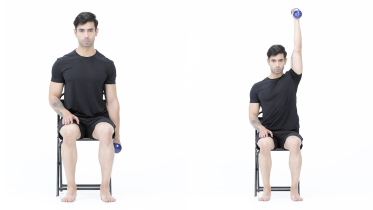
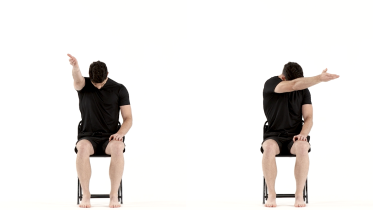
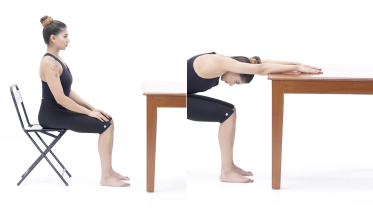
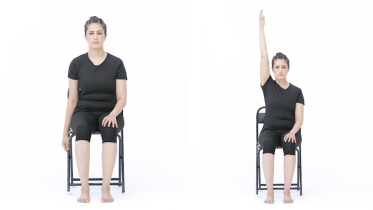
Seated passive shoulder flexion
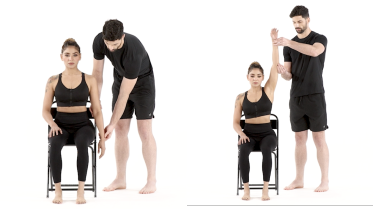
In seated passive shoulder flexion, a helper holds your arm and lifts it forward and up over your head while you sit and let the arm go completely relaxed. Your own shoulder muscles do no work (passive range of motion). Physios use it when a shoulder is too painful or weak to lift by itself, and early on after some shoulder operations if the surgeon allows it.
How to do the seated passive shoulder flexion
- Sit upright on a firm chair with your feet flat and about shoulder width apart, hands resting in your lap.
- Your helper stands beside the arm that needs to move. They support it with one hand around the forearm near the wrist and the other at the elbow.
- Let that arm go heavy and loose, as if it belongs to someone else. Sit tall and keep your body still.
- The helper slowly lifts the straight arm forward and up toward the ceiling, thumb pointing up, only as far as is comfortable. The video shows the arm reaching right up next to the ear.
- The helper then lowers it along the same path, just as slowly, until it rests by your side again.
What you should feel
A gentle stretch at the front, underneath or back of the shoulder near the top of the lift, while your arm muscles stay quiet. Mild discomfort that fades once the arm is down again is common.
Common mistakes
- Helping with the lift. If you feel your shoulder muscles switch on, breathe out and let the helper take the weight.
- Leaning back or arching your back as the arm goes up.
- The helper moving quickly or pushing on past the point where you said stop.
How often
A common range is 5 to 10 slow lifts, 2 to 4 times a day, pausing briefly at the top only if that stays comfortable. After surgery, your surgical team decides how high the arm may go. Your physio will adjust this.
Stop and check with your physio if
- Pain turns sharp, keeps building with each lift, or you feel pins and needles spreading into the arm.
- Pins and needles in your arm or hand that do not go away after you stop, or part of your arm or hand goes numb. Get medical advice the same day. If one side of your face or body suddenly goes numb or weak, or your speech becomes slurred or muddled, call emergency services, even if it goes away.
- A sudden pop or tearing feeling in the shoulder that brings sharp pain, new weakness or trouble lifting the arm. Stop and contact your surgical team the same day, or get medical advice the same day if you have not had surgery.
- The shoulder feels as if it has slipped out of place, looks a different shape or suddenly locks so you cannot move the arm, or your hand turns cold, pale or blue. Go to an emergency department straight away, without driving yourself, and do not try to put the shoulder back in yourself.
- Your wound becomes more red, hot, swollen or painful, or starts to leak. Contact your medical team the same day.
From the clinic
After shoulder surgery, including a rotator cuff repair, or after a shoulder fracture or dislocation, follow your surgeon's or physio's plan, and do only the movements and range they have cleared. Many plans allow only passive movement at first, where the arm is moved for you and its muscles stay relaxed. That is what this exercise is. Your helper does all the lifting, and the arm stays limp from start to finish. Your physio can show your helper where to hold and how high to go.
Agree on a word such as "stop" before you begin, and the helper stops the moment you say it. Go slow and smooth. Reaching the top matters less. When no helper is around, the pendulum exercise is another gentle early option, and shoulder flexion with a stick usually comes later, once the arm is allowed to help.
Written and checked by the PocketPhysio editorial team. Last updated 2026-09-28.
This page is general education, not a diagnosis or a personal treatment plan. If you have pain, an injury or a health condition, see a physiotherapist or doctor before starting new exercises.