Seated dumbbell shoulder press
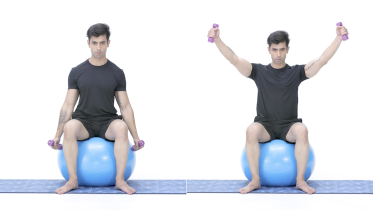
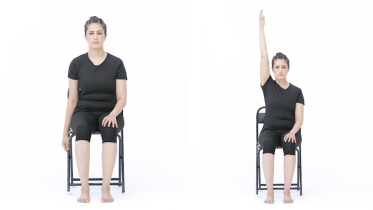
A seated dumbbell shoulder press strengthens the muscles that lift your arm overhead, mainly the front of the shoulder (deltoid), while the muscle at the back of the upper arm (triceps) straightens the elbow. You sit on a chair, curl a light dumbbell up to your shoulder, then press it straight up toward the ceiling and bring it back down to the shoulder. In the video it is done one arm at a time.
How to do the seated dumbbell shoulder press
- Sit upright on a sturdy chair with your feet flat on the floor. Hold a light dumbbell in one hand, both arms relaxed by your sides.
- Bend that elbow and curl the dumbbell up to the front of your shoulder, keeping your upper arm close to your side and your palm facing in. Each press starts from here.
- Push the dumbbell up toward the ceiling, with your palm still facing in and your elbow pointing forward rather than out to the side, until your elbow is straight and your arm is up beside your head, or as high as it goes without pain.
- Keep your neck soft and your back upright as the arm rises. The shoulder should not hitch up toward your ear.
- Lower the dumbbell slowly to your shoulder and press again. After the last press, lower it to your side, and change arms if both are in your program.
What you should feel
Work in the shoulder, mostly at the front, and in the back of the upper arm as the elbow straightens. Your neck should stay relaxed throughout.
Common mistakes
- Arching your lower back or leaning away to force the weight up.
- Hitching the shoulder toward your ear as the arm rises.
- Pushing on into a painful part of the range instead of stopping short of it.
- Letting the dumbbell drop back to the shoulder.
How often
Many programs use 2 to 3 sets of 8 to 12 slow presses with each arm and a light weight, 2 to 3 times a week. Your physio will adjust this.
Stop and check with your physio if
- A sharp or pinching pain at the top of the shoulder as the arm goes overhead.
- The shoulder feels unstable, as though it could slip out of place.
- Pain, pins and needles or numbness running down the arm.
- Pins and needles in your arm or hand that do not go away after you stop, or part of your arm or hand goes numb. Get medical advice the same day. If one side of your face or body suddenly goes numb or weak, or your speech becomes slurred or muddled, call emergency services, even if it goes away.
- The shoulder feels as if it has slipped out of place, looks a different shape or suddenly locks so you cannot move the arm, or your hand turns cold, pale or blue. Go to an emergency department straight away, without driving yourself, and do not try to put the shoulder back in yourself.
From the clinic
Start lighter than you think. A small dumbbell or a filled water bottle is plenty for the first sessions, and the weight only goes up once every press is smooth and pain free. If you have high blood pressure, breathe steadily through every repetition and never hold your breath. Breathing out on the way up is an easy habit to build. The curl at the start works the front of the upper arm as well, much like a biceps curl.
Check with your physio before you start if lifting your arm overhead is painful, or if you have a rotator cuff problem, a frozen shoulder or a shoulder that has dislocated in the past. After shoulder surgery or a broken arm, pressing a weight overhead usually waits until your surgeon's protocol allows it. If your arm cannot get overhead comfortably yet, shoulder flexion with a stick gives it help from your other hand. The dumbbell front raise is another option, as it stops at shoulder height.
Written and checked by the PocketPhysio editorial team. Last updated 2026-09-28.
This page is general education, not a diagnosis or a personal treatment plan. If you have pain, an injury or a health condition, see a physiotherapist or doctor before starting new exercises.