
How to regain strength after a hospital stay
Warning signs, and when to get help
How long does it take to regain strength after a hospital stay?
Longer than the stay, and longer than most people are led to expect. Two studies answer the two halves of the question, and neither of them is comfortable reading.
The best measurement of how fast it goes is a small study. Eleven healthy volunteers with an average age of 67 spent ten days in continuous bed rest, eating a normal diet with enough protein, and came out having lost 13.2 percent of their knee extension strength and 14 percent of their stair climbing power, with aerobic capacity 12 percent lower than when they went in (Kortebein and colleagues, 2008). Nothing was wrong with those people. An illness, an operation, broken sleep and a poor appetite all sit on top of pure inactivity in a real admission, which is why that figure is better read as a floor than as a ceiling.
There is a detail in it that matters more than the percentages. Over the same ten days, the standard performance tests the researchers used did not change. Strength can fall a long way before a test, or a reader, can see it, which is part of why the weakness comes as a shock in the first week at home.
Getting it back runs to a year rather than a month, and it is not guaranteed. One study followed people aged 70 and over who had been admitted as emergencies to general medical wards at two American hospitals between 1993 and 1998, and compared them with how they had been two weeks before admission. Among those who went home needing help with washing, dressing or getting about that they had not needed before, 30 percent were back at their old level twelve months later. Among those who left hospital still able to do everything they could before, 67 percent were at their old level at a year (Boyd and colleagues, 2008).
The gap between those two numbers is the thing to take from this page. How much you had lost by the morning you came home counts for more than how many nights you were in.
So plan in months. The first changes usually show up within a week or two, and they show up in small practical things rather than in how much you can lift.
Standing up without pushing off the arms of the chair. Carrying a cup through to the next room. Doing the stairs once a day instead of staying upstairs. Those are the markers worth watching, because they move before anything you could measure on a scale.
Why am I so weak after a hospital stay?
Because muscle keeps only what it is asked for, and almost nothing in a hospital day asks anything of your legs. Even a short admission with a few days of bed rest takes strength out faster than most people believe is possible. The medical word for what has happened is deconditioning, and it means what it sounds like: the fitness and strength you had has lapsed rather than been damaged.
Illness is doing its own damage alongside the inactivity. The European working group on sarcopenia names three separate causes of muscle loss: disease, particularly an inflammatory one, physical inactivity whether from a sedentary life or from disease-related immobility, and inadequate intake of energy or protein, including from poor appetite, trouble absorbing food or difficulty eating (Cruz-Jentoft and colleagues, 2019). An admission usually arrives with all three at once, and that is why two weeks in hospital with a chest infection costs more than two weeks of sitting at home would.
The chair is where you feel it first. Standing up from a seat is one of the hardest things most people do in a day, and it is the movement that gives way soonest. Once it starts to go, everything shrinks around it: you sit longer, you go out less, you lose more. That is why the program below puts chair work at every stage instead of treating it as a beginner's exercise.
Some of what you have lost is practice rather than muscle, which is the encouraging half. The nervous system forgets the pattern of a movement quickly and relearns it quickly, so the first week or two of improvement is often faster than anything that follows. Enjoy it, but do not read it as the rate for the next six months.
If nobody has measured you and you simply want to get stronger as you age, strength training for older adults is the page for that. If a doctor or physio has timed your chair stands or measured your grip and told you the result was low, or has used the word sarcopenia about you, the sarcopenia program follows that diagnostic pathway. This page is for the specific event of a stay in hospital: what the first week looks like, how long the whole thing takes, and the weakness that needs a doctor rather than a program.
When weakness is not loss of condition, and needs help today
Being weak after you come home is not the same as getting weaker after you come home. Loss of condition improves slowly, and improves a little further on a day when you have eaten and slept properly. Weakness that is worse this week than last, or that arrived suddenly, or that has brought something else new along with it, is a symptom. It belongs with a doctor before it belongs with an exercise program.
Here is what gets mistaken for loss of condition. Read it now rather than when something happens, because several of these are much easier to explain away than to notice.
A blood clot in a leg, which is more likely after any spell of being much less mobile than usual. The NHS lists throbbing pain in one leg, usually the calf or thigh, swelling in one leg, skin that looks red, blue or darker than usual, and swollen veins that are sore to touch, and any one of those on its own is enough to get urgent advice. A clot that has traveled to the lungs shows up as sudden breathlessness or chest pain, and that is a call to emergency services.
An infection, which does not always announce itself. A wound, a chest, a urine infection or the site where a drip went in can all produce a few days of feeling weaker and more tired with no obvious temperature. The NHS notes that confusion is common in older people who have pneumonia, and that urine infections are a common cause of sudden confusion, so the first sign of an infection is sometimes muddled thinking rather than a cough or a fever.
Anemia from blood loss. The symptoms the NHS lists for iron deficiency anemia are tiredness and a lack of energy, shortness of breath, noticeable heartbeats, skin paler than usual and headaches, and it says the condition is often caused by blood loss. What makes it worth checking rather than pushing through is the direction of travel: tiredness and breathlessness that build week by week, doing something you managed easily a fortnight ago. It is treatable, and it does not get treated while it is being put down to being out of condition.
A new or changed medicine. Most people come home from hospital on a different list from the one they went in with. The NHS names some medicines among the causes of low blood pressure, among the causes of falls, and among the causes of sudden confusion. Never stop or change a prescribed medicine on your own. Ask your doctor or pharmacist to go through the whole list instead, and say that you have become weak, dizzy or muddled since you came home.
A drop in blood pressure when you stand up. Dizziness, blurred vision, weakness, feeling sick or fainting in the moments after getting out of a chair is postural hypotension. The NHS lists it among the causes of falls, and your doctor can check it.
Confusion, which has the medical name delirium. Suddenly becoming muddled, much drowsier than usual, unable to follow what is being said, unsure where you are, or seeing or hearing things that are not there is an emergency at home, whatever has caused it. There is a quiet form as well, and that is the one taken for loss of condition: withdrawing, answering slowly, moving about less, losing interest in food, over hours or days rather than weeks. NICE names those as the signs most often missed. Both are on the warning list below, each with its own route.
Fluid the heart is not keeping up with. Breathlessness that comes on when you lie flat, waking at night needing to sit up to breathe, ankles or legs more swollen than when you came home, or weight that climbs by the day are the pattern, and the NHS puts breathlessness on lying down, sudden weight gain and coughing up frothy pink phlegm among the reasons to get urgent advice. Going back into hospital in the first weeks at home is common for exactly this, and it is treatable.
A new neurological event. One-sided weakness, a face that droops, speech that slurs, a sudden loss of balance, or a foot that has started to drag or catch is not something to train through. Those signs mean calling emergency services even if they have already gone away.
Each of these is written out in full, with what to do and how quickly, in the warning signs at the foot of this page. There is a link straight to that list at the top of this page as well. Read it before you start the program rather than afterwards.
Does being sent home mean you are cleared to exercise?
No. Discharge is a judgement that you no longer need to be in a hospital bed. It is not a statement that you are safe to start a strength program, and it is not a set of limits on what you can do.
So the first job is finding out who sets your limits. After an operation, your surgical team decides how much weight goes through the limb, which movements are off and when each restriction lifts, and that plan beats everything on this page for as long as it runs. With a heart or lung condition, or blood pressure that is not under control, your doctor is the one to ask before you begin. If you were handed a rehabilitation plan or a physio referral when you left, use that rather than this page, and take this page to the appointment if it is useful.
Before you decide that nobody is reachable, work down the list, because one unanswered call is not the same thing as having nobody to ask.
There is usually a number on your discharge letter. The ward or the team you went home from will take a call about their own patient, and that is the right place for anything to do with an operation, a wound or a drain. Your own doctor's practice can be asked for a telephone appointment, and saying that you came out of hospital last week changes how that request is handled. A pharmacist will go through your medicine list with you without an appointment. In the United Kingdom, NHS 111 answers day and night and will tell you what to do next.
If nobody gave you anything and you still cannot get hold of anybody, that is not a reason to sit still. Stage 1 of the program below is done sitting or lying, which is where nearly everybody starts in any case, and the warning signs tell you when to stop and who to contact. The one exception inside stage 1 is standing up out of the chair using the armrests, which does put your weight through your legs. Leave that one out, and ask first, if you were told to put only part of your weight through a leg, or none of it, or to keep using a frame or crutches for now. If instead you were told to limit what you lift, push or pull with an arm, or to keep an arm in a sling or a splint, the same applies to the band row and the grip squeeze in stage 1, and to the wall push-ups in stage 2.
Standing work away from the chair is the part that waits until you have asked. If you have tried and genuinely cannot reach anybody, the question is not whether you feel strong enough, which is not something you can judge from the inside. It is whether any of these six things is true of you. Take them one at a time and answer each one about yourself, because a single yes keeps you in stage 1.
- An operation during this stay or in the past three months, or an operation at any time since which you were given a restriction and nobody has told you it has lifted.
- You were told to limit the weight going through a leg, or to keep using a frame or crutches.
- A broken bone, or a wound that has not healed.
- You were told that your heart, lungs or blood pressure need settling.
- You get breathless, or feel your heart race, doing something small such as getting to the toilet or getting dressed, when that was not happening on the day you came home. This one does not wait for a call back: it is on the same-day list in the warning signs below, so get medical advice the same day.
- Anything new on one side of your body, such as weakness, numbness or a foot that drags, or dizziness and feeling faint when you stand up. These do not wait for a call back either, and they do not all get the same answer. New weakness or numbness on one side of your body or face means calling emergency services now, even if it has already passed, and the stroke line in the warning signs below gives the rest of the signs that go with it. A foot that drags or catches, and dizziness or feeling faint when you stand up, need medical advice the same day.
If one of those is true, that is the thing to ask about, and stage 1 is where you stay until you have an answer.
If all six are no, you can start the stage 2 work with a hand on a counter for the whole of every exercise, and keep trying to get a physio to see you. There is one further condition, in the falls section below, and it is about company rather than about medicine: if you have fallen in the past year, feel unsteady on your feet, or take medicines that make you dizzy, the standing work waits until somebody can be at home while you do it.
Falls: the riskiest few weeks
A strength program means standing up, and standing up is how people fall. Set this part up properly before you do anything else, because it is the difference between a program and an accident.
Use a firm, heavy chair that will not slide or tip, with its back against a wall. A wheeled office chair is not safe for this. Keep one hand on a kitchen counter or a solid worktop for everything you do standing at it, and keep the other hand free rather than holding anything.
A walking aid is different: if you came home with a stick, crutches or a frame, it stays in your hand for every walk, including the walking practice in the program. Wear flat shoes that fit well and grip the floor, not socks, tights or bare feet. Move the rug, the trailing cable and anything else on the floor out of the space before you start rather than halfway through a set.
Keep your phone in a pocket every time you exercise, not on a table across the room. If you have a personal alarm, wear it for the session, and if you live alone without one, ask whoever arranged your discharge about getting one.
Then there is the question of being on your own. If you have fallen in the past year, feel unsteady on your feet, or take medicines that make you dizzy, keep a hand on the counter throughout, practice only when someone else is at home, and ask your doctor or physio about a falls check. If that is you and nobody can be there, stay with stage 1 until somebody can, or until a physio or doctor has seen you, which is not the same as doing nothing, because the seated work in stage 1 needs nobody there. The one exception inside stage 1 is standing up from the chair with the armrests, whose own page asks a reader who has fallen before to have somebody nearby for it. If none of that applies and you simply live alone, do the standing exercises at a time of day when somebody normally rings or calls in, so that if you do end up on the floor you are not there for long.
The NHS advice if you cannot get up is to call for help with a phone or an alarm, or by shouting or banging on a wall or the floor, and while you wait to keep warm, covering yourself with anything you can reach such as a coat or a blanket, keep moving your arms and legs, and change position about every half an hour, which helps prevent pressure sores.
Build in one habit from the first session: pause for a few seconds after you stand up, before you walk off. A quick rise leaves some people light-headed, and that moment is where falls happen. If you do feel dizzy, sit back down and wait for it to pass rather than carrying on, and the warning signs below say when that needs checking.
Getting up from the floor is worth being able to do, and it is deliberately not in the program below. Learn it with a physio first. The balance and falls prevention program is the other half of this work, and it pairs with the strength side rather than replacing it.
How to use this program
Pick the stage that matches you today. If you are not sure, start at stage 1. Move up when the current stage feels easy and you have recovered by the next day, and drop back a stage for a few days after a bad night or a setback rather than stopping altogether.
This page is for adults. A child or teenager who has come home from hospital should follow the plan from their own doctor or physio, and ask them before trying any exercise on this page. If you are pregnant, check with your midwife or physio before you start. If your stay was for a cesarean or any other operation, the first of the six questions in "Does being sent home mean you are cleared to exercise?" covers you, and your surgical team sets your limits.
Each exercise page gives a typical starting dose. In the first week at home, the right number is usually fewer repetitions than the page suggests, done more often through the day. Little and often beats one long session when you tire quickly, and it has a safety advantage too: a short set does not leave you so tired that standing up afterwards is risky.
More often means splitting the page's number across the day, not doing the whole of it three times over, because it is the total by bedtime that your legs feel. Two or three short goes at a stage is plenty in the first week. Your physio will adjust the exercises and the numbers to suit you.
There is a measured answer on how often, for this exact situation, although it is expert agreement rather than trial evidence. Fifteen clinicians and researchers from eight countries reached consensus on a program of daily sessions in the first week after discharge, then two to three times a week out to about twelve weeks, combining strength, aerobic and functional work, individually tailored and supervised (Aarden and colleagues, 2023). The supervision is part of what they were describing, and a web page cannot be that, which is a fair argument for getting a physio involved even briefly at the start. The same panel agreed an intensity, and this page does not pass it on, because it was a share of maximum heart rate and the panel attached it to there being no reasons against exercising at all. A heart rate ceiling is close to meaningless for someone on a medicine that slows the heart, and misleadingly gentle for someone whose heart is already racing because she is short of blood.
The evidence on whether any of this works splits in a way worth knowing. Trials of exercise given during the admission itself have not shown a clear gain in day-to-day independence by the time people go home: a Cochrane review of 24 trials in 7,511 patients aged 65 and over, admitted for medical reasons, found a difference of 1.8 points on a 100 point independence scale in the 16 of those trials that measured it, where 11 points is the smallest difference a patient would notice, and rated the certainty low (Hartley and colleagues, 2022). The same review found, with moderate certainty, that exercise did not increase falls in hospital.
After discharge the picture improves, though not by much and not cleanly: a meta-analysis of randomized trials in people who had just gone home found greater improvement in physical function overall with exercise than with usual care, which in those trials included advice to be active, while none of the individual measures it looked at separately, grip strength, the chair and balance and walking battery, the six-minute walk and gait speed, reached significance on its own, and the authors put that down to how few trials existed (Carneiro and colleagues, 2022). And in older adults generally, strength work that gets harder as you get stronger has a large effect on strength and a moderate to large effect on getting out of a chair (Liu and Latham, 2009). Those 121 trials were mostly in older people who were not acutely unwell, and the reviewers add a caution of their own about carrying the exercises straight across to clinical groups, because the trials recorded harms poorly. In most of them the training ran two to three times a week.
The practical reading of all that: the work that changes things is the work you do at home after the ward, and the chair is the thing to train.
Progress comes in two forms, and the order matters. Take help away first, which means fewer hands on the chair, a lower seat, a lighter touch on the counter. Then add load. Change one thing at a time, and add repetitions before you add weight. A firm cushion on the chair is the easiest dial on the whole program: take it out when standing up gets easy, put it back on a bad day.
Breathe steadily through every repetition rather than holding your breath, which matters most if you have high blood pressure. The WHO guidelines ask adults of every age for muscle strengthening on at least two days a week and are plain that some activity is better than none (Bull and colleagues, 2020). That last point is the right frame for a week when you can manage almost nothing.
Soreness for a day or two after a new exercise is normal. Sharp pain during an exercise means stop that exercise for today, and a joint that is more painful or swollen the next day means the load was too much for now, so do less next time rather than stopping altogether. Being far more tired the next day than the session should explain means you did too much, so do less next time rather than giving up. If it keeps happening week after week even as you do less, stop putting it down to the exercise: that pattern is on the warning list below. A calf or thigh that is swollen, warm or red is not ordinary soreness, and it is on the warning list below.
The exercise program
The exercises below carry their own stop signs and precautions. Open the line under an exercise and read them before you try it.
Stage 1: The first week, from a chair or a bed
Start here whatever you were in for, and stay here until standing work has been cleared by your surgeon, doctor or physio, or, if you have tried everybody and can reach nobody, until you have been through the questions in 'Does being sent home mean you are cleared to exercise?' above. Almost everything in this stage is done sitting or lying, so your weight is supported and a wobble cannot put you on the floor. Ankle pumps get the blood in your legs moving and are worth doing often while you are still sitting for most of the day. Quad sets switch the thigh back on, and seated knee extension works the muscle that gets you out of a chair. Sit to stand using armrests is the one exercise here that lifts your body weight: use a firm, heavy chair with its back against a wall, and let the armrests take as much of the work as you need. Leave that one out, and ask first, if you were told to put only part of your weight through a leg, or none of it, or to keep using a frame or crutches for now. The band row and the grip squeeze keep your arms and hands going, which matter for pushing up out of a chair and for carrying a cup. Leave those two out, and ask first, if you were told to limit what you lift, push or pull with an arm, or to keep an arm in a sling or a splint. Diaphragmatic breathing is here if you were in for a chest or heart problem, or if you find yourself short of breath. Do a little at a time, several times a day, rather than one long session, and start at the bottom of the range each exercise page gives rather than the top.
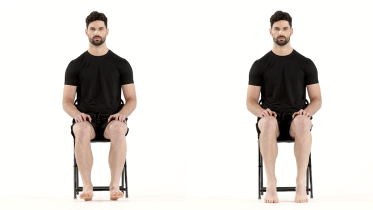 Ankle pumps
Stop signs and precautions for the ankle pumps
Before you start
- Had surgery on your foot or ankle, or wearing a cast or boot? Check which movements are allowed before you start.
When to stop and get help
- Your calf or thigh is getting more swollen, or becomes warm, tender, red or darker than usual, or has a new throbbing or cramping pain. This can be a blood clot, especially after an operation, an injury, time in a cast, boot or brace, or a spell of being much less mobile than usual, and after an operation it can also be an infection. Stop and contact your medical team or get medical advice the same day. If you are also short of breath or have chest pain, call emergency services.
- You suddenly become short of breath, get chest pain or pain in your upper back that may be worse when you breathe in, cough up blood, your heart beats very fast, or you faint. Call emergency services straight away, even if your leg looks normal, as this can be a blood clot in the lungs (pulmonary embolism).
- Any sharp pain in the foot or ankle.
- Emergency: while you are in a cast or boot, your toes turn blue, white or pale, or feel cold. Do not wait to see if raising your leg helps. Go to an emergency department straight away, and do not drive yourself. The cast or boot may be cutting off the blood supply, or pressure may be building up inside the leg (compartment syndrome), and both need checking quickly.
- In a cast or boot, the pain gets worse, your toes feel numb, tingle or burn or look more swollen, or the cast or boot feels too tight. Stop, raise your foot to about hip level and no higher, keep moving your toes and contact your fracture clinic or get medical advice straight away. If you wear a boot, loosen the straps but keep it on. Do not prop the foot higher than that and do not put ice on it, because if pressure is building up inside the lower leg both of those cut down the blood reaching your foot. If you cannot move your toes, the pain is severe even after painkillers, or the numbness, tingling, burning or swelling has not settled within 30 minutes of raising your foot, go to your fracture clinic or an emergency department straight away, and do not drive yourself.
- Since the fracture or cast, the foot or ankle is getting more painful rather than less, the skin becomes very sensitive to light touch, or the foot changes color, temperature, swelling or sweating compared with the other one, or looks shiny. See your doctor or physio as soon as you can, within a few days at most, as this can be complex regional pain syndrome (CRPS) and early treatment may help.
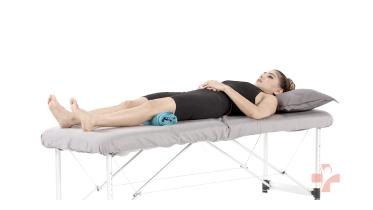 Quad sets (towel under knee)
Stop signs and precautions for the quad sets (towel under knee)
Before you start
- After a knee fracture or knee surgery, including a knee replacement, follow your surgeon's or physio's plan, and start this exercise only when they have cleared you.
When to stop and get help
- Your knee pain goes up sharply.
- Your calf or thigh is getting more swollen, or becomes warm, tender, red or darker than usual, or has a new throbbing or cramping pain. This can be a blood clot, especially after an operation, an injury, time in a cast, boot or brace, or a spell of being much less mobile than usual, and after an operation it can also be an infection. Stop and contact your medical team or get medical advice the same day. If you are also short of breath or have chest pain, call emergency services.
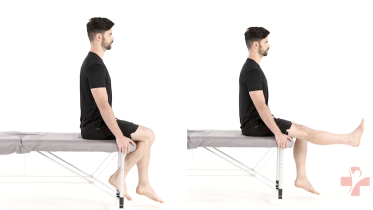 Seated knee extension
Stop signs and precautions for the seated knee extension
Before you start
- After knee ligament surgery, such as an ACL reconstruction, get the go-ahead from your surgeon or physio before you do this one. Many protocols limit how far the knee may straighten against resistance in sitting during the early stage.
- After a knee fracture or knee surgery, including a knee replacement, follow your surgeon's or physio's plan, and start this exercise only when they have cleared you. Ask again before you add an ankle weight.
When to stop and get help
- You feel sharp pain at the front of the knee or under the kneecap.
- The knee swells up or is clearly more painful later that day or the next morning.
- Chest pain or pressure, dizziness or feeling faint, a racing or irregular heartbeat, or being far more out of breath than the effort should cause.
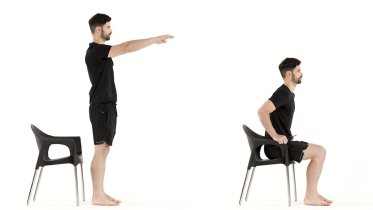 Sit to stand using armrests
Stop signs and precautions for the sit to stand using armrests
Before you start
- If you have had a hip replacement or other hip surgery, get the go-ahead from your surgeon or physio before you try sit to stand using armrests. Lowering into a chair and rising from it takes the hip beyond a right angle when the seat is low, and many surgeons ask you to avoid that for the first months after some operations.
- If knee pain builds as you go, or you have had knee surgery, check with your physio what seat height to use.
- If balance is a worry or you have fallen before, have someone nearby and place the chair next to a counter or wall you can reach once upright. If you have osteoporosis, set the chair up the same way, next to a counter or wall, though thin bones on their own are not a reason to wait until someone is at home before you stand up out of a chair. Wear flat shoes that fit well and grip the floor, not socks, tights or bare feet.
When to stop and get help
- You feel dizzy, lightheaded or faint as you get up. Sit back down and wait for it to pass. If it does not pass within a minute or two, or it keeps happening, get medical advice the same day before you practice again. If you faint, or it does not settle within a few minutes of keeping still, call emergency services. A drop in blood pressure on standing, or a side effect of a medicine, can cause this, so mention your medicines when you get advice.
- Your knee, hip or back hurts sharply, or a wrist or shoulder hurts as you push on the armrests.
- A leg buckles, or you feel close to falling.
- Chest pain or pressure, dizziness or feeling faint, a racing or irregular heartbeat, or being far more out of breath than the effort should cause.
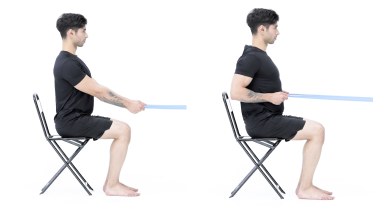 Seated row with band
Stop signs and precautions for the seated row with band
Before you start
- After shoulder surgery, rows with a band usually wait until later in rehab, so check with your surgeon or physio first.
- After heart or chest surgery, pulling against a band usually waits until your breastbone has had time to heal, so ask your surgeon or surgical team when to start: only the team that wired it can clear loaded pulling. If the breastbone clicks, grinds, shifts or feels as if it is moving while you do it, stop, and contact your surgical team the same day.
- If you have high blood pressure, breathe steadily through every repetition and never hold your breath.
- Do not lean forward to reach the band or twist to one side as you pull, and if you have had a fracture in your spine, check with your physio before you start.
When to stop and get help
- A sharp pain or catching feeling in your shoulder as you pull.
- Pain, tingling or numbness spreading down an arm.
- Pins and needles in your arm or hand that do not go away after you stop, or part of your arm or hand goes numb. Get medical advice the same day. If one side of your face or body suddenly goes numb or weak, or your speech becomes slurred or muddled, call emergency services, even if it goes away.
- A sudden pop or snap at the front of your elbow, sudden sharp pain there, or the muscle at the front of your upper arm bunches up or changes shape. Stop and go to an urgent care center or emergency department the same day, even if you can still bend the elbow, as this can be a torn biceps tendon.
- Chest pain or pressure, dizziness or feeling faint, a racing or irregular heartbeat, or being far more out of breath than the effort should cause.
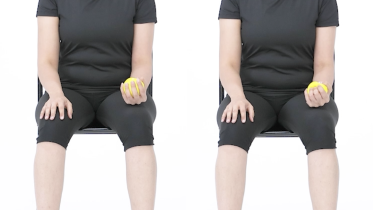 Hand grip squeeze
Stop signs and precautions for the hand grip squeeze
Before you start
- After a broken wrist, hand or forearm, or surgery on any of them such as a tendon repair, start only when your doctor, surgeon, physio or hand therapist says the bone or repair is ready for this, and follow their plan for how much to do.
- Arthritis at the base of the thumb and rheumatoid arthritis can both flare with hard gripping. Ask your physio how firm to go, and skip it on days when the joints are hot and swollen.
- Keep breathing through each hold, because holding your breath while you strain can push your blood pressure up.
When to stop and get help
- Sharp pain in the wrist, a finger joint or at the base of the thumb.
- Your hand or fingers go numb or start to tingle. If one side of your face or body suddenly goes numb or weak, or your speech becomes slurred or muddled, call emergency services, even if it goes away.
- Hand joints that are more swollen, hot or stiff afterward.
- Since the fracture or cast, the hand is getting more painful rather than less, the skin becomes very sensitive to light touch, or the hand changes color, temperature, swelling or sweating compared with the other one, or looks shiny. See your doctor or physio as soon as you can, within a few days at most, as this can be complex regional pain syndrome (CRPS) and early treatment may help.
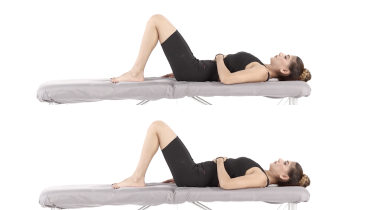 Diaphragmatic breathing
Stop signs and precautions for the diaphragmatic breathing
Before you start
- If lying flat makes you more short of breath, do not lie flat for this. Sit upright in a chair or prop yourself on pillows instead, which works just as well for learning the pattern. Being short of breath when you lie down, waking at night needing to sit up to breathe, more swelling in your ankles or legs, or gaining weight quickly over a few days are all reasons to get medical advice the same day rather than to practice through, because the NHS lists breathlessness when lying down among the reasons to get urgent advice.
- If you are pregnant and past the first three months, check with your physio before exercising flat on your back.
When to stop and get help
- Your fingers or the skin around your mouth start to tingle, or you feel light-headed or spaced out. This can mean you are breathing too fast or too deeply, so stop and let your breathing go back to normal. If it has not settled within a few minutes, get medical advice the same day. If you faint, or the numbness or tingling is on one side of your face or body, call emergency services, even if it goes away.
- You suddenly become short of breath, your chest feels tight or heavy, or you are far more short of breath than usual. Stop, rest and use your breathing control. Call emergency services if the breathlessness came on suddenly, your chest feels tight or heavy, your breathing does not go back to normal, you are gasping, choking or cannot get your words out, you have pain that spreads to your arms, back, neck or jaw, you feel suddenly confused or very drowsy, or your lips or skin turn very pale, blue or gray (on brown or black skin this can be easier to see on the palms of the hands). If everything settles quickly, get medical advice the same day before you do these exercises again.
- Chest pain or pressure, dizziness or feeling faint, a racing or irregular heartbeat, or being far more out of breath than the effort should cause.
Stage 2: Standing up, standing still and walking indoors
Move up when stage 1 feels easy, you have recovered by the next day, and standing exercise has been cleared for you, or, if you have tried everybody and can reach nobody, when the questions in 'Does being sent home mean you are cleared to exercise?' above have all come back no. Keep one hand on a kitchen counter, a solid worktop or a sturdy chair back for the whole of every standing exercise in this stage, not just at the start of it. The walking practice is the one exception, and there the support is your stick, crutches or frame rather than a counter. If you have fallen in the past year, feel unsteady on your feet, or take medicines that make you dizzy, keep a hand on the counter throughout, practice only when someone else is at home, and ask your doctor or physio about a falls check. If that is you and nobody can be there, stay with stage 1 until somebody can, or until a physio or doctor has seen you, which is not the same as doing nothing, because the seated work in stage 1 needs nobody there. The one exception inside stage 1 is standing up from the chair with the armrests, whose own page asks a reader who has fallen before to have somebody nearby for it. If none of that applies and you simply live alone, do the standing exercises at a time of day when somebody normally rings or calls in, keep your phone in your pocket, and wear your alarm if you have one. Sit to stand without pushing off the armrests is the most useful exercise here, because standing up is the movement that fails first. Marching, hip abduction and calf raises train walking. Balance at a chair is where you practice letting go, with the chair still inside arm's reach, and wall push-ups load your arms with your feet still on the floor. Leave that one out, and ask first, if you were told to limit what you lift, push or pull with an arm, or to keep an arm in a sling or a splint. One go at each of these a day is enough, and start at the bottom of the range each exercise page gives rather than the top: seven exercises at the top of their ranges adds up to far more standing work than it looks like on the page, so add repetitions before you add anything else. If you came home with a frame, crutches or a stick, keep using them for walking until your physio says otherwise, and use the cane walking pattern rather than inventing one. If nobody gave you a walking aid, do not buy one for this program: the wrong height or the wrong hand makes walking less steady, and which aid suits you is a decision for a physio or doctor.
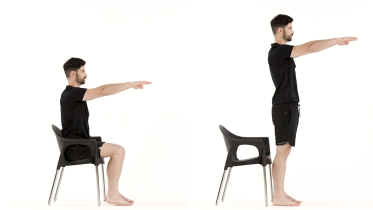 Sit to stand
Stop signs and precautions for the sit to stand
Before you start
- After a knee fracture or knee surgery, including a knee replacement, follow your surgeon's or physio's plan, and start this exercise only when they have cleared you.
- If you have had a hip replacement or other hip surgery, get the go-ahead from your surgeon or physio before you try sit to stand. Standing up from a low seat bends the hip past a right angle, and many surgeons ask you to avoid that for the first months after some operations. Ask them how high your seat should be. If you are pregnant, check with your midwife or physio before you start.
- Set up before the first stand: use a chair that will not slide, ideally with its back against a wall, and have someone nearby, or set the chair beside a kitchen counter you can reach, if you are not sure of your balance or you have fallen in the past year. Wear flat shoes that fit well and grip the floor, not socks, tights or bare feet.
When to stop and get help
- You feel dizzy, lightheaded or faint as you get up. Sit back down and wait for it to pass. If it does not pass within a minute or two, or it keeps happening, get medical advice the same day before you practice again. If you faint, or it does not settle within a few minutes of keeping still, call emergency services.
- Sharp pain in the knee, hip or lower back.
- Your knee gives way or you feel you might fall.
- Chest pain or pressure, dizziness or feeling faint, a racing or irregular heartbeat, or being far more out of breath than the effort should cause.
- You are pregnant and notice bleeding or fluid leaking from your vagina, regular painful tightenings, tummy pain that does not settle when you rest or comes with lower back pain, or a change in your baby's usual movements, such as moving less than usual. Stop and contact your midwife or maternity unit straight away. Do the same for a severe headache, problems with your vision such as blurring or flashing lights, pain just below your ribs, or sudden swelling of your face, hands or feet, which can be signs of pre-eclampsia. Call emergency services if the bleeding is heavy, the tummy pain is severe, bleeding or tummy pain comes with pain in your shoulder or feeling sick, faint or dizzy, or a headache comes on suddenly and is very severe.
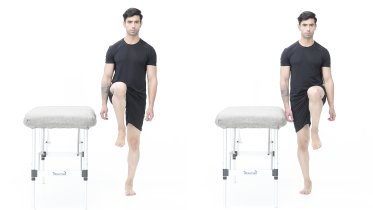 Standing marching
Stop signs and precautions for the standing marching
Before you start
- If you have had a hip replacement, get the go-ahead from your surgeon or physio before you try standing marching. Bringing the knee up above hip height bends the hip past a right angle, and many surgeons ask you to avoid that for the first months after some operations. Ask your team how high to lift, and when you may stand on the operated leg alone while the other knee comes up.
When to stop and get help
- A sharp pinch in the groin or the crease of the hip as your knee rises.
- You feel dizzy, lightheaded, faint or sick, or the room seems to spin. Hold your support, sit down and get medical advice the same day before you practice again. If you faint, it does not settle within a few minutes of sitting still, your vision suddenly blurs or goes double, or you cannot stand or walk steadily, call emergency services.
- You feel unsteady even with your fingertips on the support. Grip it with your whole hand and lower the lifted foot.
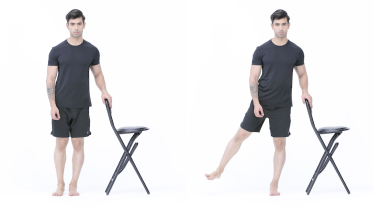 Standing hip abduction
Stop signs and precautions for the standing hip abduction
Before you start
- If you have had a hip replacement or other hip surgery, get the go-ahead from your surgeon or physio before you try standing hip abduction. Some operations limit this kind of work for the first months, so the timing depends on your surgery. Your surgical team will also tell you how far to lift.
When to stop and get help
- You feel sharp pain at the side of the hip, in the groin or in the lower back.
- You feel dizzy, lightheaded, faint or sick, or the room seems to spin. Hold your support, sit down and get medical advice the same day before you practice again. If you faint, it does not settle within a few minutes of sitting still, your vision suddenly blurs or goes double, or you cannot stand or walk steadily, call emergency services.
- You feel unsteady, even with the chair.
- Pain, numbness or tingling runs down the leg.
- Your calf or thigh is getting more swollen, or becomes warm, tender, red or darker than usual, or has a new throbbing or cramping pain. This can be a blood clot, especially after an operation, an injury, time in a cast, boot or brace, or a spell of being much less mobile than usual, and after an operation it can also be an infection. Stop and contact your medical team or get medical advice the same day. If you are also short of breath or have chest pain, call emergency services.
- Chest pain or pressure, dizziness or feeling faint, a racing or irregular heartbeat, or being far more out of breath than the effort should cause.
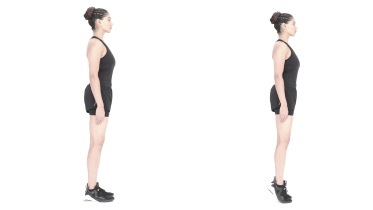 Calf raises
Stop signs and precautions for the calf raises
Before you start
- After an Achilles tendon repair or ankle surgery, calf raises usually come in at a set stage of your surgeon's protocol, often on both feet before one. Check with your physio before you start.
- After a knee or hip replacement, or other leg surgery, follow your surgeon's or physio's plan, and hold a counter or a sturdy chair back for the whole set. Rising onto your toes puts your weight forward onto a smaller base, which is where the balance goes.
When to stop and get help
- Sharp pain in the Achilles tendon, heel or arch.
- A sudden pop or snap at the back of your ankle or heel, a feeling that someone kicked you there, or sudden pain there after which you cannot push off or rise onto your toes on that leg. Stop, take the weight off that leg carefully and go to an urgent care center or emergency department the same day, even if you can still walk, as this can be a torn Achilles tendon.
- Achilles or heel pain that is clearly worse the next morning. Ease off and check with your physio.
- Your calf or thigh becomes swollen, warm, tender, red or darker than usual, or has a throbbing or cramping pain that feels different from normal muscle ache. Stop and get medical advice the same day, as this can be a blood clot. If you are also short of breath or have chest pain, call emergency services.
- Your ankle gives way, or you lose your balance.
- Since the fracture or cast, the foot or ankle is getting more painful rather than less, the skin becomes very sensitive to light touch, or the foot changes color, temperature, swelling or sweating compared with the other one, or looks shiny. See your doctor or physio as soon as you can, within a few days at most, as this can be complex regional pain syndrome (CRPS) and early treatment may help.
- You feel dizzy, lightheaded, faint or sick, or the room seems to spin. Stop, sit down and get medical advice the same day before you exercise again. If you faint, it does not settle within a few minutes of sitting still, your vision suddenly blurs or goes double, or you cannot stand or walk steadily, call emergency services.
- Chest pain or pressure, dizziness or feeling faint, a racing or irregular heartbeat, or being far more out of breath than the effort should cause.
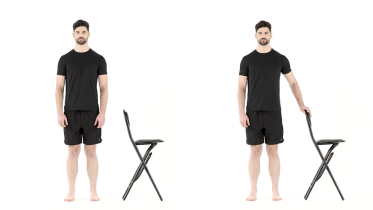 Standing balance at a chair
Stop signs and precautions for the standing balance at a chair
Before you start
- After a knee replacement or other knee surgery, a hip replacement, or a broken hip or leg fixed with screws, a nail or a plate, follow your surgeon's or physio's weight-bearing plan, and start this exercise only when they have cleared you. Taking your hand off the chair puts your full body weight through both legs, so if you have been told to put only part of your weight through that leg, or none of it, or to keep using a frame or crutches for now, this exercise is not yours yet, whatever the leg feels able to do. Keep the hand on the chair until they tell you it can come off.
When to stop and get help
- You feel dizzy, lightheaded, faint or sick, or the room seems to spin. Hold your support, sit down and get medical advice the same day before you practice again. If you faint, it does not settle within a few minutes of sitting still, your vision suddenly blurs or goes double, or you cannot stand or walk steadily, call emergency services.
- You start to tip and need the chair to catch yourself. Put your hand back on it, rest, then try a shorter hold.
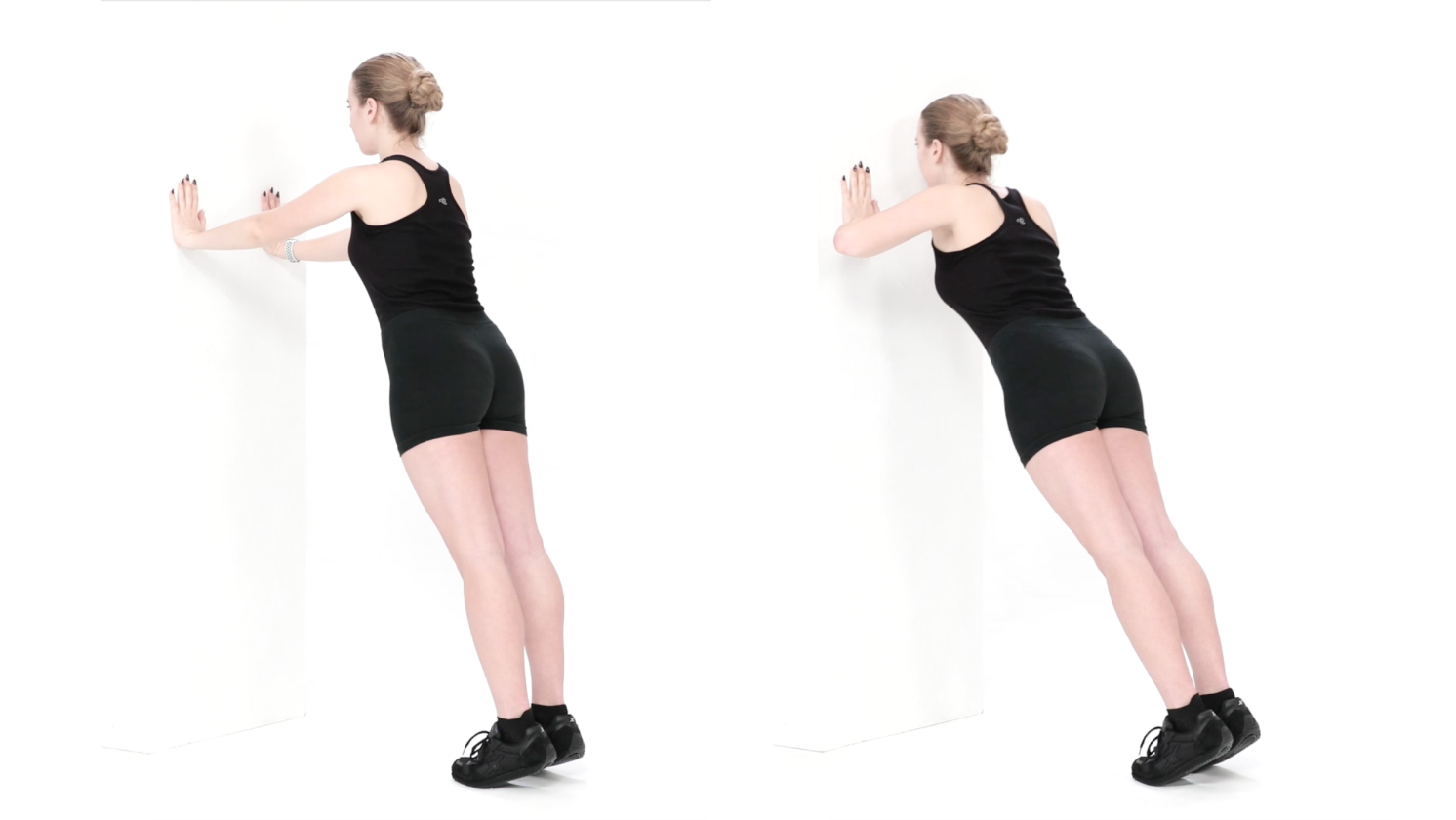 Wall push-ups
Stop signs and precautions for the wall push-ups
Before you start
- After a broken or dislocated elbow, or elbow surgery such as a tendon repair, follow your surgeon's or physio's plan, and start this exercise only when they have cleared you. If you have just hurt your arm and have severe pain or cannot move the elbow, do not exercise it. Go to an urgent care center or emergency department the same day. If you heard a snap or a crack at the moment of the injury, the arm looks a different shape or sits at an odd angle, a bone is showing, or your arm or hand tingles, feels numb or turns cold, pale or blue, go to an emergency department straight away or call emergency services, and do not drive yourself.
- After shoulder surgery, including a rotator cuff repair, or after a shoulder fracture or dislocation, follow your surgeon's or physio's plan, and do only the movements and range they have cleared. Many plans allow only passive movement at first, where the arm is moved for you and its muscles stay relaxed. Putting weight through your arms usually comes later, so check with your physio first.
- After recent heart or chest surgery, get your surgeon's or surgical team's okay first, because leaning your weight into your hands and pressing back off the wall loads the healing breastbone and the front of the chest. If the breastbone clicks, grinds, shifts or feels as if it is moving while you do it, stop, and contact your surgical team the same day.
When to stop and get help
- Sharp pain in the shoulder, elbow or wrist.
- Pain, numbness or tingling spreads down the arm.
- Pins and needles in your arm or hand that do not go away after you stop, or part of your arm or hand goes numb. Get medical advice the same day. If one side of your face or body suddenly goes numb or weak, or your speech becomes slurred or muddled, call emergency services, even if it goes away.
- Your feet start to slip on the floor.
- A sudden pop or tearing feeling in the shoulder that brings sharp pain, new weakness or trouble lifting the arm. Stop and contact your surgical team the same day, or get medical advice the same day if you have not had surgery.
- The shoulder feels as if it has slipped out of place, looks a different shape or suddenly locks so you cannot move the arm, or your hand turns cold, pale or blue. Go to an emergency department straight away, without driving yourself, and do not try to put the shoulder back in yourself.
- Chest pain or pressure, dizziness or feeling faint, a racing or irregular heartbeat, or being far more out of breath than the effort should cause.
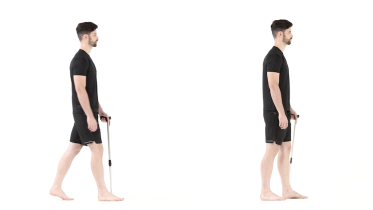 Walking with a cane
Stop signs and precautions for the walking with a cane
Before you start
- If you have broken a bone in your leg or had an operation on it, follow the weight-bearing plan your surgeon or physio gave you. Do not swap crutches or a frame for a single cane until they tell you that you are ready.
When to stop and get help
- You feel dizzy, lightheaded, faint or sick, or the room seems to spin. Hold your support, sit down and get medical advice the same day before you practice again. If you faint, it does not settle within a few minutes of sitting still, your vision suddenly blurs or goes double, or you cannot stand or walk steadily, call emergency services.
- You stumble, your leg gives way, or you have to grab something to stay upright. Stop and sit down.
- Your calf or thigh becomes swollen, warm, tender, red or darker than usual, or has a throbbing or cramping pain that feels different from normal muscle ache. Stop and get medical advice the same day, as this can be a blood clot. If you are also short of breath or have chest pain, call emergency services.
- New or much worse pain in your hip, knee or ankle that changes the way you walk.
- Since the fracture or cast, the foot or ankle is getting more painful rather than less, the skin becomes very sensitive to light touch, or the foot changes color, temperature, swelling or sweating compared with the other one, or looks shiny. See your doctor or physio as soon as you can, within a few days at most, as this can be complex regional pain syndrome (CRPS) and early treatment may help.
- You have had a fall or an injury and now have severe hip pain, or you cannot walk or put weight on the leg. Call emergency services or go to an emergency department. This can be a sign of a broken hip (hip fracture).
- Chest pain or pressure, dizziness or feeling faint, a racing or irregular heartbeat, or being far more out of breath than the effort should cause.
Stage 3: Stairs, load and getting back out of the house
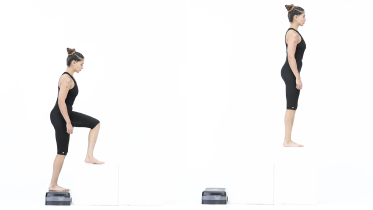
Move up when stage 2 feels easy, your balance is steady and the standing exercises leave you no worse the next morning. This is the stage that decides whether you get back to what you did before, because the load has to keep rising in small steps or strength stops improving. Keep lowering the seat for the chair squat and for sit to stand as it gets easier. Hold the handrail for stair climbing and use a low step for step ups. Semi-tandem stance narrows your base a little, so do it at the counter. The curl and the shoulder press start with a light weight or none at all, and go up in small steps on 2 to 3 days a week with a rest day between. Nothing in this stage needs doing every day: 2 to 3 days a week for the loaded work, with a day in between, is the pattern the research uses, and the walking fills the other days. The loaded work here means the chair squat, the step ups, the stairs, the curl and the press. Where one of their own pages offers a daily option, or gives no frequency at all, follow this stage instead, because each of those pages is written for one exercise on its own rather than for five of them in the same week. Build walking back by adding minutes rather than pace, and split a long walk into two shorter ones if one leaves you flattened the next day. Brisk is where this ends up, not where it starts, so judge the effort by your breathing rather than by a speed or a step count: you should be able to talk in short sentences while you walk, and the pace only goes up once the minutes are easy. Getting up from the floor is deliberately not in this program: it is worth being able to do and it belongs in a session with a physio before you ever try it alone.
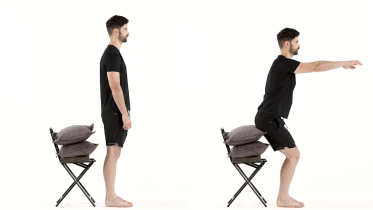 Chair squat
Stop signs and precautions for the chair squat
Before you start
- After a knee fracture or knee surgery, including a knee replacement, follow your surgeon's or physio's plan, and start this exercise only when they have cleared you.
- Knee pain on the way down is a sign to put a cushion back rather than push through it, and after knee surgery your physio will tell you how deep to go. If you have had a hip replacement, get the go-ahead from your surgeon or physio before you try chair squats. A low seat makes the hip bend past a right angle, and many surgeons ask you to avoid that for the first months after some operations. Ask them what seat height suits you.
- Osteoporosis, a recent fall or shaky balance are all reasons to keep a kitchen counter within reach for every rep, and to ask your physio before you take a cushion away.
When to stop and get help
- A sharp pain in your knees, hips or low back, or knee pain that builds rep by rep.
- A knee buckles, or you start to lose your balance.
- You feel dizzy, lightheaded or faint as you get up. Sit back down and wait for it to pass. If it does not pass within a minute or two, or it keeps happening, get medical advice the same day before you practice again. If you faint, or it does not settle within a few minutes of keeping still, call emergency services.
- Chest pain or pressure, dizziness or feeling faint, a racing or irregular heartbeat, or being far more out of breath than the effort should cause.
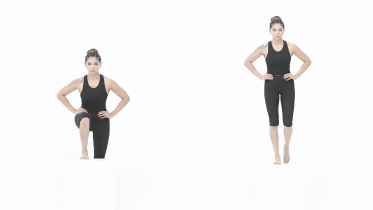 Step up
Stop signs and precautions for the step up
Before you start
- If you have had a hip or knee replacement, or other hip or knee surgery, get the go-ahead from your surgeon or physio before you try step ups. Some operations limit this kind of work for the first months, so the timing depends on your surgery. Your surgeon or physio will also tell you what step height is right for you.
- With a heart condition or high blood pressure, check with your doctor before you start.
- If you have fallen in the past year, have osteoporosis or feel unsteady on your feet, set the step beside a handrail, a kitchen counter or a sturdy chair back, keep one hand on it for every repetition, and ask your physio whether to start with step ups at all or to build up on a single stair first.
When to stop and get help
- You feel sharp pain in the knee or the knee gives way.
- Pain at the front of the knee builds with each rep.
- You feel dizzy, lightheaded, faint or sick, or the room seems to spin. Hold your support, sit down and get medical advice the same day before you practice again. If you faint, it does not settle within a few minutes of sitting still, your vision suddenly blurs or goes double, or you cannot stand or walk steadily, call emergency services.
- You feel unsteady enough that you might fall. Stop and sit down.
- Chest pain or pressure, dizziness or feeling faint, a racing or irregular heartbeat, or being far more out of breath than the effort should cause.
 Stair climbing
Stop signs and precautions for the stair climbing
Before you start
- If you have had a hip or knee replacement, or other hip or knee surgery, get the go-ahead from your surgeon or physio before you try stair climbing. Some operations limit this kind of work for the first months, so the timing depends on your surgery.
- With a heart condition or high blood pressure, check with your doctor before you start.
- If you have fallen in the past year, have osteoporosis or feel unsteady on your feet, have someone with you for the first sessions and ask your physio whether to start on a single step.
When to stop and get help
- A sharp pain in your knee or hip, or a knee that gives way.
- The knee or hip is more swollen, or clearly more painful, the next morning. Stairs load the thigh harder than anything else in a home program, so cut the number of trips rather than pushing on, and after knee or hip surgery check with your physio before you build it up again.
- You feel unsteady or catch your foot on a step. Hold the rail, stop, and sit down on a step until you feel settled.
- Chest pain or pressure, dizziness or feeling faint, a racing or irregular heartbeat, or being far more out of breath than the effort should cause.
- You feel dizzy, lightheaded, faint or sick, or the room seems to spin. Hold your support, sit down and get medical advice the same day before you practice again. If you faint, it does not settle within a few minutes of sitting still, your vision suddenly blurs or goes double, or you cannot stand or walk steadily, call emergency services.
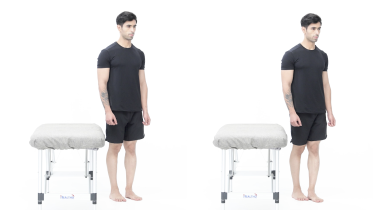 Semi-tandem stance
Stop signs and precautions for the semi-tandem stance
Before you start
- If you have had a hip replacement or other hip surgery, get the go-ahead from your surgeon or physio before you try semi-tandem stance. Some operations limit this kind of work for the first months, so the timing depends on your surgery.
- Clear the floor of rugs, cables and clutter before you start. Wear flat shoes that fit well and grip the floor, not socks, tights or bare feet.
- If you have fallen in the past year, feel unsteady on your feet, or take medicines that make you dizzy, keep a hand on the support throughout, practice only when someone else is at home, and ask your doctor or physio about a falls check.
When to stop and get help
- You feel dizzy, lightheaded, faint or sick, or the room seems to spin. Hold your support, sit down and get medical advice the same day before you practice again. If you faint, it does not settle within a few minutes of sitting still, your vision suddenly blurs or goes double, or you cannot stand or walk steadily, call emergency services.
- You tip out of position and have to grab the support hard to stop yourself falling.
- New pain in your feet, ankles or knees while you stand.
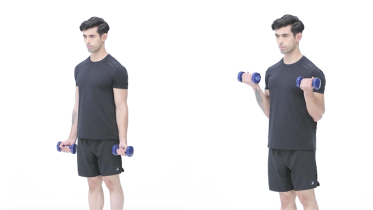 Biceps curl
Stop signs and precautions for the biceps curl
Before you start
- After a broken or dislocated elbow, or elbow surgery such as a tendon repair, follow your surgeon's or physio's plan, and start this exercise only when they have cleared you. If you have just hurt your arm and have severe pain or cannot move the elbow, do not exercise it. Go to an urgent care center or emergency department the same day. If you heard a snap or a crack at the moment of the injury, the arm looks a different shape or sits at an odd angle, a bone is showing, or your arm or hand tingles, feels numb or turns cold, pale or blue, go to an emergency department straight away or call emergency services, and do not drive yourself.
- After a biceps tendon repair or shoulder surgery, curls against resistance usually wait until your surgeon's protocol allows them. Check with your physio before you pick up a weight.
- Keep breathing through each repetition rather than holding your breath, especially if you have high blood pressure.
When to stop and get help
- Sharp pain at the front of the shoulder or at the elbow.
- A sudden pop or snap at the front of your elbow, sudden sharp pain there, or the muscle at the front of your upper arm bunches up or changes shape. Stop and go to an urgent care center or emergency department the same day, even if you can still bend the elbow, as this can be a torn biceps tendon.
- Pain, numbness or tingling that spreads down the arm.
- Pins and needles in your arm or hand that do not go away after you stop, or part of your arm or hand goes numb. Get medical advice the same day. If one side of your face or body suddenly goes numb or weak, or your speech becomes slurred or muddled, call emergency services, even if it goes away.
- Chest pain or pressure, dizziness or feeling faint, a racing or irregular heartbeat, or being far more out of breath than the effort should cause.
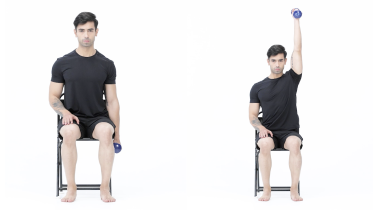 Seated dumbbell shoulder press
Stop signs and precautions for the seated dumbbell shoulder press
Before you start
- Check with your physio before you start if lifting your arm overhead is painful, or if you have a rotator cuff problem, a frozen shoulder or a shoulder that has dislocated in the past. After shoulder surgery or a broken arm, pressing a weight overhead usually waits until your surgeon's protocol allows it.
- After recent heart or chest surgery, get your surgeon's or surgical team's okay first, because pressing a dumbbell up overhead loads the healing breastbone and the front of the chest. If the breastbone clicks, grinds, shifts or feels as if it is moving while you do it, stop, and contact your surgical team the same day.
- If you have high blood pressure, breathe steadily through every repetition and never hold your breath.
When to stop and get help
- A sharp or pinching pain at the top of the shoulder as the arm goes overhead.
- The shoulder feels unstable, as though it could slip out of place.
- Pain, pins and needles or numbness running down the arm.
- Pins and needles in your arm or hand that do not go away after you stop, or part of your arm or hand goes numb. Get medical advice the same day. If one side of your face or body suddenly goes numb or weak, or your speech becomes slurred or muddled, call emergency services, even if it goes away.
- The shoulder feels as if it has slipped out of place, looks a different shape or suddenly locks so you cannot move the arm, or your hand turns cold, pale or blue. Go to an emergency department straight away, without driving yourself, and do not try to put the shoulder back in yourself.
- Chest pain or pressure, dizziness or feeling faint, a racing or irregular heartbeat, or being far more out of breath than the effort should cause.
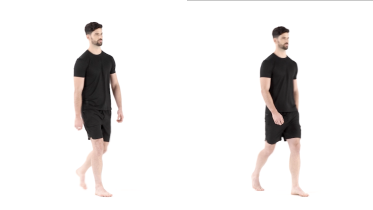 Brisk walking
Stop signs and precautions for the brisk walking
Before you start
- With a heart or lung condition, high blood pressure, or after a recent operation, ask your doctor or physio how much to walk and how fast before you start. If you are pregnant, check with your midwife or physio before you start.
When to stop and get help
- Chest pain or pressure, dizziness or feeling faint, a racing or irregular heartbeat, or being far more out of breath than the effort should cause.
- You feel dizzy, lightheaded, faint or sick, or the room seems to spin. Stop, sit down and get medical advice the same day before you exercise again. If you faint, it does not settle within a few minutes of sitting still, your vision suddenly blurs or goes double, or you cannot stand or walk steadily, call emergency services.
- A sharp pain in a foot, ankle, knee or hip that changes the way you walk.
- Aching, cramping or tightness in a calf, thigh or buttock that comes on at about the same walking distance every time and clears within a few minutes of standing still, and a doctor has not checked it yet. Keep the walk gentle and book an appointment with your doctor before you build up any further, as narrowed arteries in the legs (peripheral arterial disease) can cause this and are managed differently. If leg pain carries on while you are resting or in bed, or wakes you at night, get medical advice the same day. If a foot or leg suddenly turns cold, pale or blue, or suddenly becomes very painful, numb or weak, call emergency services and do not drive yourself, because the blood supply to the leg may be blocked and a leg that has gone numb or weak with it can be impossible to save if it is not treated within about six hours.
- Your calf or thigh becomes swollen, warm, tender, red or darker than usual, or has a throbbing or cramping pain that feels different from normal muscle ache. Stop and get medical advice the same day, as this can be a blood clot. If you are also short of breath or have chest pain, call emergency services.
- You feel unsteady on your feet or close to falling.
- You are pregnant and notice bleeding or fluid leaking from your vagina, regular painful tightenings, tummy pain that does not settle when you rest or comes with lower back pain, or a change in your baby's usual movements, such as moving less than usual. Stop and contact your midwife or maternity unit straight away. Do the same for a severe headache, problems with your vision such as blurring or flashing lights, pain just below your ribs, or sudden swelling of your face, hands or feet, which can be signs of pre-eclampsia. Call emergency services if the bleeding is heavy, the tummy pain is severe, bleeding or tummy pain comes with pain in your shoulder or feeling sick, faint or dizzy, or a headache comes on suddenly and is very severe.
Fatigue and pacing, which is not the same as strength
Plenty of people looking for this page are not really asking about muscle. They are asking why they are so tired. The two travel together and they do not answer to the same treatment: weakness gets better with loading, while fatigue gets worse if the loading is badly spread.
Pacing is the answer, and it is dull on purpose. Work out roughly what you can do on an average day without paying for it tomorrow, then do slightly less than that, consistently, instead of doing everything on a good day and nothing for the two days after. Break the big jobs into pieces with a sit down between them, so a shower and getting dressed are not one single effort. Put the exercises at the time of day you have most in the tank, which for most people is the morning.
Fatigue after a serious illness can run for a long time. Among survivors of intensive care in a Dutch study, 36 percent of those admitted for a medical reason reported fatigue a year afterward (Geense and colleagues, 2021). That is a more unwell group than most readers of this page, and the point of the figure is not the number. It is that months of tiredness is a known pattern rather than a sign you are doing something wrong.
Two kinds of tiredness are not fatigue and need checking instead of pacing. Tiredness that builds week by week alongside breathlessness doing everyday things, a racing heart or paler skin than usual is on the warning list below. So is tiredness with a cough, a temperature or feeling hot and shivery.
Eating and drinking enough to rebuild
You cannot rebuild muscle out of nothing, and appetite is often the last thing to come back after an illness. Inadequate intake of energy or protein is named as a cause of muscle loss in its own right, alongside inactivity and disease, with poor appetite, trouble absorbing food, difficulty eating and limited access to healthy food among the reasons for it (Cruz-Jentoft and colleagues, 2019).
This page gives no protein figure, and that is deliberate. How much you need depends on your body size, your kidney function, your other conditions and what you are already eating, so the number belongs to your doctor or a dietitian rather than to a web page. The practical half needs nobody's permission: something with protein at each meal rather than all of it at dinner, smaller meals more often if a full plate puts you off, and a drink kept within reach of the chair you spend the day in rather than in the kitchen.
If you are losing weight without trying, eating much less than usual, or finding eating difficult, that is not something to sort out once you are stronger. It is on the warning list below, and it is the kind of thing a doctor can act on.
If your stay was for an operation
Your surgical team's plan replaces this one for as long as it runs. They set how much weight can go through the limb, which movements are off, and when each restriction lifts. None of that can be worked out from how the limb feels, because a repair is often comfortable long before it can take load.
We have pages built around the common operations, and they follow the surgical timetable rather than this general one: after a hip replacement, after a knee replacement and after a broken hip, after a rotator cuff repair, after a shoulder replacement, after a broken ankle and after a broken wrist. Use one of those if it fits your operation.
Three months is the rough line this page uses for when to ask, and rough is all it is. Restrictions after a repaired tendon or ligament routinely run past it. In a review of 96 published rehabilitation protocols for rotator cuff repair, the commonest point for going back to working the shoulder against resistance was twelve weeks, the protocols varied widely either side of that, and the larger the tear the later it came (Coda and colleagues, 2020). Where a bone was fixed with screws, plates, nails or wires, the restriction usually ends when your surgeon says the bone has healed rather than on a date in a diary.
So the question is not how long ago the operation was. It is whether you were given a restriction that nobody has told you has lifted, and if you were, treat it as still running and ask, whatever the calendar says. Where this page still earns its place is the rest of you, because an operation on one knee costs you strength in both legs, in your arms and in your stamina, and most surgical protocols say very little about any of that.
Three sets of warning signs matter more after an operation than after a medical admission, and all three are at the foot of this page: the wound and infection signs, the blood clot signs, and the signs that the operation itself has given way. Learn them now. Infection and clots are the two complications most likely to be mistaken for a slow recovery.
The third set is the one nobody mentions on the way out of the ward. A new joint can come out of its socket. A repaired tendon can tear again. The screws, plate, nail or wires holding a bone can shift before the bone has healed, and the bone around a new joint or a plate can break after a knock small enough that you would not have given it a thought before the operation. From the inside, all of those look like the leg or the arm going backward, which is exactly what loss of condition looks like, so they get put down to a bad week.
The difference is the suddenness and the function: if the limb was taking your weight or lifting a cup last week and will not now, or if you heard a crack, a pop or a clunk and something changed after it, that is a question for the team who operated, not for your next physio appointment. Both lines are in the warning signs at the foot of this page, one of them an emergency.
If you were in intensive care
A spell in intensive care is its own recovery, and a slower one. Weakness, fatigue, poor memory and concentration, low mood and anxiety are all common afterwards, and they are grouped under the name post-intensive care syndrome, which describes a pattern rather than being a diagnosis (Hiser and colleagues, 2023). The figures behind that come from a Dutch study of 2,345 people who answered the same questions before their admission and again a year later: new physical, cognitive or mental health problems at one year were reported by 58 percent of those admitted to intensive care for a medical reason and 64 percent of those admitted after urgent surgery (Geense and colleagues, 2021). The review that collects those numbers points out that the physical problems in that study were measured with a questionnaire that had not been validated, so read them as showing how common the problem is rather than as a precise rate.
Start at stage 1 even if you were fit beforehand. Expect the timescale in months, and read a single flat week as normal rather than as failure. Several weeks with nothing moving, or ground going backward, is a different thing, and it is a reason to ask rather than to wait, which is also what the guideline below says.
Ask for a rehabilitation referral instead of assuming one will arrive, and mention the memory and mood side as well as the legs, because people tend to report only the legs. Have the chest signs on the warning list clear in your head before you start too, because a new cough or new breathlessness needs checking rather than pushing through.
What should happen after critical care has a published shape, and it is worth knowing because it tells you what to ask for. NICE sets it out for the NHS in England in its guideline on rehabilitation after critical illness in adults. Four parts of it matter to you at home. You should have been given the contact details of the person coordinating your rehabilitation, once when you left critical care and again when you left hospital, so ask for a name and a number if you have neither.
Before you went home there should have been a functional assessment covering both sides of this, the physical one, which it describes as weakness, not being able to sit, stand or walk, fatigue, pain, breathlessness, swallowing trouble, continence, changes in vision or hearing, difficulty speaking or writing, and equipment needs, and the non-physical one, which it describes as anxiety, low mood, post-traumatic symptoms, memory and attention problems, confusion and relationship difficulties. The guideline asks for a review 2 to 3 months after you left critical care, face to face, with the same assessment done again, and it says that if you are recovering more slowly than your goals expected, or something new has appeared, that review is where a referral to a rehabilitation or specialist service is made. So if nobody has contacted you by the two month mark, that is the point to ask rather than to wait. It also says a structured self-directed rehabilitation manual, lasting at least six weeks and coordinated by a clinician throughout, may be offered as part of the program, which is a thing you can ask about by name.
Arrangements and names differ by country, so what NICE sets for England may not be what your service does. The questions are the same everywhere: who is coordinating this, when is my review, and what do I do if I am not getting better as fast as we agreed.
For the breathing side alongside the strength work, the breathing exercises for COPD and long-term chest conditions page covers techniques that help with breathlessness, and cardiac rehab covers the same ground after a heart problem.
Rehab at home: what the service is called where you live
There is usually something between the hospital and nothing at all, and its name changes with the country. In the United Kingdom you may hear reablement or intermediate care. In the United States, home health or rehabilitation in a skilled nursing facility. Canada, Australia and New Zealand each have their own arrangements and their own words for them.
We cannot tell you what you qualify for, because eligibility, duration and cost differ by country, by region and by insurer, and any figure a page gave you would be wrong somewhere. The question is the part we can give you, and who to put it to. Before you leave, ask the ward what rehabilitation has been arranged, who will come, when they will come, and who to contact if nobody does. Once you are home, ask your own doctor or physical therapist, and say plainly what you cannot manage rather than describing how you feel, because a service is arranged against tasks rather than against tiredness. The NHS has a page on care after a hospital stay which sets out how the arranging works in England, and it is a useful picture of the shape of it even if you live somewhere else.
Ask about a falls assessment in the same conversation. The NHS says a doctor may refer you to a specialist falls service, which can look for causes such as muscle weakness, weak bones or eyesight problems and can review your medicines, and that in some areas you can refer yourself after a fall.
For the person helping
If you are reading this for somebody else, the most useful thing you can do is also the hardest to make yourself do: leave them the bits they can still do. Every time you fetch the cup, a repetition disappears. Strength comes back through the standing up, the walking to the kitchen and the reaching into the cupboard, so the job is to make those safe rather than to take them away.
Four things help more than they look like they will. Set the chair up, which means firm, high, with arms, back against a wall, and a cushion on the seat for as long as standing up is hard. Be present rather than hands on, standing to the side while they do a set so that a wobble has somewhere to land. Keep a written list of what they are meant to be doing, because people come home from hospital tired and spoken instructions do not stick. And take the medicine list to the doctor and ask for the whole list to be reviewed, mentioning any new weakness, dizziness or muddled thinking since the discharge.
Then there is the watching, and you are better placed for it than anyone. Tiredness and breathlessness that build week by week. A calf or thigh that has become swollen or warm. A wound getting redder. Being more muddled, drowsy or agitated than usual, which you will spot first because you know what normal looks like for them.
Sudden confusion is an emergency at home. So is a fall where they cannot get up, or a fall they cannot remember.
The change that gets missed is the quiet one. Delirium does not always look like agitation. NICE says the kind most often missed shows up as withdrawal, slow responses, moving about less, poorer concentration and a smaller appetite, and that the changes to act on are recent ones, over hours or days, that may come and go through the day. All of that reads as tiredness, low mood or simply getting old, which is why it goes unreported.
Tell their team about a change in how they are, even a change that keeps coming and going, and even if it has passed by the time you get through. NICE's own advice to families is that delirium is common and usually temporary, and that the team wants to be told. If it does not clear, go back, because that is a reason to look again for a cause rather than to accept it as permanent.
One line for you rather than for them. A recovery measured in months is long enough to wear out the person doing the helping, and asking early what support exists for carers where you live is sensible rather than an indulgence.
When to see a physio or doctor
See a physio or your doctor if you are not getting steadily better over two weeks, if standing up from a chair, walking or the stairs are still beyond you, if you feel unsteady or have had a fall, or if you are not sure which stage of this program suits you. Ask sooner rather than later, because the first month appears to set the pattern: in the study described above, whether people had got back to their old level by one month was linked to where they ended up at a year (Boyd and colleagues, 2008). These are also the weeks when a treatable cause of weakness is most likely to be sitting undetected.
Go back to whoever looked after you in hospital, rather than waiting for a routine appointment, if the problem looks like a wound, a clot, an infection or something to do with your operation. Take your discharge letter and your medicine list to any appointment. If you are worried about falling, say so plainly, because that sentence is what opens the door to a falls service.
Some signs need help faster than an appointment, from a call to emergency services down to a visit within a day or two. They are all in the warning signs below, each with its own timing. Read that list once before you start the program and once more a week later, because the things on it are not the things you would think to look for.
For physiotherapists
The prognostic point worth acting on comes from Boyd and colleagues (2008): among patients aged 70 and over discharged with new or additional self-care disability, whether they had recovered by one month was associated with their functional outcome at twelve. That makes the first month the window to be intensive in, rather than the month to let settle before starting.
Measure instead of asking. The 30-second chair stand test, the Timed Up and Go and the six-minute walk test each carry their own norms, and gait speed is the cheapest repeatable measure in the set. The comparison that matters is premorbid function two weeks before admission, which is a history to take from the patient or the family rather than a number to measure today, because current performance tells you the deficit and not the target.
On dose, there is no trial-grade figure for an unsupervised frail patient at home in week one, which is why this page gives structure and defers the numbers. Aarden and colleagues (2023) is the closest thing to a prescription for this population and it is Delphi consensus: daily sessions in the first week post-discharge, two to three a week out to twelve weeks, combined strength, aerobic and functional work, with tailoring and supervision treated as part of the intervention rather than as an optional extra. The panel also reached consensus on intensity up to 70 to 80 percent of maximum heart rate, conditional on contraindications being absent, and that figure is deliberately not on the reader-facing part of this page: it is unusable for a patient on rate-limiting medication, newly anemic or in atrial fibrillation, and the condition attached to it is one the reader cannot check alone. Hartley and colleagues (2022) and Carneiro and colleagues (2022) point in different directions, and the reading that fits both is that the dose which changes function is the one delivered after discharge and progressed, not the one delivered on the ward.
The same cohort that gives this page its recovery figures also gives the prognosis, which is worth having in mind before setting a target with a family. Of the patients discharged with new or additional self-care disability, 41.3 percent had died by twelve months, 28.6 percent were alive without having recovered their baseline and 30.1 percent were back at baseline; for those discharged at their baseline the three figures were 17.8, 15.2 and 67 percent (Boyd and colleagues, 2008). Those were patients aged 70 and over admitted nonelectively to general medical services at two American hospitals between 1993 and 1998, so they do not describe someone home after an elective joint replacement, and the authors' own conclusion was that rehabilitation of greater length, carer support and palliative care all needed evaluating. The mortality figure is kept out of the reader-facing part of this page on purpose. It is prognosis rather than education, it changes nothing the reader can do, and most readers are not in that cohort.
Screen the medical causes before progressing the program, and screen the discharge medicine list as a matter of course. An orthostatic blood pressure, asking whether a blood count has been checked when tiredness is building rather than easing, and a delirium screen in anyone whose family says they are not themselves are all faster than three wasted weeks of exercise therapy. The same applies to the premorbid baseline: a patient who was already housebound before the admission needs a different target from one who was shopping on foot two weeks ago, and the program above assumes the second.
Warning signs
Get emergency help now
- Emergency: if chest pain, pressure or tightness does not ease quickly when you rest, spreads to your arm, neck, jaw, stomach or back, or comes with sweating, feeling sick, feeling light-headed or being short of breath, call emergency services straight away, as this can be a heart attack. If it eases quickly and none of these happen, get medical advice the same day, and do not exercise again until you have been checked.
- Emergency: since your hospital stay, you suddenly become short of breath, you get chest pain or pain in your upper back that may be worse when you breathe in, you cough up blood, your heart is beating very fast, or you faint. Call emergency services straight away, even if your legs look normal. These can be signs of a blood clot in the lungs (pulmonary embolism).
- Emergency: any sign of a stroke, even if it goes away. That means a face that droops on one side, an arm you cannot lift or keep up, slurred or muddled speech, weakness or numbness on one side of your body or face, sudden blurred vision, double vision or loss of sight, trouble swallowing, sudden dizziness with unsteadiness or falling over, a sudden severe headache, or a sudden fall where your legs give way but you do not black out (a drop attack). Call emergency services straight away.
- Emergency: sudden confusion, for example you, or the person you care for, suddenly become muddled, much drowsier than usual, unable to follow what is said, unsure where you are, or you see or hear things that are not there. Call emergency services or go to an emergency department straight away, without driving yourself, and take your medicines or a list of them with you. Sudden confusion can come from an infection, a stroke, a head injury, a low blood sugar level in someone with diabetes or other causes that need treating quickly.
- Emergency: a racing, pounding, fluttering or irregular heartbeat that does not settle when you rest, or that comes with dizziness, feeling faint or fainting, chest pain or shortness of breath. Call emergency services straight away. If it has already stopped, get medical advice the same day.
- Emergency: you have just fallen and cannot get up, or you think you may have hurt your head, neck, back or hip. Stay where you are, keep warm and call emergency services, or get someone to call for you. If you got up and walked without trouble and only notice pain later, use the same-day lines in this list instead.
- Emergency: you fell and cannot remember the fall or how it happened. Go to an emergency department straight away, and do not drive yourself. You may have blacked out or hit your head without knowing it.
- Emergency: after a knock to the head, being very drowsy or finding it hard to keep your eyes open, confusion, a fit (seizure), new weakness or numbness anywhere in your body, new trouble understanding, speaking, walking or keeping your balance, new problems seeing or hearing, clear fluid coming from your ears or nose, bleeding from your ears or bruising behind them, a black eye when your eye was not hit, a dent in your head or a wound with something stuck in it, or a change in behavior. Call emergency services straight away. These can be signs of an injury to the brain.
- Emergency: after a knock to the head, you were knocked out, even for a moment, you cannot remember what happened just before or after, you have had a headache ever since, or you are being sick (vomiting). The same applies, even if you feel fine, if you take medicine that thins your blood, other than aspirin on its own, have a bleeding or clotting condition, have had brain surgery in the past, or had been drinking alcohol or taking drugs when it happened. Go to an emergency department straight away, and do not drive yourself.
- Emergency: since an operation, the limb that was operated on suddenly cannot be used. You could put your weight through that leg yesterday and cannot today, the arm or leg will not move, it has changed shape or sits at an odd angle, or you heard a crack or felt a clunk and then could not stand on it. Keep still, keep the weight off it, do not try to push anything back into place, and go to an emergency department straight away without driving yourself, or call emergency services if you cannot get up. A new joint can come out, a repair or the metalwork holding a bone can give way, and the bone around either can break, and all of those are treated in hospital.
- Emergency: you have had a hip replacement and have sudden severe pain in your hip or groin, sometimes with a clunk or pop, and you cannot move the leg or put weight on it, or the leg suddenly looks shorter or turned in or out. Do not try to walk on it or push it back into place. Keep still and call emergency services or go to an emergency department, and do not drive yourself. Your new hip may have come out of its socket (dislocated), and a medical team needs to put it back.
Get help today
- Same day: a calf or thigh that is newly swollen or getting more swollen, warm, tender, red or darker than usual, has swollen veins that are sore to touch, or has a throbbing or cramping pain that does not fit your injury or condition, or that feels different from normal muscle soreness after exercise. This can be a sign of a blood clot (deep vein thrombosis), especially after surgery, an injury, time in a cast or boot, a long trip or a spell of being much less mobile than usual. Get medical advice the same day. If you are also short of breath or have chest pain, call emergency services.
- Same day: in the days or weeks since you came home you are getting more and more tired, breathless doing everyday things such as walking to the toilet or getting dressed, dizzy or lightheaded, your heart is racing, or your skin looks paler than usual. Contact the team who looked after you, or get medical advice the same day. Tiredness and breathlessness that build up like this are not part of the usual recovery. Blood loss from an illness, an injury or an operation can leave you short of red blood cells (anemia), which is treatable, and a slow bleed or an infection can show up the same way. If breathlessness comes on suddenly, or you get chest pain, call emergency services, as the emergency line above explains.
- Same day: a new or worsening cough, phlegm, a high temperature, chest pain when you breathe or cough, or feeling more short of breath than you were when you came home. Get medical advice the same day. A chest infection can show up as a cough, breathlessness, a high temperature, chest pain, wheezing, an aching body, loss of appetite and tiredness, and the NHS notes that feeling confused is common in older people who have pneumonia, so the first sign is not always a cough. If you are struggling to breathe, your lips, skin or tongue turn pale, blue or blotchy, you cough up blood, your heart is beating very fast or you suddenly feel confused, call emergency services. If you have a very high or very low temperature, shivering you cannot control, you are breathing very fast or finding it hard to breathe, you are confused or your speech is slurred, your skin, lips or tongue look blue, gray, pale or blotchy (on brown or black skin this can be easier to see on the palms of the hands or soles of the feet), or you have a rash that does not fade when you press it, call emergency services, as this can be sepsis.
- Same day: you have become short of breath when you lie down flat, or you wake in the night needing to sit up to breathe, your ankles, legs or tummy are more swollen than when you came home, you have gained weight quickly over a few days, or you are coughing up frothy pink phlegm. Get medical advice the same day. The NHS lists breathlessness when you lie down, suddenly gaining weight and coughing up frothy pink phlegm as reasons to get urgent advice, because the heart may not be keeping up with the fluid in your body, which is treatable and is a common reason for going back into hospital in the first weeks at home. If you are struggling to breathe, or you have chest pain, call emergency services.
- Same day: since an operation, the wound is red, hot, swollen, leaking fluid or opening up, you have a fever or feel hot and shivery, or the pain in that area is new or getting worse quickly. Contact your surgical team or the ward you went home from the same day rather than waiting for your physio appointment, and if you cannot reach them, go to an emergency department the same day. This can be an infection in the wound or deeper, around a repair or a new joint. Redness can be harder to see on brown or black skin. If you have a very high or very low temperature, shivering you cannot control, you are breathing very fast or finding it hard to breathe, you are confused or your speech is slurred, your skin, lips or tongue look blue, gray, pale or blotchy (on brown or black skin this can be easier to see on the palms of the hands or soles of the feet), or you have a rash that does not fade when you press it, call emergency services, as this can be sepsis.
- Same day: since an operation, a smaller fall or knock has left the operated area newly painful, swollen or bruised, even if you can still use the limb and it looks normal, or you felt a pop or a snap near a repair and can still use the limb but it has gone weak, so you cannot push off, straighten the knee or lift the arm the way you could a week ago. Stop the exercises, go back to your crutches, frame or stick and keep your full weight off that leg, and get it checked by your surgical team or the ward you went home from the same day. If you cannot reach them, go to an urgent care center or emergency department the same day. Ask whether you need an X-ray: a break in the bone around metalwork or a new joint is not always obvious at first, an X-ray is what shows it, and walking normally on one can move the broken ends apart.
- Same day: in the past few hours or days you, or the person you care for, have become quieter and more withdrawn, slower to answer, harder to hold a conversation with, less interested in food, or are moving about less than usual, and this is a change from how you were. Get medical advice the same day and say when the change started. NICE names withdrawal, slow responses, reduced movement, worse concentration and a smaller appetite as the signs of the quiet kind of delirium, which is the kind most often missed, and asks for changes like these to be assessed rather than watched. Delirium is common and usually passes, but the cause of it needs finding. If the confusion came on suddenly, or they are much drowsier than usual, muddled or cannot follow what is said, use the emergency line above instead. If they also have a temperature, are not drinking, or you cannot keep them awake, call emergency services.
- Same day: you blacked out or fainted, even for a moment. Get medical advice the same day. Call emergency services instead if the person is not breathing, cannot be woken within 1 minute, has not fully recovered or has trouble speaking or moving, has chest pain or a pounding, fluttering or irregular heartbeat, fainted while exercising or lying down, is shaking or jerking, or was badly hurt.
- Same day: dizziness, lightheadedness, blurred vision or feeling faint when you stand up that is new for you, does not pass within a minute or two, keeps happening, or has made you fall. Sit or lie down, and get medical advice the same day. This can be a drop in blood pressure on standing (postural hypotension), a type of low blood pressure, which the NHS lists among the causes of falls, and your doctor can check it. Tell them about your medicines, because some can cause it. If it does not settle within a few minutes of sitting or lying still, call emergency services. If you faint, use the fainting line above.
- Same day: dizziness or feeling faint during or after exercise, other than the brief lightheadedness as you stand up covered in the line above, without any of the emergency signs above. Stop the exercises and get medical advice the same day. If you faint, it does not settle within a few minutes of sitting still, or you cannot stand or walk steadily, call emergency services.
- Same day: after a fall, you are in pain, have hurt yourself or feel unwell, or you were on the floor for an hour or more, without any of the emergency signs above. Get medical advice the same day, even if you managed to get up.
- Same day: a leg or foot that is getting weaker, for example your foot drags, catches on the ground or slaps down when you walk (foot drop). Get medical advice the same day. If the weakness is getting worse by the hour, go to an emergency department.
- Same day: you are taking tablets or having injections to lower your risk of a blood clot and you notice blood in your urine, black or bloody stools, bleeding gums, a nosebleed that goes on and on, bruising far beyond what the knock would explain, or you are being sick or coughing up blood. Get medical advice the same day, and do not stop the medicine on your own. Bleeding more easily is the known trade-off of these medicines (NHS), and the dose or the type may need looking at. Go to an emergency department if the bleeding will not stop, you feel faint, or you bang your head while you are taking it, even if you feel fine, because the NHS advises getting urgent advice after a head injury on medicine that thins your blood and only a hospital can scan for a bleed inside the head.
- Same day: new hip or groin pain after a fall, even a small one, if you are older, have low bone density (osteoporosis) or have taken steroid tablets for a long time, even if you can still walk. Get medical advice the same day. A broken hip is not always obvious at first.
- Same day: back pain after a minor fall or strain if you are older, have low bone density (osteoporosis) or have taken steroid tablets for a long time. Get medical advice the same day. Until it has been checked, stop the exercises and keep away from lifting, bending forward and twisting, because those load a bone in the spine that may be broken.
- Same day: a sore, a blister or broken skin over a bony area such as a heel, hip, bottom, tailbone or elbow that is hot, swollen, red or darker than usual, has pus coming from it, is severely painful or getting more painful, or comes with a high temperature. Get medical advice the same day, from your doctor, a nurse or NHS 111 in the UK. An infected pressure sore (pressure ulcer) needs treating, and the risk is higher while you move less than usual and in the weeks after an operation (NHS). If you feel very unwell, or you have any of the sepsis signs listed above, call emergency services.
- Losing weight without trying. If you are being treated for cancer now, contact your cancer team the same day.
- Losing weight without trying. If you also have new back or neck pain, get medical advice the same day.
Book an appointment
- Within a few days: a patch of skin over a bony area, such as a heel, hip, bottom, tailbone or elbow, that is discolored and does not change color when you press it (usually red on white skin, purple or blue on brown or black skin), that feels warm, spongy or hard, or that is sore or itchy. Book an appointment with your doctor or nurse within a few days, keep the pressure off it until then and change position often. That is how a pressure sore (pressure ulcer) starts, and the risk is higher while you move less than usual, in the weeks after an operation, and where you sit or lie in one position for long (NHS). If it is already broken, weeping or painful, use the same day line above.
- Within a few days: you have had a fall, even if you were not hurt, or you keep tripping, stumbling or feeling that your legs might give way. Book an appointment with your doctor within a few days and ask about a falls assessment. Tell them about every fall, even the ones where you were not hurt.
- Within a few days: you are eating or drinking much less than usual, or you cannot manage to wash, dress, cook or get to the toilet safely on your own. Book an appointment with your doctor within a few days, and say plainly what you cannot manage rather than how you feel. Not managing at home is a reason to ask for help rather than something to push through. The NHS route for that is a care needs assessment: it says the first step for someone who needs help to cope day to day is to ask for one, that it is free and anyone can ask for one, and that you should describe every everyday task you struggle with, including small ones such as turning a tap on and off, because leaving things out can reduce the care you are offered. Who arranges it differs by country, so ask your own doctor or the team who sent you home. Muscle will not rebuild on too little food and drink either.
- Losing weight without trying. See your doctor within a day or two and mention it.
- Routine: your strength or your walking has stopped improving over a week or two, or you cannot manage the exercises you were given, and you have none of the signs above. This is not an emergency, but ask your physio or your doctor for a review in the next week or two.
Common questions
How long does it take to regain strength after a hospital stay?
Longer than the stay, and the honest planning horizon is months. In a study of people aged 70 and over admitted as emergencies to general medical wards, 30 percent of those who went home needing help with self-care they had managed before the admission were back at their old level twelve months later, against 67 percent of those who left hospital still able to do what they could before (Boyd and colleagues, 2008). What that says is that how much you had lost by the day you left matters more than how many nights you were in. Most people notice the first changes within a week or two, in practical things rather than in how much they can lift: standing up without pushing off the chair arms, carrying a cup to the next room, managing the stairs once a day.
Why do you lose so much muscle in hospital?
Because muscle responds to being used, and almost nothing in a hospital day uses your legs. Illness adds to it: the European working group on sarcopenia names disease, physical inactivity and inadequate intake of energy or protein as three separate causes of muscle loss, and an admission usually brings all three at once (Cruz-Jentoft and colleagues, 2019). There is no reliable figure for muscle lost per day, which is a common search, because the research measures a whole period rather than a daily rate. The closest measurement is 11 healthy volunteers averaging 67 years old who spent ten days in continuous bed rest on a normal diet, and lost 13.2 percent of their knee extension strength and 14 percent of their stair climbing power, with aerobic capacity 12 percent lower by the end (Kortebein and colleagues, 2008). They were not ill at all, so treat that as a floor rather than a ceiling.
What exercises can you do after a hospital stay?
Seated and supported work first, standing work once somebody has cleared you for it. The program on this page starts with ankle pumps, quad sets, seated knee extension and standing up from a chair using the armrests, all done with your weight supported, then adds sit to stand without your hands, standing marching, calf raises and balance at a chair, and finally stairs, step ups and light weights. Each exercise page gives a typical starting dose, and in the first week at home fewer repetitions done more often through the day usually works better than one long session. Your physio will adjust the exercises and the numbers to suit you. If you have had an operation, the plan from your surgical team replaces this one for as long as it runs.
When is weakness after leaving hospital a reason to get medical help?
When it is getting worse rather than better, when it arrived suddenly, or when anything else new has arrived with it. Loss of condition improves slowly and improves further on a day when you have eaten and slept. Weakness that is worse this week than last can instead be a blood clot, a wound, chest or urine infection, anemia from blood loss, a new or changed medicine, a drop in blood pressure when you stand, fluid the heart is not keeping up with, confusion or a new neurological event, and most of those are treatable and often missed. After an operation there is one more: a repair, a fixation or a new joint that has given way, which shows itself as a limb that was working last week and will not take your weight or lift a cup now, and which goes to the team who operated rather than to a physio appointment. One-sided weakness, a drooping face, slurred speech or sudden confusion means calling emergency services, even if it has already passed. Weakness that is not worse but has simply stopped improving over a week or two is worth a review too, which is the slowest route on the list and still a route. Every sign is written out with what to do and how fast in the warning signs at the foot of this page.
References
- Kortebein P, Symons TB, Ferrando A, et al. Functional impact of 10 days of bed rest in healthy older adults. Journals of Gerontology Series A: Biological Sciences and Medical Sciences. 2008;63(10):1076-1081. https://doi.org/10.1093/gerona/63.10.1076
- Boyd CM, Landefeld CS, Counsell SR, et al. Recovery of activities of daily living in older adults after hospitalization for acute medical illness. Journal of the American Geriatrics Society. 2008;56(12):2171-2179. https://doi.org/10.1111/j.1532-5415.2008.02023.x
- Hartley P, Keating JL, Jeffs KJ, Raymond MJM, Smith TO. Exercise for acutely hospitalised older medical patients. Cochrane Database of Systematic Reviews. 2022;11:CD005955. https://doi.org/10.1002/14651858.CD005955.pub3
- Carneiro MAS, Oliveira-Junior G, Castro-E-Souza P, et al. Impact of exercise intervention-based changes on physical function biomarkers in older adults after hospital discharge: a systematic review with meta-analysis of randomized clinical trials. Ageing Research Reviews. 2022;80:101673. https://doi.org/10.1016/j.arr.2022.101673
- Aarden JJ, Major ME, Aghina CMW, et al. Recommendations for an exercise intervention and core outcome set for older patients after hospital discharge: results of an international Delphi study. PLoS One. 2023;18(3):e0283545. https://doi.org/10.1371/journal.pone.0283545
- Coda RG, Cheema SG, Hermanns CA, et al. A Review of Online Rehabilitation Protocols Designated for Rotator Cuff Repairs. Arthroscopy, Sports Medicine, and Rehabilitation. 2020;2(3):e277-e288. https://doi.org/10.1016/j.asmr.2020.03.006
- Liu CJ, Latham NK. Progressive resistance strength training for improving physical function in older adults. Cochrane Database of Systematic Reviews. 2009;(3):CD002759. https://doi.org/10.1002/14651858.CD002759.pub2
- Hiser SL, Fatima A, Ali M, Needham DM. Post-intensive care syndrome (PICS): recent updates. Journal of Intensive Care. 2023;11:23. https://doi.org/10.1186/s40560-023-00670-7
- Geense WW, Zegers M, Peters MAA, et al. New Physical, Mental, and Cognitive Problems 1 Year after ICU Admission: A Prospective Multicenter Study. American Journal of Respiratory and Critical Care Medicine. 2021;203(12):1512-1521. https://doi.org/10.1164/rccm.202009-3381OC
- Cruz-Jentoft AJ, Bahat G, Bauer J, et al. Sarcopenia: revised European consensus on definition and diagnosis. Age and Ageing. 2019;48(1):16-31. https://doi.org/10.1093/ageing/afy169
- Bull FC, Al-Ansari SS, Biddle S, et al. World Health Organization 2020 guidelines on physical activity and sedentary behaviour. British Journal of Sports Medicine. 2020;54(24):1451-1462. https://doi.org/10.1136/bjsports-2020-102955
- National Institute for Health and Care Excellence. Rehabilitation after critical illness in adults. Clinical guideline CG83. Published 25 March 2009. https://www.nice.org.uk/guidance/cg83
- National Institute for Health and Care Excellence. Delirium: prevention, diagnosis and management in hospital and long-term care. Clinical guideline CG103. Published 28 July 2010, last updated 18 January 2023. https://www.nice.org.uk/guidance/cg103
- NHS. Care after a hospital stay. https://www.nhs.uk/social-care-and-support/care-after-a-hospital-stay/
- NHS. Getting a care needs assessment. Page last reviewed 22 August 2024. https://www.nhs.uk/social-care-and-support/help-from-social-services-and-charities/getting-a-needs-assessment/
- NHS. Sudden confusion (delirium). Page last reviewed 28 May 2024. https://www.nhs.uk/symptoms/confusion/
- NHS. DVT (deep vein thrombosis). Page last reviewed 30 April 2026. https://www.nhs.uk/conditions/deep-vein-thrombosis-dvt/
- NHS. Pneumonia. Page last reviewed 17 July 2026. https://www.nhs.uk/conditions/pneumonia/
- NHS. Sepsis. Page last reviewed 14 May 2026. https://www.nhs.uk/conditions/sepsis/
- NHS. Iron deficiency anaemia. Page last reviewed 26 January 2024. https://www.nhs.uk/conditions/iron-deficiency-anaemia/
- NHS. Low blood pressure (hypotension). Page last reviewed 11 July 2023. https://www.nhs.uk/conditions/low-blood-pressure-hypotension/
- NHS. Heart failure. Page last reviewed 26 June 2026. https://www.nhs.uk/conditions/heart-failure/
- NHS. Falls. Page last reviewed 6 March 2025. https://www.nhs.uk/conditions/falls/
- NHS. Fainting. Page last reviewed 17 August 2026. https://www.nhs.uk/symptoms/fainting/
- NHS. Symptoms of a stroke. Page last reviewed 12 September 2024. https://www.nhs.uk/conditions/stroke/symptoms/
Written and checked by the PocketPhysio editorial team. Last updated 2026-11-02.
This page is general education, not a diagnosis or a personal treatment plan. See a physiotherapist or doctor for advice about your own situation.