
Ankle fracture rehab: exercises after a broken ankle
What is a broken ankle?
A broken ankle (ankle fracture) is a break in one or more of the bones that make up the ankle joint. Most often that is the lower end of the shin bone (tibia) or of the thinner bone beside it (fibula), where they form the bony bumps on each side of the ankle (malleoli). The NHS lists a boot, a plaster cast, putting the bones back in place and surgery as the main treatments, chosen after an X-ray shows how bad the break is.
This page is for adults whose broken ankle is being treated in a boot or cast without surgery, and for the rehab that follows. If your ankle was fixed with surgery (plates, screws or a pin), follow your surgeon's and physio's plan for weight bearing and exercise rather than this page. This page is also not for children or teenagers: follow the plan from their fracture clinic and ask their doctor or physio which exercises to do. If an X-ray showed no break, the ankle sprain program is the better starting point.
Following your weight-bearing plan
Your fracture clinic will tell you how much weight you may put through the leg, how long to wear the boot or cast and whether to use crutches (NHS). Stick to that plan, because it depends on which bones are broken and how stable the break is. For a break in just one of the bony bumps of the ankle, treated without surgery, NICE advises putting as much weight on it as you can bear straight away (NICE NG38). Other breaks need partial weight or no weight for a while, and OrthoInfo warns that weight put on some breaks too early can move the pieces of bone out of place.
For the same kind of break, NICE also advises a fracture clinic review within 2 weeks if it is not certain the ankle is stable, and a review if symptoms are not improving 6 weeks after the injury (NICE NG38). If you are unsure what your plan is, ask your fracture clinic before you change how you walk.
Swelling and blood clots while you are in a boot or cast
Swelling is normal after a broken ankle. The NHS advises resting and raising your ankle whenever you can, and gently moving your toes and bending your knee while you wear the boot or cast. A plaster care leaflet from Chelsea and Westminster Hospital adds gently tightening your calf and thigh muscles every couple of hours to help blood flow. Do not get a plaster cast wet or push anything under it to scratch (NHS).
A leg in a cast or boot is also more likely to form a blood clot in a deep vein (deep vein thrombosis). NICE advises doctors to consider blood-thinning medicine for people with a leg immobilized in this way when their risk of a clot outweighs their risk of bleeding (NICE NG89). If you were given injections or tablets, use them exactly as your team told you. The warning signs of a clot are listed below.
How long does a broken ankle take to heal?
The NHS says a broken ankle usually takes 6 to 8 weeks to heal, but it can take longer. OrthoInfo gives at least 6 weeks for early healing and 10 to 12 weeks for complete healing, and says most people are back to normal activities within 3 to 4 months. Full recovery from some ankle fractures can take up to 2 years, and many people have stiffness and swelling for months after the bone has healed (OrthoInfo).
Most of the rehab work comes after the boot or cast is off, and recovery carries on for months after that. How fast you move through the stages depends on the break, your age, your fitness before the injury and your job or sport.
Why does exercise help after a broken ankle?
Weeks in a boot or cast protect the break. They can also leave the ankle stiff, the calf weak and your walk uneven. The stages below deal with those one at a time.
For many adults, moving the ankle early seems to give about the same result as keeping it in a cast. In the AIR trial, 669 adults wore either a plaster cast or a removable brace, and the brace group took it off to do ankle movement exercises from the start. Ankle function at 16 weeks was about the same in both groups (Kearney and colleagues, 2021).
The evidence for particular exercise programs is thin. A 2024 Cochrane review of 53 studies with 4,489 adults could not tell whether any physical therapy approach after a broken ankle worked better than usual care, because the studies were small and different from each other (Lewis and colleagues, 2024). So the stages here follow common physio practice, built on the plan your fracture clinic sets, rather than a single tested program.
How to use this program
Start only when your fracture clinic says you can begin ankle exercises, and within the weight-bearing plan they gave you. Stage 1 is for the first days out of the cast, or out of the boot for exercise. Move to stage 2 when your team allows weight through the leg and the stage 1 movements feel easy, and to stage 3 when you walk without a limp. The signs for each stage are a rough guide from common practice. They are not fixed rules.
Each exercise page gives a typical starting dose. As a rough guide, many programs do the early movement exercises 2 to 3 times a day, use 2 to 3 sets of 10 to 15 for calf raises, and hold stretches for 20 to 30 seconds, 2 to 3 times. Balance holds often start at 10 to 30 seconds. Your physio will adjust the exercises and the numbers to your ankle and to what you need to get back to.
Stiffness, a stretch or mild discomfort during the exercises is fine if it settles soon after and is no worse the next morning. Sharp pain, pain that builds with every repetition, or an ankle that is clearly more swollen the next morning means the load was too much. Drop back a step rather than stopping altogether, and raise your leg after the session if it has swollen.
The exercise program
Stage 1: Get the ankle moving and the swelling down
For when the cast comes off, or when your team says you may take the boot off to exercise. After weeks of protection the ankle is usually stiff and puffy. The aim is to move it gently in every direction, little and often, sitting or lying with the leg supported. Ankle pumps, circles and the alphabet move it up, down and around. The two active turns tilt the sole of the foot in and then out. Many programs use about 10 to 15 slow repetitions of each movement, or 1 to 2 rounds of the alphabet, 2 to 3 times a day. Keep them gentle: stiffness, a mild stretch or mild discomfort that eases soon after you stop is expected, sharp pain is not. Raise your leg afterward if the ankle has swollen, and put the boot back on between sessions if your team wants you to keep wearing it.
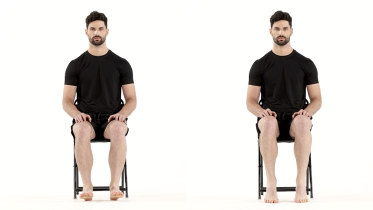 Ankle pumps
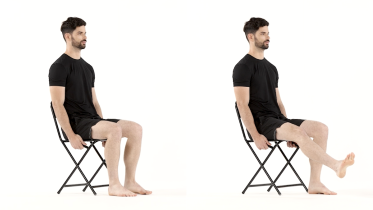 Ankle circles
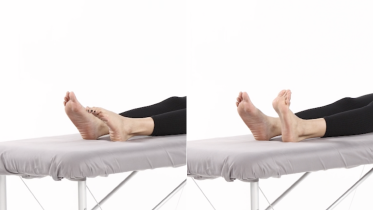 Ankle alphabet
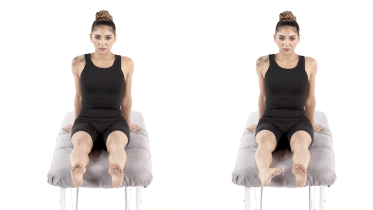 Active ankle inversion
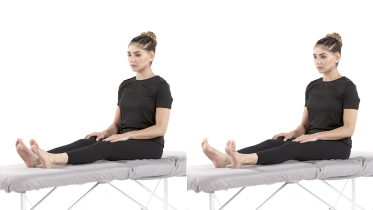 Active ankle eversion
Stage 2: Build strength and walk without a limp
Start this stage when your team says you can put weight through the leg. In the standing exercises, put through only as much weight as your plan allows. The two weight shifts get the ankle used to taking your weight again, forward and back and then side to side, with a counter to hold. Calf raises, first sitting and then standing on both feet, rebuild the push-off you lost in the boot. The two calf stretches are for an ankle that still will not bend forward enough on stairs or slopes. Walking with a cane and walking with longer steps practice landing on the heel and pushing off. Do not swap crutches for a cane until your team or physio says you are ready.
 Forward and backward weight shift
 Side to side weight shift
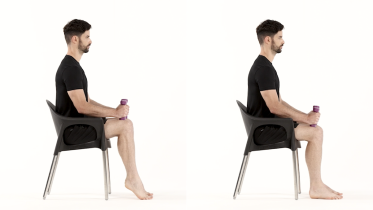 Seated calf raise
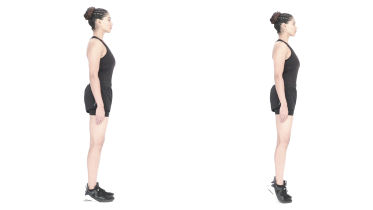 Calf raises
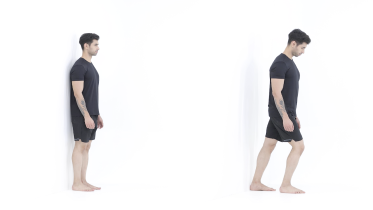 Calf stretch
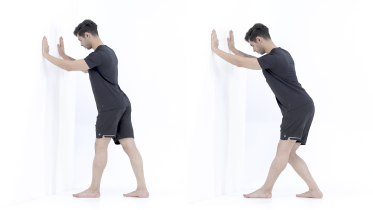 Soleus stretch
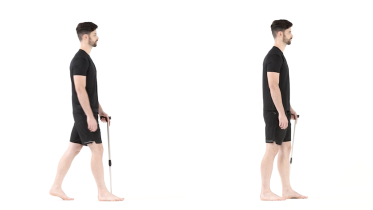 Walking with a cane
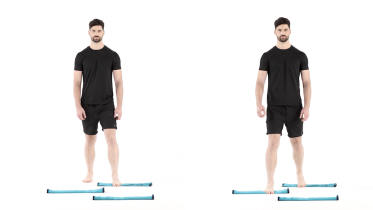 Walking with longer steps
Stage 3: Balance, stairs and getting back to activity
For when you walk without a limp and calf raises on both feet feel easy. Balance work goes from feet together to heel to toe (tandem stance) to standing on the injured leg, with a counter or sturdy chair within reach. Step-ups and stepping up and over a low step build strength for stairs. Single leg heel raises work toward the calf strength that running and jumping need. If the ankle is still stiff, the half-kneeling stretch and the stretch on a step put more of your body weight over it. Planning a return to running or sport? A physio can compare the two legs for strength, balance and hopping and plan the build-up with you.
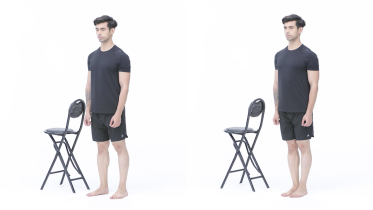 Standing with feet together
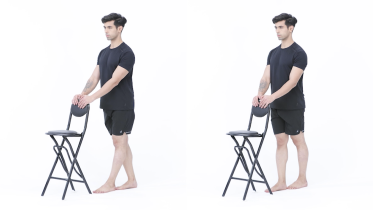 Tandem stance
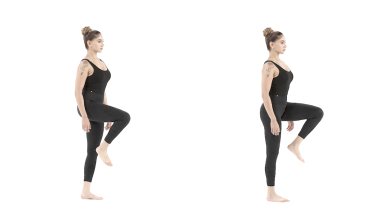 Single leg stance
 Step up
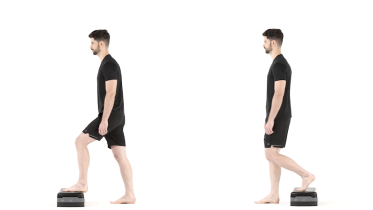 Step up and over
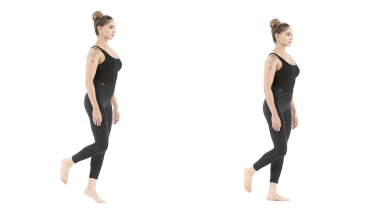 Single leg heel raise
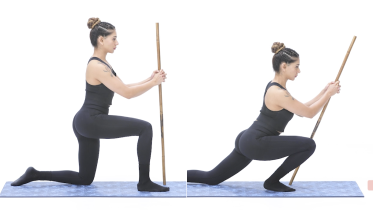 Half-kneeling ankle stretch
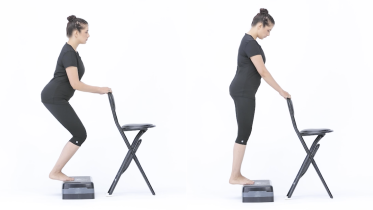 Soleus stretch on a step
Balance and falls after a broken ankle
After weeks in a boot or cast, and perhaps on crutches, balance and leg strength usually need rebuilding. Do the balance work next to a kitchen counter or a sturdy chair you can hold. Wear flat shoes that fit well and grip the floor, not socks, tights or bare feet. Clear rugs and clutter from the floor where you practice.
If you are older, have fallen before, or feel unsteady on your feet, the balance and falls prevention program builds on stage 3 and covers home safety and what to do after a fall. Ask your doctor or physio whether a falls check would help.
When to see a physio or doctor
The NHS says you may need to see a physio to get your foot and ankle moving again. Ask for a referral if your ankle is still very stiff, you still limp, you cannot manage stairs, or you are unsure how far to push the exercises. Ask as well if you need to get back to a physical job or sport. A physio can test your strength and balance against the other leg. Ask for a review too if your ankle is not improving 6 weeks after the injury.
If your ankle was operated on, your surgeon and physio set the plan, including when you can put weight through the leg. The warning signs below say how quickly to get help.
For physiotherapists
This page gives patients a starting framework for rehab after an ankle fracture managed non-operatively in a boot or cast. It does not cover post-operative protocols; operated patients are directed to their surgeon's and physio's plan. NICE NG38 advises immediate unrestricted weight bearing as tolerated for unimalleolar fractures managed non-operatively, orthopedic follow-up within 2 weeks where stability is uncertain, and return for review if symptoms are not improving at 6 weeks.
The AIR trial (Kearney and colleagues, 2021) found no significant difference in the Olerud-Molander Ankle Score at 16 weeks between a below-knee cast and a removable brace in 669 adults, 54% of them managed operatively, with no difference in the prespecified operative versus non-operative subgroup analysis. The brace group was encouraged to remove the brace for active unloaded ankle range of motion as often as pain allowed, with each movement done 10 times, 3 times a day. The cast group started range of motion on cast removal. Deep vein thrombosis occurred in 3 participants in each group.
The AIM trial (Willett and colleagues, 2016) randomized 620 adults over 60 with overtly unstable fractures to surgery or close contact casting applied in theater under anesthesia by a trained surgeon. The Olerud-Molander Ankle Score at 6 months was equivalent. Infection and wound breakdown were more common after surgery (10% vs 1%), radiological malunion was more common after casting (15% vs 3%), and 19% of those who initially received a cast converted to surgery for early loss of reduction.
The 2024 Cochrane review (Lewis and colleagues, 2024) found little or no difference in ankle function between removable and non-removable supports after non-operative management (low-certainty evidence), and very low-certainty evidence for physical therapy interventions compared with usual care. Most included studies were after surgical fixation, and those findings are outside the scope of this page. Screen at each visit for signs of deep vein thrombosis, compartment syndrome and neurovascular compromise under a cast, skin or wound problems and complex regional pain syndrome. NICE NG89 advises considering pharmacological VTE prophylaxis for people with lower limb immobilization whose VTE risk outweighs their bleeding risk, so check that this has been assessed.
See a doctor promptly if
- Emergency: sudden, severe pain in your lower leg that is much worse than you would expect, especially after an injury or with a plaster cast or tight bandage on the leg. It may come with a tight, swollen leg, pain that gets worse when the muscle is stretched, numbness, pins and needles or weakness. Call emergency services or go to an emergency department straight away, and do not drive yourself. This can be acute compartment syndrome, which needs urgent surgery.
- Emergency: while you are in a cast or boot, your toes turn blue, white or pale, or feel cold. Do not wait to see if raising your leg helps. Go to an emergency department straight away, and do not drive yourself. The cast or boot may be cutting off the blood supply, or pressure may be building up inside the leg (compartment syndrome), and both need checking quickly.
- In a cast or boot, the pain gets worse, your toes feel numb, tingle or burn or look more swollen, or the cast or boot feels too tight. Stop, raise your foot above your hip, keep moving your toes and contact your fracture clinic or get medical advice straight away. If you wear a boot, loosen the straps but keep it on. If you cannot move your toes, the pain is severe even after painkillers, or the numbness, tingling, burning or swelling has not settled within 30 minutes of raising your foot, go to your fracture clinic or an emergency department straight away, and do not drive yourself.
- Your cast is cracked, soft, loose or wet, your cast or boot rubs painfully, or there is a bad smell or liquid coming from under the cast. Contact your fracture clinic or plaster room straight away. If they cannot see you that day, go to an emergency department.
- A calf or thigh that is newly swollen, warm, tender, red or darker than usual, has swollen veins that are sore to touch, or has a throbbing or cramping pain that does not fit your injury or condition, or that feels different from normal muscle soreness after exercise. This can be a sign of a blood clot (deep vein thrombosis), especially after surgery, an injury, time in a cast or boot, a long trip or a spell of being much less mobile than usual. Get medical advice the same day. If you are also short of breath or have chest pain, call emergency services.
- A wound, blister or sore on your leg or foot becomes more red, hot, swollen or painful, or starts to leak or ooze, or you have a high temperature or feel hot, cold or shivery. Contact your fracture clinic or medical team the same day.
- Your ankle suddenly becomes much more painful, or you can no longer put weight on it when you could before, for example after a slip, a trip or a twist. Keep your weight off it and get it checked the same day at your fracture clinic or an emergency department. If the ankle looks out of shape or sits at an odd angle, or a bone is showing through the skin, go to an emergency department straight away, and do not drive yourself.
- Since the fracture or cast, your foot or ankle is getting more painful rather than less, often with a burning pain that feels far worse than the injury, the skin becomes very sensitive to light touch, bedclothes or a change in temperature, or the foot changes color, temperature, swelling or sweating compared with the other one, or looks shiny. See your doctor or physio as soon as you can, within a few days at most, as this can be complex regional pain syndrome (CRPS) and early treatment may help.
- Your ankle is not improving 6 weeks after the injury, or you still limp badly, cannot bend the ankle much or it keeps giving way weeks after the cast or boot came off. This is not an emergency, but ask your fracture clinic, doctor or physio for a review in the next week or two.
Common questions
How long does a broken ankle take to heal?
The NHS says a broken ankle usually takes 6 to 8 weeks to heal, but it can take longer. OrthoInfo, from the American Academy of Orthopaedic Surgeons, says most ankle fractures take at least 6 weeks for early healing and 10 to 12 weeks for complete healing, and that most people return to normal activities within 3 to 4 months. It adds that full recovery from some ankle fractures can take up to 2 years, and that many people have stiffness and swelling for months after the bone has healed. Healing of the bone is only part of it. That is why the exercises carry on after the boot or cast comes off.
Can I walk on a broken ankle in a boot?
It depends on the break, so follow what your fracture clinic told you. For a break in just one of the bony bumps of the ankle, treated without surgery, NICE advises putting as much weight on the ankle as you can bear straight away (NICE NG38). Other breaks need less weight, or none, for a while, and you may be given crutches. OrthoInfo warns that putting weight on some breaks too early can move the pieces of bone out of place. If you are unsure what you are allowed, ask your fracture clinic before you change how you walk.
Does a broken ankle always need surgery?
No. The NHS lists treatments ranging from a boot or plaster cast to putting the bones back in place or surgery. In the AIM trial, 620 adults over 60 with an unstable ankle fracture had either surgery or a closely molded cast applied in the operating room by a trained surgeon (Willett and colleagues, 2016). Ankle function at 6 months was about the same, with fewer infections and wound problems in the cast group, but more ankles healed out of line on X-ray (malunion). About 1 in 5 of the cast group later had surgery because the fracture slipped, so this is a decision for your surgeon, not a reason to avoid surgery you have been advised to have.
Is a removable boot as good as a cast for a broken ankle?
For many adults, it seems to be. In the AIR trial of 669 adults with an ankle fracture suitable for a cast, some treated with surgery first and some without, a removable brace worked about as well as a plaster cast at 16 weeks (Kearney and colleagues, 2021). The brace group took it off to do ankle movement exercises from the start. A Cochrane review found little or no difference in ankle function between removable and non-removable supports after a fracture treated without surgery (Lewis and colleagues, 2024). Your fracture clinic will choose the support that suits your break.
Why is my ankle still swollen after a fracture?
Swelling that lasts for months is common after a broken ankle, even once the bone has healed, and OrthoInfo says raising your leg helps. Keep up the ankle exercises, and raise your leg when you sit. A calf that is newly swollen, warm, tender or red is different, and needs medical advice the same day.
When can I drive after a broken right ankle?
OrthoInfo says that if your right ankle is affected, you can probably drive again at 9 to 12 weeks. That is a rough guide, and it depends on your break and how your ankle is recovering. A plaster care leaflet from Chelsea and Westminster Hospital strongly advises against driving in any type of plaster cast. Check with your doctor or fracture clinic before you drive again.
References
- NHS. Broken ankle. Page last reviewed 5 November 2025. https://www.nhs.uk/conditions/broken-ankle/
- National Institute for Health and Care Excellence. Fractures (non-complex): assessment and management. NICE guideline NG38. Published 17 February 2016, last reviewed 23 June 2025. https://www.nice.org.uk/guidance/ng38
- Willett K, Keene DJ, Mistry D, et al. Close Contact Casting vs Surgery for Initial Treatment of Unstable Ankle Fractures in Older Adults: A Randomized Clinical Trial. JAMA. 2016;316(14):1455-1463. https://doi.org/10.1001/jama.2016.14719
- Kearney R, McKeown R, Parsons H, et al. Use of cast immobilisation versus removable brace in adults with an ankle fracture: multicentre randomised controlled trial. BMJ. 2021;374:n1506. https://doi.org/10.1136/bmj.n1506
- Lewis SR, Pritchard MW, Parker R, et al. Rehabilitation for ankle fractures in adults. Cochrane Database of Systematic Reviews. 2024;9:CD005595. https://doi.org/10.1002/14651858.CD005595.pub4
- American Academy of Orthopaedic Surgeons. Ankle fractures (broken ankle). OrthoInfo. https://www.orthoinfo.org/en/diseases--conditions/ankle-fractures-broken-ankle/
- Chelsea and Westminster Hospital NHS Foundation Trust. Care of your plaster cast. Patient leaflet. https://www.chelwest.nhs.uk/your-visit/patient-leaflets/care-of-your-plaster-cast
- North Bristol NHS Trust. Care of plaster casts. Patient information, October 2024. https://www.nbt.nhs.uk/care-of-plaster-casts
- Leeds Teaching Hospitals NHS Trust. Walker boot. Fracture clinic patient information. https://www.leedsth.nhs.uk/services/fracture-clinic/virtual/walker-boot/
- NHS. Deep vein thrombosis (DVT). Page last reviewed 30 April 2026. https://www.nhs.uk/conditions/deep-vein-thrombosis-dvt/
- National Institute for Health and Care Excellence. Venous thromboembolism in over 16s: reducing the risk of hospital-acquired deep vein thrombosis or pulmonary embolism. NICE guideline NG89. Published 21 March 2018, last updated 13 August 2019. https://www.nice.org.uk/guidance/ng89
- NHS. Compartment syndrome. Page last reviewed 4 September 2026. https://www.nhs.uk/conditions/compartment-syndrome/
- NHS. Complex regional pain syndrome. Page last reviewed 27 October 2022. https://www.nhs.uk/conditions/complex-regional-pain-syndrome/
Written and checked by the PocketPhysio editorial team. Last updated 2026-09-26.
This page is general education, not a diagnosis or a personal treatment plan. See a physiotherapist or doctor for advice about your own situation.