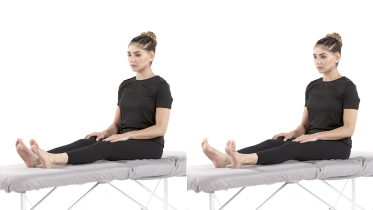
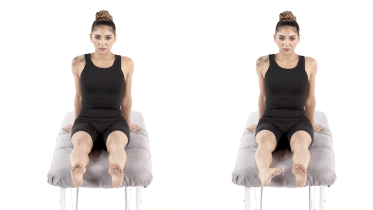
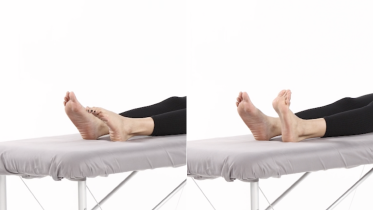
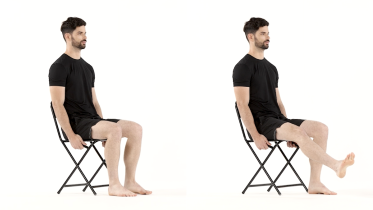
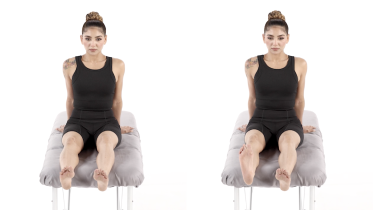
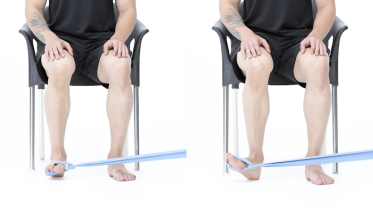
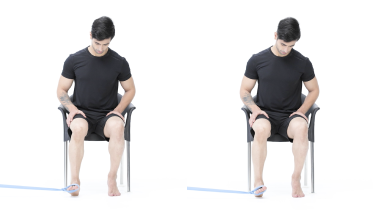
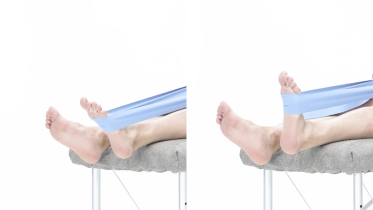
Seated calf raise
A seated calf raise means lifting your heels while you sit in a chair, with a weight resting on your knees. Because your knees stay bent, most of the work goes to the deeper calf muscle (soleus). Your body weight stays off the ankle, so some programs use it before standing calf raises. You will see it in a lot of Achilles and lower leg programs.
How to do the seated calf raise
- Sit tall toward the front of a sturdy chair, feet flat on the floor and knees bent to about a right angle. The voice guide has your knees together.
- Rest a dumbbell upright on top of your knees and hold it steady with both hands, as the video shows. No dumbbell? Start without one, or use any weight that sits steady on your knees.
- Keep your back straight and push down through the balls of your feet to lift your heels as high as they will go. Your toes stay on the floor.
- Pause at the top for a moment.
- Lower your heels slowly back to the floor, then lift again.
What you should feel
Work in the lower, deeper part of your calf, sometimes building to a burn near the end of the set. You should not feel sharp pain at the back of the heel.
Common mistakes
- Pushing the weight up with your arms instead of letting your heels lift it.
- Lifting the heels only a little. Go as high as you can control.
- Letting the heels drop back to the floor quickly.
- Slumping or leaning back in the chair.
How often
Many programs start with 2 to 3 sets of 10 to 20, a few days a week, and add weight as it gets easy. Your physio will adjust this, including how heavy the weight should be.
Stop and check with your physio if
- Sharp pain in the Achilles tendon, heel or calf, or pain that keeps building through the set.
- A sudden pop or snap at the back of your ankle or heel, a feeling that someone kicked you there, or sudden pain there after which you cannot push off or rise onto your toes on that leg. Stop, take the weight off that leg carefully and go to an urgent care center or emergency department the same day, even if you can still walk, as this can be a torn Achilles tendon.
- Your calf or thigh becomes swollen, warm, tender, red or darker than usual, or has a throbbing or cramping pain that feels different from normal muscle ache. Stop and get medical advice the same day, as this can be a blood clot. If you are also short of breath or have chest pain, call emergency services.
- Since the fracture or cast, the foot or ankle is getting more painful rather than less, the skin becomes very sensitive to light touch, or the foot changes color, temperature, swelling or sweating compared with the other one, or looks shiny. See your doctor or physio as soon as you can, within a few days at most, as this can be complex regional pain syndrome (CRPS) and early treatment may help.
From the clinic
This is the sitting partner of the bent-knee calf raise, which works the same deep calf muscle standing on one leg. Once the seated version feels easy with a fair weight, your physio may move you on to that, or to calf raises on both feet.
For a painful Achilles tendon, mild discomfort during the set is usually accepted, as long as it has settled within a day. The next morning tells you most. If the tendon is clearly sorer or stiffer when you get up, the load was too much: ease off and check with your physio. After an Achilles tendon repair or ankle surgery, your surgeon's protocol sets when you start and how much weight you add, so ask your physio before you begin.
Written and checked by the PocketPhysio editorial team. Last updated 2026-09-26.
This page is general education, not a diagnosis or a personal treatment plan. If you have pain, an injury or a health condition, see a physiotherapist or doctor before starting new exercises.