
Achilles tendinopathy exercises and physiotherapy
What is Achilles tendinopathy?
The Achilles tendon is the thick cord at the back of your ankle. It joins your calf muscles to your heel bone, and it takes the load every time you push off to walk, climb stairs, run or jump. Achilles tendinopathy is pain in that tendon that comes with loading it, often after it has had more load than it was used to. You may also see it called Achilles tendinitis or tendinosis.
The usual story is a gradual start. The tendon is stiff and sore first thing in the morning or when you get up after sitting, often eases once you get moving, then aches again after a long day or a run. It is often tender to squeeze, and it can look thickened or a little swollen. Many people have little pain when they are not loading it.
The Guy's and St Thomas' NHS leaflet lists being overweight, tight or weak calf muscles, a stiff ankle and a sudden increase in activity as common contributors, along with training errors. Some antibiotics matter too. Fluoroquinolones, such as ciprofloxacin, have been linked to both tendinopathy and tendon tears (Silbernagel and colleagues, 2020), and the UK medicines regulator warns about this (MHRA, 2024).
This page is for adults. If your Achilles tendon has torn (ruptured), or you have had surgery on it, this program is not for you: follow the plan from your surgeon and physio. A child or teenager with heel pain should be checked by a doctor or physio before starting any program.
Midportion or insertional Achilles tendinopathy?
There are two main types, and they are handled a little differently. Midportion tendinopathy is pain in the cord of the tendon, usually about 2 to 6 cm above the heel bone (Silbernagel and colleagues, 2020). Insertional tendinopathy is pain right at the back of the heel, where the tendon attaches to the bone.
With insertional pain, the tendon gets pressed against the heel bone when the ankle bends up a long way. The Kent Community Health NHS leaflet describes this pressure (compression) as a key factor, and advises against walking uphill or on slopes and against flat shoes. That is why dropping the heel below a step, or a deep calf stretch, is often avoided at first with insertional pain. Programs usually start heel raises on a flat floor, and some put a small lift under the heel during the exercises (Silbernagel and colleagues, 2020).
The evidence for insertional pain is thinner. The US physical therapy guideline covers midportion tendinopathy only. For insertional pain, a small pilot study of 27 people had them lower their heels only to floor level, never below it. At about 4 months, 23 of 34 tendons, about two thirds, were back to their previous activity and the people were satisfied (Jonsson and colleagues, 2008). There was no comparison group, so treat it as a promising approach rather than proof.
Why does exercise help Achilles tendinopathy?
The tendon needs to get used to load again, and exercise lets you build that up in steps you control. The US clinical practice guideline for physical therapists recommends tendon loading exercise, with loads as high as the tendon tolerates, as the first treatment for midportion Achilles tendinopathy (Chimenti and colleagues, 2024). It advises doing it at least 3 times a week.
Several kinds of loading seem to work. The guideline found benefit across slow lowering, heavy slow, isometric and other progressive programs, done anywhere from once a day to 3 times a week. Slow lowering exercise (eccentric training) became popular after a small study of 15 recreational athletes whose Achilles pain had not settled with other treatment: after 12 weeks of daily training, all were back to running (Alfredson and colleagues, 1998). It was a small study and not a randomized trial.
Later, a randomized trial of 58 people with midportion pain for more than 3 months compared that approach with heavy slow resistance training, using heavy calf raises 3 times a week (Beyer and colleagues, 2015). Both groups improved by 12 weeks and held it at 1 year, with no difference between them. People in the heavy slow group completed more of their planned sessions.
You probably do not need to stop all activity, either. The guideline advises against complete rest and suggests carrying on with activities within your pain tolerance. In a trial of 38 people, those who kept running and jumping during their exercise program, guided by a pain-monitoring rule, did as well as those who rested from those activities for 6 weeks (Silbernagel and colleagues, 2007). The researchers found no negative effects from carrying on.
How to use this program
Pick the stage that matches your tendon today. If you are unsure, start at stage 1, and move up when the current stage feels easy and your tendon is no worse the next morning. The signs given for each stage come from common practice and are a rough guide, not fixed rules.
Programs vary a lot in how often and how hard. The original eccentric program used 3 sets of 15 slow lowerings with the knee straight and 3 sets of 15 with it bent, twice a day, every day, for 12 weeks. The heavy slow resistance program used 3 calf raise exercises 3 times a week, done slowly, with the weight going up and the repetitions coming down over 12 weeks to sets of about 6. Many home programs start at 2 to 3 sets of 10 to 15 and add weight as it gets easy. Your physio will adjust the exercises, the numbers and the weight to your tendon and to what you need to get back to.
Breathe normally through the holds and heavy raises rather than holding your breath, especially if you have high blood pressure. Keep a hand on a wall or counter for the standing exercises if your balance is unsteady.
Some tendon pain during the exercises is common and usually acceptable. In the Swedish pain-monitoring model, pain during exercise was allowed up to 5 on a 0 to 10 scale. Pain after exercise could also reach 5, but it had to settle by the next morning, and pain and stiffness were not allowed to build from week to week (Silbernagel and colleagues, 2007). Silbernagel's later clinical guide puts the priority on avoiding moderate or severe pain and symptoms that worsen over time (Silbernagel and colleagues, 2020). If the tendon is clearly worse the next morning, the load was too much, so drop back a step rather than stopping altogether.
If your pain is at the back of the heel (insertional), keep heel raises on a flat floor or at step level, and skip any exercise that lets the heel drop below a step until your physio says otherwise.
The exercise program
Stage 1: Settle the tendon and start loading
For a tendon that hurts with everyday walking, is very stiff first thing in the morning, or is too sore for calf raises yet. Running and jumping are usually paused at this stage, but keep the tendon working. The two hold exercises load the calf without the ankle moving: you press the ball of your foot into a wall, or rise onto your toes and hold there, on both feet if one leg is too much. The seated calf raise and the band exercise let the ankle move without your body weight on the leg, and each exercise page gives a typical starting dose that your physio will adjust. If your pain is where the tendon joins the heel bone, the wall press puts the tendon on a stretch over the heel, so place your toes lower on the wall or leave that one out.
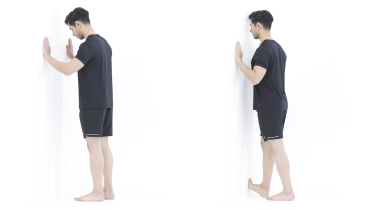 Isometric calf press against a wall
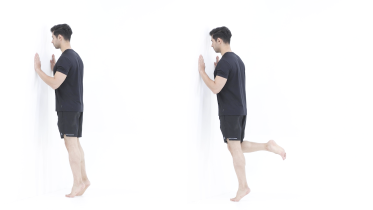 Isometric calf raise hold
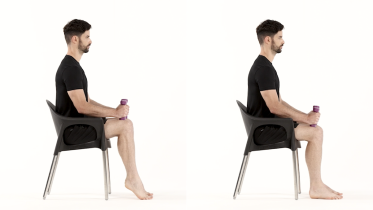 Seated calf raise
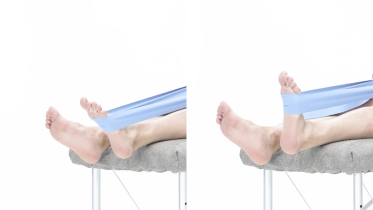 Ankle plantar flexion with band
Stage 2: Build calf strength on two feet, then one
When everyday walking is comfortable and the tendon settles well by the next morning after stage 1. Start with calf raises on both feet on a flat floor, then move to one leg. The bent-knee calf raise shifts more of the work to the deeper calf muscle (soleus). The eccentric calf raise loads the tendon on the slow way down: up on both feet, down on the sore one. For now, keep your heels at floor level or step level, not hanging below a step.
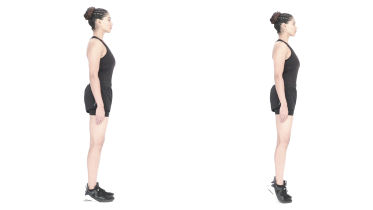 Calf raises
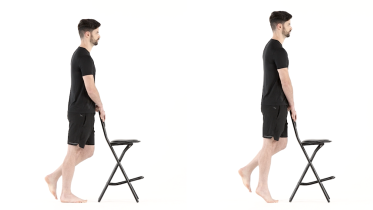 Bent-knee calf raise
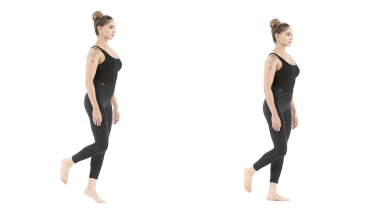 Single leg heel raise
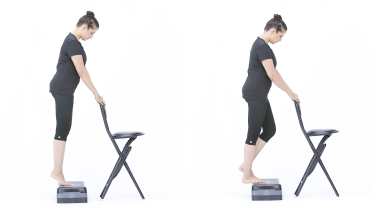 Eccentric calf raise
Stage 3: Heavier, slower strength work
When you can do 2 to 3 sets of single leg heel raises with good control and the tendon is no worse the next morning. This is where the weight goes up (dumbbells for the standing raises, a backpack for the eccentric raise, a heavier weight on your knees for the seated calf raise), and you move slowly, about 3 seconds up and 3 seconds down. For the calf raise on a step, the balls of your feet sit on the edge and the heels lower to about step level. With midportion pain, programs often let the heels sink a little below the step later on, once your physio adds that stage, but if your pain is where the tendon joins the heel bone, keep to step level or the floor and ask your physio before you let the heel drop below the step. Toe walking keeps the calf working for longer spells, and it is a step toward long walks and running.
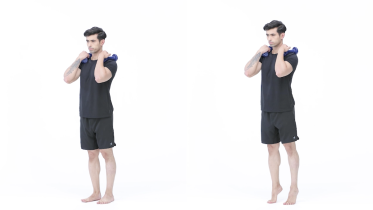 Weighted calf raise
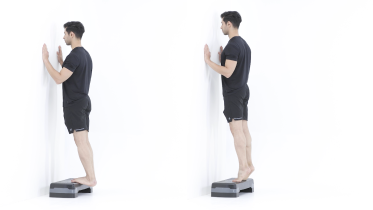 Calf raise on a step
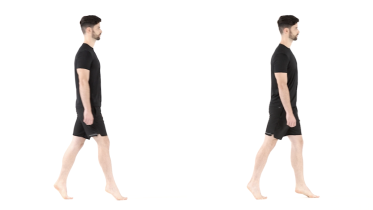 Toe walking
Stage 4: Hopping and a gradual return to running
When heavy calf raises feel strong, everyday walking is close to pain free, and the tendon is steady the morning after your sessions. Hopping loads the tendon far more than a calf raise, so start with low pogo hops on both feet and raise the height in small steps before you hop on one leg. Keep the heavy calf raises going 2 to 3 times a week. Many physios then bring running back with short, easy runs on flat ground, and use the tendon the next morning as the guide to how fast to build.
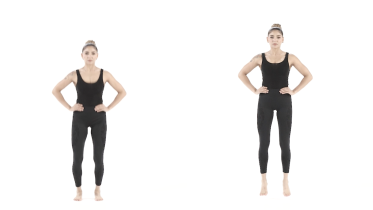 Pogo hops
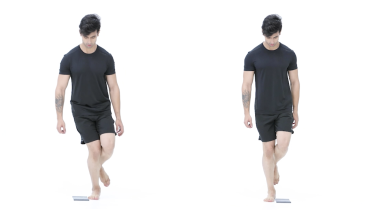 Single leg hops over a line
Running, shoes and daily load
What you do between sessions counts too. The Guy's and St Thomas' leaflet advises relative rest: cut back on activities such as running that load the tendon heavily, and keep your fitness up in other ways. Cycling or swimming can stand in for running for a while. With insertional pain, the Kent leaflet also advises avoiding walking uphill or on slopes and sticking to flat ground.
Shoes can help. The Guy's and St Thomas' leaflet suggests supportive footwear rather than flat shoes. For insertional pain, the Kent leaflet suggests shoes with a heel of about 2 cm, or a silicone heel cushion, used in both shoes so your legs stay the same length. Painkillers can help in the short term, and ice wrapped in a towel eases the pain for some people. Ask a pharmacist if you are not sure a medicine is safe for you.
Before you go back to running, Silbernagel and colleagues (2020) suggest that everyday walking should cause very little pain, about 1 to 2 out of 10. They note that people who get more than 2 out of 10 pain from 20 hops on the sore leg will struggle to start running. Their plan also keeps weighted calf raises going 2 to 3 times a week once you are back. Rushing the return is a common reason the pain comes back.
If progress is slow despite months of steady exercise, other treatments may be discussed. Shockwave therapy is one option both NHS leaflets mention. The Kent leaflet advises against steroid injections for insertional pain. It says they may give temporary relief but could lead to the tendon tearing.
When to see a physio or doctor
See a physio or doctor if the pain is severe, stops you walking normally, keeps getting worse, or has not improved after a few weeks of looking after it yourself. It is also worth a proper assessment if you are not sure the pain is coming from the Achilles tendon, because a few other problems cause pain in the same area. A physio can confirm whether it is midportion or insertional, set your starting stage and adjust the load as you go. For insertional pain that has not improved after 3 months of loading exercises, the Kent leaflet says an ultrasound scan should be considered.
If you have torn your Achilles tendon or had surgery on it, go back to your surgeon or physio for your rehab plan rather than using this page. The warning signs below need prompt medical attention.
For physiotherapists
This page gives patients a starting framework for midportion and insertional Achilles tendinopathy. The 2024 JOSPT guideline (Chimenti and colleagues, 2024), which updates the 2018 version (Martin and colleagues, 2018), covers midportion tendinopathy only. Its lead recommendation (grade A) is tendon loading exercise, with loads as high as tolerated, as first-line treatment for people without presumed frailty of the tendon structure, done at least 3 times a week (grade E). It also recommends education alongside loading, with either a pain science or a pathoanatomic focus, and advising that complete rest is not indicated (both grade B).
The 2018 stretching recommendation stands unchanged (grade C): plantar flexor stretching with the knee flexed and extended may be used when dorsiflexion is limited. Pharmacological treatment, surgery and shockwave therapy are outside its scope.
For insertional tendinopathy, the evidence base is smaller. Jonsson and colleagues (2008) removed dorsiflexion from the eccentric regimen, lowering to floor level only. Silbernagel and colleagues (2020) suggest limiting dorsiflexion to reduce compression between the tendon and the calcaneus, for example with a heel lift during heel rises, and the protocol in the Silbernagel 2007 trial kept people with insertional pain on the floor rather than the step edge. Apply the same thinking to calf stretches and to the step and wall exercises in this program.
Base progression on the 24-hour response, using the pain-monitoring model (Silbernagel and colleagues, 2007), rather than a fixed sheet. The VISA-A, used in the Silbernagel 2007 and Beyer 2015 trials, is a practical way to track progress. Differentials to keep in mind include acute rupture, posterior ankle impingement or os trigonum syndrome, an accessory soleus and sural nerve irritation (Silbernagel and colleagues, 2020). Screen for inflammatory enthesitis when the Achilles or plantar heel pain comes with inflammatory back pain or peripheral joint symptoms. Ask about recent fluoroquinolone use; the MHRA lists age over 60, kidney problems, an organ transplant and corticosteroid use as factors that raise the risk of tendon injury, which can start within 48 hours of the first dose or months after the course ends.
See a doctor promptly if
- You felt a sudden pop or snap at the back of your ankle, it felt as if someone hit or kicked you in the calf, or walking or rising onto your toes on that leg suddenly became weak or difficult. Stop exercising and go to an urgent care center or emergency department the same day, even if you can still walk, as this can be a torn (ruptured) Achilles tendon. This page does not cover a rupture.
- A calf or thigh that is newly swollen, warm, tender, red or darker than usual, has swollen veins that are sore to touch, or has a throbbing or cramping pain that does not fit your injury or condition, or that feels different from normal muscle soreness after exercise. This can be a sign of a blood clot (deep vein thrombosis), especially after surgery, an injury, time in a cast or boot, a long trip or a spell of being much less mobile than usual. Get medical advice the same day. If you are also short of breath or have chest pain, call emergency services.
- Your tendon pain or swelling started while you were taking a fluoroquinolone antibiotic, such as ciprofloxacin or levofloxacin, or in the months after a course. Contact your doctor straight away. The UK medicines regulator (MHRA) advises stopping the antibiotic at the first sign of tendon pain or swelling and talking to your doctor. Hold off the calf exercises until you have been checked.
- The tendon or heel is hot, red and swollen, or you have a fever or feel unwell. Get medical help the same day, and go to an emergency department if you feel very unwell. If you have a very high or very low temperature, shivering you cannot control, you are breathing very fast or finding it hard to breathe, you are confused or your speech is slurred, your skin, lips or tongue look blue, gray, pale or blotchy (on brown or black skin this can be easier to see on the palms of the hands or soles of the feet), or you have a rash that does not fade when you press it, call emergency services, as this can be sepsis.
- The pain started with a fall or a blow to the back of the ankle, and there is bruising or you cannot put weight on the foot. Get it checked the same day.
- Your heel or Achilles pain comes with back pain and stiffness that is worse in the morning and at night, or with painful, swollen joints elsewhere, or both heels became painful without an obvious reason. The same applies if you also have psoriasis, Crohn's disease or ulcerative colitis, or have had a red, painful, inflamed eye (iritis). This is not an emergency, but see your doctor in the next week or two, as it can be a sign of an inflammatory arthritis such as ankylosing spondylitis.
- You have numbness, tingling, burning or loss of feeling in the foot, often along the outer edge. Book an assessment with a doctor or physio in the next week or two.
- The pain is there at night or at rest as well as with activity and keeps getting worse. See your doctor within a few days. If you have had cancer, now or in the past, or are losing weight without trying, see your doctor sooner, within a day or two, and mention it. This applies even if the pain is not getting worse. If you are being treated for cancer now, contact your cancer team the same day.
Common questions
How long does Achilles tendinopathy take to heal?
Usually months rather than weeks. The Guy's and St Thomas' NHS leaflet says most people need 6 to 9 months of rehabilitation before they can return to full activities without pain. A clinical guide by Silbernagel and colleagues notes that full recovery can take a year or longer for some people, and that the pain often comes back when the return to sport is rushed. In the main trials, people did their exercises for 12 weeks, and on average they improved clearly in that time.
Can I keep running with Achilles tendinopathy?
Often you can keep some running, with limits. In a Swedish trial, people who kept running and jumping while they did their exercises did as well as people who rested from those activities for 6 weeks (Silbernagel and colleagues, 2007). They followed a pain-monitoring rule: pain during and after activity no higher than 5 out of 10, settled by the next morning, and not building up week to week. If running makes the tendon clearly worse the next morning, cut back. Your physio will adjust how much running suits your tendon.
What is the difference between insertional and midportion Achilles tendinopathy?
It is about where the pain sits. Midportion pain is in the cord of the tendon, a few centimeters above the heel bone. Insertional pain is right at the back of the heel, where the tendon attaches to the bone. The difference matters for exercise: with insertional pain, positions that bend the ankle up a long way press the tendon against the heel bone, so programs usually keep heel raises on a flat floor at first rather than letting the heel drop below a step.
Should I stretch my Achilles tendon?
Strengthening is the main treatment, and stretching is at most an extra. The US physical therapy guideline says physios may add calf stretches, with the knee straight and with it bent, for midportion pain when your ankle does not bend up as far as it should. If your pain is where the tendon joins the heel bone, stretches that pull the ankle up a long way can press the tendon against the bone, which is why programs for insertional pain usually leave them out at first. Your physio will tell you whether a gentle calf stretch has a place in your program.
Are steroid injections good for Achilles tendinopathy?
They are not a first choice for either type. The clinical guide by Silbernagel and colleagues (2020) reports no evidence to support injections for Achilles tendinopathy, either on their own or added to exercise. For insertional pain, the Kent Community Health NHS leaflet advises against steroid injections: they may give temporary relief, but they are not a cure and could lead to the tendon tearing. Exercise stays the main treatment, and any injection is a decision to make with your doctor.
References
- Chimenti RL, Neville C, Houck J, Cuddeford T, Carreira D, Martin RL. Achilles Pain, Stiffness, and Muscle Power Deficits: Midportion Achilles Tendinopathy Revision - 2024. Journal of Orthopaedic and Sports Physical Therapy. 2024;54(12):CPG1-CPG32. https://doi.org/10.2519/jospt.2024.0302
- Martin RL, Chimenti R, Cuddeford T, Houck J, Matheson JW, McDonough CM, Paulseth S, Wukich DK, Carcia CR. Achilles Pain, Stiffness, and Muscle Power Deficits: Midportion Achilles Tendinopathy Revision 2018. Journal of Orthopaedic and Sports Physical Therapy. 2018;48(5):A1-A38. https://doi.org/10.2519/jospt.2018.0302
- Silbernagel KG, Thomee R, Eriksson BI, Karlsson J. Continued sports activity, using a pain-monitoring model, during rehabilitation in patients with Achilles tendinopathy: a randomized controlled study. American Journal of Sports Medicine. 2007;35(6):897-906. https://doi.org/10.1177/0363546506298279
- Silbernagel KG, Hanlon S, Sprague A. Current Clinical Concepts: Conservative Management of Achilles Tendinopathy. Journal of Athletic Training. 2020;55(5):438-447. https://doi.org/10.4085/1062-6050-356-19
- Alfredson H, Pietila T, Jonsson P, Lorentzon R. Heavy-load eccentric calf muscle training for the treatment of chronic Achilles tendinosis. American Journal of Sports Medicine. 1998;26(3):360-366. https://doi.org/10.1177/03635465980260030301
- Beyer R, Kongsgaard M, Hougs Kjaer B, Ohlenschlaeger T, Kjaer M, Magnusson SP. Heavy Slow Resistance Versus Eccentric Training as Treatment for Achilles Tendinopathy: A Randomized Controlled Trial. American Journal of Sports Medicine. 2015;43(7):1704-1711. https://doi.org/10.1177/0363546515584760
- Jonsson P, Alfredson H, Sunding K, Fahlstrom M, Cook J. New regimen for eccentric calf-muscle training in patients with chronic insertional Achilles tendinopathy: results of a pilot study. British Journal of Sports Medicine. 2008;42(9):746-749. https://doi.org/10.1136/bjsm.2007.039545
- Guy's and St Thomas' NHS Foundation Trust. Achilles tendinopathy. Patient information, resource number 4609/VER3. Last reviewed October 2024. https://www.guysandstthomas.nhs.uk/health-information/achilles-tendinopathy
- Kent Community Health NHS Foundation Trust. Achilles insertional tendinopathy. Patient leaflet 01271. Published 2 December 2024. https://www.kentcht.nhs.uk/leaflet/achilles-insertional-tendinopathy/
- Medicines and Healthcare products Regulatory Agency. Fluoroquinolone antibiotics: must now only be prescribed when other commonly recommended antibiotics are inappropriate. Drug Safety Update. 22 January 2024. https://www.gov.uk/drug-safety-update/fluoroquinolone-antibiotics-must-now-only-be-prescribed-when-other-commonly-recommended-antibiotics-are-inappropriate
- Cambridge University Hospitals NHS Foundation Trust. Achilles tendon rupture. Patient information. Approved 14 January 2025. https://www.cuh.nhs.uk/patient-information/achilles-tendon-rupture/
- NHS. Tendonitis. Page last reviewed 9 June 2023. https://www.nhs.uk/conditions/tendonitis/
- NHS. Deep vein thrombosis (DVT). Page last reviewed 30 April 2026. https://www.nhs.uk/conditions/deep-vein-thrombosis-dvt/
- NHS. Symptoms: Ankylosing spondylitis. Page last reviewed 5 January 2023. https://www.nhs.uk/conditions/ankylosing-spondylitis/symptoms/
Written and checked by the PocketPhysio editorial team. Last updated 2026-09-28.
This page is general education, not a diagnosis or a personal treatment plan. See a physiotherapist or doctor for advice about your own situation.