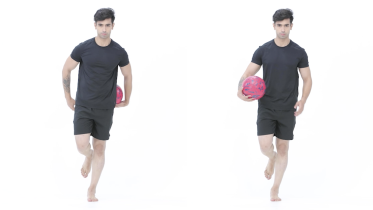
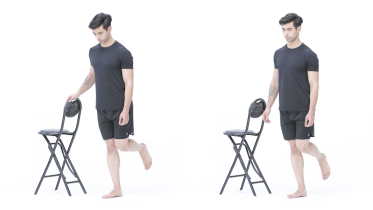
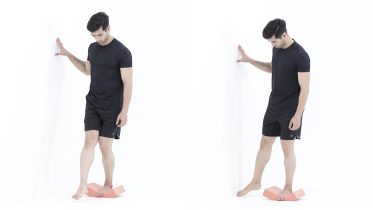
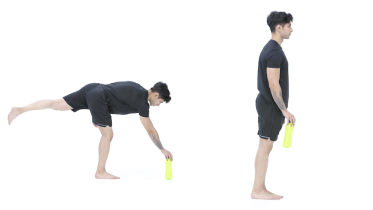
Single leg hops over a line
Single leg hops over a line are small hops on one leg, forward over a line on the floor and then back again. The focus is the landing: soft and balanced, with your kneecap staying in line with your second toe. They usually come late in knee and ankle rehab, once balance and single leg strength are good, as a step toward running, sport or jumping.
How to do the single leg hops over a line
- Make a line on the floor with tape, or use a line in the flooring. Clear the space around you and work on a firm, non-slip floor, barefoot or in supportive athletic shoes.
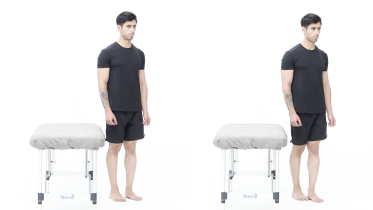
- Stand just behind the line on one leg with that knee slightly bent. Lift the other foot off the floor by bending its knee, and keep your arms relaxed by your sides.
- Hop forward over the line. Land on the front of your foot and let the heel come down as your knee and hip bend to soak up the landing.
- As you land, keep your kneecap pointing toward your second toe. The knee should not wobble side to side or roll inward.
- Steady yourself, then hop backward over the line and land the same way. Keep the hops small and controlled rather than fast.
- Finish your set, then switch legs.
What you should feel
Work in the calf, thigh and buttock of the hopping leg, and your breathing will pick up. Each landing should feel steady at the ankle and knee, not jarring.
Common mistakes
- Landing on a straight leg with a loud thud.
- The knee dropping inward or wobbling side to side as you land.
- Hopping too far or too fast to stay in control.
- Carrying on when you are tired and the landings get sloppy.
How often
Many programs start with 1 to 3 sets of 5 to 10 hops forward and back on each leg, with a rest between sets, a few times a week. Your physio will adjust this and decide when you are ready to hop.
Stop and check with your physio if
- Sharp pain in the knee, ankle, foot or shin, on landing or afterward.
- The knee gives way or the ankle rolls.
- Swelling in the knee or ankle later that day or the next morning.
- A sudden pop or snap at the back of your ankle or heel, a feeling that someone kicked you there, or sudden pain there after which you cannot push off or rise onto your toes on that leg. Stop, take the weight off that leg carefully and go to an urgent care center or emergency department the same day, even if you can still walk, as this can be a torn Achilles tendon.
From the clinic
Hopping puts much more load through the leg than standing or walking, so this is not a starting exercise. After a knee ligament injury, knee surgery or an ankle sprain, wait until your physio clears you to hop. Before hopping, physios usually want the knee or ankle to be free of swelling, and want you to hold single leg stance steadily, do controlled single leg heel raises and a slow backward step-down on the same leg without the knee dropping inward.
Think quiet landings. If you can hear each landing, bend the knee and hip a little more as you touch down. Use a flat line only, never an object you could catch your foot on, and stop the set as soon as your landings get wobbly, because tired landings are when the knee tends to drop inward.
For the first sessions, work next to a wall or counter you can touch if you lose your balance. If you have osteoporosis or have fallen in the past year, ask your physio or doctor before you do any hopping. If you have had a hip or knee replacement, get the go-ahead from your surgeon before you try single leg hops over a line. Many surgeons advise against jumping and hopping after a joint replacement for good, not just for the first months, because each landing sends high impact through the new joint.
Written and checked by the PocketPhysio editorial team. Last updated 2026-09-28.
This page is general education, not a diagnosis or a personal treatment plan. If you have pain, an injury or a health condition, see a physiotherapist or doctor before starting new exercises.