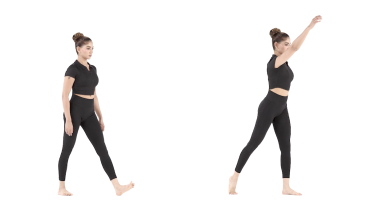
Seated diagonal weight shift
The diagonal weight shift is a sitting balance exercise done with a stick or cane. You sit tall, hold the stick upright with its tip on the floor between your feet, and lean forward and out to one side while the top of the stick draws a circle, as if you were stirring a big pot. Your weight travels forward and across the seat and back again. That practices the trunk control you use to reach for something low and to one side, or to lean forward before you stand up.
How to do the seated diagonal weight shift
- Sit toward the front of a firm chair without wheels, feet flat and a little wider than hip width apart, back upright.
- Stand a stick or cane upright in front of you with its tip on the floor between your feet, and hold it with both hands at about chest height.
- Lean forward and out to one side, guiding the top of the stick round in a wide circle, as if stirring a big pot. Let your weight travel forward and onto that side of the seat.
- Carry the circle round and back to the upright start, keeping the tip of the stick resting on the floor.
- Do the set number of circles in one direction, then circle the other way.
What you should feel
Work in the muscles along your back and at the sides of your trunk, and your weight rolling around the seat. Your feet press into the floor as you lean forward.
Common mistakes
- Slumping through the back instead of leaning forward with a long spine.
- Leaning so far that the stick has to hold you up.
- Lifting the tip of the stick off the floor.
- Making the circle fast or jerky.
How often
Many programs start with 5 to 10 slow circles in each direction, once or twice a day. Your physio will adjust this.
Stop and check with your physio if
- You feel dizzy, faint or unsteady. Stop and get medical advice the same day. If you faint, it does not settle within a few minutes of sitting still, or you cannot stand or walk steadily, call emergency services.
- You start to slide or tip off the chair and cannot bring yourself back upright.
- Sharp pain in your back, hips or shoulders.
From the clinic
This page explains the general technique, not a stroke rehab program. If a stroke or any other condition has left one side of your body weaker, ask your physio before you try this at home.
The stick guides the movement, but it is not there to lean on. Use a walking cane or a stick with a rubber tip, and a heavy chair without wheels, ideally with its back against a wall. Wear flat shoes that fit well and grip the floor, not socks, tights or bare feet. If your sitting balance is unsure, you have fallen before, or one side of your body is weaker, have someone stand beside you on the side you lean toward. Start with small circles and make them wider only while you can come back to the middle on your own.
A sudden loss of balance is different. Call emergency services straight away for any sign of a stroke, even if it goes away: sudden dizziness with unsteadiness or falling over, a face that droops on one side, an arm you cannot lift or keep up, slurred or muddled speech, weakness or numbness on one side of your body or face, sudden blurred vision, double vision or loss of sight, or a sudden severe headache. If one side is already weak or numb from an earlier stroke, new or suddenly worse weakness or numbness is a sign, and every other sign in this list still counts.
The lean combines bending forward with a turn of the trunk. If you have low bone density (osteoporosis), ask your physio how far to lean before you start, and lean from your hips with a long back rather than rounding it. If you have had a fracture in your spine, check with your physio before you begin. If you have had surgery on your spine, chest or heart in recent months, get the go-ahead from your surgical team or physio first.
If you have had a hip replacement, get the go-ahead from your surgeon or physio before you try the seated diagonal weight shift. Leaning forward from the chair bends the hip past a right angle, and many surgeons ask you to avoid that for the first months after some operations. For other directions of sitting balance, see seated trunk rotation and the seated reach up and out to the side.
Written and checked by the PocketPhysio editorial team. Last updated 2026-09-26.
This page is general education, not a diagnosis or a personal treatment plan. If you have pain, an injury or a health condition, see a physiotherapist or doctor before starting new exercises.