Semi-tandem stance
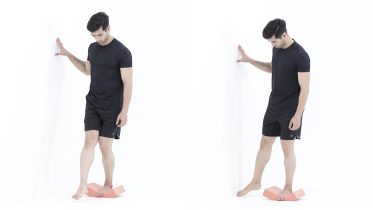
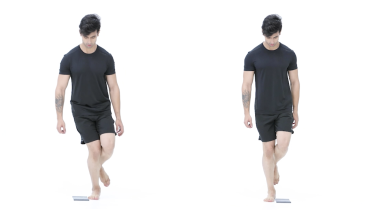
In semi-tandem stance you stand with your feet touching side by side and one foot moved forward about half its length, so the heel of the front foot sits beside the big toe of the back foot. That small shift narrows your base, which makes it harder than standing with your feet together but easier than full heel to toe tandem stance. In the video the man holds the position with his arms by his sides and a padded bench next to him.
How to do the semi-tandem stance
- Stand beside a kitchen counter or a sturdy chair that cannot move, close enough to rest a hand on it.
- Bring your feet together, then slide one foot forward about half its length, so its heel sits beside the big toe of the other foot. Keep the insides of the feet touching.
- Stand tall with your arms hanging loosely at your sides and your weight shared between both feet. Fix your eyes on a point ahead of you rather than on the floor.
- Hold steadily for the time your program sets, then step out of the position.
- Swap feet, with the other foot now half a length in front, and hold again.
What you should feel
A gentle sway with small, constant corrections in your ankles and the soles of your feet. It should feel a little harder than standing with your feet together.
Common mistakes
- Letting a gap open between your feet, which makes the stance wider and easier.
- Leaning your whole weight on the support.
- Letting most of your weight sink onto the back foot.
- Stiffening up and holding your breath.
How often
A reasonable place to begin is 10 to 30 seconds per hold, 3 to 5 holds with each foot forward, once or twice a day. Your physio will adjust this.
Stop and check with your physio if
- You feel dizzy, lightheaded, faint or sick, or the room seems to spin. Hold your support, sit down and get medical advice the same day before you practice again. If you faint, it does not settle within a few minutes of sitting still, your vision suddenly blurs or goes double, or you cannot stand or walk steadily, call emergency services.
- You tip out of position and have to grab the support hard to stop yourself falling.
- New pain in your feet, ankles or knees while you stand.
From the clinic
Semi-tandem is the middle step in a common order of standing balance positions: feet side by side, then semi-tandem, then full tandem stance heel to toe, and later single leg stance. Folding your arms across your chest, as the voice guide suggests, takes away the small arm movements that help you catch a wobble, so add it only when the basic hold feels easy. Your physio may later ask you to close your eyes, which is a far bigger jump.
Keep a counter or sturdy chair within reach, and let your fingertips touch it for the first few sessions. Practice on a firm floor with rugs moved aside. Wear flat shoes that fit well and grip the floor, not socks, tights or bare feet. After any fall in the last year, or if you feel unsteady or use any medicine that can upset your balance, rest one hand on the support for the whole hold and make sure another person is home whenever you practice. Your physio or doctor can also check whether you would benefit from a falls assessment.
A sudden loss of balance is different. Call emergency services straight away for any sign of a stroke, even if it goes away: sudden dizziness with unsteadiness or falling over, a face that droops on one side, an arm you cannot lift or keep up, slurred or muddled speech, weakness or numbness on one side of your body or face, sudden blurred vision, double vision or loss of sight, or a sudden severe headache.
Written and checked by the PocketPhysio editorial team. Last updated 2026-09-26.
This page is general education, not a diagnosis or a personal treatment plan. If you have pain, an injury or a health condition, see a physiotherapist or doctor before starting new exercises.