
Concussion recovery and return to play after a head injury
Warning signs, and when to get help
When a head injury is an emergency
Some symptoms after a knock to the head need an ambulance, not a recovery plan. Read the warning signs at the foot of this page before you read anything else here, and act on them if any of them fits.
Any of these means going now, not waiting. Being knocked out, even briefly. A gap in your memory of what happened. Being sick. A headache that has not let up since the injury. Drowsiness, confusion, a seizure, new weakness or numbness, new trouble with speech, walking, balance, vision or hearing, fluid or blood from the ears, bruising behind the ears, or a change in behavior.
Any head injury in someone taking blood thinning medicine means going now too. It is one of the commonest reasons a head knock that looks minor turns out not to be.
Aspirin on its own is where the documents part company, so here is both halves of it. The warning list at the foot of this page follows NICE, where being on a blood thinner other than aspirin by itself is enough on its own to need an emergency department. The sport guidance is stricter: the UK grassroots red flag list names current blood thinning therapy with no exception made for aspirin, and the New Zealand list names warfarin and aspirin outright, both as a red flag needing urgent review. If aspirin is the only one you take, go by the stricter reading and get seen.
How it happened counts as well as how the person looks, and this is the part that gets missed when somebody seems all right. NICE puts a high-energy head injury on its 999 list on its own, with no symptoms needed, and gives examples: a pedestrian struck by a vehicle, somebody thrown out of one, a fall from more than 1 metre or more than five stairs, a diving accident, a high-speed or rollover crash, a motorized recreational vehicle, a bicycle collision, or any other high-energy mechanism. The NHS 999 list says the same in shorter form, naming a fall from a height of more than 1 metre or 5 stairs and a head hit at high speed such as in a road accident. If that is how it happened, the ambulance call does not wait to see how they feel.
The neck comes with the head, and this is the injury a concussion page is most likely to let somebody miss. A force big enough to concuss is big enough to injure the bones and joints of the neck, and NICE gives neck injury after a head injury its own pathway with its own list of mechanisms that count: a fall from more than 1 metre or more than 5 stairs, a load driven straight down through the head such as a dive, a high-speed crash, a car that rolled over, being thrown from a vehicle, an accident on a motorized recreational vehicle, and a bicycle collision.
So if someone has hit their head and has neck pain, or numbness, tingling or weakness in an arm or a leg, or you simply cannot be sure, do not move them and do not sit them up. Keep them still, leave their head where it is, and call emergency services. A neck that has been broken and then moved is a different injury from a neck that has been broken and left alone.
The UK grassroots guidance puts severe neck pain on its red flag list in its own right, and says that where a neck injury is suspected the player should only be moved by healthcare professionals with the right training. It also warns, in as many words, that other significant injuries including injuries to the neck or the face happen alongside concussion, and that telling a concussion apart from something more serious such as bleeding in the brain can be very difficult.
Being seen once does not close the question either. These signs count whenever they appear, in the first hour or a week later, and NICE's criteria for scanning the neck after a head injury take in people who turn up late as well as people who come straight in. If somebody was assessed, told it was a concussion and sent home, and then becomes drowsy or confused, keeps being sick, has a headache that keeps building, or starts behaving oddly, that is an emergency on the day it happens rather than something to raise at the follow-up appointment.
Even where there are no emergency signs, the UK grassroots guidance asks for every suspected concussion to be assessed by an onsite healthcare professional, or by contacting NHS 111 within 24 hours, with 999 and ambulance transfer where needed. Where any red flag is present, the player should receive urgent medical assessment. That is the floor, not the ideal.
If you are reading this for somebody else: take them out of play straight away and keep them out. The slogan the UK guidance is built on is "if in doubt, sit them out", and it exists because nobody at the side of a pitch can tell a concussion from something worse. The consensus statement names the signs that mean removing a player on the spot: being knocked out or possibly knocked out, a seizure, stiffening up, unsteadiness or poor balance, confusion, a change in behavior, and not remembering the incident. Anyone with one of those does not go back on that day, whatever they say about feeling fine.
What happens in a concussion
A concussion is a brain injury caused by a blow to the head, the face, the neck or the body, with the force transmitted to the head. The NHS describes it as a temporary brain injury that can last a few weeks. Nothing shows up on an ordinary head scan, and that is part of the definition rather than a reassurance: the international consensus statement describes concussion as an injury where no abnormality is seen on standard CT or MRI. A normal scan does not mean nothing happened (Patricios and colleagues, 2023).
The word concussion settles less than it sounds. The same document says plainly that the symptoms and signs of a concussion may occur at the same time as other injuries, and names injuries to the neck among them. Being told you have concussion is not a statement that your neck, your skull and the rest of you have been checked and found clear. A scan of the head does not look at the neck either: NICE sets separate criteria for scanning the cervical spine after a head injury, and the things that decide it are different ones, among them being 65 or over, how the injury happened, tenderness in the bony middle of the back of the neck, and pins and needles or weakness in an arm or a leg (NICE guideline NG232, section 1.6). If you landed on an outstretched hand, a hip or a shoulder in the same fall, that injury needs looking at in its own right, which is what the fall injury warnings at the foot of this page are for.
Symptoms come in clusters and not everyone gets all of them. Headache, pressure in the head, feeling slowed down or in a fog, light and noise sensitivity, dizziness and unsteadiness, neck pain, nausea, blurred or doubled vision, trouble concentrating or remembering, irritability, low mood, and sleep that is either broken or far too much.
The neck takes the same force the head did, which is why whiplash and concussion so often arrive together and why neck pain is still there in week three. The balance system takes a hit too, so people feel fine sitting down and wrong in a supermarket aisle, something dizziness and BPPV goes into in more detail. Both of those are physiotherapy territory, and both get missed.
The first 24 to 48 hours: relative rest, not a dark room
Relative rest means doing less, not doing nothing, and the change away from the darkened room is the biggest shift in concussion advice of the last decade.
The international consensus statement says it as plainly as a guideline ever says anything: clinicians should avoid recommending complete rest and isolation, even for the first 24 to 48 hours, and should recommend a period of relative rest instead. Getting back to ordinary daily activities early is encouraged, as long as symptoms go up no more than mildly and briefly, which that document defines as an increase of no more than 2 points on a 0 to 10 scale lasting less than an hour. It also puts a boundary on the screen advice: cutting screen use in the first 48 hours is worth doing, and there is no good evidence it helps after that (Patricios and colleagues, 2023).
Those two numbers do most of the work in the first fortnight. If a walk, a conversation or half an hour of homework leaves your headache 1 or 2 points worse and back to normal within the hour, you have found the right level. If it goes up more than that, or is still up an hour later, the dose was too big, so rest and try a smaller version the next day.
The UK guidance sets stage 1 as a relative rest period of 24 to 48 hours, with activity kept to 10 to 15 minute slots. The NHS advice for the same days is to rest and reduce stress, use an ice pack wrapped in a cloth for short periods if there is swelling, take paracetamol for headache, and have an adult stay with you or your child for at least the first 24 hours. It also says plainly that you do not need to stay awake if you are tired, which still surprises people.
Nobody returns to sport, training or a PE lesson on the day of a suspected concussion, and in the UK no return happens inside 24 hours at all. The NHS also advises against alcohol and recreational drugs until you feel better, against driving until you have fully recovered, and against sleeping pills unless a doctor has advised them.
What you can do in those first two days is gentle: short walks indoors, sitting outside, a conversation, a bit of screen time if it does not make your head worse. Breathing control in stage 1 of the program below is there partly for this window, because the first 48 hours of a concussion is a tense, braced, frightened time for most people and the breath goes with it.
How long does concussion recovery take?
Most adults are better within a few weeks. The NHS puts a concussion at a few weeks and advises seeing a GP if head injury symptoms last more than 2 weeks. The UK sport guidance sets its own marker at 28 days: if symptoms continue beyond that, stay out of sport and get medical advice from a GP. It also puts an earlier check in the diary, which is the one people miss: contact NHS 111 if symptoms are getting worse, or have not improved, by 14 days after the injury. Its own estimate is that about two thirds of people are back to full sport by 28 days, with children, adolescents and young adults often taking longer.
Children and adolescents take longer. The UK guidance says children and adolescents may take longer to recover than adults, and that returning to education too early can make symptoms worse and lengthen recovery. The ACC and Sport New Zealand guidance says extra caution is required for child, adolescent and female athletes because they take longer to recover.
Feeling better and being allowed back are two different events, and this is where arguments start. The staged protocols have a minimum length built into them regardless of how good you feel, and in three of our five markets there is a minimum number of days as well. Recovery is not the gate on its own.
Recovery is not a straight line. A good Tuesday followed by a flat Thursday is the usual pattern, not a setback, and the useful measure across a fortnight is how much you can do before symptoms rise, not how you feel on any one afternoon.
Return to learn or work comes before return to sport
Every document behind this page puts school or work first, and it is the step most often skipped.
The CDC's first step is getting back to regular activities including school, with a healthcare provider's clearance, before any of the sport steps begin. The UK guidance has stage 4 as returning to study or work alongside beginning sport training with no head impact risk, and stage 5 as full academic or work activity with full training. The ACC guidance in New Zealand asks for return to work or school to be achieved before return to play.
In practice that means getting through a full day of lessons or a full day at your desk, without symptoms climbing, before anyone talks about contact. For a student that usually goes shortest day first, then half days, then full days, with permission to leave a lesson if the headache builds. For an adult it is usually the screen time and the noise, not the hours.
Tell the school or the employer what is happening. A concussion that nobody at school knows about is a concussion where the student gets marked down for falling asleep in class.
The staged return to play, and the rule where you live
There is no single global number. What applies to you depends on where you play.
All five documents use a staged progression of about six steps, from relative rest, through daily activities, light aerobic exercise and non-contact training, to full contact practice and then competition. The UK guidance says no stage should last less than one day. The CDC says each step typically takes a minimum of 24 hours, and that if symptoms come back the athlete stops, contacts their provider, and restarts at the previous step once symptom free after more rest.
The consensus statement puts a floor under that arithmetic. It tells clinicians and athletes to expect at least a week to get through the whole thing, and says a typical unrestricted return to sport takes up to a month (Patricios and colleagues, 2023). So one week is the floor that document puts under its own six steps, and only if every stage goes perfectly. Nowhere in any of this is there a version that finishes in two or three days.
What differs between countries is the floor underneath that progression.
| Where you play | The document that governs it | What it sets |
|---|---|---|
| USA | CDC HEADS UP, Returning to Sports | A 6-step Return to Play Progression: back to regular activities, light aerobic activity, moderate activity, heavy non-contact activity, practice and full contact, then competition. Each step typically takes a minimum of 24 hours. Return to practice only with your healthcare provider's approval and supervision. Your state's youth sports law and your school's or league's own rule sit on top of this, so check both. |
| UK | UK Concussion Guidelines for Non-Elite (Grassroots) Sport | Immediate removal from play. No return to competition, training or PE within 24 hours. NHS 111 within 24 hours, 999 if needed. Six stages, none shorter than a day. Training with head impacts needs 14 days free of symptoms at rest, so stage 5 cannot start before day 15 at the earliest. Stage 6, competition, should not be reached before day 21, and there is no return to competition before 21 days from injury. |
| Canada | Canadian Guideline on Concussion in Sport, 2nd edition, 2024, from Parachute | Before returning to full contact practice and game play, the athlete must give their coach a standardized Medical Clearance Letter stating that a medical doctor or nurse practitioner has personally evaluated them and cleared them to return to sport. Provincial law may apply on top. |
| Australia | The AIS Concussion and Brain Health Position Statement 2024, alongside the Australian Concussion Guidelines for Youth and Community Sport | The Australian Institute of Sport attributes both figures to the 2024 position statement: a minimum of 21 days before returning to competitive contact, and 14 days symptom free at rest before returning to contact sport training. The youth and community guidelines are written for those under 19 and for community sport, where a healthcare practitioner is less likely to be available. |
| New Zealand | ACC National Guidelines for Sport Concussion, produced with national sporting organisations | A suspected concussion is assessed by a doctor, who confirms or rules it out, and nobody whose concussion is confirmed returns to full play for less than 21 days. The guideline sets it out as two gates, counting the day of injury as day 0. Contact based and sport specific training (its stage 5) needs you back at and coping with full time work or learning, symptom free, through stages 1 to 4, and at least 14 days past the injury. Competition (stage 6) needs you still symptom free at stage 5, at least 21 days past the injury, and medical clearance from a qualified medical professional in general practice or primary care. Extra caution for child, adolescent and female athletes, who take longer to recover. Written for community sport; high performance sport has separate advice. |
If you play in the UK, Australia or New Zealand, three weeks is the floor, and feeling fine in week two changes nothing. If you play in the USA or Canada, there is no 21 day figure in the national guidance, so the gate is the staged progression plus your clinician's sign off, plus whatever your state, province, league or school requires.
Those numbers are easy to read as a timetable, and they are not one. Every day count on this page starts from the day of the injury, which all three documents that use one call day 0.
The two fourteens in the table are different counts: New Zealand's 14 means 14 days since the injury, while the UK and Australian 14 means 14 days with no symptoms at rest, counted from the first day you were free of them. That second one is why day 15 and day 21 are floors rather than dates to aim at.
The UK document works three worked examples through with calendar dates. In the two where recovery goes smoothly, symptoms clear on day 4 and day 5, and even then stage 5 lands on day 18 and day 19, and competition on day 25 and day 21. In the third the person is still stuck at day 14 and the document says plainly that they cannot return within 21 days. A day count can only ever push your return later than the number, never earlier.
The international consensus statement on concussion in sport from the 6th conference, held in Amsterdam in October 2022 and published in 2023, is the document all of these build on, and it is worth knowing what it does and does not set. Its return to sport strategy has six steps, from symptom limited daily activity, through light and then moderate aerobic exercise, individual sport specific exercise and non-contact training drills, to full contact practice and then return to sport. Each step typically takes a minimum of 24 hours, step 1 can begin within 24 hours of the injury, and steps 4 to 6 begin only after symptoms, cognitive function and any other clinical findings from the concussion have settled, including with and after exertion.
Two gates in it belong to a clinician rather than to you, and the second is wider than people expect. Medical clearance is needed before step 3 if the training involves any risk of an accidental head impact. And a medical determination of readiness has to happen before returning to any activity at risk of contact, collision or a fall, which the statement says may be needed before any of steps 4 to 6, depending on the sport and on local law. Read that second one twice, because a fall counts as much as a collision.
The same document also tells clinicians to get people walking or on a stationary bike after the first 24 to 48 hours while avoiding the risk of contact, collision or a fall, so the test it is applying is whether that risk is present in the way you are doing something, not which list the exercise is on. That is the reasoning behind the conditions attached to stage 3 of the program below, and behind leaving the hopping in stage 4 until somebody has cleared you for it (Patricios and colleagues, 2023).
What the consensus statement does not set is a day count. It gives no 21 day minimum, which is why the figures in the table above are attributed to the national documents that do set them. What it does report is an observed average rather than a rule: unrestricted return to sport typically happens within a month of the injury in children, adolescents and adults, with a pooled mean of 19.8 days across 57 studies. The conference also produced the assessment tools your clinician may use, including the SCAT6, the Child SCAT6 for ages 8 to 12 and the CRT6, which it strongly recommends every adult supervising children's and adolescent sport should use.
Is concussion recovery different for children?
Yes, and the differences have rules attached.
Children and adolescents may take longer to recover than adults, which the UK guidance states directly, and it warns that returning to education too early can make symptoms worse and prolong recovery. New Zealand's guidance asks for extra caution with child, adolescent and female athletes for the same reason.
The hospital end of it is written separately for them as well. NICE does not apply its adult scanning criteria to anyone under 16; it sets a different list, and for a baby under 1 year old a bruise, swelling or cut on the head bigger than 5 cm is on its own enough to need a CT head scan within the hour. Suspected non-accidental injury is on the same one hour list (NICE guideline NG232, recommendations 1.5.10 and 1.5.11).
The 21 day minimum in the UK, Australia and New Zealand is written for youth and community sport specifically. The Australian guidance is aimed at those under 19 and at community sport, where a healthcare practitioner is less likely to be on site, which is the situation most parents are actually in.
For a child, the order of priorities is school, then sport, with nothing skipped. The consensus statement makes return to school the priority in children and adolescents and asks for a full return to learning before unrestricted return to sport, although the two strategies can run alongside each other. The reassuring figure in it is that 93% of athletes of all ages are fully back to learning with no extra academic support by 10 days. Where support is needed, the sort it describes is practical: a shorter school day, rest breaks from deskwork, less screen time, more time for assignments, printed class notes, delayed tests, and no activity at school that risks contact, collision or a fall, while still allowing safe non-contact activity such as walking (Patricios and colleagues, 2023).
Expect a slower run through the stages, expect the school to need telling, and expect a flat week somewhere in the middle. And expect to be the unpopular one, because the pressure to get a child back for a fixture is real and the standdown rule exists so that you do not have to argue the clinical case yourself.
If a child or adolescent still has symptoms beyond 4 weeks, the consensus statement says active rehabilitation and collaborative care may help, which is a reason to ask for a referral, not to wait longer.
Repeat concussions are not something to plan from a page. New Zealand's guidelines put a number on when that is no longer a judgement call: three or more concussions in one season, or more than five across a sporting career, should bring a review from a clinician with expertise in sport related concussion, such as a sport and exercise medicine physician, a neurologist or a neuropsychologist, before any return to sport. The consensus statement asks for individualised assessment for children and adolescents with repeat concussions who want to keep playing or move up a level, and adds the part parents often miss: a child advised against contact sport should be encouraged into non-contact sport or exercise instead, not out of sport altogether.
Does exercise help concussion recovery?
For a teenager with a fresh sport-related concussion, yes, and this is one of the more satisfying changes in modern practice.
In a randomized trial, 103 athletes aged 13 to 18 presenting within 10 days of a sport-related concussion were given either individualized, progressive sub-symptom threshold aerobic exercise or a placebo stretching program that would not raise the heart rate much, both for about 20 minutes a day. Median recovery was 13 days with aerobic exercise and 17 days with stretching (Leddy and colleagues, 2019). A second trial in 118 adolescents, with heart rate monitors to check the intensity, reported a 48% reduced risk of persistent post-concussive symptoms in the exercise group, with a hazard ratio of 0.52 for stretching against aerobic exercise, and no adverse events (Leddy and colleagues, 2021).
Now the part the enthusiasm usually leaves out. Both trials were in adolescent athletes seen inside 10 days of the injury. A 2026 randomized trial took a different population, 81 adults aged 18 to 59 with persistent symptoms and exercise intolerance 3 to 24 months after a mild traumatic brain injury, and added structured sub-symptom threshold aerobic exercise to usual care. There was no difference in symptom burden at 12 weeks or 6 months against usual care with general exercise information and advice, although exercise tolerance on a treadmill test did improve and stayed improved (Valaas and colleagues, 2026).
The consensus statement goes further than those two trials. It says prescribed aerobic exercise below the symptom threshold, started 2 to 10 days after the injury and set from a heart rate found on an exercise test, reduces the chance of symptoms lasting beyond a month and also helps people whose symptoms have already lasted longer than a month (Patricios and colleagues, 2023). The 2026 adult trial is the reason we do not repeat the second half of that as settled, and the words "prescribed" and "exercise test" are the reason this is not a thing to set up yourself.
Early, measured aerobic exercise after a fresh concussion in a young athlete has good trial support for shortening recovery. The same approach, months later, in an adult with persistent symptoms, improved how much exercise they could tolerate but did not reduce their symptoms. Below your symptom threshold is the operative phrase in both cases, and setting that threshold is a job for a clinician with a treadmill test, not for a guess on a treadmill at the gym.
Neck and dizziness treatment, where physiotherapy does most of its work
Physiotherapy does not treat the brain injury. It treats the neck and the balance system that were injured in the same moment, and that is where the strongest evidence for hands-on rehabilitation sits.
In a randomized trial of people aged 12 to 30 with dizziness, neck pain or headaches persisting after a sport-related concussion, both groups had weekly physiotherapy for up to 8 weeks with postural education, range of movement work, rest and graded exertion. One group also had cervical spine and vestibular rehabilitation. Medical clearance within 8 weeks was achieved by 11 of 15 in that group against 1 of 14 in the other, and on an intention to treat analysis the treatment group was 3.91 times more likely to be cleared by 8 weeks (Schneider and colleagues, 2014). The numbers are small, so hold the exact figures loosely. The direction they point in is not in doubt.
What that looks like in a clinic is stage 2 and stage 3 of the program below. Deep neck flexor work and gentle neck movement for the neck. Gaze stabilization and neck activation with eye movements for the link between head movement and eye control. Then balance that gets progressively harder, from a narrow stance to a foam pad to walking with your head turning.
Headache after a concussion is worth separating out, because the treatment depends on where it comes from. A headache driven by neck stiffness and neck movement behaves like cervicogenic headache and often responds to neck work. A band-like headache that builds through the day sits closer to tension type headache. Neither of those is the same as a headache that has not let up since the injury, which is in the emergency list at the foot of this page.
How to use this program
Start at stage 1, after the first 24 to 48 hours of relative rest, and only once the head injury has been assessed. If you are not sure which stage you are on, you are on stage 1.
That assessment has to take in your neck as well as your head. This program has you tucking your chin, turning your head and training your eyes against head movement in the first weeks after a force that reached your brain through your neck, and NICE is clear that where a neck injury is suspected after a head injury, the range of movement in the neck can only be checked safely before imaging if none of its high-risk factors is present (NICE guideline NG232, section 1.6). So the neck goes first, and a clinician does that part, not you.
See a doctor the same day, before any exercise, if you are 65 or over, have low bone density (osteoporosis) or have taken steroid tablets for a long time, if your neck pain is severe, if you cannot turn your head halfway toward each shoulder, or if it hurts when you press on the bony middle of the back of your neck. Having none of these does not rule out an injury. And if you have had any neck pain at all since the knock, get the neck looked at before you start the neck work, however mild it feels: the New Zealand guidelines put a complaint of neck pain on their red flag list in its own right, with no severity attached to it, and ask for urgent review.
After neck surgery or a broken bone in the neck, check with your surgeon or physio before you start. If you have rheumatoid arthritis, or you have been told the spaces around the nerves or spinal cord in your neck are narrowed, check with your physio or doctor before you start. The same applies if you have Down syndrome or have been told the top of your neck is unstable.
The rule that governs everything here is the symptom threshold. Work at a level that does not make your symptoms more than mildly worse, and stop if they climb. Mildly worse has a number attached in the international consensus statement: no more than 2 points worse on a 0 to 10 scale, and settling inside an hour. Anything bigger or longer than that means the session was too much, so stop for the day and try a smaller version tomorrow.
The UK guidance frames stage 3 as building tolerance for mental and physical activity, and warns that progressing too quickly through its middle stages while symptoms are significantly worsened by exercise may slow recovery. Little and often beats one long session.
As a rough guide, the stage 1 and stage 2 work is often done once or twice a day in short blocks, with 1 to 2 sets of 5 to 10 slow repetitions or a 20 to 30 second hold for the stretches. The balance holds in stage 3 are commonly 3 to 5 goes of 10 to 30 seconds. The stage 4 running work usually starts at a few minutes and builds. Your physio or physical therapist will adjust all of it, and in this condition they will adjust it more often than in most, because the threshold moves week by week.
A concussion makes one part of this genuinely hard, and it is worth saying out loud. This whole protocol is counted in days, and a head injury degrades the memory and attention you need to keep that count. Needing it written down is not you doing badly at recovery. So write it down on the first day. Do not trust yourself to remember it later, when you will be more tired than you are now.
Put the date of the injury where you will see it, in a note on your phone, the calendar or on the fridge, and label it day 0, which is what both the UK and the New Zealand documents call it. Underneath it, write the first day you are completely free of symptoms at rest, because the UK and Australian 14 day counts run from that day rather than from the injury. Work the dates out once, in writing, instead of redoing the arithmetic every morning.
If somebody else can keep the diary, let them: the ACC guidance in New Zealand names the timing of the progressions and the clearance to return as the healthcare professional's job rather than yours, and every other document here expects a clinician to be timing it too. If the count is lost anyway, take the later date and never the earlier one. Losing it cannot put you back into contact sport early, because the last steps need a clinician's sign off whatever your notes say.
All of the stage 3 work, the two walking drills as well as the standing holds, is done within arm's reach of a kitchen counter, a wall or a sturdy chair, and with another adult in the house. Treat that as a condition of doing it at all rather than as a tip, because a fall during balance training after a concussion is exactly the thing everybody is trying to avoid. If you are still dizzy or unsteady, if turning your head sets your symptoms off, or if you have stumbled or felt you might fall at any point since the injury, stage 3 waits and is done with a physio rather than on your own. The same goes if you have fallen in the past year, you feel unsteady on your feet generally, or you take medicines that make you dizzy: keep a hand on the counter throughout and ask your doctor or physio about a falls check. Balance and falls prevention covers that in more depth.
If you are doing this with a child or a teenager, read the children's section above before you start. What is different for them: they take longer to recover, school comes before sport in a way that is written into the guidance rather than implied, and the 21 day minimum in the UK, Australia and New Zealand was written for youth and community sport in the first place. Go through the stages more slowly than this page's rough timings suggest, and let the school know.
One rule sits across the whole program, whatever stage you are on. Until a clinician has said you are ready for higher risk activity, keep away from anything that carries a risk of contact, collision or a fall, which is the consensus statement's own wording and the reason the hopping in stage 4 waits. The whole of stage 3 sits inside that rule rather than outside it. That is why every part of it is done within arm's reach of something solid and with another adult in the house, why it waits for a physio in anyone who is still dizzy, unsteady or has nearly gone over since the injury, and why a reader who cannot do it on those terms leaves it until they can.
Stage 4 maps to the running and non-contact training steps of the published protocols, and it is the last stage this page can take you to. Full contact practice and competition are the final two steps of every one of them, they need sign off from a clinician, and nothing in a home program is permission to return to contact. In the UK, Australia and New Zealand there is a minimum number of days on top of that.
Check with your doctor before you start if you have a heart or lung condition or blood pressure that is not under control. If chest pain, pressure or tightness does not ease quickly when you rest, spreads to your arm, neck, jaw, stomach or back, or comes with sweating, feeling sick, feeling light-headed or being short of breath, call emergency services straight away, as this can be a heart attack. If it eases quickly and none of these happen, get medical advice the same day, and do not exercise again until you have been checked.
If you are pregnant, check with your midwife, doctor or physio before you start this program. Tell your maternity unit about the injury itself as well: NHS maternity advice is to call your maternity unit if you have fallen and hit your head, and also if you have fallen and landed on your tummy. That call is about the pregnancy, not the concussion, and it is made whether or not you feel shaken up. The NHS also advises against sports and activities carrying a risk of falling or bumping your bump during pregnancy, which puts the balance work in stage 3 and the hopping in stage 4 in your midwife's or physio's hands rather than yours.
The exercise program
Stage 1: Light activity below your symptom threshold
For after the first 24 to 48 hours of relative rest, and only once a clinician has assessed the head injury. The idea is movement that does not make your symptoms more than mildly worse. Breathing control gives you something to do while you are still resting and helps with the tight, braced feeling most people get in the first days. Marching on the spot and brisk walking are the light aerobic work the guidelines ask for at this point: the UK light aerobic stage is walking or stationary cycling for 10 to 15 minutes, started at a pace where you can still speak easily in short sentences, and its first 24 to 48 hours keep any activity to 10 to 15 minute slots. The chin tuck starts the neck off gently, because the neck is almost always involved in a head injury and is often the thing still aching in week three. Stop if symptoms climb more than mildly, rest, and try a shorter or easier version next time. More than mildly has a definition worth knowing: the international consensus statement counts an increase of more than 2 points on a 0 to 10 scale, or one that lasts more than an hour, as more than mild and brief (Patricios and colleagues, 2023). Your physio will adjust this.
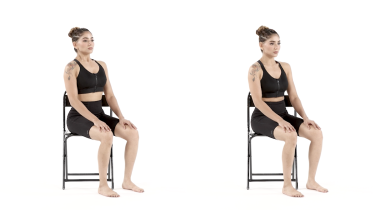 Breathing control
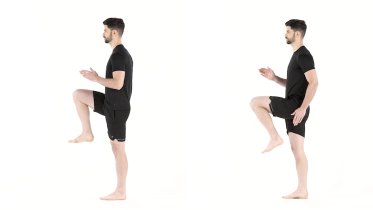 Marching on the spot
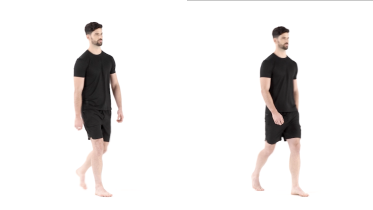 Brisk walking
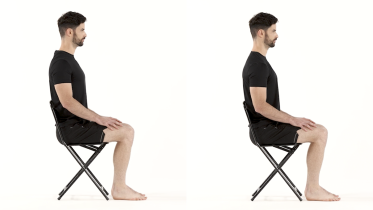 Chin tuck
Stage 2: Neck and eyes
When the stage 1 work no longer stirs symptoms up, which for most people is within the first week or two. Neck pain, headache and dizziness after a concussion often come from the neck and the balance system rather than from the brain injury itself, and this is the part of recovery where physiotherapy has the most evidence behind it. The international consensus statement recommends cervicovestibular rehabilitation when dizziness, neck pain or headache persist for more than 10 days, so if you are in that position, this work belongs with a physio rather than on your own (Patricios and colleagues, 2023). The deep neck flexor exercise, neck rotation, the isometric holds and the upper trapezius stretch work the neck. Gaze stabilization and neck activation with eye movements train the link between head movement and eye control, which is what leaves people feeling off balance in a supermarket aisle. Go slowly and in small doses. A common starting point is 1 to 2 sets of 5 to 10 slow repetitions, or a 20 to 30 second hold for the stretch, once or twice a day, stopping before symptoms rise more than mildly.
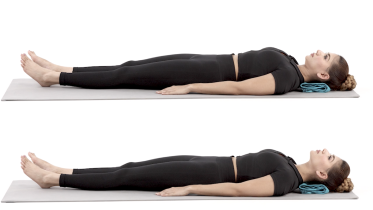 Deep neck flexor exercise
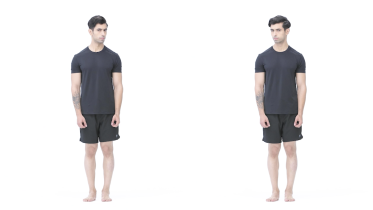 Neck rotation
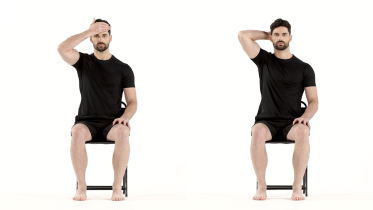 Neck isometric exercises
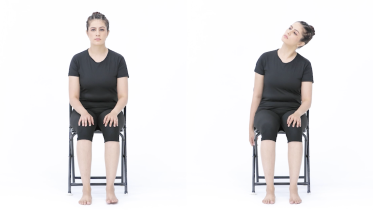 Upper trapezius stretch
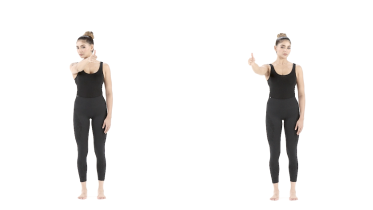 Gaze stabilization x2
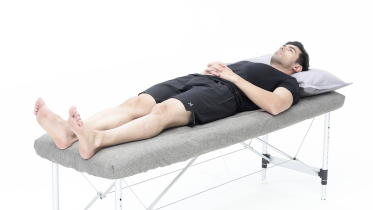 Neck activation with eye movements
Stage 3: Balance and dual task
Two conditions come before any of this stage, and they are conditions rather than suggestions. Every exercise here, the two walking drills included, is done within arm's reach of a kitchen counter, a wall or a sturdy chair, and with another adult in the house, because an unsteady moment here is how people fall and hit their head a second time. And if you are still dizzy or unsteady, if turning your head brings your symptoms on, or if you have stumbled or felt you might fall at any point since the injury, do this stage with a physio rather than on your own: the international consensus statement tells people to avoid the risk of a fall until a qualified healthcare professional has judged them safe for higher risk activity, and where dizziness, neck pain or headache have lasted more than 10 days it recommends cervicovestibular rehabilitation, which means a physio rather than a page (Patricios and colleagues, 2023). If you cannot set it up that way, leave this stage until you can. Past that, start it when the neck and eye work is comfortable and you are managing a full day of school or work. Balance after a concussion often feels fine standing still and falls apart when you add movement or thinking, which is why this stage goes from a narrow stance to a foam pad and then to walking with your head turning or your mind busy. Walking while counting backward is the dual task one: it is meant to feel awkward. Short holds are better than long ones, often 3 to 5 goes of 10 to 30 seconds, and a few minutes of the walking drills. If symptoms climb, drop back to an easier version rather than pushing through.
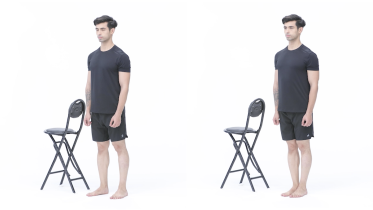 Standing with feet together
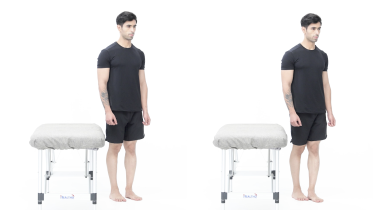 Semi-tandem stance
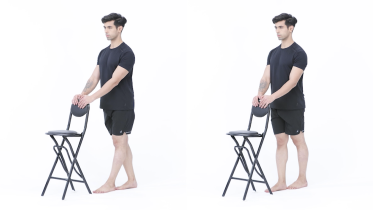 Tandem stance
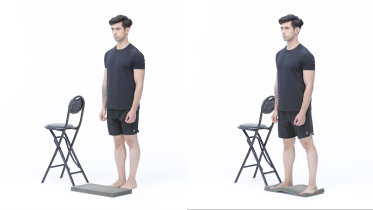 Standing balance on a foam pad
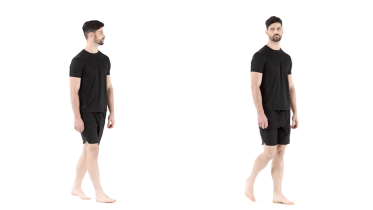 Walking with head turns
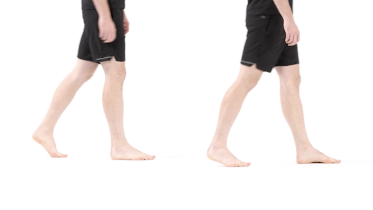 Walking while counting backward
Stage 4: Running and non-contact drills
Read this before you open any of the four below. Skater hops are hopping and landing on one leg, so they carry a risk of falling, and the consensus statement is clear that anything carrying a risk of contact, collision or a fall waits until a qualified healthcare professional has judged you ready for it: leave them out until then and keep to the other three. The rest of the stage lines up with the running and non-contact training steps of the published protocols, and it is the last one a home program can take you to. Wait for it. The UK guidance starts its non-contact training stage only once you are not getting symptoms at rest, the New Zealand guidelines require you to be symptom free and back at full time work or school first, and the consensus statement holds the steps at this level until symptoms and examination findings have settled, including after exertion. Jogging on the spot and high knees add aerobic load and head movement together. Single leg stance brings in the balance control your sport needs, and it is done within arm's reach of something solid, like the stage 3 work. Work out whether symptoms return at this intensity before you go near a pitch. Then read this twice: full contact practice and competition are the final two steps of every protocol on this page, they need sign off from a clinician, and no stage of a home program is permission to return to contact. In the UK, Australia and New Zealand there is also a minimum number of days before competitive contact that applies whatever your symptoms are doing. Your physio or physical therapist will tell you which step you are actually on.
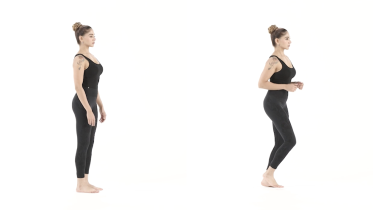 Jogging on the spot
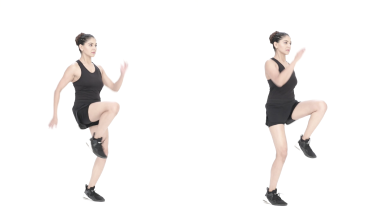 High knees running in place
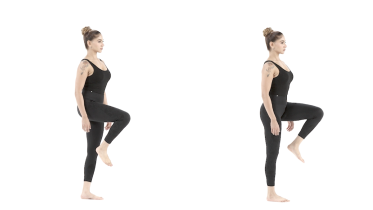 Single leg stance
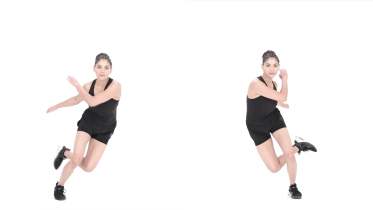 Skater hops
What to avoid while you are recovering
The NHS list for the days after a head injury is short and worth following to the letter: no returning to work or school until you feel better, no driving until you have fully recovered, no alcohol or recreational drugs until you feel better, no sleeping pills unless a doctor has advised them, and no contact sports for at least 3 weeks. For children it adds avoiding rough play for a few days.
Beyond those, the things that reliably set people back in the first fortnight are the ones that stack up quietly. A long drive. A loud restaurant. A full day of screens with no breaks. Trying to clear the backlog at work in one go on the first day back.
None of them is dangerous, and all of them will cost you a day or two.
A second head knock before you are recovered is the risk every standdown rule is written to reduce, which is why the non-contact restriction in the middle stages is not negotiable and why the UK guidance keeps training with head impacts out until 14 days free of symptoms at rest. Alcohol muddies everything as well: it makes the symptoms of a concussion harder to tell apart from the symptoms of a drink, which is a problem for the person assessing you.
If a knock to the head is a routine hazard in your sport, it is worth reading up on the pattern: pickleball injuries and padel injuries both cover head and facial contact in racket sports, which people do not expect until it happens.
When symptoms last longer than 4 weeks
Symptoms that are still there at a month need a clinician rather than more patience. The UK sport guidance is direct about it: if symptoms continue beyond 28 days, stay out of sport and get medical advice from a GP, and have it assessed and managed by an appropriate healthcare professional. The NHS sets an earlier trigger for general head injury symptoms at more than 2 weeks, and the UK sport guidance asks you to ring NHS 111 if things are worse or no better by 14 days.
The consensus statement sets the same marker earlier still. Where symptoms are persisting, getting worse, or simply not steadily improving 2 to 4 weeks after the injury, it recommends a full assessment across the different systems involved and referral for rehabilitation (Patricios and colleagues, 2023). Waiting out a second month is not the plan.
Persistent symptoms are not one thing, which is why a single treatment does not fit them. Some come from the neck. Some come from the balance and visual system. Others are headaches with their own pattern and their own treatment, or sleep, mood and exercise intolerance feeding each other.
A good assessment separates them out. That matters because the parts coming from the neck and the balance system are the parts physiotherapy treats well.
The 2026 adult trial is the honest note to end this section on. In adults who already had persistent symptoms 3 to 24 months after injury, adding a structured sub-symptom aerobic program to usual care improved how much exercise they could tolerate but did not reduce their symptom burden (Valaas and colleagues, 2026). That is not a reason to do nothing. It is a reason to get assessed properly rather than assume the protocol that helps a 15 year old in week one will help an adult in month eight.
When to see a physio or doctor
Get assessed after every suspected concussion, which is what the UK guidance asks for within 24 hours, by an onsite healthcare professional or through NHS 111. Go now, not later, for anything in the emergency list at the foot of this page.
See a physio or doctor as well if neck pain, headache or dizziness is still there after the first week or two, if your balance has not come back, if you cannot manage a full day of school or work, or if symptoms rise every time you try to exercise. Those four are the ones a physiotherapist can usually do something about, and leaving them for months does not make them easier to treat.
Go back to your doctor if symptoms are still present at 28 days, if they are getting worse rather than better, or if a new symptom appears that was not there at the start. And see somebody before you return to any contact sport, because in every one of the five markets on this page the final steps need a clinician's sign off, and in three of them there is a minimum standdown as well. If you want the general version of which symptoms need checking before you start any exercise program, red flags in physiotherapy sets it out.
If your neck is the main problem, neck pain and whiplash have the fuller programs for it.
This page is education, not advice about your own head injury. Nothing here overrides what a doctor, a physiotherapist or your sport's own concussion rule has told you, and no page can assess a head injury.
For physiotherapists
Treat the market question as a clinical one. The 21 day minimum before competitive contact in UK grassroots, Australian youth and community, and New Zealand community sport is a floor independent of symptom resolution, and the UK document also gates head-impact training on 14 days symptom free at rest, putting stage 5 no earlier than day 15. Note that day 15 is reachable only where symptoms clear on day 1, since the 14 days runs from the first symptom free day: the document's own examples put stage 5 at day 18 and day 19 and competition at day 25 and day 21. New Zealand's 14 day gate is a different count again, being 14 days post-injury rather than 14 symptom free days, so quoting a bare fourteen to a patient without saying which one it is will set the wrong date.
The CDC progression and the Parachute guideline do not set a day count, so in the USA and Canada the limiting factors are the staged progression, clinician clearance, and state or provincial law and league rules. Confirm which document the patient's sport actually uses before you set a timeline, because getting this wrong is a governance problem as well as a clinical one.
On early aerobic exercise, the population boundaries carry the recommendation. Leddy and colleagues (2019) randomized 103 athletes aged 13 to 18 within 10 days of injury and shortened median recovery from 17 to 13 days (P = .009); Leddy and colleagues (2021) reported a 48% reduction in persistent symptom risk in 118 adolescents, HR 0.52 (95% CI 0.28 to 0.97, P = 0.039). Valaas and colleagues (2026), in 81 adults with persistent symptoms 3 to 24 months post-injury, found no RPQ difference at 12 weeks or 6 months but a sustained improvement in Buffalo Concussion Treadmill Test threshold. Do not transfer the acute adolescent effect size to a chronic adult presentation.
Clear the cervical spine before you examine its range of movement, not after. NICE NG232 recommendation 1.6.1 is explicit that where a cervical spine injury is suspected after a head injury, range of movement can only be assessed safely before imaging in someone with none of the high-risk factors in 1.6.2 and at least one low-risk feature, which it lists as a simple rear-end collision, comfort in sitting, having been ambulatory at any time since the injury, no midline cervical tenderness, or delayed onset of neck pain. The high-risk factors that send a patient for a CT cervical spine within the hour include a GCS of 12 or less, blunt polytrauma, and clinical suspicion of cervical injury with any of age 65 or over, a dangerous mechanism, focal peripheral neurological deficit or limb paraesthesia. Section 1.6 is a separate pathway from the CT head criteria in 1.5, so a cleared head scan clears nothing about the neck. The SCOAT6 includes cervical range of movement, muscle spasm and palpation for segmental or midline tenderness for the same reason.
Cervicovestibular rehabilitation is the strongest physiotherapy-specific evidence here. Schneider and colleagues (2014) randomized patients aged 12 to 30 with persistent dizziness, neck pain or headache; 11 of 15 versus 1 of 14 were medically cleared within 8 weeks, with an intention to treat likelihood ratio of 3.91 (95% CI 1.34 to 11.34). Small sample, large effect, consistent with practice.
Sourcing notes for anyone revising this page. The Amsterdam 2023 consensus statement is read and quoted here directly: the 6 step RTS and 4 step RTL strategies, the instruction to avoid complete rest and isolation even in the first 24 to 48 hours, the mild and brief exacerbation threshold of 2 points on a 0 to 10 scale for under an hour, subsymptom threshold aerobic exercise prescribed 2 to 10 days post-injury off a heart rate threshold, cervicovestibular rehabilitation where dizziness, neck pain or headache persist beyond 10 days, multimodal evaluation and referral at 2 to 4 weeks, and a pooled mean of 19.8 days to unrestricted RTS across 57 studies. It sets no minimum standdown before competition, so the 21 day figures are national, but it does put a floor under its own strategy, telling clinicians and athletes to expect at least a week to get through all of it, with typical unrestricted RTS taking up to a month. It also returns an athlete who becomes symptomatic during steps 4 to 6 to step 3, not to the step below. The ACC guideline PDF is also readable and is the source for the New Zealand stage 5 and stage 6 criteria quoted in the table, including the 14 and 21 day minimums and the repeat concussion threshold of 3 in a season or more than 5 in a career. NICE NG232 and the UK grassroots HTML version were both read in full on 24 October 2026 and are the sources for the structural material: the high-energy head injury definition, the 999 and emergency department lists, the separate cervical spine pathway in section 1.6, the under 16 and under 1 year scanning criteria, and the UK red flags of severe neck pain and any suspicion of a skull fracture. Both answer a plain curl with a browser user agent, --compressed and -L. Neither is paywalled, and nothing on this page rests on a document nobody here has read.
Added on 24 October 2026, after all five national documents were read again at source rather than from an earlier read. The ACC PDF is headed Updated March 2024 and the Appendix 1 protocol table is the source for the New Zealand stage 5 and stage 6 criteria, with day 0 defined as the day of the injury. Its red flag list is the source for two points this page now makes in body text: a complaint of neck pain appears on it in its own right with no severity attached, and regular medication that could cause prolonged bleeding is named as warfarin and aspirin, which is why the aspirin carve-out in the NICE-derived warning line is explained rather than left to contradict the text around it. The UK grassroots HTML version carries three worked examples with calendar dates, and they are the source for the statement that day 15 and day 21 are floors: in example 1 symptoms clear on day 4 and stage 5 falls on day 18 with competition on day 25, in example 2 symptoms clear on day 5 and stage 5 falls on day 19 with competition on day 21, and in example 3 the player cannot return within 21 days at all. The AIS page attributes both Australian figures to the 2024 position statement in one sentence. The Parachute medical clearance letter wording was read on the Canadian guideline page. The CDC page refuses curl from here, so its date and its six steps were read from the Internet Archive snapshot of 17 September 2026, which carries September 15, 2025 as both last updated and last reviewed. The consensus statement was read through the Internet Archive snapshot of 30 August 2025 of its BJSM landing page, which renders the full text; bjsm.bmj.com itself answers 403. One caution for whoever revises this next: the tables in that archived copy are not in the HTML, so anything that lives only in table 1 or table 2 cannot be checked that way. The phrase "written determination of readiness" was removed from this page for exactly that reason, since the body text says medical determination of readiness and the word written could not be verified anywhere outside the tables.
Warning signs
Get emergency help now
- Emergency: after a knock to the head, being very drowsy or finding it hard to keep your eyes open, confusion, a fit (seizure), new weakness or numbness anywhere in your body, new trouble understanding, speaking, walking or keeping your balance, new problems seeing or hearing, clear fluid coming from your ears or nose, bleeding from your ears or bruising behind them, a black eye when your eye was not hit, a dent in your head or a wound with something stuck in it, or a change in behavior. Call emergency services straight away. These can be signs of an injury to the brain.
- Emergency: a knock to the head in a high-energy accident, even if you feel completely well. That means a fall from a height of more than 1 meter (about 3 feet) or more than 5 stairs, a crash at high speed, a car that rolled over, being thrown from a vehicle, being hit by a vehicle while walking or cycling, a bike crash, an accident on a quad bike or similar motorized vehicle, a fall from a horse, a diving accident, or any other heavy, fast impact to the head. Call emergency services straight away, without waiting to see how you feel. A high-energy head injury is a reason for emergency assessment on its own, with no symptoms needed.
- Emergency: after a knock to the head, you were knocked out, even for a moment, you cannot remember what happened just before or after, you have had a headache ever since, or you are being sick (vomiting). The same applies, even if you feel fine, if you take medicine that thins your blood, other than aspirin on its own, have a bleeding or clotting condition, have had brain surgery in the past, or had been drinking alcohol or taking drugs when it happened. Go to an emergency department straight away, and do not drive yourself.
- Emergency: severe neck pain after a knock to the head, whatever the fall or the knock was like. Keep still and call emergency services, and do not let anyone move you until someone trained has checked your neck. If the neck pain only starts later and nobody has checked your neck since, go to an emergency department straight away, and do not drive yourself.
- Emergency: after a knock to the head, swelling, a deep cut or severe pain at the exact spot that was hit, or in a baby under 1 year old a bruise, swelling or cut on the head bigger than 5 cm. Call emergency services or go to an emergency department straight away, and do not drive yourself. These can be signs of a broken skull.
- Emergency: neck pain straight after a high-energy accident, such as a crash at high speed, a car that rolled over, being thrown from a vehicle, being hit by a vehicle while walking or cycling, a motorbike or quad bike accident, a horse riding accident, a diving injury, or a fall from a height or down several stairs. Keep still and call emergency services. If the neck pain only starts later and nobody has checked your neck since, go to an emergency department straight away, and do not drive yourself.
- Emergency: in the first days after the accident, numbness, tingling, pins and needles or weakness in your arms or legs, or a sudden electric shock feeling in your neck and back that runs into your arms or legs. If it starts straight after the accident, keep still and call emergency services. If it starts later, call emergency services or go to an emergency department straight away, and do not drive yourself.
- Emergency: new neck or back pain after a fall, a knock or a jolt, even a minor one such as a trip or a sudden stop in a car, if you have a condition that stiffens the spine, such as ankylosing spondylitis. Call emergency services or go to an emergency department straight away, do not drive yourself, and tell the staff about your spine condition, so they keep your neck and back in their usual position. A stiff spine can break after a small injury, and the break is easy to miss at first. If the pain started straight after the injury, or you also have numbness, tingling or weakness in your arms or legs, keep still and call emergency services.
- Emergency: after a fall or a knock, a wrist, hand or arm that has changed shape or sits at an odd angle, that goes numb, tingles or has pins and needles, that turns pale, blue or cold, that has a bone showing through the skin, or that has a cut bleeding heavily. Go to an emergency department straight away, or call emergency services, and do not drive yourself. Do not try to straighten the arm or push the bone back yourself.
- Emergency: you have had a fall or an injury and now have severe hip pain, or you cannot walk or put weight on the leg. Call emergency services or go to an emergency department. This can be a sign of a broken hip (hip fracture).
- Emergency: call emergency services straight away for any sign of a stroke, even if it goes away: sudden dizziness with unsteadiness or falling over, a face that droops on one side, an arm you cannot lift or keep up, slurred or muddled speech, weakness or numbness on one side of your body or face, sudden blurred vision, double vision or loss of sight, trouble swallowing, a sudden severe headache, or a sudden fall where your legs give way but you do not black out (a drop attack).
- Emergency: dizziness with a new, severe headache, or a sudden, severe headache that feels unlike anything you have had before. Call emergency services straight away.
- Emergency: vertigo or dizziness together with new hearing loss, double vision or loss of vision, trouble speaking, or weakness, numbness or tingling in an arm or leg. Call emergency services or go to an emergency department straight away.
- Emergency: you fell and cannot remember the fall or how it happened. Go to an emergency department straight away, and do not drive yourself. You may have blacked out or hit your head without knowing it.
Get help today
- Same day: you blacked out or fainted, even for a moment, without any of the emergency signs above. Get medical advice the same day. Call emergency services instead if the person is not breathing, cannot be woken within 1 minute, has not fully recovered or has trouble speaking or moving, has chest pain or a pounding, fluttering or irregular heartbeat, fainted while exercising or lying down, is shaking or jerking, or was badly hurt.
- Same day: neck pain after a car accident or a fall, even a minor one, if you are 65 or older, have low bone density (osteoporosis) or have taken steroid tablets for a long time. Get your neck checked by a doctor the same day, for example at an emergency department, before you start these exercises. At 65 or older, doctors usually want an X-ray or scan of the neck after an accident.
- Same day: after a fall or a knock, a wrist, hand or arm that is very painful, that you cannot use because of the pain, that is badly swollen or bruised, or that is very stiff or hard to move, with no change of shape, no numbness or tingling, no pale, blue or cold skin, no bone showing and no cut that is bleeding heavily. Get it checked the same day at an urgent care center or an emergency department, and do not exercise that arm until it has been seen. A fall onto an outstretched hand often breaks a bone near the wrist, and an X-ray is the only way to be sure.
- Same day: you feel dizzy after a knock to the head, without any of the emergency signs above. Get medical advice the same day.
- Same day: sudden new dizziness, or feeling faint or unsteady, without any of the stroke signs above. Stop, sit down and get medical advice the same day. If you faint, it does not settle within a few minutes of sitting still, or you cannot stand or walk steadily, call emergency services.
- Same day: an electric shock feeling runs down your back or into your arms or legs as your head bends forward, without any of the emergency signs above. Stop and get medical advice the same day.
Book an appointment
- Within a few days: you have had a fall, even if you were not hurt, or you keep tripping, stumbling or feeling that your legs might give way. Book an appointment with your doctor within a few days and ask about a falls assessment. Tell them about every fall, even the ones where you were not hurt.
Common questions
How long does it take to recover from a concussion?
For most adults, a few weeks. The NHS describes concussion as a temporary brain injury that can last a few weeks, and advises seeing a GP if symptoms of a head injury last more than 2 weeks. The UK grassroots sport guidance sets a different marker: if symptoms continue beyond 28 days, stay out of sport and get medical advice from a GP. Children and adolescents take longer than adults, and both the UK guidance and the ACC guidelines in New Zealand say so directly. Be careful with averages, though. Feeling better is not the same as being cleared, and in the UK, Australia and New Zealand the minimum standdown before competitive contact sport applies whatever your symptoms are doing.
How many days before you can return to play after a concussion?
It depends on where you play, which is the single most important thing on this page. In the UK the graduated return has six stages and stage 6, return to competition, should not be reached before day 21, with no return to competition before 21 days from the injury. In Australia the youth and community guidance sets a minimum of 21 days before returning to competitive contact, with 14 days symptom free at rest before contact training. In New Zealand a suspected concussion is assessed by a doctor who confirms or rules it out, and where it is confirmed the ACC guidelines mean no return to full play for less than 21 days. Those day numbers are floors and not dates: the UK document's own worked examples reach competition on day 25 and day 21, because its 14 day count runs from the first day you are free of symptoms at rest. The USA and Canada do not set a 21 day figure: the CDC's 6-step progression says each step typically takes a minimum of 24 hours, and Canada requires a medical clearance letter before full contact play. On top of all of that, your own sport, league or school may have a stricter rule, and in the USA your state law may too.
Should you rest in a dark room after a concussion?
No. The international consensus statement tells clinicians to avoid recommending complete rest and isolation even for the first 24 to 48 hours, and to recommend relative rest instead, with an early return to daily activities as long as symptoms rise no more than 2 points on a 0 to 10 scale for less than an hour (Patricios and colleagues, 2023). The UK guidance asks for a relative rest period of 24 to 48 hours, keeping activity to 10 to 15 minute slots, and then a gradual increase in light physical activity. The CDC's first step is getting back to regular activities including school, with a provider's clearance, before any sport steps begin. The NHS advice for the first days is rest, reducing stress, an ice pack for swelling and paracetamol for headache, and it says you do not need to stay awake if you are tired. What nobody now recommends is days in a dark, silent room. Relative rest means cutting back, not switching off.
Does exercise help concussion recovery?
In adolescents with a recent sport-related concussion, the evidence is reasonably good. In a randomized trial of 103 athletes aged 13 to 18 seen within 10 days of injury, individualized sub-symptom threshold aerobic exercise for about 20 minutes a day gave a median recovery of 13 days against 17 days for a placebo stretching program (Leddy and colleagues, 2019). A second trial in 118 adolescents found a 48% reduced risk of persistent symptoms with aerobic exercise, with a hazard ratio of 0.52 (Leddy and colleagues, 2021). Both were in adolescent athletes seen inside 10 days, which matters, because a 2026 trial in 81 adults who already had persistent symptoms 3 to 24 months after a mild brain injury found no difference in symptom burden against usual care with general exercise advice, although exercise tolerance on a treadmill test did improve (Valaas and colleagues, 2026). So early, measured aerobic exercise after a fresh concussion in a teenage athlete has trial support. The same approach months later, in an adult, has not shown the same symptom benefit.
Can physiotherapy help after a concussion?
Yes, particularly for the neck and the dizziness. In a randomized trial of people aged 12 to 30 with dizziness, neck pain or headaches persisting after a sport-related concussion, everyone got weekly physiotherapy and one group also got cervical spine and vestibular rehabilitation. Medical clearance within 8 weeks was reached by 11 of 15 in the treatment group against 1 of 14 in the control group, and the treatment group was 3.91 times more likely to be cleared by 8 weeks (Schneider and colleagues, 2014). Those are small numbers, so treat the exact figures loosely, but the direction is clear and it matches what we see in clinic. A physio or physical therapist does not treat the brain injury. They treat the neck, the balance system and the eye and head coordination that so often get hurt in the same event.
What happens if you go back too early after a concussion?
The guidelines are built around not finding out. The UK grassroots guidance warns that progressing too quickly through its middle stages while symptoms are significantly worsened by exercise may slow recovery, and it asks for 14 days free of symptoms at rest before any training with head impacts, which is why stage 5 cannot start before day 15 at the earliest. New Zealand's guidance asks for extra caution in children, adolescents and female athletes because they take longer to recover. The practical answer is that going back early risks a longer recovery and a second injury to a brain that has not finished settling, which is the reason a minimum standdown exists at all in three of our five markets. If you are being pushed to play, the standdown rule is yours to point at.
Do I need a scan after a concussion?
Usually not, and the decision is not yours to make at home. Scans after a head injury are used to look for bleeding and fractures, not to diagnose concussion, and in the UK which patients get one is set by NICE guideline NG232 on head injury assessment and early management. Two parts of that guideline are worth knowing about. It scans the head on one set of criteria and the neck on another, so a head scan that came back normal has said nothing about your cervical spine. And it names reasons to scan that have nothing to do with how rough you feel. In someone who lost consciousness or has a gap in their memory, being 65 or over, having a bleeding or clotting disorder, and a dangerous mechanism such as a fall from more than 1 metre or more than 5 stairs each count on their own; and being on an anticoagulant or antiplatelet other than aspirin by itself is a reason to consider a head scan with none of the rest present. What matters from your side is getting assessed in the first place: the UK guidance asks for every suspected concussion to be seen by an onsite healthcare professional or by calling NHS 111 within 24 hours, with urgent assessment and 999 if necessary where any red flag is present. The emergency signs on this page are the ones that mean going now rather than waiting for an appointment.
References
- Patricios JS, Schneider KJ, Dvorak J, et al. Consensus statement on concussion in sport: the 6th International Conference on Concussion in Sport, Amsterdam, October 2022. British Journal of Sports Medicine. 2023;57(11):695-711. https://doi.org/10.1136/bjsports-2023-106898
- Sport and Recreation Alliance and UK Government. UK concussion guidelines for non-elite (grassroots) sport. Published 2023, updated November 2024. https://sportandrecreation.org.uk/campaigns-and-policy/concussion/concussion-guidelines-for-grassroots-sport-html-version
- Centers for Disease Control and Prevention. HEADS UP: returning to sports. Page dated 15 September 2025, which is the date the page itself carries as both last updated and last reviewed. https://www.cdc.gov/heads-up/guidelines/returning-to-sports.html
- Parachute. Canadian guideline on concussion in sport, 2nd edition. 2024. https://parachute.ca/en/professional-resource/concussion-collection/canadian-guideline-on-concussion-in-sport/
- Australian Institute of Sport. Concussion in sport: Australian concussion guidelines for youth and community sport, and the Concussion and Brain Health Position Statement 2024. https://www.ausport.gov.au/concussion
- ACC and Sport New Zealand. National guidelines for sport concussion. https://sportnz.org.nz/resources/national-guidelines-for-sport-concussion/
- ACC. Sport concussion in New Zealand: national guidelines. The document is headed Updated March 2024, although the file name reads jan2024. Read in full on 24 October 2026. https://sportnz.org.nz/media/50udkfu5/acc_cis-guidelines_jan2024.pdf
- Sport New Zealand. New course helps adults recognise and respond to concussion. 31 August 2026. https://sportnz.org.nz/about/news-and-media/news-updates/new-course-helps-adults-recognise-and-respond-to-concussion/
- NHS. Head injury and concussion. Page last reviewed 29 May 2025. https://www.nhs.uk/conditions/head-injury-and-concussion/
- NHS. Exercise in pregnancy. https://www.nhs.uk/pregnancy/keeping-well/exercise/
- NHS Healthier Together (South West London). Fainting in pregnancy: call your maternity unit if you have fallen and hit your head, or fallen and landed on your tummy. https://www.swlondon-healthiertogether.nhs.uk/pregnancy/worried-you-are-unwell-during-pregnancy/fainting
- National Institute for Health and Care Excellence (NICE). Head injury: assessment and early management. NICE guideline NG232. Published 18 May 2023. https://www.nice.org.uk/guidance/ng232
- Leddy JJ, Haider MN, Ellis MJ, Mannix R, Darling SR, Freitas MS, Suffoletto HN, Leiter J, Cordingley DM, Willer B. Early subthreshold aerobic exercise for sport-related concussion: a randomized clinical trial. JAMA Pediatrics. 2019;173(4):319-325. https://doi.org/10.1001/jamapediatrics.2018.4397
- Leddy JJ, Master CL, Mannix R, et al. Early targeted heart rate aerobic exercise versus placebo stretching for sport-related concussion in adolescents: a randomised controlled trial. Lancet Child and Adolescent Health. 2021;5(11):792-799. https://doi.org/10.1016/S2352-4642(21)00267-4
- Schneider KJ, Meeuwisse WH, Nettel-Aguirre A, Barlow K, Boyd L, Kang J, Emery CA. Cervicovestibular rehabilitation in sport-related concussion: a randomised controlled trial. British Journal of Sports Medicine. 2014;48(17):1294-1298. https://doi.org/10.1136/bjsports-2013-093267
- Valaas LV, Soberg HL, Rasmussen MS, Steenstrup SE, Brunborg C, Roe C, Kleffelgard I. Effects of sub-symptom threshold aerobic exercise on persistent postconcussion symptom burden and exercise intolerance: a randomized controlled trial. Physical Therapy. 2026;106(6):pzag049. https://doi.org/10.1093/ptj/pzag049
Written and checked by the PocketPhysio editorial team. Last updated 2026-10-24.
This page is general education, not a diagnosis or a personal treatment plan. See a physiotherapist or doctor for advice about your own situation.