
Dizziness and BPPV, treatment and vestibular rehab exercises
What BPPV is and what it feels like
BPPV stands for benign paroxysmal positional vertigo. Tiny crystals in the inner ear move out of their usual place and into one of the balance canals, and when you move your head they shift and set off a brief, strong spinning feeling (St George's NHS). The usual triggers are lying down, rolling over in bed, looking up and bending forward. Each spell usually lasts less than a minute, but it can be intense and leave you feeling sick or off balance.
"Benign" means BPPV is not dangerous in itself. The risk is what the spinning can lead to, such as a fall on the stairs or on the way to the bathroom at night. The BPPV guideline asks clinicians to talk with patients about that safety risk and about the chance of it coming back (Bhattacharyya 2017).
How BPPV is diagnosed
A doctor or physio usually confirms BPPV with a positional test. In the Dix-Hallpike test, they move you from sitting to lying back with your head turned to one side and tipped slightly back, and watch your eyes for a flicker (nystagmus) that comes with the spinning (Bhattacharyya 2017). If that test does not show the typical pattern, a roll test while you lie on your back checks a different canal. The result tells them which ear and which canal are involved, and that decides the treatment. The guideline advises against scans and inner ear balance tests when the signs fit BPPV and nothing else points to another cause.
How the Epley maneuver treats BPPV
The Epley maneuver is a repositioning treatment done by a trained clinician. They move your head and body through a set series of positions, lying back and then rolling onto your side before you sit up, to move the crystals back out of the canal (Bhattacharyya 2017). You may feel some spinning in one or more positions, and some people feel sick (Hilton 2014). It is designed for the most common type, in the back canal of the inner ear (posterior canal BPPV). Other canals need different maneuvers, which is one reason the diagnosis comes first.
The guideline advises clinicians to treat posterior canal BPPV with a repositioning maneuver, or refer to someone who can, and not to use medicines that dampen the balance system, such as antihistamines or sedatives, as a routine treatment (Bhattacharyya 2017). A Cochrane review included 11 mostly small trials with 745 people (Hilton 2014). In the five that compared the Epley with a sham maneuver or no treatment, the spinning cleared completely in 56% after the Epley, compared with 21%. There were no serious side effects, although feeling sick during the maneuver was common and some people could not have it because of neck problems. In one trial, a single Epley worked better than a week of Brandt-Daroff exercises done three times a day, and the Semont maneuver gave similar results to the Epley.
Most people do not need to sleep upright or avoid lying on one side afterward. A Cochrane review found these restrictions added only a small benefit to the Epley alone (Hunt 2012), and the guideline advises clinicians not to recommend them after treatment for posterior canal BPPV (Bhattacharyya 2017). BPPV often comes back, so it helps to know the pattern and to go back for treatment if it returns (Hilton 2014).
Can you do the Epley maneuver at home?
There is no Epley video on this site, and this page leaves out the steps on purpose. The right maneuver depends on which ear and which canal are affected. Done on the wrong side, or with a stiff or painful neck, it will not help, and the spinning it sets off can make you fall. Some NHS services give people with BPPV a home exercise sheet for Brandt-Daroff exercises, with advice to have another person present and to stop if the neck or back hurts or you feel faint (Rotherham NHS). If your doctor or physio teaches you a home version, follow their instructions exactly, and go back to them if the spinning has not settled.
Vestibular rehabilitation for dizziness that lingers
Vestibular rehabilitation is an exercise program for dizziness and unsteadiness that come from the balance system of the inner ear. The APTA guideline describes gaze stability work, where you keep your eyes on a target while your head moves, and habituation, where you repeat a movement that brings on mild to moderate dizziness so it bothers you less over time (Hall 2022). Balance and walking training are the other main parts. A Cochrane review of 39 trials with 2,441 people found moderate to strong evidence that it is safe and effective when the balance organ on one side is affected, and the benefits were still there 3 to 12 months later (McDonnell 2015).
For BPPV itself, the same review found repositioning maneuvers worked better than exercise in the short term, and the two together were effective for longer-term recovery (McDonnell 2015). The BPPV guideline lists vestibular rehabilitation, at home or with a clinician, as an option alongside the maneuver (Bhattacharyya 2017). Exercises do not replace the maneuver.
The APTA guideline gives a strong recommendation to offer vestibular rehabilitation to people with a weak balance organ in the inner ear (peripheral vestibular hypofunction), for example after vestibular neuritis (Hall 2022). That guideline does not cover BPPV. For BPPV, the evidence puts the maneuver first, with exercises as an option alongside it (McDonnell 2015, Bhattacharyya 2017). The APTA guideline also advises against using eye-only exercises on their own, which is why side to side eye movements, figure 8 eye tracking and ball toss eye tracking sit alongside gaze exercises where your head moves, never instead of them.
How to use this program
Start only after a doctor or physio has found the cause of your dizziness. New dizziness, or dizziness that has changed, needs checking first. Begin at stage 1, and move up when the exercises feel easy and any dizziness fades quickly.
If you are pregnant and past the first three months, check with your physio before exercising flat on your back. If you have had neck surgery, check with your surgeon or physio before you start any exercise where your head moves. If your neck is sore or stiff, check with your physio before you add speed to any head movement.
Each exercise page gives its own starting range. As a rough guide, the lying gaze exercises often start at 30 seconds to 1 minute, working up to 1 to 2 minutes, 3 to 5 times a day. The seated head nods and side to side eye movements often start at 30 seconds to about a minute, 2 to 3 times a day, with the time built up before the speed. Balance holds often start at 10 to 30 seconds, and walking with head turns at 2 to 4 lengths of a hallway, once or twice a day. Your physio will adjust this.
For comparison, in the first 3 months after symptoms start, the APTA guideline suggests home gaze exercises at least 3 times a day, adding up to at least 12 minutes a day, alongside weekly clinic visits. After that, it suggests 3 to 5 times a day, at least 20 minutes a day, for 4 to 6 weeks (Hall 2022). Those figures are for a weak balance organ, not BPPV, and the guideline gives them only as weak recommendations, so your physio will set your own amounts.
The exercise program
Stage 1: Head and eye movements, lying or sitting
For when a doctor or physio has found the cause of your dizziness and wants you to start gently. Lying down takes balance out of the task, so the two lying gaze exercises can train the reflex that keeps your vision steady while your head moves. Seated head nods and side to side eye movements repeat a movement that brings on mild dizziness, so that over time it bothers you less (habituation). Aim for mild dizziness that fades within a few minutes of stopping. Sit quietly until it has settled before you stand up.
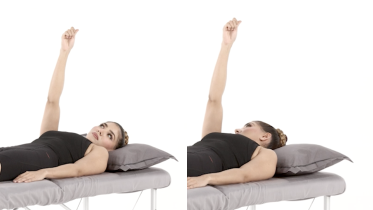 Lying gaze stabilization with head turns
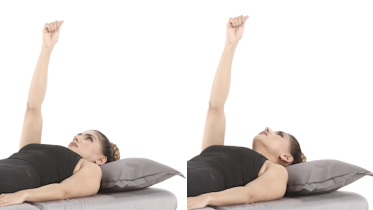 Lying gaze stabilization with head nods
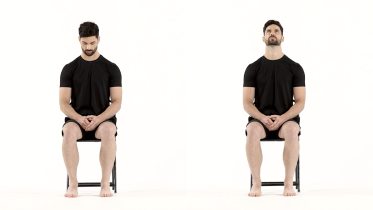 Seated head nods
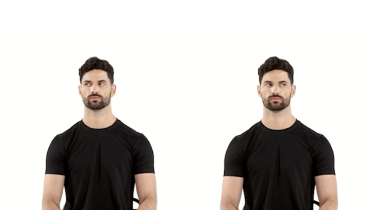 Side to side eye movements
Stage 2: Standing, with support close by
When stage 1 feels easy and any dizziness settles quickly. Keep doing the stage 1 gaze exercises, where your head moves, as your physio sets them. Stand next to a kitchen counter or a sturdy chair every time. Figure 8 eye tracking and ball toss eye tracking make your eyes follow a moving target while you stay upright. They are added to the gaze exercises where your head moves, never used instead of them. Semi-tandem and tandem stance narrow your base, and the turn to look behind adds a head and trunk turn while your feet stay still.
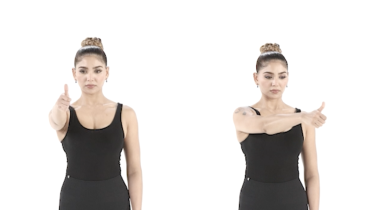 Figure 8 eye tracking
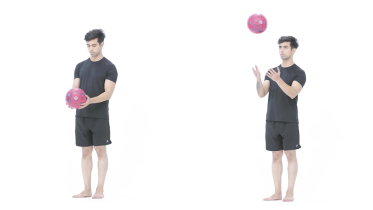 Ball toss eye tracking
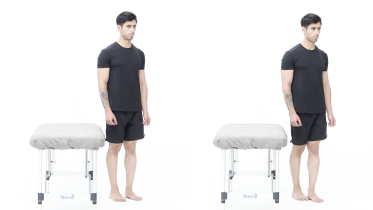 Semi-tandem stance
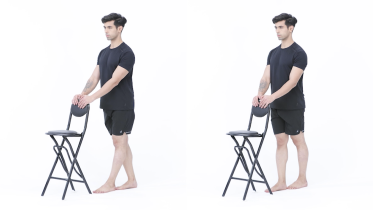 Tandem stance
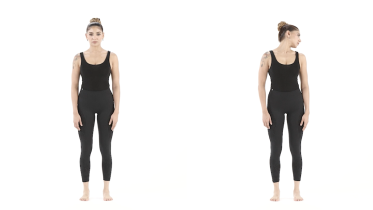 Standing turn to look behind
Stage 3: Harder gaze work, a soft surface and moving around
When stage 2 feels steady and you can hold tandem stance with only a fingertip on the support. Gaze stabilization x2 moves your thumb one way and your head the other, which is harder than watching a still target. Standing on a foam pad takes away some of the feeling from your feet, and head turns on the pad then add your inner ear to the task. Walking with head turns and turning on the spot then take that work into moving around the house. Keep a wall or counter within reach, and have another adult at home.
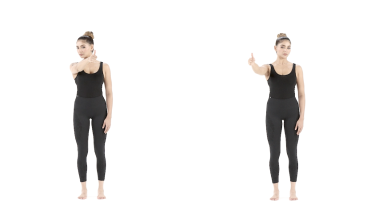 Gaze stabilization x2
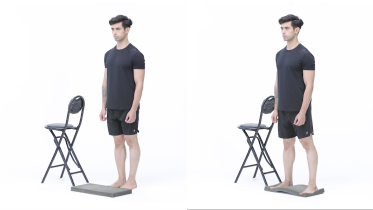 Standing balance on a foam pad
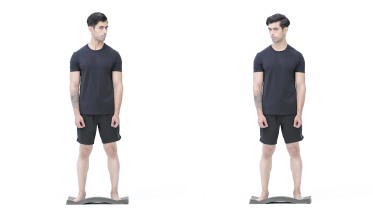 Foam pad balance with head turns
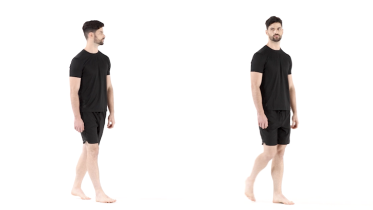 Walking with head turns
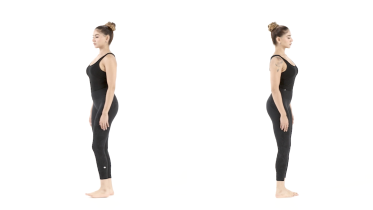 Turning on the spot
How much dizziness is normal during the exercises?
Mild dizziness, a swimmy head or feeling slightly off balance is expected during the gaze exercises, the head nods, the eye movement and eye tracking exercises, and the head turns on the foam pad. That is how habituation and gaze training work. It should fade within a few minutes of stopping. If mild dizziness takes more than about 10 minutes to settle, go slower or shorter next time and tell your physio.
Build up the time first and the speed later, and slow down if the target you are watching goes blurry. Sit quietly until any dizziness has settled before you stand up or walk.
Stop, sit or lie still and get medical advice the same day, before you do the exercises again, if the dizziness becomes severe or stronger than your physio said to expect, you are being sick, or you feel faint. If you faint, it is no better after 10 minutes of keeping still, you suddenly lose hearing in one or both ears, or you are far more unsteady on your feet than usual, call emergency services.
The other exercises in the program are different. Semi-tandem and tandem stance, standing on the foam pad without head turns, the turn to look behind, walking with head turns and turning on the spot are not meant to make you dizzy, and the 10 minute guide above does not apply to them. If one of them makes you dizzy, faint or unsteady, hold your support, stop and sit down, and get medical advice the same day. If you faint, it does not settle within a few minutes of sitting still, or you cannot stand or walk steadily, call emergency services.
Stay safe from falls
Dizziness and unsteadiness make a fall more likely. The BPPV guideline asks clinicians to check for poor balance, a lack of support at home and a higher risk of falling (Bhattacharyya 2017). Do every standing exercise beside a kitchen counter or a sturdy chair, on a clear floor. Wear flat shoes that fit well and grip the floor, not socks, tights or bare feet. If you have fallen in the past year, feel unsteady or take medicines that can make you dizzy, keep a hand on the support and practice only when another adult is at home.
Around the house, the NHS advises getting out of bed slowly, sitting down straight away if you feel dizzy, sleeping with extra pillows and moving your head slowly. It also suggests a walking stick if you are at risk of falling, and advises against bending over or stretching your neck to reach up (NHS vertigo). Do not drive, climb ladders or use machinery while you feel dizzy (NHS dizziness). For a wider plan, see balance and falls prevention.
A sudden loss of balance is different. Call emergency services straight away for any sign of a stroke, even if it goes away: sudden dizziness with unsteadiness or falling over, a face that droops on one side, an arm you cannot lift or keep up, slurred or muddled speech, weakness or numbness on one side of your body or face, sudden blurred vision, double vision or loss of sight, or a sudden severe headache.
When dizziness is not BPPV
Plenty of things besides BPPV cause dizziness, and the guideline asks clinicians to tell them apart (Bhattacharyya 2017). Spinning that follows a cold or flu and lasts hours or days, rather than seconds, can be labyrinthitis or vestibular neuritis, an inflammation in the inner ear. Labyrinthitis can also affect your hearing. Most people get their balance back over 2 to 6 weeks, although it can take longer, and vestibular rehabilitation with a physio or audiologist helps if balance problems linger (NHS labyrinthitis). The NHS also lists migraine, some medicines and Meniere's disease, a rare inner ear condition that can bring ringing in the ear (tinnitus) or hearing loss, among the causes of vertigo.
Feeling light-headed or faint, rather than spinning, often has a different cause. The NHS lists a drop in blood pressure when you stand or sit up quickly, dehydration, low blood sugar, anemia, stress or anxiety, and new medicines (NHS dizziness). Do not stop or change a medicine without advice from your doctor or pharmacist. Feeling faint or dizzy with a racing, pounding or irregular heartbeat needs emergency help. If your dizziness comes with neck pain, see the neck pain page and its warning signs.
If BPPV treatment has not worked, the guideline advises checking again for BPPV that has not cleared and for other inner ear or brain causes (Bhattacharyya 2017).
When to see a doctor or physio
See your GP or a physio if you get spells of spinning when you lie down, roll over or look up, so the cause can be confirmed and treated. The NHS advises seeing a GP if vertigo or dizziness does not go away or keeps coming back, or comes with ringing or other sounds in your ears. After BPPV treatment, or a spell of waiting to see if it settles, the guideline suggests a check within a month (Bhattacharyya 2017). After a head injury, see your GP if symptoms last more than 2 weeks (NHS). Children with dizziness should see a doctor rather than follow this program.
For physiotherapists
The 2017 AAO-HNS update (Bhattacharyya 2017) diagnoses posterior canal BPPV when the Dix-Hallpike provokes vertigo with torsional, upbeating nystagmus, with a supine roll test when the history fits and the Dix-Hallpike shows horizontal or no nystagmus. It advises against imaging and vestibular testing when diagnostic criteria are met without atypical features, against routine vestibular suppressants, and against postprocedural postural restrictions after repositioning for posterior canal BPPV. Clinicians should assess modifying factors (impaired mobility or balance, CNS disorders, lack of home support, fall risk), reassess within 1 month, and evaluate persistent symptoms for unresolved BPPV or an underlying peripheral vestibular or CNS disorder. Vestibular rehabilitation, self-administered or supervised, is listed as an option.
Hilton 2014 included 11 trials (745 participants): complete resolution of vertigo favored the Epley over sham or control (OR 4.42, 95% CI 2.62 to 7.44; 5 trials, 273 participants; 56% versus 21%), as did conversion to a negative Dix-Hallpike (OR 9.62, 95% CI 6.0 to 15.42; 8 trials, 507 participants). Nausea during the maneuver was reported in 16.7% to 32%, some patients could not tolerate it because of cervical spine problems, and a recurrence rate of 36% was reported after treatment. McDonnell 2015 found repositioning more effective than exercise-based rehabilitation for BPPV in the short term, with the combination effective for longer-term functional recovery.
Hall 2022 (Academy of Neurologic Physical Therapy) strongly recommends offering vestibular rehabilitation to symptomatic patients with unilateral or bilateral peripheral vestibular hypofunction, and recommends against voluntary saccadic or smooth pursuit exercises in isolation as gaze stability training. Suggested home gaze stability dosing, with weekly clinic visits (weak recommendations), is at least 3 times and 12 minutes a day in the acute and subacute phase, 3 to 5 times and at least 20 minutes a day for 4 to 6 weeks in chronic unilateral hypofunction, and 3 to 5 times and 20 to 40 minutes a day for 5 to 7 weeks in bilateral hypofunction. Balance and gait training of 20 minutes a day for 4 to 6 weeks is suggested for chronic unilateral hypofunction. Listed exclusions for unilateral hypofunction include risk of bleeding or cerebrospinal fluid leak, significant cognitive impairment likely to limit carryover, very active or frequent Meniere's attacks, and severe mobility limitations. The guideline does not cover BPPV, Meniere's disease or concussion.
See a doctor promptly if
- Emergency: call emergency services straight away for any sign of a stroke, even if it goes away: sudden dizziness with unsteadiness or falling over, a face that droops on one side, an arm you cannot lift or keep up, slurred or muddled speech, weakness or numbness on one side of your body or face, sudden blurred vision, double vision or loss of sight, or a sudden severe headache.
- Emergency: vertigo or dizziness together with new hearing loss, double vision or loss of vision, trouble speaking, or weakness, numbness or tingling in an arm or leg. Call emergency services or go to an emergency department straight away.
- Emergency: dizziness with a new, severe headache, or a sudden, severe headache that feels unlike anything you have had before. Call emergency services straight away.
- If chest pain, pressure or tightness does not ease quickly when you rest, spreads to your arm, neck, jaw, stomach or back, or comes with sweating, feeling sick, feeling light-headed or being short of breath, call emergency services straight away, as this can be a heart attack. If it eases quickly and none of these happen, get medical advice the same day, and do not exercise again until you have been checked.
- Emergency: a racing, pounding, fluttering or irregular heartbeat that does not settle when you rest, or that comes with dizziness, feeling faint or fainting, chest pain or shortness of breath. Call emergency services straight away. If it has already stopped, get medical advice the same day.
- Same day: you blacked out or fainted, even for a moment. Get medical advice the same day. Call emergency services instead if the person cannot be woken within 1 minute, has not fully recovered or has trouble speaking or moving, has chest pain or a pounding, fluttering or irregular heartbeat, fainted while exercising or lying down, is shaking or jerking, or was badly hurt.
- Emergency: after a knock to the head, being very drowsy or finding it hard to keep your eyes open, confusion, a fit (seizure), new weakness or numbness anywhere in your body, new trouble understanding, speaking, walking or keeping your balance, new problems seeing or hearing, clear fluid coming from your ears or nose, bleeding from your ears or bruising behind them, a black eye when your eye was not hit, a dent in your head or a wound with something stuck in it, or a change in behavior. Call emergency services straight away. These can be signs of an injury to the brain.
- Emergency: after a knock to the head, you were knocked out, even for a moment, you cannot remember what happened just before or after, you have had a headache ever since, or you are being sick (vomiting). The same applies, even if you feel fine, if you take medicine that thins your blood, other than aspirin on its own, have a bleeding or clotting condition, have had brain surgery in the past, or had been drinking alcohol or taking drugs when it happened. Go to an emergency department straight away, and do not drive yourself.
- Emergency: you have just fallen and cannot get up, or you think you may have hurt your head, neck, back or hip. Stay where you are, keep warm and call emergency services, or get someone to call for you. If you got up and walked without trouble and only notice pain later, use the lines below.
- Emergency: you fell and cannot remember the fall or how it happened. Go to an emergency department straight away, and do not drive yourself. You may have blacked out or hit your head without knowing it.
- Emergency: you have had a fall or an injury and now have severe hip pain, or you cannot walk or put weight on the leg. Call emergency services or go to an emergency department. This can be a sign of a broken hip (hip fracture).
- Same day: sudden new dizziness, or feeling faint or unsteady, without any of the stroke signs above. Stop, sit down and get medical advice the same day. If you faint, it does not settle within a few minutes of sitting still, or you cannot stand or walk steadily, call emergency services.
- Same day: dizziness or spinning that has been there all the time for a day or more, rather than coming in short spells when you move your head, without any of the emergency signs above. Get medical advice the same day. If you cannot stand or walk steadily, call emergency services.
- Same day: you feel dizzy after a knock to the head, without any of the emergency signs above. Get medical advice the same day.
- Same day: after a fall, you are in pain, have hurt yourself or feel unwell, or you were on the floor for an hour or more, without any of the emergency signs above. Get medical advice the same day, even if you managed to get up.
- Same day: vertigo with being sick or feeling very sick, a very high temperature, or feeling hot, cold or shivery, without any of the emergency signs above. Get medical advice the same day.
- Same day: sudden hearing loss in one or both ears, or hearing that has got worse over a few days, without dizziness or any of the emergency signs above. Get medical advice the same day, as it may need treating quickly.
- Within a few days: short spells of spinning when you lie down, roll over in bed or look up, or dizziness that keeps coming back, without any of the signs above. See your GP or a physio within a few days so the cause can be confirmed and treated.
Common questions
How long does BPPV last?
Each spell of spinning usually lasts less than a minute (St George's NHS). BPPV can settle on its own, and the BPPV guideline accepts a period of watching and waiting, with a check afterward (Bhattacharyya 2017). In the Cochrane review, the Epley maneuver cleared the spinning in more people than a sham maneuver or no treatment (Hilton 2014). BPPV often comes back after treatment. If it does, see your doctor or physio again.
Can I do the Epley maneuver at home?
Only if a doctor or physio has confirmed BPPV, told you which ear and which canal are affected, and taught you the movements. The Epley is designed for one type of BPPV, and other types need different maneuvers. Some NHS services give people with BPPV a sheet of home exercises, a different set of movements called Brandt-Daroff exercises, with advice to have someone else present (Rotherham NHS). Do not copy an online video if you have not been diagnosed or if you have neck or back problems.
What should I avoid with BPPV?
The NHS advises getting out of bed slowly, sleeping with extra pillows, moving your head slowly and sitting down straight away if you feel dizzy. It also advises avoiding bending over or stretching your neck to reach up, and not driving, climbing ladders or using machinery while you feel dizzy. After an Epley maneuver, most people do not need to sleep upright or avoid lying on one side (Hunt 2012, Bhattacharyya 2017). Your physio will tell you if your case is different.
Is dizziness a sign of a stroke?
It can be. The NHS lists feeling dizzy or falling over among the symptoms of a stroke. Inner ear problems are the most common cause of vertigo (NHS), but sudden dizziness with unsteadiness, or dizziness with a drooping face, a weak arm, slurred speech or a change in your vision, means calling emergency services straight away, even if it goes away.
Do vestibular rehabilitation exercises work?
For problems affecting the balance organ on one side, the evidence is good. A Cochrane review of 39 trials found moderate to strong evidence that vestibular rehabilitation is safe and effective, and in trials that checked again 3 to 12 months later the benefits were still there (McDonnell 2015). For BPPV itself, a repositioning maneuver worked better in the short term, and the two together were effective for longer-term recovery. The APTA guideline recommends offering it to people with a weak inner ear balance organ (Hall 2022).
Should vestibular exercises make you dizzy?
A little. Mild dizziness or a swimmy head during the exercises is expected, because repeating a movement that brings it on is how the exercises work (Hall 2022). It should fade within a few minutes of stopping. If it becomes severe or stronger than your physio said to expect, you are being sick, or you feel faint, stop, keep still and get medical advice the same day. If you faint, it is no better after 10 minutes of keeping still, you suddenly lose hearing in one or both ears, or you are far more unsteady on your feet than usual, call emergency services. Your physio will set the speed and time. The balance holds, turning and walking exercises on this page are not meant to make you dizzy. If they do, stop, sit down and get medical advice the same day. If you faint, it does not settle within a few minutes of sitting still, or you cannot stand or walk steadily, call emergency services.
References
- Bhattacharyya N, Gubbels SP, Schwartz SR, et al. Clinical practice guideline: benign paroxysmal positional vertigo (update). Otolaryngology-Head and Neck Surgery. 2017;156(3 Suppl):S1-S47. https://doi.org/10.1177/0194599816689667
- Hall CD, Herdman SJ, Whitney SL, et al. Vestibular rehabilitation for peripheral vestibular hypofunction: an updated clinical practice guideline from the Academy of Neurologic Physical Therapy of the American Physical Therapy Association. Journal of Neurologic Physical Therapy. 2022;46(2):118-177. https://doi.org/10.1097/NPT.0000000000000382
- McDonnell MN, Hillier SL. Vestibular rehabilitation for unilateral peripheral vestibular dysfunction. Cochrane Database of Systematic Reviews. 2015;(1):CD005397. https://doi.org/10.1002/14651858.CD005397.pub4
- Hilton MP, Pinder DK. The Epley (canalith repositioning) manoeuvre for benign paroxysmal positional vertigo. Cochrane Database of Systematic Reviews. 2014;(12):CD003162. https://doi.org/10.1002/14651858.CD003162.pub3
- Hunt WT, Zimmermann EF, Hilton MP. Modifications of the Epley (canalith repositioning) manoeuvre for posterior canal benign paroxysmal positional vertigo (BPPV). Cochrane Database of Systematic Reviews. 2012;(4):CD008675. https://doi.org/10.1002/14651858.CD008675.pub2
- Academy of Neurologic Physical Therapy. Summary of updated BPPV clinical practice guideline. Fact sheet. 2021. https://www.neuropt.org/docs/default-source/vestibular-sig/vsig-physician-fact-sheets/summary-of-updated-bppv-clinical-practice-guideline.pdf
- National Institute for Health and Care Excellence (NICE). Head injury: assessment and early management. NICE guideline NG232. 2023. https://www.nice.org.uk/guidance/ng232
- NHS. Vertigo. https://www.nhs.uk/conditions/vertigo/
- NHS. Dizziness. https://www.nhs.uk/symptoms/dizziness/
- NHS. Labyrinthitis and vestibular neuritis. https://www.nhs.uk/conditions/labyrinthitis/
- NHS. Hearing loss. https://www.nhs.uk/conditions/hearing-loss/
- NHS. Symptoms of a stroke. https://www.nhs.uk/conditions/stroke/symptoms/
- NHS. Heart palpitations. https://www.nhs.uk/conditions/heart-palpitations/
- NHS. Fainting. https://www.nhs.uk/symptoms/fainting/
- NHS. Chest pain. https://www.nhs.uk/symptoms/chest-pain/
- NHS. Head injury and concussion. https://www.nhs.uk/conditions/head-injury-and-concussion/
- St George's University Hospitals NHS Foundation Trust. Benign paroxysmal positional vertigo (BPPV). https://www.stgeorges.nhs.uk/service/therapies/neurology-vestibular-physiotherapy-outpatients/benign-paroxysmal-positional-vertigo-bppv/
- The Rotherham NHS Foundation Trust. Home treatment of BPPV. https://www.therotherhamft.nhs.uk/patients-and-visitors/patient-information/home-treatment-bppv
Written and checked by the PocketPhysio editorial team. Last updated 2026-09-26.
This page is general education, not a diagnosis or a personal treatment plan. See a physiotherapist or doctor for advice about your own situation.