Lying gaze stabilization with head turns
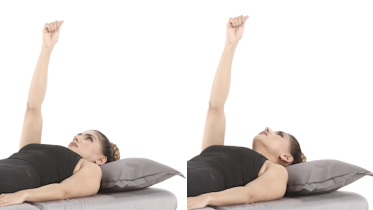
Lying gaze stabilization with head turns means lying on your back, fixing your eyes on one small target and turning your head gently from side to side while the target stays sharp. It works the reflex that keeps your vision steady when your head moves (the vestibulo-ocular reflex). Physios use it in rehab for some inner ear problems, and lying down takes balance out of the task. In the video she holds one arm straight up and watches her raised thumb.
How to do the lying gaze stabilization with head turns
- Lie on your back on a bed or firm surface with a pillow under your head, your legs out straight and your arms relaxed by your sides.
- Pick a target: a small mark on the ceiling, or your own thumb, with one arm raised straight up above your face as the video shows.
- Keep your eyes on the target and slowly turn your head a short way to one side, then back through the middle and over to the other side. Your eyes stay put while your head moves.
- Watch that the target stays clear. If it blurs or seems to jump, slow your head down until it is sharp again. Blurred or double vision that stays when your head is still is a stop sign, not part of the exercise.
- Carry on turning from side to side at an even pace for the time your physio has set, then rest with your head still until any dizziness fades.
What you should feel
Your eyes working hard to hold the target still, and perhaps a light, swimmy feeling that eases soon after your head stops moving.
Common mistakes
- Letting your eyes drift off the target as your head turns.
- Turning so fast that the target blurs.
- Turning farther than is comfortable, or lifting your head off the pillow.
- Sitting up straight away afterwards, before any dizziness has settled.
How often
Many programs begin with 30 seconds to 1 minute of head turns, working up to 1 to 2 minutes, 3 to 5 times a day. Speed goes up only while the target stays clear. It is usually one of several gaze exercises, so your total practice time each day is longer. Your physio will adjust this.
Stop and check with your physio if
- The dizziness becomes severe or stronger than your physio said to expect, you are being sick, or you feel faint. Stop, sit or lie still and get medical advice the same day before you do these exercises again. If you faint, it is no better after 10 minutes of keeping still, you suddenly lose hearing in one or both ears, or you are far more unsteady on your feet than usual, call emergency services.
- Things look double, your vision suddenly blurs or goes, your speech slurs or becomes muddled, swallowing becomes hard, your face or lips go numb, one side of your face droops or one side of your body goes weak or numb, you suddenly become so dizzy or unsteady that you fall or cannot stand or walk, your legs suddenly give way but you do not black out (a drop attack), or you get a sudden severe headache. Stop and call emergency services, even if it goes away.
- Neck pain comes on as you turn, or pain, numbness or tingling spreads into an arm.
From the clinic
Start these exercises only after a doctor or vestibular physio has found the cause of your dizziness. New dizziness, or dizziness that has changed, needs checking first.
Some dizziness is expected. Turning your head while your eyes stay fixed is meant to stir it up a little, and it should be mild and usually settle within a few minutes of stopping. Your physio will tell you how much to allow. If it takes more than about 10 minutes to settle, go slower or shorter next time and tell your physio. Severe dizziness is different: stop and follow the stop signs on this page.
If turning your head while lying down sets off a short, strong burst of spinning, stop and tell your physio before you carry on. That can be a sign of benign paroxysmal positional vertigo (BPPV), which is treated in a different way.
To get up, roll onto your side, push up to sitting slowly and wait a moment before you stand. If you have had neck surgery or have a known neck condition, check with your doctor or physio before you start, and keep the turns small. If you are pregnant and past the first three months, check with your physio before exercising flat on your back.
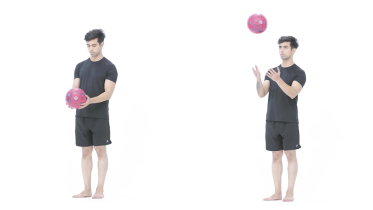
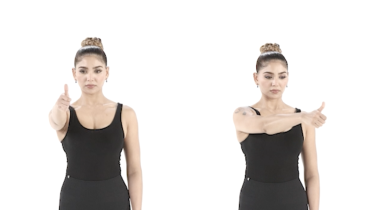
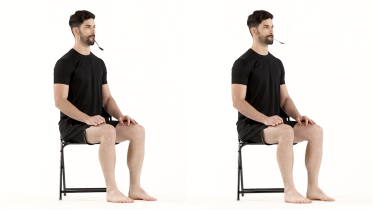
Once the target stays sharp at a steady pace, physios usually move this exercise to sitting and then standing. Balance then comes into it too. Lying gaze stabilization with head nods uses the same idea in the up and down direction, and walking with head turns is a later step some programs add.
Written and checked by the PocketPhysio editorial team. Last updated 2026-09-26.
This page is general education, not a diagnosis or a personal treatment plan. If you have pain, an injury or a health condition, see a physiotherapist or doctor before starting new exercises.