Lip pucker with a spoon
The lip pucker with a spoon is a lip strength exercise done sitting in a chair. You put the end of a clean spoon between your lips, close them firmly around it in a small pucker and hold it steady, with no help from your teeth or hands. After a few seconds you take it out and rest. The spoon gives the ring of muscle around your mouth (orbicularis oris) something to grip, and you can tell at once if the seal weakens, because the spoon droops or slips.
How to do the lip pucker with a spoon
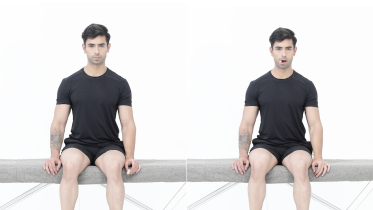
- Sit upright in a chair with your feet flat and your hands resting on your thighs. Have a clean teaspoon ready.
- Place the handle end of the spoon between your lips, not between your teeth, with the bowl pointing forward and down in front of you.
- Close your lips firmly around it, pushing them slightly forward, then let go with your hand so your lips alone hold the spoon steady.
- Hold for a few seconds, breathing through your nose, with your teeth apart and your jaw loose.
- Take the spoon out with your hand, let your lips relax for a moment, then repeat.
What you should feel
A firm squeeze around your lips, strongest at the front of your mouth. Your jaw, tongue and neck stay relaxed, and it should not hurt.
Common mistakes
- Biting the spoon, which hands the work to your teeth and jaw.
- Tipping your head back or down to stop the spoon from sliding.
- Holding your breath while your lips are working.
- Moving to a heavier spoon before a light teaspoon stays steady easily.
How often
Many programs use 5 to 10 holds of 3 to 10 seconds each, once to 3 times a day. Your physio will adjust this.
Stop and check with your physio if
- Pain in your lips, jaw or teeth, or a sore on your lip that the spoon rubs. Stop, and see your dentist, doctor or physio if it keeps happening.
- You cough, choke or splutter on saliva while the spoon is in. Take it out, sit upright and let your breathing settle. If this happens again, or swallowing is already hard for you, check with your speech and language therapist before you repeat the exercise. If you cannot breathe, speak or cough, call emergency services.
- Things look double, your vision suddenly blurs or goes, your speech slurs or becomes muddled, swallowing becomes hard, your face or lips go numb, one side of your face droops or one side of your body goes weak or numb, you suddenly become so dizzy or unsteady that you fall or cannot stand or walk, your legs suddenly give way but you do not black out (a drop attack), or you get a sudden severe headache. Stop and call emergency services, even if it goes away.
From the clinic
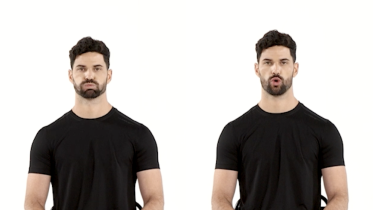
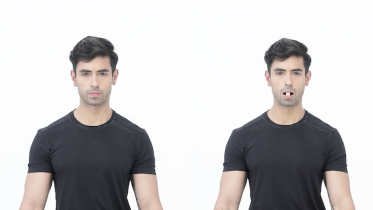
In the video the man sets the spoon in place with one hand, then rests both hands on his thighs while his lips hold it. The spoon points forward and down at an angle, with the bowl well below his chin. The voice guide describes holding it level, which takes more lip strength, so start at the angle shown and bring it closer to level only when that feels easy. If the spoon will not stay up at first, try a light plastic one, or start with the lip pucker exercise, which uses the same forward pucker with nothing to hold. The cheek puff exercise also relies on a tight lip seal, this time to keep air in.
Stay seated while the spoon is in your mouth, and use one that nobody else is sharing. If you have been told you have a swallowing problem (dysphagia), or drinks and saliva often make you cough, ask your speech and language therapist whether this exercise suits you before you try it.
This page explains the general technique, not a stroke rehab program. With a face weakened by Bell's palsy or another facial nerve problem, a specialist facial therapist should decide which lip exercises you do and how hard to work. If one side of your face is already weak from Bell's palsy or an earlier stroke, and a doctor has checked it, that known droop is not a new sign. New drooping on the other side, weakness that suddenly gets worse, and every other sign in the stop list still mean calling emergency services, even if they go away. After an operation or injury affecting your lips, mouth, jaw or teeth, check with your surgical team or dentist first.
Written and checked by the PocketPhysio editorial team. Last updated 2026-09-28.
This page is general education, not a diagnosis or a personal treatment plan. If you have pain, an injury or a health condition, see a physiotherapist or doctor before starting new exercises.