Walking with head turns
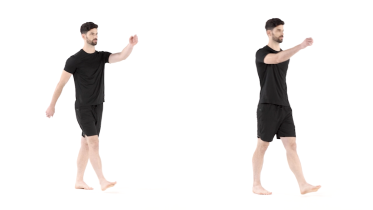
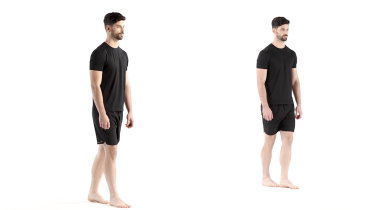
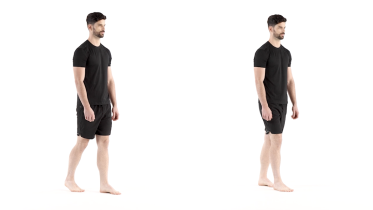
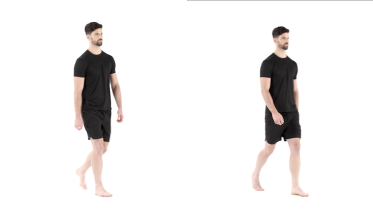
Walking with head turns means walking at a comfortable pace while you turn your head to look left and right, without stopping. When your head moves, your eyes and inner ear have to help keep you steady while your legs keep going, much as they do when you check for traffic or look for someone in a crowd. Physios often use it in balance programs. It also turns up in rehab for some inner ear problems, where your physio sets how you do it.
How to do the walking with head turns
- Choose a clear, well-lit path a few meters long beside a wall or counter, so support is always within reach.
- Start walking at your normal, comfortable pace, looking straight ahead.
- Without slowing down, turn your head smoothly to look to one side, then bring it back through the middle and over to the other side.
- Keep your body facing forward and your steps on a straight line. Only your head moves.
- Carry on turning your head from side to side at a steady rhythm until you reach the end of the path. Stop, turn around with small steps and walk back the same way.
What you should feel
More concentration than ordinary walking, and small corrections through your ankles and hips each time your head turns. Your walking may slow or drift a little at first.
Common mistakes
- Slowing down or stopping each time you turn your head.
- Turning your shoulders and trunk with your head, so you drift off your line.
- Whipping your head round quickly instead of turning it smoothly.
- Looking down at the floor between turns.
How often
Many programs begin with 2 to 4 lengths of a hallway or room, once or twice a day, with slow, steady head turns. Your physio will adjust this.
Stop and check with your physio if
- You feel dizzy, lightheaded, faint or sick, or the room seems to spin. Hold your support, sit down and get medical advice the same day before you practice again. If you faint, it does not settle within a few minutes of sitting still, your vision suddenly blurs or goes double, or you cannot stand or walk steadily, call emergency services.
- You stumble or veer off course and cannot recover without holding on.
- Turning your head brings on neck pain, or pain or tingling that spreads into an arm.
- Things look double, your vision suddenly blurs or goes, your speech slurs or becomes muddled, swallowing becomes hard, your face or lips go numb, one side of your face droops or one side of your body goes weak or numb, you suddenly become so dizzy or unsteady that you fall or cannot stand or walk, your legs suddenly give way but you do not black out (a drop attack), or you get a sudden severe headache. Stop and call emergency services, even if it goes away.
From the clinic
Practice along a corridor wall or kitchen counter, close enough that one hand could reach it straight away. The voice guide asks for this too. If you use a stick or walker for everyday walking, use it here as well, and keep the head turns small until you feel steady. If you have had a fall in the past 12 months or feel unsteady, have a helper walk beside you and ask your physio about a falls check. Clear the floor first, and wear flat shoes with a good grip.
If you have an inner ear problem, get dizzy when you move your head or are being treated for vertigo, check with your doctor or physio before you start. Exercises for inner ear problems are set for each person, and your physio may ask you to do them differently from the steps here and will tell you how much dizziness to expect. If turning your head makes you dizzy, stop, sit still until it settles, and get medical advice the same day before you try again. After neck surgery or a broken bone in the neck, check with your surgeon or physio before you start.
A sudden loss of balance is different. Call emergency services straight away for any sign of a stroke, even if it goes away: sudden dizziness with unsteadiness or falling over, a face that droops on one side, an arm you cannot lift or keep up, slurred or muddled speech, weakness or numbness on one side of your body or face, sudden blurred vision, double vision or loss of sight, or a sudden severe headache.
Once side to side turns feel easy, your physio may add looking up and down as you walk, or a slightly faster pace. Figure 8 walking is a different challenge, where the whole body changes direction instead of just the head.
Written and checked by the PocketPhysio editorial team. Last updated 2026-09-28.
This page is general education, not a diagnosis or a personal treatment plan. If you have pain, an injury or a health condition, see a physiotherapist or doctor before starting new exercises.