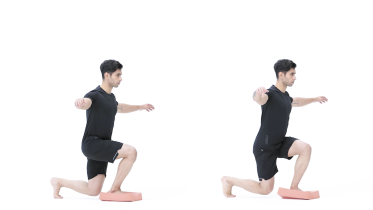
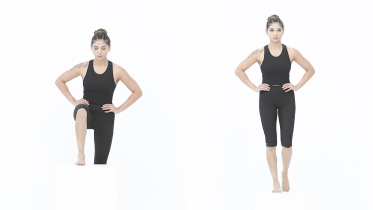
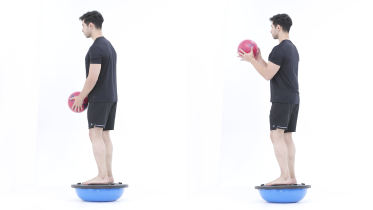
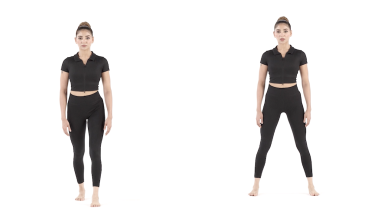
Brisk walking
Brisk walking is ordinary walking done at a quicker pace. You start slowly, then speed up bit by bit until you are breathing faster and feeling warm, but can still hold a conversation. It works the muscles at the front and back of your thighs, plus your buttocks and calves, and it raises your heart rate without the impact of running. Physios often use it as a first step back into regular activity.
How to do the brisk walking
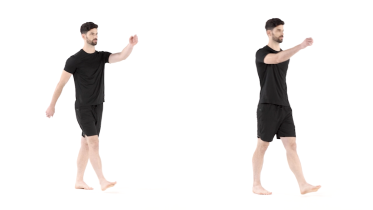
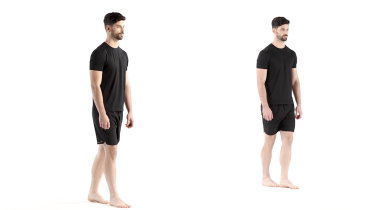
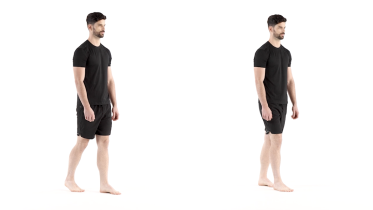
- Choose a flat, even route with good light and nothing to trip over. The man in the video walks barefoot indoors to show the movement. Wear flat shoes that fit well and grip the floor, not socks, tights or bare feet.
- Stand tall with your head up and your eyes looking ahead rather than down at your feet.
- Set off at a slow, relaxed pace for the first few minutes so your legs and breathing can warm up.
- Pick up your speed a little at a time. At a brisk pace your breathing is quicker and you feel warm, but you can still talk. You would not be able to sing.
- Let your arms swing naturally, each arm moving forward with the opposite leg, and let each foot land on the heel and roll through to the toes.
- Ease back to a slow pace for the last few minutes before you stop.
What you should feel
Your breathing and heart rate going up, and steady work through your legs from the buttocks down to the calves. It should feel like purposeful effort, not a struggle.
Common mistakes
- Speeding up straight away, before a slow warm-up.
- Walking so fast that you cannot talk, or so slowly that your breathing does not change.
- Looking down at the ground, which rounds the upper back.
- Taking very long strides to go faster, instead of quicker, natural steps.
How often
Many programs start with 10 to 20 minutes, including a few minutes of slow walking at each end, on most days of the week, adding time before adding speed. Your physio will adjust this.
Stop and check with your physio if
- Chest pain or pressure, dizziness or feeling faint, a racing or irregular heartbeat, or being far more out of breath than the effort should cause.
- You feel dizzy, lightheaded, faint or sick, or the room seems to spin. Stop, sit down and get medical advice the same day before you exercise again. If you faint, it does not settle within a few minutes of sitting still, your vision suddenly blurs or goes double, or you cannot stand or walk steadily, call emergency services.
- A sharp pain in a foot, ankle, knee or hip that changes the way you walk.
- You feel unsteady on your feet or close to falling.
- You are pregnant and notice bleeding or fluid leaking from your vagina, regular painful tightenings, tummy pain that does not settle when you rest or comes with lower back pain, or a change in your baby's usual movements, such as moving less than usual. Stop and contact your midwife or maternity unit straight away. Do the same for a severe headache, problems with your vision such as blurring or flashing lights, pain just below your ribs, or sudden swelling of your face, hands or feet, which can be signs of pre-eclampsia. Call emergency services if the bleeding is heavy, the tummy pain is severe, bleeding or tummy pain comes with pain in your shoulder or feeling sick, faint or dizzy, or a headache comes on suddenly and is very severe.
From the clinic
The voice guide keeps it simple: begin slowly, then build up to a brisk pace. How fast that is depends on you. For someone recovering from an illness or operation, brisk might be a gentle stroll with a little more purpose, and that still counts.
The WHO advises adults to do at least 150 minutes of moderate-intensity activity a week, and brisk walking is one way to get there. Short walks on most days soon add up. If you cannot get outside, marching on the spot raises your heart rate in a small space, and jogging on the spot is a harder step once walking feels easy.
If your balance is unsure, walk a route with a rail or wall along it, use your walking aid if you have one, and pick a time when the path is dry and well lit. With a heart or lung condition, high blood pressure, or after a recent operation, ask your doctor or physio how much to walk and how fast before you start. If you are pregnant, check with your midwife or physio before you start. If you have diabetes or numb feet, always walk in shoes and socks, even indoors, and check your feet for blisters or cuts afterward.
If chest pain, pressure or tightness does not ease quickly when you rest, spreads to your arm, neck, jaw, stomach or back, or comes with sweating, feeling sick, feeling light-headed or being short of breath, call emergency services straight away, as this can be a heart attack. If it eases quickly and none of these happen, get medical advice the same day, and do not exercise again until you have been checked.
Written and checked by the PocketPhysio editorial team. Last updated 2026-09-28.
This page is general education, not a diagnosis or a personal treatment plan. If you have pain, an injury or a health condition, see a physiotherapist or doctor before starting new exercises.