
Complex regional pain syndrome (CRPS): what helps, and what the evidence shows
Warning signs, and when to get help
What is complex regional pain syndrome?
It is persistent pain in one limb that is far worse and far longer lasting than the event that started it, together with changes you can see and feel in that limb.
The pain is usually burning, stabbing or throbbing. The skin often cannot bear light touch, so a sleeve, a bedsheet or a draft of cold air hurts. The limb may be warmer or colder than the other one, redder, bluer or blotchier, more swollen or sweatier, and over months the skin can look shiny and the hair and nails change. Movement is stiff and weak, and the hand or foot is often held out of the way without the person noticing.
Most cases follow an injury to the limb, often a minor one, or an operation. The NHS adds that it has been known to follow a limb being immobilized in a plaster cast, and the field's own treatment document goes further, recording limb immobilization as a possible cause or a perpetuating factor in many cases (Harden and colleagues, 2022). There are two types: type 1, where no specific nerve injury is found, and type 2, where there is a confirmed nerve injury. Type 1 is much the more common of the two, and almost all the research is in it.
You will still meet older names for this, and they are the same condition. Reflex sympathetic dystrophy is the one in widest use, and OrthoInfo's own page carries it in the title alongside Sudeck's atrophy, shoulder-hand syndrome and causalgia. If a letter or a search result uses one of those, nothing has changed except the name.
How it differs from fibromyalgia and from a sensitized nervous system
This comparison gets searched directly in every market we write for, so it is worth doing properly.
The separations are mostly simple. CRPS is regional: it sits in one limb, usually follows an injury or an operation, and brings visible changes in the limb's color, temperature, swelling or sweating that an examiner can compare against the other side. Fibromyalgia is widespread rather than regional, and it does not produce those limb changes. The same injury-then-amplification pattern that runs through CRPS also runs through central sensitization and persistent pain, and a 2024 review describes CRPS as having been classified as a chronic primary pain disorder on the strength of mechanism research (Ferraro and colleagues, 2024).
The practical difference is in what gets measured and what gets treated. A sensitized nervous system is a mechanism and not a diagnosis; CRPS is a named diagnosis with a criteria set, a trauma trigger and an examination you can repeat. Which label fits is a job for a clinician who can see both limbs side by side, and more than one of them can be true at once.
How complex regional pain syndrome is diagnosed
There is no single test. The NHS says it is usually diagnosed by ruling out conditions with similar symptoms, and that blood tests, an MRI, an X-ray and nerve conduction studies are used for that purpose rather than to confirm the diagnosis.
One part of that matters more than the label in the first weeks after a fracture or an operation. A limb that hurts far more than it should, swells, changes color and cannot bear being touched is also how a cast or a dressing that has become too tight presents, and how pressure building up inside the limb (compartment syndrome), an infection in a wound or a joint, and a blood clot present. Those get ruled out first, because each has its own treatment and its own clock and two of them are emergencies. The European standards say it plainly: diagnosing CRPS needs no test except to rule other diagnoses out, and the assessment must establish whatever triggered it (Goebel and colleagues, 2019).
So in the early weeks after surgery or a fracture, do not settle on CRPS yourself, and do not file an abnormally painful, swollen or discolored limb as the normal course of recovery either. It goes back to the team that operated or treated the fracture, and the warning list on this page says which versions of it need the same day and which need an emergency department now.
What the NHS page does not name, and what a lot of readers are searching for, is the criteria set clinicians actually use. Harden and colleagues (2010) validated the Budapest criteria in 113 people with CRPS-I and 47 people with other neuropathic pain. The clinical version of the Budapest criteria had a sensitivity of 0.99 and a specificity of 0.68; the research version had a specificity of 0.79; the older IASP criteria had a sensitivity of 1.00 and a specificity of 0.41. Their own framing was that the IASP criteria had low specificity and risked overdiagnosis.
That is useful in a practical way. If you have been given this diagnosis, or refused it, you can reasonably ask which criteria were applied and what was found on examination, because the two sets do not agree with each other on who has the condition.
Two documents set out what good care looks like. A European Pain Federation task force produced 17 mandatory standards across 8 areas of care, of which 2 concern diagnosis and 3 concern physical rehabilitation, and the same paper reports areas where no agreement on a standard could be reached (Goebel and colleagues, 2019). The field's working treatment document is in its 5th edition and runs to 53 pages (Harden and colleagues, 2022). Its authors describe what they found as generally low to medium quality research with small numbers of subjects, and say that larger trials have failed, probably because the broad Budapest criteria gather together a condition with several mechanisms.
Both full texts were read for this page, so what they ask for is on it rather than withheld. The European standards are written as must-do statements, and three of them belong to physiotherapy: your limb function, your overall function and what you can take part in at home, at work or at school must be assessed early and again as things change; you must have access to rehabilitation from a physiotherapist or an occupational therapist as early as possible in the pathway; and those therapists must have access to training in pain rehabilitation and in CRPS rehabilitation specifically. A fourth standard, which sits in the section on referral rather than the one on rehabilitation, is the most useful line here for anyone already in treatment: referral to specialized care must be started if your pain is not clearly reducing and your function not clearly improving within 2 months of starting treatment, when you have been doing the rehabilitation (Goebel and colleagues, 2019).
The three stages, and the study that found against them
If you have read about CRPS already, you have probably met a three-stage model. OrthoInfo sets it out as stage I, acute, up to 3 months; stage II, dystrophic, 3 to 12 months; and stage III, atrophic, after a year, and attaches a poorer outlook for regaining movement to the third. That page carries no reference list.
The model has been tested, and it did not survive. Bruehl and colleagues (2002) ran a cluster analysis on 113 patients who met the IASP criteria. Three statistically distinct subgroups came out, but the subgroups did not differ significantly in how long people had had pain, which is the first thing a sequential staging model predicts. The authors concluded that their results argue against three sequential stages, and what they had found were subtypes rather than stages.
The field's own treatment document agrees. It calls the existence of sequential stages clinical lore and an unsubstantiated theory based on certain authors' clinical experience rather than on study, and cites the same cluster analyses (Harden and colleagues, 2022).
So the stage numbers are a description that got repeated, not a timetable. This page does not pass on the stage III outlook as a prediction about you, because the model that generates the prediction does not hold up. If a report you have been given uses a stage number, it is reasonable to ask what it is based on.
What the rehabilitation evidence actually shows
This is the part most pages skip, and it is the most useful thing a physiotherapy site can tell you.
Cochrane has reviewed this twice. Smart, Ferraro, Wand and O'Connell (2022) included 34 randomized trials and 1,339 participants across physical rehabilitation, electrotherapy, cortically directed rehabilitation, electroacupuncture and exposure-based approaches. Twenty-seven of the 34 trials were at high risk of bias overall and the other seven at unclear risk. Their conclusion was that it remains very uncertain what physiotherapy interventions do to pain and to disability in CRPS, and that this matched what the same team had concluded in 2016. Every comparison where evidence existed was graded very low certainty.
The second Cochrane document looked across all treatments rather than physiotherapy alone. Ferraro and colleagues (2023) reviewed 5 Cochrane and 12 non-Cochrane reviews and found no high-certainty evidence for the effectiveness of any therapy for CRPS. They also warned that current non-Cochrane reviews of CRPS treatments are of low methodological quality and should not be relied on for an accurate summary of the evidence, which is a direct caution about a great deal of what ranks well in a search.
A few specifics from that overview are worth having. There was low-certainty evidence that bisphosphonates may reduce pain, with moderate-certainty evidence that they probably increase adverse events of any kind (risk ratio 2.10, 95 percent confidence interval 1.27 to 3.47, number needed to harm 4.6, across 4 trials and 181 participants). There was moderate-certainty evidence that lidocaine local anesthetic sympathetic blockade probably does not reduce pain intensity compared with placebo. And the review identified no randomized trial evidence at all for tricyclic antidepressants or for opioids in CRPS, both of which appear on the NHS treatment page.
NICE has no CRPS guideline. Its chronic pain guideline, for people aged 16 and over, recommends offering a supervised group exercise program and encouraging people to stay physically active for longer-term general health, and advises against offering biofeedback, all for chronic primary pain rather than for CRPS specifically (NG193, 2021). Whether CRPS belongs in that category is a classification question rather than a settled one, so the recommendations are quoted here for what they are.
Two of the sources on this page point the other way, and that is worth saying out loud rather than leaving you to notice it. OrthoInfo recommends injecting an anesthetic near the sympathetic nerves early in the course of CRPS, to avoid progression to the later stages, and lists biofeedback among the treatments. The injection claim does not survive the rest of the evidence. Cochrane 2023 found moderate-certainty evidence that lidocaine sympathetic blockade probably does not reduce pain intensity compared with placebo. The field's own treatment document says these blocks lack high quality evidence, calls their role largely empiric and says they are currently out of favor, while noting that a subset of people do respond and that a block can open a less painful window for rehabilitation (Harden and colleagues, 2022). And the reason given for going early, preventing progression to a later stage, rests on the staging model that did not survive cluster analysis.
Biofeedback is unsettled rather than wrong. The same treatment document recommends relaxation training, preferably alongside thermal or muscle-tension biofeedback, and elsewhere in the same chapter states that there are no well-controlled trials of traditional biofeedback in CRPS. NICE advises against it for chronic primary pain. So this page makes no claim about it either way, and both of these belong in a conversation with a pain service rather than in a program.
None of that means nothing helps. It means the honest claim is modest, and anyone promising you a protocol with good evidence behind it is overstating what exists.
Moving the affected limb, and why this page gives no set for it
The single most searched thing on this topic is a printable list of exercises for a named limb: a hand set, a foot set, a leg set, as a PDF. This page does not have one, and the reason is worth stating rather than hiding.
The direction of travel is clear and the sources agree on it. The NHS self-management advice includes support to stay active and to use the affected body part, and its aim for physical rehabilitation is to let you gradually increase your activities and function without making the pain worse. OrthoInfo goes further, calling active exercise that emphasizes normal use of the limb essential to permanent relief. So this is not a condition that gets better by being protected.
The dose is the problem, and it is not a problem a range of repetitions can solve. The NHS says that too much or too vigorous exercise can aggravate the condition, and that your therapy needs the support of a therapist with experience of CRPS. It also names the difficulty plainly: in CRPS, any movement or stimulation of the limb will increase the pain or the other symptoms, including swelling, color changes and sweating. Working out which increase is acceptable and which is a flare takes someone who can see and feel the limb week to week.
And this page cannot know which limb you have. A set containing wall push-ups harms a reader whose CRPS is in the hand. A set containing brisk walking harms a reader whose CRPS is in the foot. That is not a dosing problem, it is not knowing what the sentence is about.
What that looks like in practice. Once a clinician has examined your limb, chosen the movements and set the amount, the gentle active movements they are most likely to start with for a hand or wrist are opening and closing the hands, tendon glides and wrist flexion and extension, and for a foot or ankle, ankle pumps, ankle circles and active ankle inversion. Those pages carry their own doses, and on this condition the number on the page is a starting point for a conversation rather than an instruction. Do not start any of them on the strength of this page alone.
One thing before the program itself. The warning list at the foot of this page comes first, and the link under the summary at the top goes straight to it: if a line on it applies to you, that is the next step and not the stage below. That list is also where the line about thoughts of suicide or of harming yourself sits, because pain at this level does that to people, and it needs help the same day rather than an exercise.
The exercise program
The exercises below carry their own stop signs and precautions. Open the line under an exercise and read them before you try it.
Stage 1: A dose you could repeat tomorrow, with nothing that touches the painful limb
These three cost nothing in pain, which is what makes them worth having on the days when everything else is out of reach. They will not take the pain away, and nobody should tell you otherwise. What they are is the relaxation half of the pain management the field's own treatment document asks for, supported in CRPS by case series and by trials in other long-term pain conditions. Be clear about how thin that is. The same document records that adequate randomized trials of psychological treatment in CRPS are not available to guide this part of care, and the one small randomized trial it cites, 18 people given home physiotherapy with or without weekly autogenic relaxation training, found pain, movement and swelling improved about equally in both groups (Harden and colleagues, 2022). Slow breathing suits about 5 to 10 slow breaths, or a few minutes, 1 to 3 times a day; breathing control is often done as 2 to 5 minutes or 10 to 20 slow breaths at bedtime or whenever you notice yourself bracing; the body scan takes a few minutes once or twice a day. Movement of the affected limb is not something that comes after this stage, and it is not something to start from a web page: it usually begins early, and it is set up and progressed by a clinician who has examined the limb. One thing to know before you follow the steps: all three tell you where to put your hands or your feet, and the breathing one asks for both hands on your stomach. Those placements are for the limb that does not hurt. Put the painful hand or foot where it touches nothing, or leave it out of the position altogether, because not one of these three needs it. Your physio will adjust all of this.
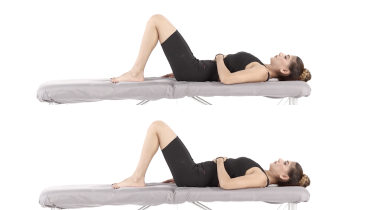 Diaphragmatic breathing
Stop signs and precautions for the diaphragmatic breathing
Before you start
- If lying flat makes you more short of breath, do not lie flat for this. Sit upright in a chair or prop yourself on pillows instead, which works just as well for learning the pattern. Being short of breath when you lie down, waking at night needing to sit up to breathe, more swelling in your ankles or legs, or gaining weight quickly over a few days are all reasons to get medical advice the same day rather than to practice through, because the NHS lists breathlessness when lying down among the reasons to get urgent advice.
- If you are pregnant and past the first three months, check with your physio before exercising flat on your back.
When to stop and get help
- Your fingers or the skin around your mouth start to tingle, or you feel light-headed or spaced out. This can mean you are breathing too fast or too deeply, so stop and let your breathing go back to normal. If it has not settled within a few minutes, get medical advice the same day. If you faint, or the numbness or tingling is on one side of your face or body, call emergency services, even if it goes away.
- You suddenly become short of breath, your chest feels tight or heavy, or you are far more short of breath than usual. Stop, rest and use your breathing control. Call emergency services if the breathlessness came on suddenly, your chest feels tight or heavy, your breathing does not go back to normal, you are gasping, choking or cannot get your words out, you have pain that spreads to your arms, back, neck or jaw, you feel suddenly confused or very drowsy, or your lips or skin turn very pale, blue or gray (on brown or black skin this can be easier to see on the palms of the hands). If everything settles quickly, get medical advice the same day before you do these exercises again.
- Chest pain or pressure, dizziness or feeling faint, a racing or irregular heartbeat, or being far more out of breath than the effort should cause.
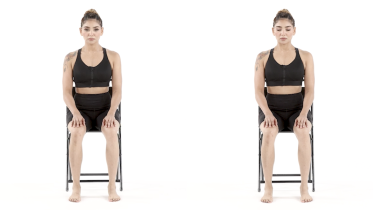 Body scan relaxation
Stop signs and precautions for the body scan relaxation
When to stop and get help
- Your fingers or the skin around your mouth start to tingle, or you feel light-headed or spaced out. This can mean you are breathing too fast or too deeply, so stop and let your breathing go back to normal. If it has not settled within a few minutes, get medical advice the same day. If you faint, or the numbness or tingling is on one side of your face or body, call emergency services, even if it goes away.
- You feel faint, dizzy or unwell. Open your eyes, stay seated and get medical advice if it does not pass quickly. If you faint while exercising, call emergency services, even if you feel fine again quickly.
- Upsetting thoughts, memories or feelings come up and keep building. Open your eyes, look around the room and stop for now, and talk to your doctor or therapist if it keeps happening.
- Chest pain or pressure, dizziness or feeling faint, a racing or irregular heartbeat, or being far more out of breath than the effort should cause.
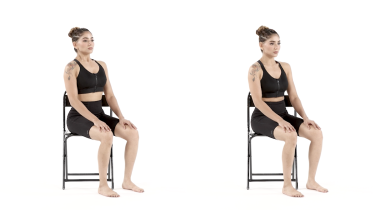 Breathing control
Stop signs and precautions for the breathing control
Before you start
- If you are pregnant and past the first three months, check with your physio before exercising flat on your back.
When to stop and get help
- Your fingers or the skin around your mouth start to tingle, or you feel light-headed or spaced out. This can mean you are breathing too fast or too deeply, so stop and let your breathing go back to normal. If it has not settled within a few minutes, get medical advice the same day. If you faint, or the numbness or tingling is on one side of your face or body, call emergency services, even if it goes away.
- You suddenly become short of breath, your chest feels tight or heavy, or you are far more short of breath than usual. Stop, rest and use your breathing control. Call emergency services if the breathlessness came on suddenly, your chest feels tight or heavy, your breathing does not go back to normal, you are gasping, choking or cannot get your words out, you have pain that spreads to your arms, back, neck or jaw, you feel suddenly confused or very drowsy, or your lips or skin turn very pale, blue or gray (on brown or black skin this can be easier to see on the palms of the hands). If everything settles quickly, get medical advice the same day before you do these exercises again.
Stage 2: Whole-body activity, which is only limb-neutral if your CRPS is in an arm or hand
Read the gate before the list. Walking, marching and bridging all put load through the feet and legs, so if your CRPS is in a foot, ankle, knee or leg, none of this is neutral ground and all of it belongs to your own physio to set rather than to this page. Stage 1 stays open to you whichever limb is affected, so a gate here is not a reason to stop moving. If your CRPS is in a hand, wrist or arm, these three are a reasonable way to keep the rest of you moving while the limb is handled separately. Practice at standing up from a chair is deliberately not among them, which surprises people, because the version in our library has you push down through both armrests to rise. Asking a painful hand to take your body weight is the opposite of limb-neutral, and the hands-free version is no better, since it asks you to hold both arms out in front. How you get in and out of a chair is worth going through with your own physio rather than rehearsing from here. In the bridge, let the painful hand lie where it is comfortable rather than pressing it into the floor. Many programs start walking at 10 to 20 minutes on most days, adding time before speed, with marching at 30 seconds to 1 minute or 10 to 20 lifts on each leg repeated 2 to 3 times, and the bridge at 2 to 3 sets of 10 to 12. Build in steps small enough that you could repeat the same thing tomorrow, and your physio will adjust the numbers.
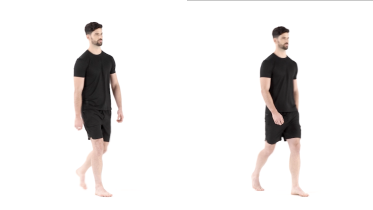 Brisk walking
Stop signs and precautions for the brisk walking
Before you start
- With a heart or lung condition, high blood pressure, or after a recent operation, ask your doctor or physio how much to walk and how fast before you start. If you are pregnant, check with your midwife or physio before you start.
When to stop and get help
- Chest pain or pressure, dizziness or feeling faint, a racing or irregular heartbeat, or being far more out of breath than the effort should cause.
- You feel dizzy, lightheaded, faint or sick, or the room seems to spin. Stop, sit down and get medical advice the same day before you exercise again. If you faint, it does not settle within a few minutes of sitting still, your vision suddenly blurs or goes double, or you cannot stand or walk steadily, call emergency services.
- A sharp pain in a foot, ankle, knee or hip that changes the way you walk.
- Aching, cramping or tightness in a calf, thigh or buttock that comes on at about the same walking distance every time and clears within a few minutes of standing still, and a doctor has not checked it yet. Keep the walk gentle and book an appointment with your doctor before you build up any further, as narrowed arteries in the legs (peripheral arterial disease) can cause this and are managed differently. If leg pain carries on while you are resting or in bed, or wakes you at night, get medical advice the same day. If a foot or leg suddenly turns cold, pale or blue, or suddenly becomes very painful, numb or weak, call emergency services and do not drive yourself, because the blood supply to the leg may be blocked and a leg that has gone numb or weak with it can be impossible to save if it is not treated within about six hours.
- Your calf or thigh becomes swollen, warm, tender, red or darker than usual, or has a throbbing or cramping pain that feels different from normal muscle ache. Stop and get medical advice the same day, as this can be a blood clot. If you are also short of breath or have chest pain, call emergency services.
- You feel unsteady on your feet or close to falling.
- You are pregnant and notice bleeding or fluid leaking from your vagina, regular painful tightenings, tummy pain that does not settle when you rest or comes with lower back pain, or a change in your baby's usual movements, such as moving less than usual. Stop and contact your midwife or maternity unit straight away. Do the same for a severe headache, problems with your vision such as blurring or flashing lights, pain just below your ribs, or sudden swelling of your face, hands or feet, which can be signs of pre-eclampsia. Call emergency services if the bleeding is heavy, the tummy pain is severe, bleeding or tummy pain comes with pain in your shoulder or feeling sick, faint or dizzy, or a headache comes on suddenly and is very severe.
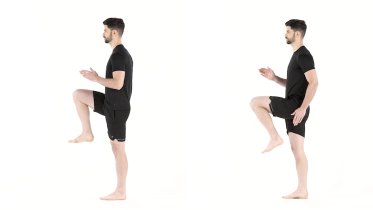 Marching on the spot
Stop signs and precautions for the marching on the spot
Before you start
- If you have had a hip replacement, get the go-ahead from your surgeon or physio before you try marching on the spot. A high knee lift can bend the hip past a right angle, and many surgeons ask you to avoid that for the first months after some operations.
When to stop and get help
- You feel dizzy, lightheaded, faint or sick, or the room seems to spin. Hold your support, sit down and get medical advice the same day before you practice again. If you faint, it does not settle within a few minutes of sitting still, your vision suddenly blurs or goes double, or you cannot stand or walk steadily, call emergency services.
- You feel unsteady or close to falling.
- Sharp pain in the hip, knee or lower back.
- Chest pain or pressure, dizziness or feeling faint, a racing or irregular heartbeat, or being far more out of breath than the effort should cause.
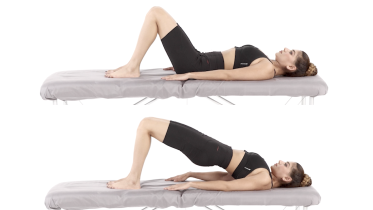 Glute bridge
Stop signs and precautions for the glute bridge
Before you start
- After hip, knee or back surgery, your surgeon's protocol decides when you can start bridges. Once you are past the first three months of pregnancy, check with your physio before exercising flat on your back.
- A bridge needs the knee bent to about 90 degrees before you lift, so if you have had knee surgery and been given a limit on how far the knee may bend, leave this one out and ask your surgeon or physio whether the bend it needs is allowed yet.
When to stop and get help
- You feel back pain rather than buttock work, even when you lift a little lower.
- Pain spreads down the leg or you get numbness or tingling.
- Your hamstrings (the back of the thighs) cramp. This is a common complaint with bridges, and bringing your feet a little closer to your bottom often eases it.
- Pain in the knee itself, or a knee that swells or is clearly more painful the next morning. The position holds the knee bent throughout, so after knee surgery stop and check with your surgeon or physio before you try it again.
Desensitization, mirror visual feedback and graded motor imagery
You will have heard of these three, and the NHS treatment page names all of them, so here is what each one is.
Desensitization means teaching the skin to tolerate touch again, by making contact with textures and temperatures the limb can currently bear and working toward ones it cannot. Mirror visual feedback uses a mirror so that the reflection of the good limb appears where the painful one is, giving the brain a normal-looking limb moving without pain. Graded motor imagery is a staged program that usually begins with recognizing left and right images of the limb, moves on to imagining movements, and then to mirror work. The NHS describes the aim of the mirror and imagery approaches as retraining the brain for missing or confused information, and makes no claim about how well they work.
This page gives no protocol, dose or progression for any of the three, for three reasons. Cochrane 2022 graded the certainty of the evidence for cortically directed rehabilitation as very low. There is no page for any of these techniques anywhere in our exercise library, so there is nothing here to send you to. And the home doses visible in the wild range from as often as a person wishes, through three times every waking hour, to ten minutes five or six times a day, which is a spread of more than an order of magnitude with nothing to choose between the ends of it. A number picked out of that range and printed here would be a guess wearing the clothes of advice.
If you want to try them, they are reasonable things to ask your pain service or physiotherapist about, and they are set up by someone who can watch what the limb does.
Vitamin C after a wrist fracture: prevention, not treatment
This comes up constantly, in every market, so it needs its own section and a careful one.
Three randomized placebo-controlled trials were pooled across 875 patients. In the group taking 500 mg of vitamin C daily for 50 days, the risk ratio for CRPS-I was 0.54 (95 percent confidence interval 0.33 to 0.91), with heterogeneity of 65 percent that did not reach significance (Aïm and colleagues, 2017).
Which three trials those are matters more than the pooled number, so here they are. Two come from one Dutch group. Zollinger and colleagues 1999 randomized 123 adults with 127 wrist fractures and found CRPS in 4 of 54 wrists on vitamin C against 14 of 65 on placebo. Zollinger and colleagues 2007 randomized 416 patients with 427 wrist fractures and found 2.4 percent on vitamin C against 10.1 percent on placebo, with the 500 mg group at 1.8 percent.
The third trial is independent of that group and found nothing. Ekrol and colleagues (2014) randomized 336 adults in Edinburgh to the same 500 mg daily for 50 days, and reported no effect on function at any point in the study, no difference in the rate of CRPS at any time point except a higher rate in the vitamin C group at 6 weeks among those with an undisplaced fracture, and more complications and more pain with use at 26 weeks among those with a displaced fracture. Its authors concluded that vitamin C confers no benefit to patients with a displaced or undisplaced wrist fracture. So the pooled benefit comes from the two trials by one group, and the one independent replication did not find it. The field's own treatment document weighs up the same trials and puts it in one line: the potential utility of vitamin C in the prevention of CRPS remains unproven (Harden and colleagues, 2022).
Now the figure that puts those in context. A population register study followed 247,128 distal radius fractures in 203,533 patients in Denmark between 1998 and 2017 and found 493 cases of CRPS within a year, a one-year incidence proportion of 0.20 percent, which its authors describe as a minimum because undiagnosed cases are missed (Melbye and colleagues, 2026). The placebo arm of the 2007 trial developed CRPS at 10.1 percent. That is roughly a fiftyfold difference in starting risk between a trial population scored clinically and a whole country counted from diagnosis codes.
Three things follow, and they are the whole point of the section. The same relative reduction means very different things at 10 percent and at 0.2 percent, so this page will not turn the risk ratio into a number for your own chance. The evidence is about preventing CRPS after a wrist fracture, and no trial above tested vitamin C as a treatment for CRPS that has already developed. And whether to take it after a fracture is a question for the team looking after that fracture, who know the dose, the duration and whether it suits you.
How long does it last, and what are the chances?
The two sets of figures available point in different directions, and both deserve to be on the page.
The NHS estimates that around 85 percent of people with CRPS see their pain and some of their other symptoms ease slowly across the first 2 years. That sentence sits on a page last reviewed on 27 October 2022 and carries no citation, no reference list and no named author, so it belongs here as what the NHS tells patients rather than as a research finding.
The prospective studies that do show their own data are less encouraging. Bean and colleagues (2016) followed 59 people in Auckland who had had CRPS-1 for under 12 weeks. Over a year, almost all signs and symptoms improved significantly, with most of the gain in the first 6 months and then a plateau. At 12 months, nearly two thirds still met the IASP-Orlando criteria, a quarter met the Budapest research criteria, and only 5.4 percent were symptom-free. The authors noted their results were less optimistic than several earlier prospective studies.
An earlier systematic review by the same group covered 18 studies and 3,991 participants: its three prospective studies found marked improvement within 6 to 13 months, twelve retrospective studies documented lasting impairment, stiffness and weakness were the symptoms most likely to persist, and its own quality assessment found significant limitations in the literature, with many studies using different diagnostic criteria (Bean and colleagues, 2014). An 8-year follow-up of 45 of the original 66 in the New Zealand cohort found that anxiety, pain and disability at the start predicted how people were doing that far out (Cave and colleagues, 2023).
Most of the gap between 85 percent and 5.4 percent is not a contradiction. A reduction in pain and being free of symptoms are different outcomes, measured differently. The useful summary is that improvement is common, that most of it tends to come in the first 6 months, that complete resolution is less common than the round numbers suggest, and that none of these figures is a prediction about any one person.
Mood, sleep and asking for help
Pain this severe affects sleep, mood and what a person can do, and the NHS CRPS pages say so directly, including that some people have thoughts of suicide. That is on this page because it is true and because a page about exercise should not walk past it.
If that is where you are, the line on this page's warning list is the one to use, and it is not an exercise. Thoughts of suicide or of harming yourself need urgent help the same day, from your doctor or NHS 111 in the UK, and Samaritans can be reached on 116 123. If you have harmed yourself or feel you may be about to, that is an emergency services call or an emergency department, now.
Beyond the crisis routes, the ordinary support is worth asking for. Specialist pain services exist in all of our markets and usually include psychological support as a standard part of care rather than as a judgment about whether the pain is real. OrthoInfo makes the point from the clinician's side: it matters that doctors do not tell people with this condition that the pain is in their heads.
Children and teenagers
Nothing on this page is written for a child. Both Cochrane reviews are of adults, and the NICE recommendations quoted above apply to people aged 16 years and over, so if you are reading this for a child, take the question to the child's own doctor or pain service rather than to this page.
When to see a physio or doctor
If a limb is getting more painful rather than less after an injury, an operation, a cast or a boot, and the skin has become sensitive to light touch or the limb has changed color, temperature, swelling or sweating, see your doctor or physio as soon as you can, within a few days at most. That is the instruction on dozens of pages across this site and this is where it leads. Early treatment may help, and the first appointment is about getting the diagnosis named and a rehabilitation plan started.
If you already have the diagnosis, the reasons to get back in touch are a flare you cannot settle, loss of movement you had regained, a limb that is becoming harder to use rather than easier, or a program that is making things worse rather than slowly better. The European standards put a number on one of those: when your pain is not clearly reducing and your function not clearly improving within 2 months of starting treatment, and you have been doing the rehabilitation, referral on to specialized care is meant to start (Goebel and colleagues, 2019). Any of the warning signs on this page needs its own route rather than waiting for your next appointment.
Decisions about spinal cord stimulation, sympathetic blocks, bisphosphonates, ketamine and opioids belong to a specialist pain service, and this page carries no timeline or opinion on them. If your CRPS followed a fracture or an operation, tell the team that treated it as well as your doctor or pain service. They are the ones who can check the operated part itself, the metalwork or the implant, the wound and the healing of the bone, and they hold the plan for how much that part is allowed to do, which this page cannot know. Being referred to a pain service does not take you off their list. The relevant rehabilitation page on this site is the one for that injury: for example wrist fracture rehab, scaphoid fracture rehab, ankle fracture rehab, Achilles tendon rupture or knee stiffness after surgery. Follow the program from that team rather than this page for the operated part. If the picture is numbness, burning and weakness in a pattern that follows nerves rather than one limb, read peripheral neuropathy as well, and wrist sprain covers the minor injury that most often precedes a hand presentation.
Two more surgical questions come up often enough to answer here. The first is another operation on a limb that already has CRPS. That is a decision to make with your surgeon and a pain specialist together, before it is booked rather than after, and the evidence we can point to does not settle how often operating on an affected limb sets the condition off again, so this page gives no figure and no rule. What it does say is that both teams need to know about the CRPS while the operation is still being discussed, because the anesthetic, the pain plan and the rehabilitation afterward are all things that get set up differently when it is on the record.
The second is going back into a cast, a splint or a boot. The field's own treatment document records limb immobilization as a possible cause or a perpetuating factor in many cases of CRPS, and cites an experiment in which 30 healthy volunteers wore an arm cast for 28 days and came out of it with cold sensitivity and a temperature difference between their two limbs for the first days afterward, and a longer lasting fall in the pressure at which touch became painful (Harden and colleagues, 2022). That is not a reason to refuse support a surgeon says the bone or the repair needs. It is a reason for whoever decides it to decide it knowing you have CRPS, and to be asked how little of the limb has to be held still and for how long.
For physiotherapists
The two things this page is built to do are to state the certainty of the evidence accurately and to refuse a limb-specific home program to an unsupervised reader. Both are deliberate. Cochrane 2022 found the evidence very uncertain across 34 trials, and Cochrane 2023 found no high-certainty evidence for any therapy. Those two set the ceiling on what can honestly be claimed, and the NHS statement about too much or too vigorous exercise is the reason the limb work is gated on a clinician rather than dosed here.
Three practical notes. The Budapest criteria's specificity of 0.68 clinically and 0.79 for research (Harden and colleagues, 2010) is worth keeping in mind when a label arrives from elsewhere. The staging model still in wide circulation did not survive cluster analysis (Bruehl and colleagues, 2002), so staging language in a referral letter is worth unpacking rather than repeating. And on prognosis, the first 6 months carry most of the measured change in the Auckland cohort, with anxiety, pain and disability at baseline predicting outcomes at 8 years (Bean and colleagues, 2016; Cave and colleagues, 2023), which is an argument for getting psychological support involved early rather than when rehabilitation stalls.
Warning signs
Get emergency help now
- Emergency: if chest pain, pressure or tightness does not ease quickly when you rest, spreads to your arm, neck, jaw, stomach or back, or comes with sweating, feeling sick, feeling light-headed or being short of breath, call emergency services straight away, as this can be a heart attack. If it eases quickly and none of these happen, get medical advice the same day, and do not exercise again until you have been checked.
- Emergency: any sign of a stroke, even if it goes away. That means a face that droops on one side, an arm you cannot lift or keep up, slurred or muddled speech, weakness or numbness on one side of your body or face, sudden blurred vision, double vision or loss of sight, trouble swallowing, sudden dizziness with unsteadiness or falling over, a sudden severe headache, or a sudden fall where your legs give way but you do not black out (a drop attack). Call emergency services straight away.
- Emergency: sudden, severe pain in your forearm or hand that is much worse than you would expect and keeps getting worse, especially in the first days after the break, after an operation on the arm, or with a cast, splint or tight bandage on the arm. It may come with a tight, swollen forearm, pain that gets much worse when your fingers are gently straightened, numbness, pins and needles or weakness, or pain that keeps building and is not settled by painkillers that were working before. Call emergency services or go to an emergency department straight away, and do not drive yourself. This can be acute compartment syndrome, which needs urgent surgery.
- Emergency: sudden, severe pain in your lower leg that is much worse than you would expect, especially after an injury, after an operation on the leg, or with a plaster cast or tight bandage on the leg. It may come with a tight, swollen leg, pain that gets worse when the muscle is stretched, numbness, pins and needles or weakness, or pain that keeps building and is not settled by painkillers that were working before. Call emergency services or go to an emergency department straight away, and do not drive yourself. This can be acute compartment syndrome, which needs urgent surgery.
- Emergency: while you are in a cast or splint, your fingers turn blue, white or pale, or feel cold. Do not wait to see if raising your hand helps. Go to an emergency department straight away, and do not drive yourself. The cast or splint may be cutting off the blood supply, or pressure may be building up inside the forearm (compartment syndrome), and both need checking quickly.
- Emergency: while you are in a cast or boot, your toes turn blue, white or pale, or feel cold. Do not wait to see if raising your leg helps. Go to an emergency department straight away, and do not drive yourself. The cast or boot may be cutting off the blood supply, or pressure may be building up inside the leg (compartment syndrome), and both need checking quickly.
Get help now, day or night
- In a cast or splint, the pain gets worse, your fingers feel numb or tingle or look more swollen, or the cast feels too tight. Stop, rest your hand at about the level of your heart, keep moving your fingers and contact your fracture clinic or get medical advice straight away. Do not lift the hand higher than your heart and do not put ice on it, because if pressure is building up inside the forearm both of those cut down the blood reaching it. If you cannot move your fingers, the pain is severe even after painkillers, or the numbness, tingling or swelling has not settled within 30 minutes, go to your fracture clinic or an emergency department straight away, and do not drive yourself.
- In a cast or boot, the pain gets worse, your toes feel numb, tingle or burn or look more swollen, or the cast or boot feels too tight. Stop, raise your foot to about hip level and no higher, keep moving your toes and contact your fracture clinic or get medical advice straight away. If you wear a boot, loosen the straps but keep it on. Do not prop the foot higher than that and do not put ice on it, because if pressure is building up inside the lower leg both of those cut down the blood reaching your foot. If you cannot move your toes, the pain is severe even after painkillers, or the numbness, tingling, burning or swelling has not settled within 30 minutes of raising your foot, go to your fracture clinic or an emergency department straight away, and do not drive yourself.
Get help today
- Same day: thoughts of suicide or of harming yourself, even if you do not plan to act on them. Get urgent help the same day from your GP or NHS 111 in the UK, and you can also talk to Samaritans on 116 123. If you have harmed yourself or feel you may be about to, call emergency services or go to an emergency department straight away.
- Same day: sudden severe pain in a joint, usually in just one joint, a joint that is hot, swollen or red or whose skin has changed color, a joint that has swollen up over hours or a day or two, a joint you cannot move or put weight on, or joint pain with a high temperature or feeling hot, cold, shivery or generally unwell. Any one of those is enough on its own. Get medical advice the same day, and go to an emergency department if you feel very unwell. This can be a sign of infection in the joint, which needs treatment quickly, and the NHS says that not everyone who has it runs a temperature, so a normal temperature is not an all clear. It counts for more if you have rheumatoid arthritis, diabetes or a weakened immune system, if the joint has been replaced or operated on, or if you inject drugs, because all of those make a joint infection more likely.
- Same day: a calf or thigh that is newly swollen or getting more swollen, warm, tender, red or darker than usual, has swollen veins that are sore to touch, or has a throbbing or cramping pain that does not fit your injury or condition, or that feels different from normal muscle soreness after exercise. This can be a sign of a blood clot (deep vein thrombosis), especially after surgery, an injury, time in a cast or boot, a long trip or a spell of being much less mobile than usual. Get medical advice the same day. If you are also short of breath or have chest pain, call emergency services.
- Same day: your pain is severe and came on suddenly, it is getting worse quickly rather than climbing slowly, or new or worsening pain comes with a high temperature or feeling hot, cold or shivery. Any of those counts in a place that has hurt before as much as in a new one. Get medical advice the same day rather than waiting to find out whether it behaves like a flare.
- Same day: a leg or foot that is getting weaker, for example your foot drags, catches on the ground or slaps down when you walk (foot drop). Get medical advice the same day. If the weakness is getting worse by the hour, go to an emergency department.
- Same day: dizziness or feeling faint during or after exercise, without any of the emergency signs above. Stop the exercises and get medical advice the same day. If you faint, it does not settle within a few minutes of sitting still, or you cannot stand or walk steadily, call emergency services.
- Same day: your fingers or the skin around your mouth start to tingle, or you feel light-headed or spaced out. This can mean you are breathing too fast or too deeply, so stop and let your breathing go back to normal. If it has not settled within a few minutes, get medical advice the same day. If you faint, or the numbness or tingling is on one side of your face or body, call emergency services, even if it goes away.
- Same day: pain in one area at night that is constant, that no rest or change of position eases at all, and that keeps getting worse. If you are being treated for cancer now, contact your cancer team the same day.
- Same day: pain in one area at night that is constant, that no rest or change of position eases at all, and that keeps getting worse. If you have had cancer, now or in the past, or you have lost weight without trying, get medical advice the same day. This applies even if the pain is not getting worse.
Book an appointment
- Since the injury, an operation on your arm, or time in a cast or splint, the hand or arm is getting more painful rather than less, often with a burning pain that feels far worse than the injury or operation would explain, the skin becomes very sensitive to light touch, sleeves, bedclothes or a change in temperature, or the hand changes color, temperature, swelling or sweating compared with the other one, or looks shiny. See your doctor or physio as soon as you can, within a few days at most, as this can be complex regional pain syndrome (CRPS) and early treatment may help.
- Since the injury, an operation on your foot, ankle or leg, or time in a cast or boot, the foot or ankle is getting more painful rather than less, often with a burning pain that feels far worse than the injury or operation would explain, the skin becomes very sensitive to light touch, socks, bedclothes or a change in temperature, or the foot changes color, temperature, swelling or sweating compared with the other one, or looks shiny. See your doctor or physio as soon as you can, within a few days at most, as this can be complex regional pain syndrome (CRPS) and early treatment may help.
- Within a few days: since your operation, your injury, or time in a cast or brace, the knee or lower leg is getting more painful rather than less, often with a burning pain that feels far worse than the operation would explain, the skin becomes very sensitive to light touch, bedclothes or a change in temperature, or the leg changes color, temperature, swelling or sweating compared with the other one, or looks shiny. See your doctor or physio as soon as you can, within a few days at most, as this can be complex regional pain syndrome (CRPS) and early treatment may help.
- Within a few days: pain in one area at night that is constant, that no rest or change of position eases at all, and that keeps getting worse. See your doctor within a few days.
- Within a few days: one or more joints become swollen, for example in your hands, wrists or feet, often with stiffness that is worst in the morning. See your doctor within a few days, as swollen joints point to a different cause, such as rheumatoid arthritis, which is best treated early.
Common questions
Is there a cure for complex regional pain syndrome?
The NHS says there is currently no cure for CRPS. What that does not mean is that nothing helps or that nothing changes: symptoms do improve for many people, treatment aims at pain, function and keeping the limb in use, and the NHS estimates that around 85 percent of people see their pain and some other symptoms ease slowly over the first 2 years. That estimate carries no citation on the page it sits on, and the prospective studies that do cite their own data are less optimistic, so the section on how long it lasts gives both.
How do you get complex regional pain syndrome?
It usually starts after an injury to a limb, which can be a minor one, or after an operation. The NHS also notes it can follow a limb being immobilized, for example in a plaster cast. Why it happens to one person and not another is not settled: a 2024 review in Lancet Neurology describes changes in the nerves, the immune system and the brain's representation of the limb as the mechanisms under study (Ferraro and colleagues, 2024). Nothing you did or did not do during your recovery is known to cause it.
How is complex regional pain syndrome diagnosed?
By a clinician, from your symptoms and an examination, and there is no single test for it. The NHS says it is usually diagnosed by ruling out conditions with similar symptoms, with blood tests, an MRI, an X-ray or nerve conduction studies used for that purpose rather than to confirm CRPS. There is also a named criteria set, the Budapest criteria, which was validated in 113 people with CRPS-I and 47 with other neuropathic pain: its clinical version had sensitivity 0.99 and specificity 0.68, against the older IASP criteria's sensitivity 1.00 and specificity 0.41 (Harden and colleagues, 2010). The authors' point was that the older criteria risked overdiagnosis, which is worth knowing if you have been given or refused the label and want to ask which criteria were used.
How long can complex regional pain syndrome last?
Months to years, and the honest answer is that the figures disagree. In 59 people in Auckland with CRPS-1 of less than 12 weeks' duration, most signs and symptoms improved significantly over a year, with most of the change in the first 6 months, and yet only 5.4 percent were symptom-free at 12 months and nearly two thirds still met the IASP-Orlando criteria (Bean and colleagues, 2016). An 8-year follow-up of the same New Zealand cohort found baseline anxiety, pain and disability predicted how people were doing that far out (Cave and colleagues, 2023). A reduction in pain and being symptom-free are not the same outcome, and most of the apparent disagreement between the figures is that difference.
Does exercise help complex regional pain syndrome?
The direction of travel is use rather than rest, and the evidence for any particular program is very weak. A Cochrane review of 34 trials and 1,339 participants concluded that the evidence is very uncertain about the effects of physiotherapy on pain and disability in CRPS, with 27 of those trials at high risk of bias (Smart and colleagues, 2022). OrthoInfo states the other side of it, calling active exercise that emphasizes normal use of the limb necessary for lasting relief. The NHS puts the limit on it: too much or too vigorous exercise can aggravate the condition, which is why the dose belongs to a therapist who knows CRPS rather than to a page that cannot see your limb.
Does vitamin C prevent complex regional pain syndrome after a wrist fracture?
A meta-analysis pooled three randomized placebo-controlled trials across 875 patients and found 500 mg of vitamin C daily for 50 days associated with a lower rate of CRPS after wrist fracture, at a risk ratio of 0.54 (95 percent confidence interval 0.33 to 0.91) (Aïm and colleagues, 2017). Three cautions go with that. Two of the three trials come from one Dutch group, and the third, an independent trial of 336 patients in Edinburgh, found no benefit and some signals of harm (Ekrol and colleagues, 2014). The placebo group in the larger trial developed CRPS at 10.1 percent, while a Danish register of 247,128 distal radius fractures found a one-year rate of 0.20 percent, so the starting risk in the trials and in a whole population differ by about fiftyfold and the same relative reduction means very different things. And no trial above tested vitamin C as a treatment for CRPS that has already started. The field's own treatment document weighs up the same trials and puts it in one line: the potential utility of vitamin C in the prevention of CRPS remains unproven (Harden and colleagues, 2022). Whether to take it is a question for the clinician looking after your fracture.
What does complex regional pain syndrome feel like?
The usual description is a burning, stabbing or throbbing pain in one limb that is out of proportion to whatever started it, with skin that cannot bear light touch, bedclothes or a change in temperature. The limb often looks different from the other one: warmer or colder, redder, bluer or blotchier, more swollen, sweatier, shinier, with changes to hair and nails over time. Movement is usually stiff, weak and sometimes tremulous, and OrthoInfo notes that people with CRPS are unusually protective of the limb, with even a light touch provoking severe pain. OrthoInfo also makes a point that deserves repeating: it is important that doctors do not tell these patients the pain is in their heads.
Complex regional pain syndrome or fibromyalgia?
They are different conditions, and the quickest separation is that CRPS is regional while fibromyalgia is widespread. CRPS sits in one limb, usually follows an injury or an operation, and brings changes in that limb's color, temperature, swelling or sweating that can be compared against the other side. Fibromyalgia does none of that. Both are managed with graded activity, education and support rather than with rest, and the section on how this differs from fibromyalgia goes through it in more detail. Which label fits is a job for a clinician who can examine you.
References
- Smart KM, Ferraro MC, Wand BM, O'Connell NE. Physiotherapy for pain and disability in adults with complex regional pain syndrome (CRPS) types I and II. Cochrane Database of Systematic Reviews. 2022;5:CD010853. https://doi.org/10.1002/14651858.CD010853.pub3
- Ferraro MC, Cashin AG, Wand BM, et al. Interventions for treating pain and disability in adults with complex regional pain syndrome: an overview of systematic reviews. Cochrane Database of Systematic Reviews. 2023;6:CD009416. https://doi.org/10.1002/14651858.CD009416.pub3
- Harden RN, McCabe CS, Goebel A, et al. Complex regional pain syndrome: practical diagnostic and treatment guidelines, 5th edition. Pain Medicine. 2022;23(Suppl 1):S1-S53. https://doi.org/10.1093/pm/pnac046
- Goebel A, Barker C, Birklein F, et al. Standards for the diagnosis and management of complex regional pain syndrome: results of a European Pain Federation task force. European Journal of Pain. 2019;23(4):641-651. https://doi.org/10.1002/ejp.1362
- Harden RN, Bruehl S, Perez RSGM, et al. Validation of proposed diagnostic criteria (the Budapest Criteria) for complex regional pain syndrome. Pain. 2010;150(2):268-274. https://doi.org/10.1016/j.pain.2010.04.030
- Bruehl S, Harden RN, Galer BS, Saltz S, Backonja M, Stanton-Hicks M. Complex regional pain syndrome: are there distinct subtypes and sequential stages of the syndrome? Pain. 2002;95(1-2):119-124. https://doi.org/10.1016/S0304-3959(01)00387-6
- Ferraro MC, O'Connell NE, Sommer C, et al. Complex regional pain syndrome: advances in epidemiology, pathophysiology, diagnosis, and treatment. Lancet Neurology. 2024;23(5):522-533. https://doi.org/10.1016/S1474-4422(24)00076-0
- Bean DJ, Johnson MH, Kydd RR. The outcome of complex regional pain syndrome type 1: a systematic review. Journal of Pain. 2014;15(7):677-690. https://doi.org/10.1016/j.jpain.2014.01.500
- Bean DJ, Johnson MH, Heiss-Dunlop W, Kydd RR. Extent of recovery in the first 12 months of complex regional pain syndrome type-1: a prospective study. European Journal of Pain. 2016;20(6):884-894. https://doi.org/10.1002/ejp.813
- Cave SA, Reynolds LM, Tuck NL, Aamir T, Lee AC, Bean DJ. Anxiety, disability, and pain predict outcomes of complex regional pain syndrome: an 8-year follow-up of a prospective cohort. Journal of Pain. 2023;24(11):1957-1967. https://doi.org/10.1016/j.jpain.2023.06.003
- Zollinger PE, Tuinebreijer WE, Breederveld RS, Kreis RW. Can vitamin C prevent complex regional pain syndrome in patients with wrist fractures? A randomized, controlled, multicenter dose-response study. Journal of Bone and Joint Surgery (American). 2007;89(7):1424-1431. https://doi.org/10.2106/JBJS.F.01147
- Zollinger PE, Tuinebreijer WE, Kreis RW, Breederveld RS. Effect of vitamin C on frequency of reflex sympathetic dystrophy in wrist fractures: a randomised trial. Lancet. 1999;354(9195):2025-2028. https://doi.org/10.1016/S0140-6736(99)03059-7
- Aïm F, Klouche S, Frison A, Bauer T, Hardy P. Efficacy of vitamin C in preventing complex regional pain syndrome after wrist fracture: a systematic review and meta-analysis. Orthopaedics and Traumatology: Surgery and Research. 2017;103(3):465-470. https://doi.org/10.1016/j.otsr.2016.12.021
- Ekrol I, Duckworth AD, Ralston SH, Court-Brown CM, McQueen MM. The influence of vitamin C on the outcome of distal radial fractures: a double-blind, randomized controlled trial. Journal of Bone and Joint Surgery (American). 2014;96(17):1451-1459. https://doi.org/10.2106/JBJS.M.00268
- Melbye P, Pham TM, Nygaard NB, Kock-Jensen CH, Gundtoft PH, Viberg B. Incidence proportion of complex regional pain syndrome (CRPS) after distal radius fracture: a population-based register study. Acta Orthopaedica. 2026;97:105-109. https://doi.org/10.2340/17453674.2026.45443
- NHS. Complex regional pain syndrome. Page last reviewed 27 October 2022. https://www.nhs.uk/conditions/complex-regional-pain-syndrome/
- American Academy of Orthopaedic Surgeons. Complex regional pain syndrome (reflex sympathetic dystrophy). OrthoInfo. https://orthoinfo.aaos.org/en/diseases--conditions/complex-regional-pain-syndrome-reflex-sympathetic-dystrophy/
- National Institute for Health and Care Excellence. Chronic pain (primary and secondary) in over 16s: assessment of all chronic pain and management of chronic primary pain (NG193). 2021. https://www.nice.org.uk/guidance/ng193
Written and checked by the PocketPhysio editorial team. Last updated 2026-11-06.
This page is general education, not a diagnosis or a personal treatment plan. See a physiotherapist or doctor for advice about your own situation.