
Scaphoid fracture recovery and exercises by stage
Warning signs, and when to get help
What is a scaphoid fracture?
The scaphoid is a small bone on the thumb side of the wrist, about the size and shape of a cashew nut. You can find roughly where it sits by giving a thumbs-up and pressing into the hollow that appears at the base of the thumb. Most of these breaks happen in a fall onto an outstretched hand, often in sport or off a bike, and the wrist may look completely normal afterward.
That normal appearance is the trouble. There is usually no obvious swelling and no deformity, the hand still works, and plenty of people decide they have a wrist sprain and get on with their week. A scaphoid break that nobody finds is the one that causes long-term problems, so pain and tenderness in that hollow after a fall onto the hand is worth getting checked the same day.
Pressure on the nerve at the wrist can follow any wrist fracture, so if numbness or pins and needles in the thumb, index and middle fingers turn up once the cast is off, read carpal tunnel syndrome and tell your clinic. The warning signs at the end of this page say how quickly to act on it.
Why is a scaphoid fracture different from other broken bones?
Blood reaches the scaphoid mostly from the thumb end and runs back up through the bone. A break across the middle or the far end cuts across that supply, which leaves the upper part of the bone short of blood while it tries to heal. OrthoInfo explains that this is why a break at the waist or nearer the top of the bone is held still for longer than one nearer the thumb. The waist is the commonest place for this break, so the longer group is the usual one rather than the unlucky one.
The consequence is a healing rate that is unlike a broken collarbone or a broken wrist. In 502 adults treated in a cast at one UK center, with union judged on CT scans rather than plain X-rays, 50 of the breaks did not unite, which is 10% (Dean and colleagues, 2026). Displacement of 1 millimetre or more roughly tripled that risk, and the risk was highest in people aged 26 to 36 and fell steadily after 36.
A break that never unites does not simply stay the same. Over years, the wrist mechanics change around it and the joint wears, which is why your clinic wants the follow-up scans even when the wrist feels fine. If you have been told the break is slow to heal, that is a conversation to have early rather than a reason to wait and see.
How a scaphoid fracture is treated
For a waist fracture that is not displaced, or displaced by no more than 2 millimetres, a cast is the usual first choice, and the trial evidence backs that. SWIFFT randomly assigned 439 adults across 31 hospitals in England and Wales to early surgical fixation or to a below-elbow cast worn for six to 10 weeks, with urgent surgery if a non-union was confirmed. At 52 weeks there was no clinically relevant difference in the patient-rated wrist score between the two, surgery cost more, and the authors concluded that fractures displaced by 2 millimetres or less should start in a cast, with a suspected non-union confirmed and fixed without delay (Dias and colleagues, 2020).
An operation is not the safer-feeling shortcut it can look like from the waiting room. In that same trial, 31 of the 219 people who had early surgery (14%) had a potentially serious complication from it, against three of 220 in the cast group (1%), and eight of the operated group needed 11 further operations between them. The cast group had more cast-related problems, 40 of 220 against five of 219, but those were problems with the cast, not returns to the operating theatre (Dias and colleagues, 2020).
Which cast, and whether it holds the thumb, varies between units, and the published documents do not agree. The Australian Physiotherapy Association describes a short arm, non-removable fibreglass or plaster cast with the thumb left out, worn for six weeks (Fitt, 2025). OrthoInfo is further apart from that than it first looks. Its below-elbow cast that includes the thumb is what it describes for a break near the thumb end, and for a break at the waist or nearer the forearm, which is what this page is written for, it says the cast may include the thumb and may extend above the elbow, and that time in it is usually longer. A meta-analysis of seven studies found no significant difference in non-union between short and long arm casts, or between casts that held the thumb and casts that did not (Siotos and colleagues, 2023).
So there is no single correct cast, and nothing on this page tells you what yours should be. Two things about yours change what you can do, not how good a cast it is. If your thumb is inside the cast, it is being held still deliberately, and the thumb exercises in the program below wait until it is free. If the cast goes above your elbow, the elbow exercise in stage 1 waits too, because your elbow is also being held still on purpose.
What is not a matter of local preference is the cast coming off early. The Australian Physiotherapy Association describes the cast for this fracture as non-removable, says the evidence favours a non-removable cast over a custom-made removable one, and calls an off-the-shelf wrist splint inadequate (Fitt, 2025). So a wrist support bought from a pharmacy is not a stand-in for a cast that is uncomfortable, itchy, wet or in the way, and swapping one for the other is not a small decision. If your cast is a problem, the warning signs at the end of this page say who to ring, and they want to hear from you.
Surgery is the route for a break displaced by more than 2 millimetres, for a break at the top of the bone (the proximal pole) with any displacement at all, for a scaphoid broken alongside the end of the radius or with a perilunate injury, and for a break that has not united. A 2026 review of current British Society for Surgery of the Hand guidance sets out those indications, along with referral to a specialist within seven days of a suspected scaphoid fracture and follow-up X-rays plus CT to check healing (Imran and colleagues, 2026). Some people also choose an operation because they cannot be in a cast for six to 10 weeks. If your scaphoid was fixed, the section further down explains why this page is not your program.
What does scaphoid fracture recovery after the cast feel like?
The first thing most people notice when the cast comes off is not pain. It is that the forearm is thinner than the other one, the skin is pale and flaky, and the hand feels borrowed. Movement comes back before strength, and grip is the slowest of all, because grip needs the wrist to hold still against a force, not just move.
Tenderness in that hollow at the base of the thumb can linger for a long time, and the Australian Physiotherapy Association notes it can persist for years after the bone has united (Fitt, 2025). That is worth knowing in advance, because a tender spot months later frightens people into thinking the break has reopened. Read that the right way round, though. It applies once a scan has confirmed the bone is healed. Tenderness in that hollow before anyone has confirmed union is the main clue to a break that has not healed, so it belongs in front of your clinic rather than being written off as a normal leftover.
The rehabilitation after the cast comes off runs six to 12 weeks depending on what you need the hand for, and heavier power work waits until the bone has consolidated rather than merely united. Consolidation has a working definition, which is useful because it is the one number here you can work out yourself: about twice the time it took the break to unite (Fitt, 2025). A break that united at 10 weeks is consolidated somewhere around 20 weeks from the injury. That is the gap that catches people out, because union is the appointment where someone finally says the bone has healed, and it is not the day the wrist can be loaded hard. A manual job, a racket sport or gymnastics asks far more of the wrist than desk work, so two people with the same break can have very different timetables and both be on schedule.
How to use this program
Stage 1 is for the time in the cast. After that, let your fracture clinic's advice decide when each stage can start, because the timing depends on where the break is, how it is healing and what the scans show. Move up when the current stage feels easy and the wrist is no worse the next morning. If you are unsure, stay where you are.
Each exercise page gives its own starting range. Across this program that is mostly 5 to 10 slow rounds of the finger and wrist movements several times a day, holds of 5 to 10 seconds, and 2 to 3 sets of 10 to 15 for the later strength work. Your physio will adjust the exercises and the numbers to your break, your age and your job. If you have high blood pressure, breathe steadily through every hold and every hard squeeze and never hold your breath, because a long hard grip pushes blood pressure up.
In stage 1 every movement should be pain free. From stage 2 on, a stretch or mild discomfort is fine if it settles soon after you stop and the wrist is no worse the next morning. Sharp pain at the break, or pain that builds with each repetition, means stop. Two kinds of swelling are not an overdone session: swelling that does not go down when you raise the hand and rest it, and a wrist that is hot or red, or swollen along with a temperature. Both need your fracture clinic or doctor the same day rather than a lighter session.
One question to ask your fracture clinic before you start stage 3, because the answer changes the program rather than fine tuning it. Was anything else in the wrist injured, and in particular a ligament called the scapholunate, which runs between two of the bones next to your scaphoid? Where it has been injured, the Australian Physiotherapy Association says graduated rehabilitation leaves out the gripping exercises and early weight bearing (Fitt, 2025). Those are most of stage 3 and the last exercise in stage 4.
How often it happens is less settled than the usual quoted figure suggests. The study the figure comes from looked inside 41 scaphoid waist fractures with a camera and found some injury to that ligament in 29 of them, with a complete tear in 10, which its own authors described as higher than anyone had reported before (Jørgsholm and colleagues, 2010). Those were 40 patients somebody had already decided to examine with an arthroscope, so the numbers do not tell you the odds in a wrist that is treated in a cast and never looked inside. What they tell you is that it is common enough to be worth asking about.
So if a scapholunate injury was found, or if nobody can tell you, do not start the ball squeeze, the pinch work, the gripper, the towel wringing or the weight through the hand until your clinic or hand therapist has said which of them you may do. Everything up to the end of stage 2 is movement rather than load and is not affected.
The broken wrist program covers the other common wrist break, in the end of the radius, and goes into managing one handed at home, swelling and the first weeks in far more detail than this page does. Read it alongside this one if those are your questions, and follow the exercises here for your own break.
Read the warning signs on this page before you start stage 1, not after something happens. The list is below the program, at the foot of the page, and two of those lines belong in your head from the day the cast goes on. Fingers that turn blue, white or pale, or feel cold, mean stop and go to an emergency department straight away, without waiting to see whether raising the hand helps.
Pain that keeps getting worse in the cast, with fingers that feel numb or tingle or look more swollen, or a cast that feels too tight, means stop, rest the hand at about the level of your heart and no higher, keep moving your fingers and contact your fracture clinic straight away. Not higher than your heart, and no ice, because if pressure is building up inside the forearm both of those cut down the blood reaching the hand. The full line, including when 30 minutes is long enough to wait, is in the warning signs.
The exercise program
Stage 1: In the cast, keep everything else moving
This covers the weeks in the cast, however many they turn out to be. That is often six, it can be ten, and it is longer again if the bone is slow to unite, so this stage lasts as long as your cast does rather than a set number of weeks. The wrist is still, and the thumb may be too, so what you can work on is the fingers, the elbow and the shoulder. Open and close your hand, work through the tendon glides, then bend and straighten the elbow and lift a stick overhead holding it with loose fingers. If the cast, or a thumb held still inside it, stops you holding the stick securely, leave the stick out and lift that arm forward and overhead on its own. The point of it is the shoulder, and a stick you cannot grip properly is a stick that lands on you. Many programs use 5 to 10 slow rounds of the hand exercises several times a day and 10 to 15 elbow bends and stick lifts 2 or 3 times a day, and your physio will adjust this. Whether your thumb is inside or outside the cast decides whether you move it, and the documents disagree, so follow what your own clinic told you and do not work a thumb that is being held still on purpose. None of this should hurt at the break. If your cast goes above the elbow, leave the elbow exercise out until your clinic says otherwise. Fingers that turn blue, white or pale, or feel cold, are an emergency: stop, do not wait to see whether raising the hand helps, and go to an emergency department straight away, as the warning signs at the end of this page say.
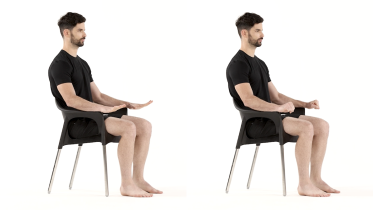 Open and close the hands
 Tendon glides
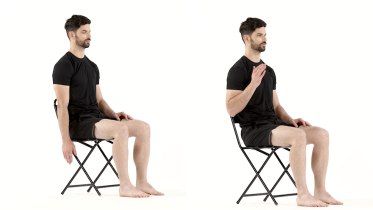 Elbow flexion and extension
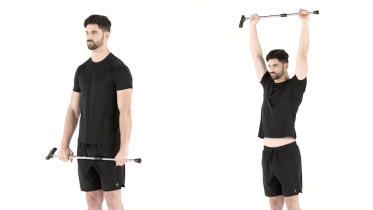 Shoulder flexion with a stick
Stage 2: Cast off, get the wrist and thumb moving
Start when the cast is off and your fracture clinic has said the wrist and thumb can move. Expect both to feel stiff and foreign. Tip the wrist up and down and side to side, move the thumb out and across to each fingertip, and draw slow figure 8s with the hands clasped. Assisted wrist extension is the one to go gently with: the hand being stretched stays dead weight, your other hand does the work, and you cup the palm from underneath rather than pulling on the fingers. These are short sessions several times a day rather than one long one: many programs use 5 to 10 slow repetitions of each movement, 3 to 5 times a day, with any stretch held about 15 to 30 seconds, and your physio will adjust this. Use the hand for light tasks such as eating, dressing and holding a toothbrush. Stiffness and a pulling feeling are expected. Sharp pain at the break is not, and means stop and tell your clinic.
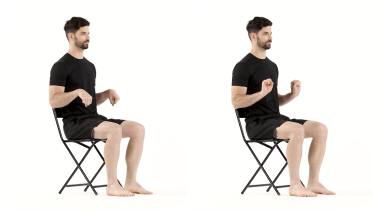 Wrist flexion and extension
 Wrist radial and ulnar deviation
 Thumb flexion and extension
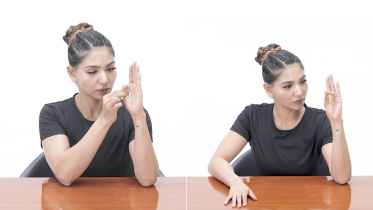 Thumb opposition
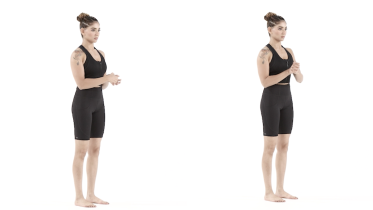 Wrist figure 8
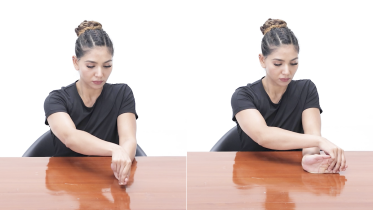 Assisted wrist extension
Stage 3: First strength for the wrist, grip and pinch
Move on when the wrist moves more freely and your fracture clinic or physio says the bone is ready for some load. Ask first whether any ligament in the wrist was injured as well, because if the scapholunate ligament was, the grip and pinch work in this stage is left out until your clinic says otherwise, as the paragraph above the program explains. The holds work the wrist muscles while the wrist stays still, which is why they come before anything that moves against resistance. A gentle push is enough: often 5 to 10 holds of 5 to 10 seconds once or twice a day. The ball squeeze, the clothespin and the cloth pull rebuild the grip and pinch you need for jars, buttons and keys, and they start light. Start light means a soft ball, about half as hard a squeeze as you could manage, and the wrist held in line with the forearm rather than bent. The ball squeeze page tells you to squeeze as firmly as you comfortably can and to let the wrist move as it likes; at this stage, with nobody yet certain the break has healed, do neither, because comfort is not a test of a scaphoid. If you have high blood pressure, breathe steadily through every hold and never hold your breath. Only add more over the following days if the wrist stays settled, and treat a wrist that is clearly sorer the next morning as a sign you did too much.
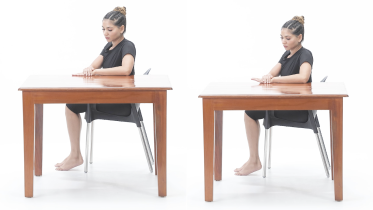 Isometric wrist extension
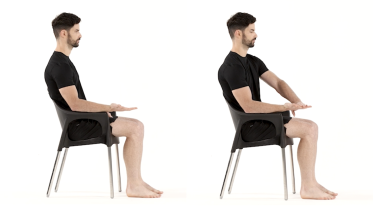 Isometric wrist flexion
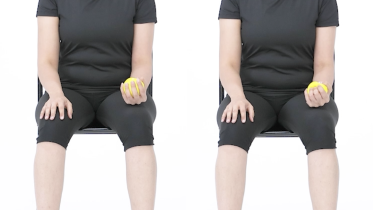 Hand grip squeeze
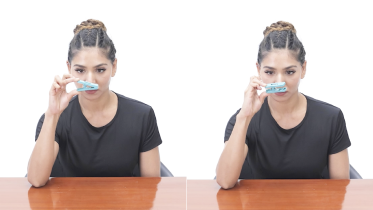 Clothespin pinch
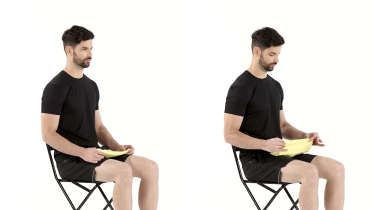 Pinch and pull with a cloth
Stage 4: Strength, twisting grip and weight through the hand
Start once the holds feel easy and your fracture clinic or physio agrees the bone has united. Lift the hand against a band, curl the wrist, turn the forearm with a light dumbbell, and use the gripper and towel wringing for the twisting grip that real tasks ask for. Most of these start at 2 to 3 sets of 10 to 15 once a day or every other day, and the wringing at 5 to 10 wrings. Start the wrist curl and the forearm turn with something light, around 0.5 to 1 kg (1 to 2 lb), which is a small water bottle or a tin, and add weight only when the current one is easy for every repetition. Keep all of it controlled rather than forceful. Heavy power work, meaning an all-out grip, a stiff gripper setting, hard wringing, lifting weights, pushing up through the hands or anything explosive, waits for consolidation rather than union, and the Australian Physiotherapy Association gives a way to date that: consolidation is about twice as long as it took the break to unite (Fitt, 2025). So if your scan confirmed union at 10 weeks, that work starts nearer 20 weeks from the injury, not at the scan. Leaning onto the hands comes last, because it puts body weight straight through the wrist, and it waits until your clinic or physio says the wrist can take weight and your palm rests flat on a table without pain. Use a counter or a heavy table that cannot slide, set at about waist height rather than low, and keep most of your weight on your feet. Start with your weight even on both hands and shift only a little toward the injured side, then a little more over the following sessions. The step after that is standing further back from the counter, which is also what sends more weight through the wrist, so change one thing at a time. Some ache with harder tasks is common for months, but pain that climbs week by week needs checking.
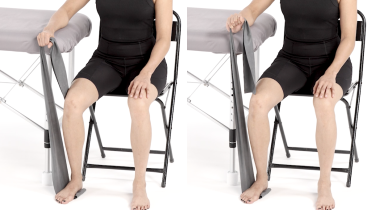 Wrist extension with band
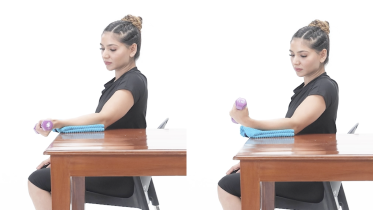 Wrist curl
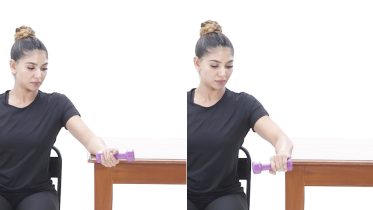 Forearm rotation with a dumbbell
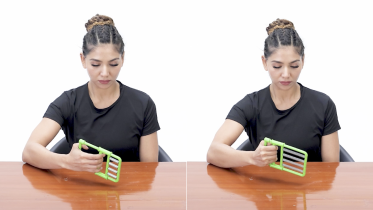 Hand gripper exercise
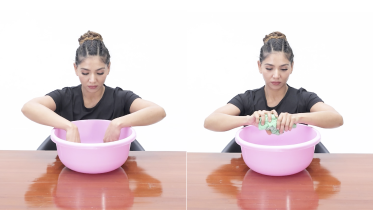 Towel wringing
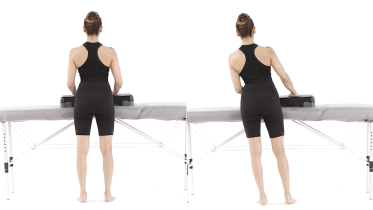 Standing weight shift onto the hands
What we notice in the clinic
What goes wrong with this break is usually nothing to do with the exercises.
Start with the appointment people skip. The wrist feels fine at eight weeks, the cast is off, work is busy, and the scan appointment goes. That scan is what tells you whether the bone has united, because a scaphoid that has not healed can feel perfectly comfortable for a while. If you remember one sentence from this page, make it that one.
Then there is the thumb. People who were given a cast that holds the thumb often arrive with a thumb far stiffer than their wrist, because nothing was moving it for six weeks and nobody warned them it would happen. That is normal and it does come back, but it takes deliberate work, which is why the thumb movements get their own place in stage 2 instead of being an afterthought.
And pushing up. Getting out of a chair or off the floor with the healing hand puts your body weight straight through the wrist, and doing it on a closed fist does not get round that: the load still runs through the wrist bones. Until stage 4, stand up pushing with the other hand, or rest the forearm of the injured side on the chair arm just below the elbow and push down through the forearm, with the hand clear of the surface.
If your scaphoid was fixed with a screw
Then this is not your program, and the reason is concrete. What was done inside your wrist, whether the break was displaced, whether a bone graft was used and how the bone looked at the end of the operation all change when you may move, grip and take weight, and only your surgeon knows those things. Your team's plan replaces every date and every stage on this page.
This is the part that catches people out. A screw does not mean the break has healed. It holds the two pieces still while the bone unites, and the bone still needs weeks to months to do that.
The wound can be a couple of stitches, the pain can settle in days, and the wrist can feel almost normal long before a scan says it has united. Loading the hand early because it feels fine is how a fixation loosens or a fixed break shifts, so gripping hard, lifting, pushing up through the palm and anything that puts your body weight through the wrist all wait for your surgeon's say-so, not for the pain to go. If a bone graft was used, that timeline is usually longer again.
Two of the warning signs below are written for an operated wrist: one for a wound or a fever, and one for new severe pain, a grip that gives way or a wrist that clicks, which can mean a fixation has loosened or the break has moved before it healed. Both ask you to contact your surgical team the same day rather than wait for a routine appointment.
Bone health and another fall
A scaphoid break usually comes from a decent fall, not a trip, so it is less often a sign of weak bones than a broken wrist in an older person. The question is still worth asking if you are over 50 and broke it in a fall from standing height or less. The osteoporosis program covers exercise for bone health, and decisions about tests and medicine belong with your doctor.
If you have fallen more than once in the past year, feel unsteady, or blacked out before the fall, that needs its own look. The balance and falls prevention program explains how strength and balance work lowers the chance of another fall, and some of it can start while the wrist heals if your physio agrees.
When to see a physio or doctor
See your fracture clinic, physio or doctor if the wrist is not getting steadily easier once the cast is off, if swelling does not settle with raising the hand and rest, if your grip is not improving over several weeks, or if pain is out of proportion to what you are doing. Ask for a referral if your work or sport needs force through that hand and you are not getting there.
Ask directly about union at each appointment: has the bone healed, what did the scan show, and what happens if it has not. The warning signs below say what needs help faster, and how fast. A wrist that is still tender in the hollow at the base of the thumb weeks later, with no review booked, belongs in front of somebody.
For physiotherapists
This page covers adult scaphoid waist fractures managed non-operatively. The staging follows the Australian Physiotherapy Association InMotion article (Fitt, 2025): short arm non-removable cast with the thumb free for six weeks in undisplaced or minimally displaced waist fractures, graded rehabilitation after cast removal lasting six to 12 weeks by functional demand, extension of casting in further four-week blocks to 12 to 14 weeks for delayed union, union on CT taken as trabeculae across 50% of the fracture line, and power work deferred to consolidation. The article's own definition of consolidation, "twice the timeframe it has taken to achieve union", is now on the page in both places the deferral appears, because a deferral to an undefined milestone is a deferral a patient resolves in their own favour, and this is the only date on the page the patient can calculate. The same article's statement that the cast is non-removable, that moderate evidence favours it over a custom removable orthosis and that an off-the-shelf wrist splint is inadequate is also now on the page, in the treatment section, for the reader considering a pharmacy brace instead of an awkward cast.
One qualifier from the same source was missing and is the most consequential addition in this review. Fitt states that the scapholunate ligament is injured in 25% of scaphoid waist fractures, citing Jørgsholm and colleagues 2010, and that graduated rehabilitation "would then exclude gripping exercises and early weight-bearing". The instruction is carried; the 25% is not, because rule 9a does not survive the trace. Jørgsholm (PMID 20193857, abstract read 2026-10-27) is 40 patients with 41 scaphoid waist fractures who all underwent wrist arthroscopy for treatment and evaluation: scapholunate injury in 29 of 41 and COMPLETE scapholunate rupture in 10 of 41, which is the 24% the quoted figure appears to be, so the commonly repeated sentence states the complete-rupture rate as the injury rate while the paper's injury rate is 71%. The population is also arthroscopically assessed rather than cast-treated, and the authors say the incidence is higher than previously reported.
The page therefore gives both numerators with their denominator, names the selection, and declines to convert either into a probability for a reader whose wrist was never looked inside. The action does not depend on the rate, which is the reason the qualifier could be carried onto a patient page at all. Stage 3 of this program is grip and pinch loading and stage 4 ends in weight through the palm, so a quarter of this page's readership was being given the two categories of exercise their own guidance document excludes.
The page now puts the question to the fracture clinic in the paragraph immediately above the program, repeats it in the stage 3 entry criterion, and holds the grip, pinch, gripper, wringing and weight-bearing items until the clinic or hand therapist answers, while leaving stages 1 and 2 unaffected because they are unloaded range of motion.
Fitt's note that persistent pain may represent an associated scapholunate injury is added to the delayed union warning line rather than replacing the non-union reasoning there, with a prompt to report a painful clunk on loading. Return to work figures from the same article (manual workers at union with range and grip within 20 to 40% of the other side, Fowler and Hughes 2015) are not on the page, because that chain has not been traced under rule 9a. The 50% trabecular bridging criterion traces to primary work in the same population: Slade and Gillon (2008) assessed scaphoid union by CT trabecular bridging, and Farracho and colleagues (2020) applied an explicit 50% trabecular bridging threshold at six weeks in 52 scaphoid fractures, where plain radiographs read for union at sensitivity 0.65 to 0.71 against 0.75 to 0.78 for cone beam CT. That is why this page asks about a scan and not an X-ray on its own.
Two divergences from our own cited sources are deliberate and are recorded here rather than left to look like oversights. Fitt states that bony union "is assessed primarily through clinical assessment", with CT where pain over the fracture site persists; this page instead tells the reader that union is confirmed on imaging and that a comfortable wrist is not proof. The reason is that the same article states snuffbox tenderness can persist for years after union, so tenderness is a poor marker in both directions, and that Imran and colleagues (2026) report BSSH guidance using radiographs plus CT to monitor healing. The page therefore keeps the instruction to attend the scan and states no absolute: Farracho and colleagues (2020) put cone beam CT sensitivity at six weeks at 0.75 to 0.78 with specificity 0.4, so imaging decides union without being certain of it.
The second divergence is the OrthoInfo cast description, corrected in this review. The page had attributed a below-elbow cast including the thumb to OrthoInfo for a waist fracture. Read today, OrthoInfo gives that cast for a fracture near the thumb (distal pole) and says that for a non-displaced waist or proximal pole fracture the cast "may include the thumb and may extend above the elbow", with longer immobilisation than for a distal fracture. The sentence was accurately quoted from a passage about a different fracture location, which is the rule 9a failure mode, and it had made the page's own stage 1 contingency for an above-elbow cast look like an afterthought rather than a described option for this fracture. Both OrthoInfo statements on the page now name the waist.
Return-to-sport rates, return times, and the radiograph against MRI diagnostic sensitivity figures quoted in the APA article reach it through a citation chain that has not been traced here, so they are not reproduced on the page.
SWIFFT (Dias and colleagues, 2020; n = 439, 31 UK centers, bicortical waist fracture displaced by 2 mm or less, presenting within 2 weeks, mean age 33, 83% male, 61% undisplaced) found no clinically relevant difference in PRWE at 52 weeks between early fixation and cast, favoured cast on cost-effectiveness, and recommended urgent fixation of confirmed non-union. Its cast arm was a below-elbow cast for 6 to 10 weeks, read from the HTA monograph abstract rather than the Lancet report, which does not state the duration. That range, not a flat six weeks, is what the page now gives alongside the APA figure. Harms in the trial: 31 of 219 (14%) potentially serious surgical complications against 3 of 220 (1%), 11 reoperations in 8 operated participants against 1 in the cast arm, and 40 of 220 cast-related complications against 5 of 219.
Surgical indications on the page follow Imran and colleagues (2026), a review of current BSSH guidance read at abstract level: displacement greater than 2 mm, proximal pole with any displacement, associated distal radius fracture or perilunate injury, specialist referral within 7 days of a suspected fracture, and radiographs plus CT for healing. The BSSH guideline itself was not reachable (three bssh.ac.uk paths returned 404 with a browser user agent on 2026-10-27), so it is not cited and no recommendation is attributed to it directly.
Dean and colleagues (2026) is the cast-treated non-union cohort: 502 adults aged 16 and over, CT-assessed union, 50 non-unions (10%), displacement of 1 mm or more associated with roughly a threefold risk, and a non-linear age association peaking at 26 to 36 years. Retrospective, single center. Siotos and colleagues (2023) pooled seven studies and found no significant difference by cast length or thumb inclusion (9.6% against 10.5%, and 10.3% against 10.1%).
Two documents disagree on thumb inclusion and the page states both rather than choosing, because the choice belongs to the treating unit and the meta-analysis found no outcome difference. The practical consequence is carried into stage 1, which does not prescribe thumb movement and tells the patient to follow their own clinic, so nobody works a thumb inside a spica.
Staging is written against the cast rather than the calendar, because the immobilisation period runs from six to ten weeks and longer in delayed union: stage 1 lasts as long as the cast, stage 2 opens on cast removal with clinic clearance for wrist and thumb movement, stage 3 on the clinic or physio agreeing the bone will take some load, and stage 4 on agreed union. Dose across the program is 5 to 10 slow repetitions several times a day for range, 15 to 30 second stretch holds, 5 to 10 isometric holds of 5 to 10 seconds once or twice daily, and 2 to 3 sets of 10 to 15 for stage 4 strength, with resistance starting around 0.5 to 1 kg (1 to 2 lb). Sustained gripping is an isometric pressor task, so the breathing instruction is given for the whole program rather than for the isometric stage alone.
Technique cues carried on this page rather than on the library exercise pages, which are written for hands in general: content/exercises/hand-grip-squeeze.md instructs a squeeze "as firmly as you comfortably can" with the wrist free to move as it likes, which is a comfort-gated maximal grip on a bone whose union is not yet confirmed, so stage 3 caps the effort at about half and holds the wrist in line with the forearm, as content/exercises/hand-gripper-exercise.md already does. content/exercises/standing-weight-shift-onto-hands.md is written as a shoulder exercise and asks for the weight to be moved onto the weaker arm from the outset, so stage 4 starts even on both hands, specifies a waist-height surface, and separates the two variables the patient can change, the shift and the distance from the counter. content/exercises/shoulder-flexion-with-a-stick.md needs a two-handed grip that a thumb spica may not allow, so stage 1 offers the stick-free version rather than leaving a cast-bound patient to improvise overhead with a dropped pole.
Screen at each contact for complex regional pain syndrome, median nerve compression and delayed union, and treat persistent scaphoid tenderness with a plan for imaging rather than reassurance. The APA's note that snuffbox tenderness can persist for years is stated on this page only for a scaphoid confirmed united on imaging, because used the other way round it becomes a reason to dismiss the main clinical sign of a non-union. Any operatively managed fracture hands over to the surgical team's protocol, and the operated warning signs on this page route a suspected failing fixation to that team the same day. Fixation is not union: a headless compression screw holds reduction while the bone heals, so grip, lift, push-up and weight-through-the-palm loading after fixation is gated by the surgeon and not by comfort, and a fixed scaphoid can still go on to non-union.
Warning signs
Get emergency help now
- Emergency: while you are in a cast or splint, your fingers turn blue, white or pale, or feel cold. Do not wait to see if raising your hand helps. Go to an emergency department straight away, and do not drive yourself. The cast or splint may be cutting off the blood supply, or pressure may be building up inside the forearm (compartment syndrome), and both need checking quickly.
- Emergency: in the first weeks after the break, the pain is severe and keeps getting worse, it hurts badly when your fingers are gently straightened, you have new weakness or trouble bending your thumb or index finger, or numbness in your fingers keeps spreading or getting worse. Go to an emergency department straight away, and do not drive yourself. Pressure may be building up inside the forearm (compartment syndrome), or swelling may be pressing on the nerve at the wrist (acute carpal tunnel syndrome), and both need treatment quickly.
- Emergency: a new fall or knock on the healing wrist, followed by numbness, tingling or pins and needles in the hand, or a wrist that has changed shape or sits at an odd angle. The same applies to a bone showing through the skin or a cut that is bleeding heavily. Go to an emergency department or call emergency services straight away, and do not drive yourself.
- Emergency: your arm, hand or fingers turn cold, pale, blue or gray compared with the other side. Call emergency services or go to an emergency department straight away, and do not drive yourself. The blood supply to the arm may be blocked.
- Emergency: you have a new fall and cannot remember the fall or how it happened. Go to an emergency department straight away, and do not drive yourself. You may have blacked out or hit your head without knowing it.
Get help now, day or night
- In a cast or splint, the pain gets worse, your fingers feel numb or tingle or look more swollen, or the cast feels too tight. Stop, rest your hand at about the level of your heart, keep moving your fingers and contact your fracture clinic or get medical advice straight away. Do not lift the hand higher than your heart and do not put ice on it, because if pressure is building up inside the forearm both of those cut down the blood reaching it. If you cannot move your fingers, the pain is severe even after painkillers, or the numbness, tingling or swelling has not settled within 30 minutes, go to your fracture clinic or an emergency department straight away, and do not drive yourself.
- Your cast or splint rubs painfully, or there is a blister-like soreness under it, or there is a bad smell, discharge or liquid coming from under the cast, or something has dropped down inside it. Contact your fracture clinic, plaster room or surgical team straight away, and out of hours go to an emergency department rather than waiting for the morning. Get medical advice the same day as well if you feel hot and shivery or have a high temperature. Skin under a cast can break down where you cannot see it.
Get help today
- Same day: your cast or splint feels too loose or uncomfortable, cracks, softens, gets wet or itches badly. Ring your fracture clinic or plaster room and ask to be seen, and go to an emergency department if they cannot see you that day. A cast that has gone loose or soft may no longer be holding the broken bone still.
- Same day: since your operation, your wound is oozing, leaking or has pus coming out of it, or its edges start to come apart, or your wrist is tender, swollen, painful or red and it is not getting better or is getting worse, or you have a high temperature or feel hot and cold or shivery. Redness can be harder to see on brown or black skin. Contact your surgical team the same day, or get urgent medical advice if you cannot reach them. These can be signs of an infection in the wound or the wrist. If you feel very unwell, go to an emergency department. If you have a very high or very low temperature, shivering you cannot control, you are breathing very fast or finding it hard to breathe, you are confused or your speech is slurred, your skin, lips or tongue look blue, gray, pale or blotchy (on brown or black skin this can be easier to see on the palms of the hands or soles of the feet), or you have a rash that does not fade when you press it, call emergency services, as this can be sepsis.
- Same day: since your operation, you have new severe pain in the wrist or at the base of the thumb, the wrist gives way or clicks when you grip, you feel a new grinding or a sense that something inside the wrist has shifted, or you cannot grip at all, whether that followed a fall, a knock, a twist or simply doing more than your plan allows. Stop the exercises, stop gripping and lifting with that hand, keep weight off it, and wear your splint if you were given one. Contact your surgical team the same day, or get assessed the same day at urgent care or an emergency department if you cannot reach them. Say that your scaphoid was fixed with a screw or a wire, and ask whether the wrist needs an X-ray or a scan. A screw or a wire can loosen or move, a break that was fixed can shift before it has healed, and a fixed scaphoid can still fail to unite. If the hand is numb, tingling, cold, pale or blue, or the wrist has changed shape, follow the emergency warning signs above instead.
- A new fall or knock that leaves the healing wrist more swollen, bruised or painful, without numbness or a change in shape. Stop the exercises, use the other hand for everything and keep weight off that hand, and get medical advice the same day. Say that it is a new injury on a healing break and ask whether the wrist needs another X-ray or scan. In the evening or at night, use an urgent care or out of hours service rather than waiting for the clinic to open. A break that is healing can move, and a wrist that still works is not proof that it has not. For the rest of that day and the next, a cast that feels tighter, pain that keeps climbing, fingers that go numb or tingle, or fingers that look pale or blue are the emergency signs at the end of this page.
- Same day: the wrist is hot, red and swollen, or you have wrist pain with a high temperature or feel hot, cold or shivery. Get medical advice the same day, and go to an emergency department if you feel very unwell. This can be a sign of infection in the joint, which needs treatment quickly.
- Same day: your forearm, hand or upper arm is getting more swollen instead of settling, or becomes warm, tender, red or darker than usual, has swollen veins that are sore to touch, or has a throbbing or cramping pain that feels different from normal muscle ache. Some bruising and swelling is expected after a break and settles over a few weeks, but a blood clot can sometimes form in the arm. Do not massage it. Stop and get medical advice the same day. If you are also short of breath or have chest pain, call emergency services.
- Same day: the wrist hurts at night or at rest and the pain keeps getting worse rather than easing as the weeks go by. If you are being treated for cancer now, contact your cancer team the same day.
- You blacked out before the fall that broke your wrist, or you cannot remember that fall, and nobody has checked why. Get medical advice the same day. A blackout needs its own check, especially if you are over 65 or it came without warning.
Book an appointment
- Since the fracture or cast, the hand is getting more painful rather than less, the skin becomes very sensitive to light touch, or the hand changes color, temperature, swelling or sweating compared with the other one, or looks shiny. See your doctor or physio as soon as you can, within a few days at most, as this can be complex regional pain syndrome (CRPS) and early treatment may help.
- Within a few days: the wrist is still tender in the hollow at the base of the thumb and the pain has not settled as the weeks go by, or it still hurts to grip or twist, or your fracture clinic has said the break is slow to heal. Keep every follow-up appointment, including the scans, even if the wrist feels fine, and ask what the plan is if it has not united. Whether the bone has healed is decided on imaging, usually a CT scan, and not on how the wrist feels, so a comfortable wrist is not proof. If nobody is reviewing you, or you have already been discharged and the wrist is still tender, see your doctor or fracture clinic within a few days and ask to be sent back rather than waiting to see whether it settles. A break that has not united is meant to be confirmed and fixed without long delay, because a scaphoid that never heals damages the wrist over the years and is harder to put right by then. Pain that stays over that spot is also how an injured ligament between two of the other wrist bones (the scapholunate) shows up, which is a second reason it belongs in front of somebody rather than being waited out, and a reason to say if the wrist clunks or gives a painful click when you load it.
- Within a few days: once the cast is off, numbness in the hand that is there all the time, the fleshy muscle at the base of your thumb looks flatter or thinner than on the other hand, or your thumb is getting weaker and you keep dropping things. See a doctor within a few days rather than waiting for it to settle. If the weakness is getting worse from day to day or spreads beyond the thumb, get medical advice the same day. Pressure on the nerve at the wrist (carpal tunnel syndrome) can follow a wrist fracture, and long-standing pressure can damage the nerve for good.
- Within a day or two: the wrist hurts at night or at rest and the pain keeps getting worse rather than easing as the weeks go by. If you have had cancer, now or in the past, or are losing weight without trying, see your doctor sooner, within a day or two, and mention it. This applies even if the pain is not getting worse.
- Within a few days: the wrist hurts at night or at rest and the pain keeps getting worse rather than easing as the weeks go by. See your doctor within a few days.
- You have had a fall, even if you were not hurt, or you keep tripping, stumbling or feeling that your legs might give way. Book an appointment with your doctor within a few days and ask about a falls assessment. Tell them about every fall, even the ones where you were not hurt.
Common questions
How long does a scaphoid fracture take to heal?
Longer than most people are told, and the published figures do not all agree. For a waist fracture that is not displaced, the Australian Physiotherapy Association describes six weeks in a short arm cast followed by graded rehabilitation, and says the rehabilitation itself lasts six to 12 weeks depending on what you need the hand to do (Fitt, 2025). Do not read six weeks as a promise, though. SWIFFT, the largest trial in this fracture, used a below-elbow cast for six to 10 weeks (Dias and colleagues, 2020). Where union is slow, the same article describes casting carried on in further blocks of four weeks, up to 12 to 14 weeks in total, before surgery is considered. OrthoInfo adds that a break at the waist or near the top of the bone is kept immobilised longer than one nearer the thumb, because the blood supply there is poorer. Your clinic sets your dates, and a scan rather than the calendar decides when the bone has united.
Will a scaphoid fracture heal without surgery?
Most do, and the trial evidence supports starting in a cast. In SWIFFT, 439 adults across 31 UK hospitals with a scaphoid waist fracture displaced by 2 millimetres or less were randomly given early surgical fixation or a below-elbow cast worn for six to 10 weeks, and at a year the wrist scores were much the same, so the authors concluded that undisplaced and minimally displaced fractures should be treated in a cast, with a suspected non-union confirmed and fixed without delay (Dias and colleagues, 2020). Not all of them heal, though. In 502 adults treated in a cast at one UK center, with union judged on CT, 50 breaks (10%) did not unite (Dean and colleagues, 2026). That is the honest number to hold in mind, and it is why the follow-up scans matter more here than for most broken bones.
What makes a scaphoid fracture less likely to heal?
Two things stood out in the largest recent cast-treated series. Displacement of 1 millimetre or more roughly tripled the risk of non-union, and age mattered in a way nobody expected: the risk peaked in people aged 26 to 36 and fell steadily after 36 (Dean and colleagues, 2026). That study was retrospective and from a single center, so treat it as the best available picture rather than the last word. Where the break sits along the bone matters too, because the blood supply enters from the thumb end, so a break nearer the top of the bone heals less readily (OrthoInfo).
Does the type of cast make a difference?
Less than you might think. A meta-analysis of seven studies found non-union in 9.6% of short arm casts and 10.5% of long arm casts, and in 10.3% of casts that held the thumb against 10.1% of those that did not, with no statistically significant difference in either comparison (Siotos and colleagues, 2023). Hold that lightly: the pooled groups were small, 156 wrists against 124 for cast length and 174 against 179 for the thumb, so this is a difference nobody has yet been able to detect rather than proof that the choices are the same. The documents in circulation still disagree: for an undisplaced waist fracture the Australian Physiotherapy Association describes a short arm cast with the thumb left out, while OrthoInfo says a cast for a break at the waist or nearer the forearm may include the thumb and may extend above the elbow. Neither is wrong, and your unit's choice is the one that applies to you. What it changes for you is practical rather than medical, because a thumb or an elbow held still cannot do its exercises.
Can I drive with a scaphoid cast on?
Ask your fracture clinic, and check with your insurer. You have to be able to grip the wheel and control the car in an emergency, and a cast that holds your thumb makes that much harder than it looks on the driveway. The answer also changes once the cast is off and while your grip is still weak, so it is worth asking again at that appointment rather than assuming.
Why does my wrist still ache months later?
Some ache with harder tasks for months is common after any wrist fracture, and tenderness in the hollow at the base of the thumb can stay for years after the bone has united (Fitt, 2025). That applies once a scan has confirmed union. Before anyone has confirmed it, tenderness in that hollow is the main clue to a break that has not healed, so get it checked rather than filing it as a normal leftover. What matters after that is the direction of travel. Grip climbing, the palm going flatter on the table and fewer tasks needing the other hand all say the wrist is moving forward, even on a sore week. Pain that is getting worse week by week, rather than slowly better, is the version that needs checking.
Do I need physiotherapy after a scaphoid fracture?
Many people do well with a clear home program and a few check-ins, and the Australian Physiotherapy Association describes rehabilitation as graduated and tailored to what the person needs to get back to, rather than one fixed protocol (Fitt, 2025). Ask for a referral if the wrist is not getting steadily easier, if swelling or stiffness is out of proportion, if your grip is not improving, or if your work needs real force from that hand. Ask sooner if pain is climbing rather than settling.
References
- Dias J, Brealey S, Cook L, et al. Surgical fixation compared with cast immobilisation for adults with a bicortical fracture of the scaphoid waist: the SWIFFT randomised controlled trial. Health Technology Assessment. 2020;24(52):1-234. https://doi.org/10.3310/hta24520
- Dean BJF, Saedi F, Riley ND, et al. Risk factors for scaphoid nonunion in acute fractures treated with cast immobilization. Bone and Joint Open. 2026;7(8):1001-1006. https://doi.org/10.1302/2633-1462.78.BJO-2026-0012.R1
- Siotos C, Asif M, Lee J, et al. Cast selection and non-union rates for acute scaphoid fractures treated conservatively: a systematic review and meta-analysis. Journal of Plastic Surgery and Hand Surgery. 2023;57(1-6):16-21. https://doi.org/10.1080/2000656X.2021.2024439
- Imran B, Miller J, Moulton L. Current trends in scaphoid fracture management: an update. British Journal of Hospital Medicine. 2026;87(3):52086. https://doi.org/10.31083/BJHM52086
- Farracho LC, Moutinot B, Neroladaki A, et al. Determining diagnosis of scaphoid healing: comparison of cone beam CT and X-ray after six weeks of immobilization. European Journal of Radiology Open. 2020;7:100251. https://doi.org/10.1016/j.ejro.2020.100251
- Slade JF 3rd, Gillon T. Retrospective review of 234 scaphoid fractures and nonunions treated with arthroscopy for union and complications. Scandinavian Journal of Surgery. 2008;97(4):280-289. https://doi.org/10.1177/145749690809700402
- Jørgsholm P, Thomsen NO, Björkman A, Besjakov J, Abrahamsson SO. The incidence of intrinsic and extrinsic ligament injuries in scaphoid waist fractures. Journal of Hand Surgery (American Volume). 2010;35(3):368-374. https://doi.org/10.1016/j.jhsa.2009.12.023
- Fitt K. Five facts about physiotherapy and scaphoid fracture. InMotion, Australian Physiotherapy Association. 3 March 2025. https://australian.physio/inmotion/five-facts-about-physiotherapy-and-scaphoid-fracture
- American Academy of Orthopaedic Surgeons. Scaphoid fracture of the wrist. OrthoInfo. https://www.orthoinfo.org/en/diseases--conditions/scaphoid-fracture-of-the-wrist/
- National Institute for Health and Care Excellence. Fractures (non-complex): assessment and management. NICE guideline NG38. 2016. https://www.nice.org.uk/guidance/ng38
- British Orthopaedic Association. BOAST: Diagnosis and management of compartment syndrome of the extremities. Updated July 2025. https://www.boa.ac.uk/asset/D0432D40%2D5D99%2D4B64%2D9952F6EB1B60C166/
- Willy C, Stichling M, Engelhardt M, Vogt D, Back DA. [Acute therapeutic measures for limb salvage Part 1: Haemorrhage control, emergency revascularization, compartment syndrome]. Unfallchirurg. 2016;119(5):374-387. https://doi.org/10.1007/s00113-016-0179-z
- North Bristol NHS Trust. Care of plaster casts. October 2024. https://www.nbt.nhs.uk/care-of-plaster-casts
- NHS. Complex regional pain syndrome. Page last reviewed 27 October 2022. https://www.nhs.uk/conditions/complex-regional-pain-syndrome/
- NHS. Osteoporosis. Page last reviewed 13 October 2022. https://www.nhs.uk/conditions/osteoporosis/
Written and checked by the PocketPhysio editorial team. Last updated 2026-10-27.
This page is general education, not a diagnosis or a personal treatment plan. See a physiotherapist or doctor for advice about your own situation.