Clothespin pinch
The clothespin pinch strengthens the thumb and fingers for pinching. You sit at a table with your elbow resting on it and your forearm upright, then squeeze an ordinary clothespin open between the pads of your thumb and index finger. Many programs later add the other fingers in turn. Physios and hand therapists often use it to build back pinch strength for small tasks such as doing up buttons, once the fingers move well without resistance.
How to do the clothespin pinch
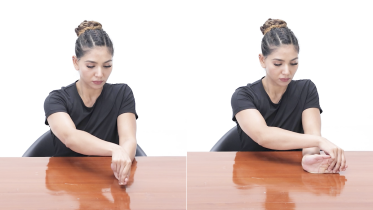
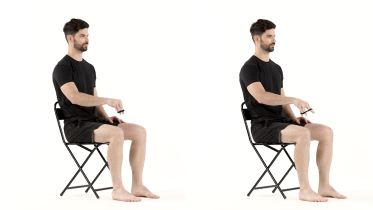
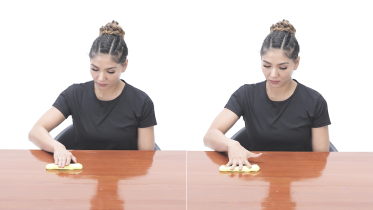
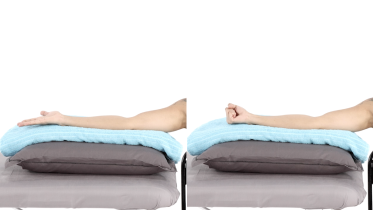
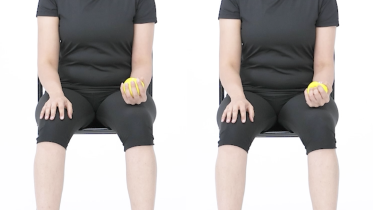
- Sit at a table with a clothespin in front of you. Rest the elbow of your working arm on the tabletop, with the forearm upright.
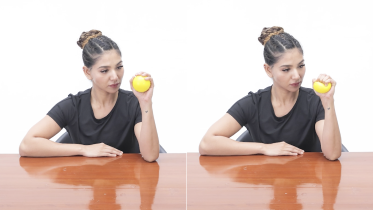
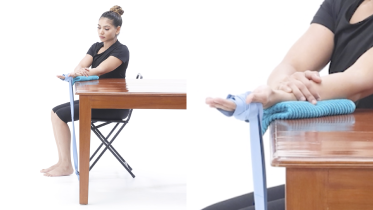
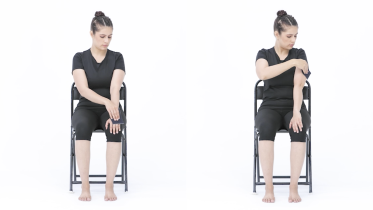
- Pick up the clothespin and place its two handles, the ends you press to open it, between the pad of your thumb and the pad of your index finger, as in the video.
- Squeeze slowly until the jaws of the clothespin open. Pause for a second or two.
- Let it close again slowly, without dropping it, then repeat.
- The video shows the index finger only. If your physio includes the other fingers, as the voice guide describes, move the clothespin to your middle, ring and little finger in turn and do the same with each.
What you should feel
Effort in the fleshy pad at the base of your thumb and in the finger doing the pinch. If you work the other fingers too, the ring and little fingers usually tire first.
Common mistakes
- Starting with a clothespin that is too stiff to open slowly and smoothly.
- Letting the thumb or finger end joint bend backward as you press.
- Snapping the clothespin shut instead of releasing it with control.
- Lifting the elbow off the table or tensing the shoulder.
How often
Many programs start with 5 to 10 slow squeezes, working up to 2 or 3 sets, once or twice a day. If the other fingers are in your program, do the same with each. Your physio will adjust this.
Stop and check with your physio if
- Sharp pain at the base of the thumb or in a finger joint.
- Pins and needles or loss of feeling in your thumb or fingertips. If one side of your face or body suddenly goes numb or weak, or your speech becomes slurred or muddled, call emergency services, even if it goes away.
- A finger gets stuck bent or snaps straight as you release the clothespin.
- Your thumb or finger joints are more swollen, hot or sore for hours afterward.
- Since the fracture or cast, the hand is getting more painful rather than less, the skin becomes very sensitive to light touch, or the hand changes color, temperature, swelling or sweating compared with the other one, or looks shiny. See your doctor or physio as soon as you can, within a few days at most, as this can be complex regional pain syndrome (CRPS) and early treatment may help.
From the clinic
Clothespins vary a lot in how hard they are to open, so try a few and begin with the lightest. If none of them feels easy yet, start without one: touch the tip of your thumb to each fingertip in turn, as in thumb opposition. The voice guide describes that easier version too, and has you lying on your back for it, but the video shows sitting at a table, so this page follows the video.
After a broken wrist, hand or forearm, or surgery on any of them such as a tendon repair, start only when your doctor, surgeon, physio or hand therapist says the bone or repair is ready for this, and follow their plan for how much to do. Resisted pinching usually comes later in rehab. Pinching puts a strong load through the joint at the base of the thumb, so check with your physio first if you have arthritis there or rheumatoid arthritis in your hands. For a stronger grip with the whole hand, see the hand gripper exercise.
Written and checked by the PocketPhysio editorial team. Last updated 2026-09-28.
This page is general education, not a diagnosis or a personal treatment plan. If you have pain, an injury or a health condition, see a physiotherapist or doctor before starting new exercises.