Fist pumps for lymphedema
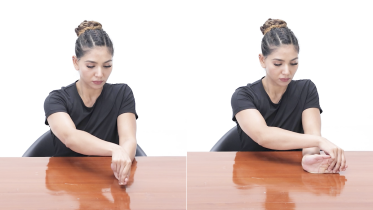
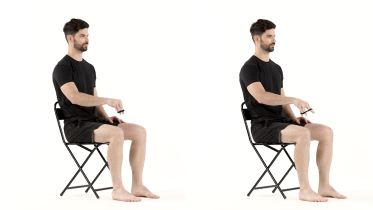
Fist pumps are a small hand exercise from arm lymphedema routines. With your affected arm resting out to the side on pillows, palm up, you curl your fingers into a fist, hold it for a moment, then relax and open the hand again. The pillows take the weight of the arm, so only the hand and forearm do any work. A lymphedema team normally decides how and when you do it, and this page covers the general technique.
How to do the fist pumps for lymphedema
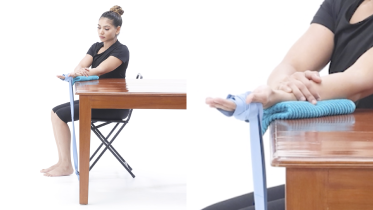
- Sit upright beside a table with pillows piled on it, and rest your affected arm on them out to the side, a little lower than your shoulder.
- Straighten the elbow and turn the palm up, with your fingers relaxed.
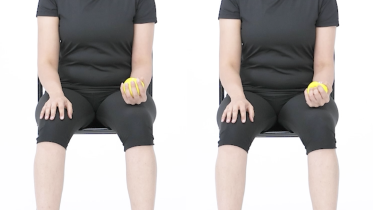
- Close your fingers slowly into a fist. A firm but comfortable grip is enough.
- Hold the fist for a couple of seconds, or as long as your team suggested.
- Relax the fingers and let the hand open fully, then pause before the next fist.
What you should feel
Light work in the palm, the fingers and the front of the forearm, and an easy stretch as the fingers open. The hand and arm should not feel fuller or tighter once you stop.
Common mistakes
- Squeezing as hard as you can, which tires the hand and forearm quickly.
- Starting the next fist before the hand has opened fully.
- Lifting the arm off the pillows or bending the elbow as you squeeze.
- Holding your breath each time the fingers close.
How often
A usual range is 10 to 15 slow fists, 2 or 3 times a day, or whatever your lymphedema team has set. Your physio will adjust this.
Stop and check with your physio if
- Pain in your fingers, hand or wrist as you squeeze, or a finger that catches or locks as it bends.
- Your hand or arm looks puffier, or feels heavier or tighter, during the exercise or afterward. Leave it for today, and contact your lymphedema team if it is still like that the following day. If the swelling comes on quickly, or the hand or arm becomes painful, warm, red or darker than usual, get medical advice the same day.
- Your fingers or hand start to tingle or go numb while you squeeze.
- Pins and needles in your arm or hand that do not go away after you stop, or part of your arm or hand goes numb. Get medical advice the same day. If one side of your face or body suddenly goes numb or weak, or your speech becomes slurred or muddled, call emergency services, even if it goes away.
- Your forearm, hand or upper arm becomes swollen, warm, tender, red or darker than usual, has swollen veins that are sore to touch, or has a throbbing or cramping pain that feels different from normal muscle ache. Do not massage it. Stop and get medical advice the same day, as this can be a blood clot. If you are also short of breath or have chest pain, call emergency services.
From the clinic
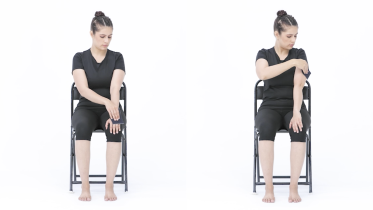
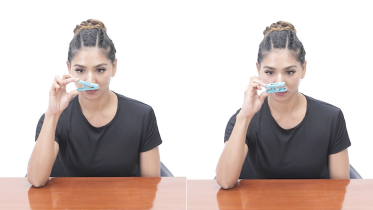
The movement is small, so it is easy to do several times through the day. A swollen hand may not close into a full fist, and that is fine: curl the fingers only as far as they go without strain. Take off rings, a watch or anything else tight on the hand or wrist before you begin. Ask your lymphedema team whether to wear your compression sleeve or glove while you do it. The same routines often use elbow bends for lymphedema and lymphedema breathing.
Lymphedema is long-lasting swelling that builds up when the lymphatic system does not drain the tissues well. According to the NHS, secondary lymphedema often affects people whose cancer involves the lymph system, or who have had lymph node treatment (NHS lymphoedema). If you have had lymph node surgery or another cancer operation in recent months, check with your surgical team or physio before you rest the arm out to the side.
If surgery to the armpit lymph nodes left you with numbness in the armpit or inner upper arm, and your team knows about it, that numbness is not a new sign. New or spreading numbness, tingling that stays after you stop, or new weakness still follow the stop list. After a broken wrist, hand or forearm, or surgery on any of them such as a tendon repair, start only when your doctor, surgeon, physio or hand therapist says the bone or repair is ready for this, and follow their plan for how much to do.
Watch the swollen area for signs of a skin infection (cellulitis), which the NHS says often affects people with lymphedema. If the skin there becomes painful, hot or swollen, or turns red or darker than usual, get medical advice the same day, as early treatment can stop it becoming more serious. Do the same for a high temperature, or if you feel hot, cold or shivery. If the skin changes come with a very high temperature or feeling hot, cold or shivery, a fast heartbeat or fast breathing, purple patches on the skin, feeling dizzy or faint, confusion, or cold, clammy or pale skin, or you feel very unwell, call emergency services or go to an emergency department straight away, and do not drive yourself.
New swelling that nobody has checked yet needs a doctor's assessment before you start, and the same day if it is in one arm or leg and you do not know the cause, or it is severe, painful or came on very suddenly. Call emergency services if swelling comes with shortness of breath, a chest that feels tight, heavy or painful, coughing up blood, a pounding heartbeat, or feeling lightheaded, faint, confused, sick or clammy. Sudden shortness of breath, chest pain or coughing up blood also needs emergency services when the swelling looks no different, as these can be signs of a blood clot in the lungs.
Written and checked by the PocketPhysio editorial team. Last updated 2026-09-28.
This page is general education, not a diagnosis or a personal treatment plan. If you have pain, an injury or a health condition, see a physiotherapist or doctor before starting new exercises.