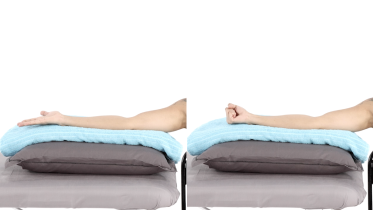
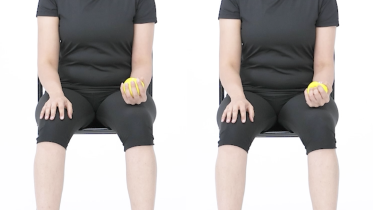
Finger spread with putty
Finger spreads with putty work the muscles that spread your fingers and thumb apart. You sit at a table, rest your fingertips on a roll of therapy putty and spread them wide, stretching the putty as you go. Hand therapists and physios often give it after hand and wrist injuries, and for hands that have become weak or stiff.
How to do the finger spread with putty
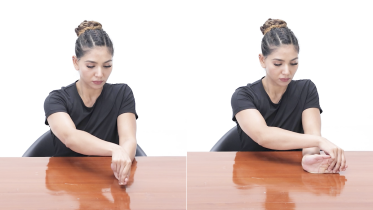
- Sit upright at a table. Roll a piece of therapy putty into a short sausage shape and lay it on the table in front of the hand you are working.
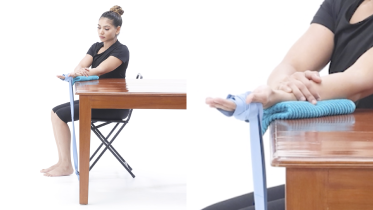
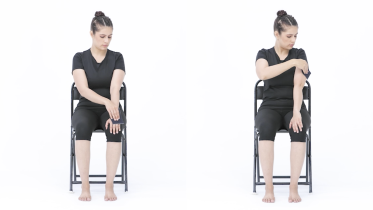
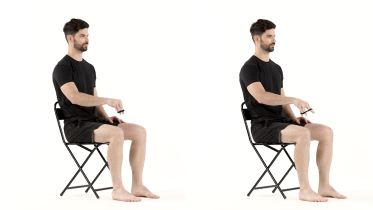
- Place that hand palm down with your fingers close together. Rest the tips of your four fingers on the putty and let your thumb rest on the table beside it, as in the video. Press down lightly so the fingertips sink in a little and grip the putty.
- Slowly spread your fingers and thumb apart as far as you can, stretching the putty out along the table.
- Keep your elbow, shoulder and body still. The movement comes from the hand only, so your wrist stays where it is.
- Relax and bring your fingers back together. Once the putty gets thin, roll it back into a sausage and repeat.
What you should feel
The small muscles between your fingers and along the side of your little finger working. They should feel tired by the end of the set, but the finger joints themselves should not hurt.
Common mistakes
- Moving the whole arm or lifting the wrist to stretch the putty, instead of spreading the fingers.
- Spreading the fingers but leaving the thumb behind.
- Using putty so firm that the fingers curl or cannot spread at all.
- Rushing through the repetitions.
How often
Many programs start with the softest putty and 2 to 3 sets of 10 to 15 slow spreads, once or twice a day. Your physio or hand therapist will adjust the putty strength and the numbers for you.
Stop and check with your physio if
- Sharp pain in a finger joint or at the base of the thumb.
- Numbness or tingling in the fingers that gets worse as you go. If one side of your face or body suddenly goes numb or weak, or your speech becomes slurred or muddled, call emergency services, even if it goes away.
- Your finger joints are more swollen, hot or stiff after the session.
From the clinic
Therapy putty comes in grades from very soft to firm, often marked by color, although the colors are not the same across brands. Start with a soft one. You should be able to finish every spread with good control, and the last few should still feel like work. Keep the putty in its container between sessions so it does not dry out or collect dirt.
After a broken wrist, hand or forearm, or surgery on any of them such as a tendon repair, start only when your doctor, surgeon, physio or hand therapist says the bone or repair is ready for this, and follow their plan for how much to do. If you have rheumatoid or another inflammatory arthritis, ask your physio or hand therapist before using putty for this. Spreading against resistance pushes the ring and little fingers toward the little finger side, which is the direction the fingers can drift in rheumatoid arthritis. Skip it on days when your finger joints are hot and swollen.
Written and checked by the PocketPhysio editorial team. Last updated 2026-09-28.
This page is general education, not a diagnosis or a personal treatment plan. If you have pain, an injury or a health condition, see a physiotherapist or doctor before starting new exercises.