
Cubital tunnel syndrome exercises and physiotherapy
What is cubital tunnel syndrome?
The ulnar nerve runs down the arm and passes around the inner side of the elbow, in a groove behind the bony point there. That spot is the funny bone: the nerve sits close to the skin, which is why a knock there sends a shock into your fingers. The ulnar nerve gives feeling to the little finger and half of the ring finger, and OrthoInfo says it controls most of the little muscles in the hand that help with fine movements, plus some forearm muscles used for a strong grip. When it is pressed or irritated at the elbow, you get cubital tunnel syndrome.
The first sign is usually numbness or tingling in the little and ring fingers (BSSH). OrthoInfo says it shows up more when the elbow is bent, for example when driving or holding a phone, and that some people wake at night with numb fingers. As it goes on, grip can weaken and fine finger tasks such as typing can feel clumsy. In severe cases the numbness is constant and the muscles in the hand get thinner, most easily seen in the web between the thumb and index finger (BSSH).
BSSH says most cases have no obvious cause, although arthritis of the elbow or an old injury can narrow the tunnel. OrthoInfo adds that keeping the elbow bent for long periods and leaning on it can play a part. In some people the nerve slides out from behind the bony point when the elbow bends, and over time that sliding back and forth may irritate it.
Cubital tunnel, carpal tunnel or golfer's elbow?
A few problems get mixed up here. Carpal tunnel syndrome is pressure on a different nerve (the median nerve) at the wrist, and the tingling is on the thumb side of the hand rather than the little finger side. It has its own carpal tunnel syndrome program, built around a wrist splint rather than an elbow one.
Golfer's elbow is a tendon problem at the same inner elbow. The main complaint is pain when you grip or lift, not tingling, and the treatment is gradual loading of the forearm muscles. The golfer's elbow program covers it. The two can happen together, because the nerve runs just behind the tendon, so tell your physio if you have both pain and tingling.
Tingling in the ring and little fingers can also come from a nerve root in the neck. If neck movement brings it on, or pain runs from the neck into the arm, see the cervical radiculopathy program and get it checked.
What helps: elbow habits and night splints
For mild or moderate symptoms, the first treatment is using the elbow in a way that takes the pressure off the nerve. OrthoInfo advises avoiding long spells with the elbow bent, and not leaning on it or putting pressure on the inner arm, for example resting your arm on an open car window. At a computer, it suggests a chair that is not too low and not resting the elbow on the armrest. BSSH also mentions protective pads for the inside of the elbow.
Look at the times your fingers tingle and change how you do those tasks. A headset or speakerphone saves holding a phone to your ear with the elbow bent. Straighten the arm now and then during long spells of reading, driving or using a tablet.
Nights count too. Both OrthoInfo and BSSH suggest a towel around the elbow. OrthoInfo describes wrapping it loosely around the straight elbow, or wearing an elbow pad backward, and BSSH gives a splint from a therapist as the other option. The point is to stop the elbow staying tightly bent for hours while you sleep.
The evidence for these steps is thin. A Cochrane review found only single small trials of each non-surgical treatment, and one of them suggests that in mild cases, advice on movements or positions to avoid may ease discomfort (Caliandro 2025).
In a trial of 70 people with mild or moderate symptoms, everyone was told what causes the symptoms and how to avoid bringing them on, and 51 of the 57 people followed up had improved at 6 months (Svernlöv 2009). There was no group without that advice, so the trial cannot show how much of the improvement came from it. The authors concluded that the outlook is good for people with mild or moderate symptoms who know the causes and how to avoid bringing the symptoms on.
A steroid injection is sometimes suggested. The same Cochrane review found the evidence very uncertain, so it is not clear whether a steroid injection helps more than a dummy injection (Caliandro 2025). If one is offered, talk it through with your doctor.
Do exercises and nerve glides help cubital tunnel syndrome?
Not much, going by the little research there is. In the trial above, one group added nerve gliding exercises and another added a night splint to the same advice, and neither group did better than the group with advice alone (Svernlöv 2009). OrthoInfo still lists nerve gliding exercises among the non-surgical options. If your physical therapist (physiotherapist) thinks it suits you, the ulnar nerve glide shows one way to do it.
The main treatment is still the elbow habits and the night position. The exercises here sit alongside them: they keep the fingers moving and the small hand muscles working while the nerve settles, then rebuild grip and forearm strength for daily tasks once the tingling eases.
How to use this program
Choose your stage by how your hand is now, and use stage 1 if in doubt. You are ready to move up when the current stage is easy and the tingling has not increased over the following day or two. The program is for cubital tunnel syndrome treated without an operation.
As a rough guide, the tendon glides are often done 2 to 4 times a day, 5 to 10 rounds each time, with each position held for about 3 to 5 seconds. Opening and closing the hand is usually 5 to 10 times, 3 to 4 times a day. Stage 2 starts with the softest putty: finger spreads are often 2 to 3 sets of 10 to 15 and key grip 1 to 3 sets of 10 to 15, both once or twice a day, and the ball squeeze is 10 to 15 squeezes held for about 3 to 5 seconds, 1 to 3 times a day. For the stage 3 wrist exercises, a common start is 10 to 15 slow repetitions, 2 to 3 sets, once a day with a light weight. The exercise pages list their own starting ranges, and your physio will adjust them to your hand and the jobs you need it for.
Watch the tingling more than anything else. Many of the videos show the elbow bent and resting on a table. In this program, keep the elbow only partly bent, rest the forearm rather than the inner elbow, and take short breaks to straighten the arm between sets.
Stop an exercise at once if it brings on tingling, pins and needles or numbness in your hand, or makes the tingling you already have stronger. If the tingling builds with each repetition, is still there more than a few minutes after you stop, or your night symptoms get worse afterward, that exercise is too much for now. Leave it out, or go back a stage. If tingling or numbness comes on in a new part of your arm or hand and does not go away after you stop, or your hand feels weaker than before, get medical advice the same day.
After a broken or dislocated elbow, or elbow surgery, including an operation to free the nerve, follow your surgeon's or physio's plan, and start these exercises only when they have cleared you. If you have just hurt your arm, see the warning signs below before you exercise.
The program is written for adults. A child or teenager with tingling or weakness in the hand should see a doctor first. If you are pregnant, check with your midwife or doctor before starting.
The exercise program
Stage 1: Ease the pressure and keep the fingers moving
Start here if your fingers tingle or go numb, often after the elbow has been bent for a while or during the night, and use it alongside the elbow habits and the night towel or splint described above. Tendon glides and opening and closing the hand move the fingers with no load at all. Do them standing, or sitting with your forearm flat on a table, and do not prop your elbow point on the tabletop the way the tendon glide video does, so the inner elbow is not pressed or bent for long. Aim for no tingling: a faint tingle should be gone a few seconds after you stop. If it builds with each repetition or hangs around, leave that exercise out for now.
 Tendon glides
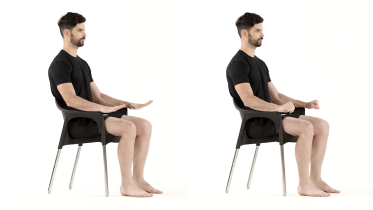 Open and close the hands
Stage 2: Gentle pinch and grip work for the hand muscles
Move up when the tingling is easing and stage 1 feels easy. The ulnar nerve supplies many of the small muscles that spread the fingers and pinch with the thumb, and finger spreads and key grip with putty put those to work. The ball squeeze adds some light work for closing the hand, but never squeeze anywhere near your hardest. Choose the softest putty and a soft ball, keep the elbow only partly bent, and let the forearm rest on the table, not the inner elbow. If your hand is already weak or clumsy, or looks thinner, get that looked at before this stage; the warning signs below give the timing.
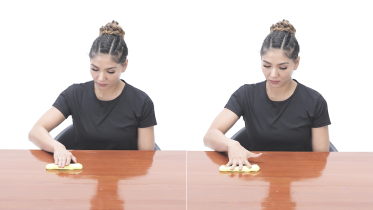 Finger spread with putty
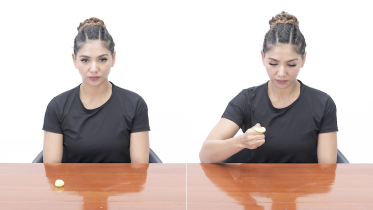 Key grip with putty
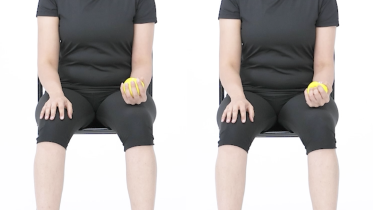 Hand grip squeeze
Stage 3: Build forearm strength for lifting and carrying
This stage is for when the tingling is mild or has gone and you want to lift and carry things normally again. Strengthening has not been shown to help the nerve itself, so the goal here is getting back to everyday tasks. Pick a very light weight, rest the forearm on a support with the elbow only partly bent, and grip the handle no harder than you need. The wrist curl loads a forearm muscle that sits over the nerve at the elbow, so it is the first one to leave out if it brings on tingling. Stop if your ring or little finger starts to tingle, and go back a stage if the tingling returns at night.
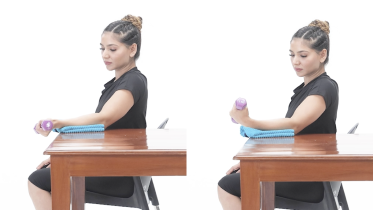 Wrist curl
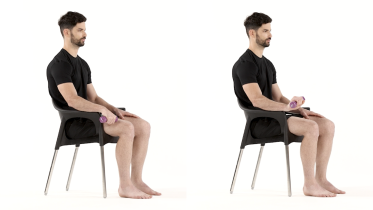 Wrist extension with weight
When is surgery considered for cubital tunnel syndrome?
A doctor may suggest surgery when non-surgical care has not worked, the nerve is badly squeezed, or the hand muscles have become weak or damaged (OrthoInfo). BSSH puts it as severe cases, or cases that do not respond to non-surgical treatment. That is why a hand that is weakening, getting clumsy or looking thinner sits on the warning list below instead of being left to settle.
The operation frees the nerve. It can be released where it lies (simple decompression) or moved to the front of the elbow (transposition), and BSSH also lists removing part of the bony point (medial epicondylectomy). A Cochrane review found probably little or no difference between simple decompression and transposition, in how well the hand works afterward or in problems after surgery, including when the nerve is badly affected (Caliandro 2025).
Surgery does not always undo the damage. BSSH says it generally stops the muscle weakness getting worse, but strength often comes back slowly and not fully. OrthoInfo notes that nerves recover slowly, and that if the nerve is very badly compressed or the muscles have wasted, some symptoms may remain even after surgery. This page does not cover rehab after the operation; your surgeon or hand therapist will guide that.
When to see a physio or doctor
OrthoInfo's advice is to see a doctor for severe symptoms, or for milder ones that have gone on longer than 6 weeks. See a doctor within a few days, rather than waiting, if your hand is getting weaker or clumsier, the numbness is constant, or the muscles in your hand look thinner. Get assessed as well if you cannot tell where the problem starts, since hand tingling can come from the neck, the elbow or the wrist. Numbness in both hands, or hands that have slowly become clumsy, needs medical advice the same day. New problems walking need emergency help, and each of the other warning signs below gives its own timing.
For physiotherapists
This page is a patient starting point for ulnar neuropathy at the elbow managed without surgery. The 2025 Cochrane update (Caliandro 2025) included 15 RCTs (970 participants). Conservative care for mild or moderate cases rests on single trials of education, night splinting, nerve gliding and perineural injections. One small RCT showed that, in mild cases, information on movements or positions to avoid may reduce subjective discomfort; the evidence for steroid injection versus placebo, and for written instructions versus surgical decompression, is very low certainty.
Svernlöv and colleagues (2009) randomized 70 patients with mild or moderate symptoms (Dellon 1989 grading) to night splinting, nerve gliding or control, and every patient was informed about the cause of symptoms. At 6 months, 51 of the 57 patients followed up (89.5%) had improved, with no significant differences between groups in any recorded variable (COPM, VAS pain, strength, neurophysiology). The authors also found normal neurophysiology in 76% of patients with typical symptoms.
On surgery, the review found low to moderate certainty evidence of little to no difference in function or surgical complications between simple decompression and decompression with subcutaneous or submuscular transposition in idiopathic cases, including severe ones, and moderate-certainty evidence of little to no difference between endoscopic and open decompression. The 2016 version had reported more wound infections after transposition; the pooled 2025 estimates no longer show a clear difference.
Flexor carpi ulnaris loading in stage 3 is kept light, with the elbow out of deep flexion, and is the first exercise to drop if it provokes ulnar symptoms. Progress hand loading on symptom response and keep the elbow out of sustained flexion during exercise. Refer for a surgical opinion when there is progressive intrinsic weakness, wasting or constant sensory loss. Screen for cervical radiculopathy and myelopathy, especially with bilateral or proximal symptoms.
See a doctor promptly if
- Emergency: any sign of a stroke, even if it goes away. That means a face that droops on one side, an arm you cannot lift or keep up, slurred or muddled speech, weakness or numbness on one side of your body or face, sudden blurred vision, double vision or loss of sight, trouble swallowing, sudden dizziness with unsteadiness or falling over, a sudden severe headache, or a sudden fall where your legs give way but you do not black out (a drop attack). Call emergency services straight away.
- If you have just hurt your arm and have severe pain, cannot move the elbow or heard a snap, do not exercise it. Go to an urgent care center or emergency department the same day. If the arm looks a different shape or sits at an odd angle, a bone is showing, or your arm or hand tingles, feels numb or turns cold, pale or blue, go to an emergency department straight away or call emergency services, and do not drive yourself.
- Emergency: new problems walking, for example your legs feel stiff, heavy or weak or you have become unsteady on your feet, new trouble controlling your bladder or bowels, or hands that suddenly become clumsy, for example you can no longer do up buttons. Call emergency services straight away. These can be signs of pressure on the spinal cord in the neck.
- Hands that have slowly become clumsy, for example trouble doing up buttons or dropping things, or numbness in both hands. Get medical advice the same day. These can be signs of pressure on the spinal cord in the neck (cervical myelopathy). If the clumsiness or numbness gets worse quickly, call emergency services straight away.
- Your hand is getting weaker, you keep dropping things, your fingers feel clumsy, the numbness is there all the time, or the web of muscle between your thumb and index finger, or the little finger side of your palm, looks thinner or hollow compared with your other hand. See a doctor within a few days rather than waiting for it to settle, because a nerve that has been squeezed hard for a long time may not fully recover. If the weakness is getting worse from day to day, or both hands are affected, get medical advice the same day.
- Tingling or numbness in your ring and little fingers that has lasted more than 6 weeks, even if it is mild. See a doctor in the next week or two, or within a few days if the symptoms are severe. OrthoInfo advises seeing a doctor for these symptoms if they are severe, or if milder symptoms have lasted more than 6 weeks, because muscle wasting from a squeezed nerve cannot be reversed.
- Pain spreads from your neck down the arm, or turning or tilting your neck brings on the tingling in your hand. The problem may be in the neck rather than the elbow. If a doctor or physio has not checked it yet, get medical advice the same day.
- The elbow is hot, red and swollen, or you have elbow pain with a high temperature or feel hot, cold or shivery. Get medical advice the same day, and go to an emergency department if you feel very unwell. This can be a sign of infection in the joint, which needs treatment quickly.
- The pain is there at night or at rest and keeps getting worse. See your doctor within a few days. If you have had cancer, now or in the past, or are losing weight without trying, see your doctor sooner, within a day or two, and mention it. This applies even if the pain is not getting worse. If you are being treated for cancer now, contact your cancer team the same day.
Common questions
Can cubital tunnel syndrome go away on its own?
Mild or moderate cases often improve without surgery. In one trial, everyone was told what brings the symptoms on and how to avoid it, and 51 of the 57 people followed up were better at 6 months (Svernlöv 2009). Every group got that advice, so the trial cannot tell how much of the improvement it caused. A hand that is getting weaker, or numbness that never goes away, is different: see a doctor rather than waiting.
How should I sleep with cubital tunnel syndrome?
With your elbow straighter. Bending the elbow stretches and presses on the nerve, and OrthoInfo notes that some people wake at night because their fingers are numb. It suggests keeping the elbow straight at night by wrapping a towel loosely around the straight elbow or wearing an elbow pad backward. The British Society for Surgery of the Hand (BSSH) suggests a folded towel wrapped around the elbow or a splint from a therapist.
Do nerve gliding exercises help cubital tunnel syndrome?
Probably not much on top of good advice. Only one trial has tested them, and adding nerve gliding exercises or a night splint to advice about the causes made no measurable difference at 6 months (Svernlöv 2009). A Cochrane review found only single small trials of each non-surgical treatment (Caliandro 2025). OrthoInfo still lists nerve gliding among the non-surgical options. If your physio gives you one, keep it gentle and well short of tingling.
What is the difference between cubital tunnel and carpal tunnel syndrome?
The nerve, and where it gets squeezed. Cubital tunnel syndrome is pressure on the ulnar nerve at the elbow, and it mainly affects the little finger and half of the ring finger. Carpal tunnel syndrome is pressure on the median nerve at the wrist, and it affects the thumb, the index and middle fingers and part of the ring finger. They are treated differently, so a proper assessment is worth it if you are not sure which you have.
When do you need surgery for cubital tunnel syndrome?
OrthoInfo gives three reasons a doctor may recommend it: non-surgical treatment has not helped, the nerve is very compressed, or the pressure has caused muscle weakness or damage. BSSH says an operation is needed in severe cases or when non-surgical treatment has not worked. It adds that surgery usually stops the weakness getting worse, although strength can take a long time to come back and may not come back completely. A hand surgeon can go through the options with you.
References
- Caliandro P, La Torre G, Padua R, Giannini F, Reale G, Padua L. Treatment for ulnar neuropathy at the elbow. Cochrane Database of Systematic Reviews. 2025;(4):CD006839. https://doi.org/10.1002/14651858.CD006839.pub5
- Svernlöv B, Larsson M, Rehn K, Adolfsson L. Conservative treatment of the cubital tunnel syndrome. Journal of Hand Surgery (European Volume). 2009;34(2):201-207. https://doi.org/10.1177/1753193408098480
- American Academy of Orthopaedic Surgeons. Cubital tunnel syndrome (ulnar nerve entrapment at the elbow). OrthoInfo. https://www.orthoinfo.org/en/diseases--conditions/ulnar-nerve-entrapment-at-the-elbow/
- British Society for Surgery of the Hand. Cubital tunnel syndrome. Patient information. https://www.bssh.ac.uk/patients/conditions/22/cubital_tunnel_syndrome
- NHS. Symptoms of a stroke. Page last reviewed 12 September 2024. https://www.nhs.uk/conditions/stroke/symptoms/
Written and checked by the PocketPhysio editorial team. Last updated 2026-09-28.
This page is general education, not a diagnosis or a personal treatment plan. See a physiotherapist or doctor for advice about your own situation.