
Golfer's elbow exercises and physiotherapy
What is golfer's elbow?
The muscles on the palm side of your forearm bend your wrist, help you grip and turn your palm to face down. They share a tendon that attaches to the bony point on the inner side of the elbow (medial epicondyle). Golfer's elbow is pain where that tendon attaches, when it has taken more load than it can handle. OrthoInfo, the patient site of the American Academy of Orthopaedic Surgeons, says the muscle that turns the forearm over (pronator teres) is the one most often involved, along with the wrist benders. You may also see it called medial epicondylitis, medial epicondylalgia or medial elbow tendinopathy.
The name suggests inflammation, but the main change in a tendon that has hurt for a while is in its structure. A review in the journal of the American Academy of Orthopaedic Surgeons describes it as degeneration of the tendon of the forearm muscles that bend the wrist and turn the palm down (Amin and colleagues, 2015). That is one reason the treatment centers on loading the tendon rather than only resting it.
You do not need to play golf to get it. OrthoInfo says it usually affects adults between 40 and 60, and lists throwing sports, tennis and weightlifting alongside golf, as well as everyday tasks such as household chores. The Royal Orthopaedic Hospital, an NHS hospital in Birmingham, links it to repeated or strenuous bending of the wrist.
The typical picture is pain on the inner side of the elbow when you grip, lift or bend the wrist, sometimes spreading into the forearm. Grip can feel weak. A nerve runs just behind that bony point (the ulnar nerve), and OrthoInfo notes that some people also get numbness and tingling in the ring and little fingers. That is a sign to get the elbow checked (see the warning signs below).
Pain on the outer side of the elbow is a different problem, tennis elbow, and the tennis elbow program covers it.
Do exercises help golfer's elbow?
Probably. The research is thin, though. Golfer's elbow has been studied much less than tennis elbow. A 2013 systematic review of exercise and hands-on treatment for both conditions found 12 trials and a review, and every one of them was about tennis elbow (Hoogvliet and colleagues, 2013).
More has been published since. A 2026 systematic review of slow lowering (eccentric) exercise for golfer's elbow found 5 studies with 143 people in total (See and colleagues, 2026). Pain and function improved in the people who did the exercise, and in one randomized trial they did better than the comparison group. The reviewers rated the overall certainty of the evidence as low and called for larger, better trials.
One of the earlier studies followed 20 people whose golfer's elbow had not improved with other treatment; after a slow lowering exercise with a flexible bar was added to their physiotherapy, their scores for arm function improved a lot (Tyler and colleagues, 2014). It had no comparison group, so the improvement cannot be put down to the exercise alone.
OrthoInfo describes exercise as the main treatment. It sets out the usual order: stretching to get full, pain-free wrist movement first, then strengthening for the muscles that bend the wrist and turn the palm down.
Much of the detail in programs like this one is borrowed from tennis elbow, where there is more evidence. The US physical therapy guideline for outer elbow pain recommends resisted exercise for the forearm muscles, and accepts static holds, lifting and slow lowering, building up through them as the elbow allows (Lucado and colleagues, 2022). A trial of unsupervised static holds for tennis elbow found less pain and disability than waiting it out at 8 weeks, but no difference in how much better people rated themselves overall, and the authors doubted it was enough as a treatment on its own (Vuvan and colleagues, 2020). Whether any of this carries over to the inner elbow has not been tested directly.
So treat the exercises as a way to ease pain and rebuild strength while the tendon settles. They are not a quick fix.
How to use this program
Pick the stage that matches your elbow today. If you are unsure, start at stage 1. Move up when the current stage feels easy and your elbow is no worse the next morning.
This program is for golfer's elbow managed without surgery. If you have had surgery on the elbow, follow the program your surgeon or physio gives you rather than this one. The same goes for a sudden injury to the ligament on the inner side of the elbow, the kind throwers can get with a pop: that needs to be assessed first, and your surgeon or physio will set the rehab.
The program is also written for adults. In children and teenagers who throw, pain on the inner elbow can come from the growth plate there (Little League elbow), and OrthoInfo warns against playing through it. A young player with this pain should stop throwing and see a doctor or physio before starting any exercise program.
Many programs use 2 to 3 sets of 10 to 15 slow repetitions for the strength exercises, once a day, with a weight light enough that the last few repetitions still look controlled. The Royal Orthopaedic Hospital leaflet has the wrist lowered over about 6 seconds in its slow lowering exercise. Stretches are often held for 15 to 30 seconds, 2 to 4 times.
The static holds start short and gentle, as the exercise page describes, and get longer only if the elbow stays settled. The grip squeeze uses short holds instead of sets, and each exercise page gives its own starting range. Your physio will adjust the exercises and the numbers to your elbow and to what you need to get back to.
A little discomfort at the inner elbow during the exercises is common. Many programs accept mild discomfort that settles within a few hours and is no worse the next morning. Sharp pain during a repetition means stop that exercise. If the elbow is clearly worse the next morning, the load was too much, so drop back a step rather than stopping altogether.
Tingling is different. Numbness or pins and needles in the ring and little fingers usually points to the nerve behind the elbow, not the tendon, and tingling elsewhere in the hand can come from another nerve or from the neck. Stop the exercise that brings it on and get it checked.
The prayer stretch is left out of this program. It holds the elbows bent and the wrists bent back at the same time, and OrthoInfo notes that tingling from the nerve behind the elbow comes on more often when the elbow is bent. The wrist flexor stretch in stage 1 keeps the elbow straight, as the Royal Orthopaedic Hospital leaflet's stretch does. Your physio may add the prayer stretch later if it suits you.
The exercise program
Stage 1: Settle the elbow and start gentle loading
For an elbow that hurts with everyday gripping, such as carrying a bag, turning a key or shaking hands. The first strength exercise is a static hold for the wrist (isometric wrist flexion): palm up, your other hand resting across it, and a press up into that hand so nothing moves. Keep the press light to moderate, well short of your hardest, and keep breathing normally; the pain should not build as you hold, and if it does, or the elbow is worse the next morning, press more gently or hold for less time. The two stretches are optional and gentle, a mild pull along the front of the forearm and never sharp pain at the inner elbow. Stop a stretch if it brings on tingling in the ring or little finger, and leave it out for now if it leaves the elbow aching afterward.
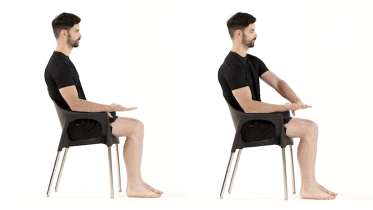 Isometric wrist flexion
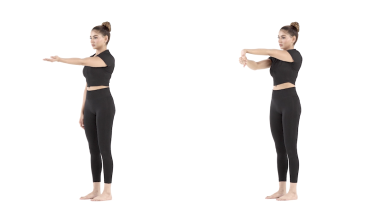 Wrist flexor stretch
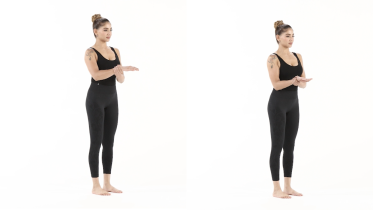 Pronator stretch
Stage 2: Strengthen the wrist and forearm
When the static holds feel easy and gripping in daily life is a little less sore. The wrist curl is the main exercise in many golfer's elbow programs, and a small water bottle is light enough to start with. If lifting hurts more than lowering, use your other hand to help the weight up and let the sore side lower it slowly on its own, over a few seconds. Turning the palm down against a band works the muscle that turns the forearm over (pronator teres), which OrthoInfo names as the muscle most often involved, so start with the lightest band or with no band at all. The grip squeeze uses the same forearm muscles; squeeze firmly but well short of your hardest.
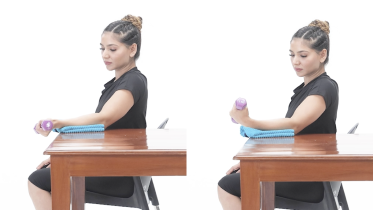 Wrist curl
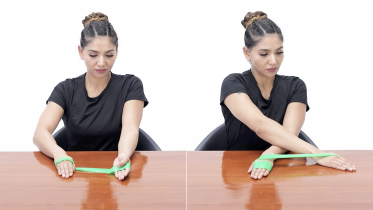 Forearm pronation with band
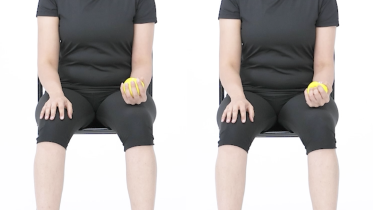 Hand grip squeeze
Stage 3: Heavier loading and the rest of the arm
When 2 to 3 sets of wrist curls with a light weight feel easy and the elbow settles well the next day, keep going with them and add weight in small steps. The wrist twist with a flexible bar is optional: in its video the bar stays upright and both wrists work at once, so hold the top of the bar with your sore arm's hand, because that wrist bends forward as you twist, and let the bar untwist slowly. The small golfer's elbow study used a different setup, where the good hand twists the bar and the sore wrist lets it untwist slowly on its own, so ask your physio which suits you. Forearm rotation with a dumbbell trains turning both ways, and the biceps curl builds strength for lifting and carrying, though you still grip the weight, so start light; the band row is for people whose physio finds weakness around the shoulder blade, an idea borrowed from tennis elbow care. This is also the stage to practice what you need to get back to, such as a golf swing, a throw or a work task, at a lighter load and for less time than usual.
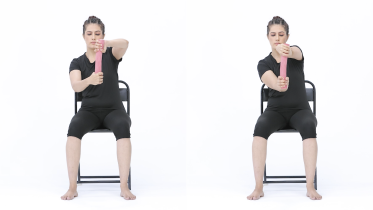 Wrist twist with a flexible bar
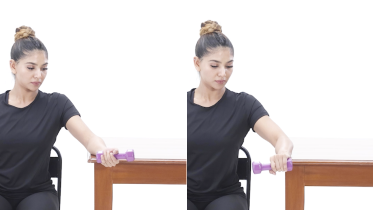 Forearm rotation with a dumbbell
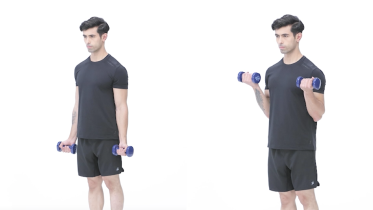 Biceps curl
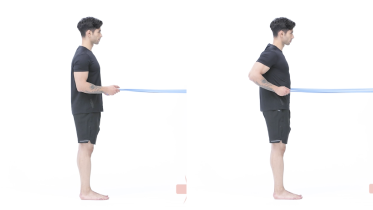 Resistance band row
What to change at work, in sport and at home
What you do the rest of the day matters too. The Royal Orthopaedic Hospital leaflet suggests resting the elbow between bouts of activity or stopping sport for a few weeks. It also suggests changing or avoiding the movements that hurt, sharing the load with your shoulder and upper arm muscles, and gripping more lightly or using a thicker handle.
OrthoInfo suggests ice on the sore area for 20 minutes at a time, several times a day (wrap it in a cloth rather than putting it straight on the skin), and a short course of anti-inflammatory medicine if you can take it. Ask a pharmacist or doctor if you are not sure a medicine is safe for you.
For golfers and throwers, OrthoInfo lists poor technique and unsuitable equipment as risk factors, so a coach or physio looking at your swing or throw can be worth it. Build back up gradually rather than returning to full sessions at once.
If your fingers tingle, protect the nerve behind the elbow. OrthoInfo's advice for that nerve is to avoid leaning on your elbow or pressing on the inside of the arm, and to keep the elbow straight at night if numb fingers wake you, for example with a towel wrapped loosely around the straight elbow.
A forearm strap may ease pain during activity for some people. There is little research on straps for golfer's elbow, so treat one as a support for the exercises rather than a replacement.
If things are still not improving after several months of this kind of care, OrthoInfo says surgery may be considered, and a specialist can talk that through with you. Rehab after surgery is not covered on this page.
When to see a physio or doctor
See a physio or doctor if your elbow pain is not easing after a few weeks of looking after it yourself, or if it stops you working, sleeping or playing your sport. It is also worth a proper assessment if you are not sure the pain is golfer's elbow, because pain on the inner elbow can also come from the nerve behind the elbow, the ligament on the inner side (common in throwers), the neck, or the joint itself.
If you already have a program and it is not helping after several weeks, a physio can check the diagnosis and change the load. The warning signs below need prompt medical attention.
For physiotherapists
This page gives patients a starting framework for medial elbow tendinopathy managed without surgery. There is no dedicated clinical practice guideline for it, and the evidence base is small. Hoogvliet and colleagues (2013) found no medial trials to include. See and colleagues (2026) found 5 studies (n = 143) of eccentric loading, with within-group gains in pain and function, between-group superiority in one RCT, and low overall certainty.
Tyler and colleagues (2014) was a case series of 20 patients with chronic medial epicondylosis that had failed earlier care. An isolated eccentric wrist flexor exercise with a FlexBar was added to standard physical therapy: the uninvolved wrist twisted the bar, and the involved wrist let it untwist over about 5 seconds, 3 sets of 15, twice a day on days without a clinic visit, for about 6 weeks on average. DASH scores improved markedly, but there was no control group and other treatments ran alongside. Stahl and Kaufman (1997) randomized 60 elbows to methylprednisolone or saline with lidocaine, alongside physical therapy and NSAIDs. Pain on a modified Nirschl grading was lower with the steroid at 6 weeks, though visual analog pain scores did not differ, and there was no difference at 3 months or 1 year.
Progression on this page follows the lateral elbow CPG by analogy (Lucado and colleagues, 2022): isometric, then concentric, then eccentric loading as tolerated, with shoulder and scapular work when impairments are found. None of that has been tested for the medial side. Base progression on pain-free grip and the 24-hour response rather than a fixed sheet.
Screen the ulnar nerve and the ulnar collateral ligament. Konarski and colleagues (2023) describe two types of medial epicondylitis, without and with ulnar nerve involvement. Tahir and colleagues (2026) list ulnar nerve entrapment, ligament injury, olecranon bursitis, arthritis and cervical radiculopathy among the differentials, and note that it may be appropriate to check UCL integrity given the overlap in presentation. In overhead throwers with medial pain, a pop or reduced throwing velocity, assess UCL integrity before loading and refer if it is in doubt. Ulnar sensory change, intrinsic weakness or wasting, or symptoms provoked by sustained elbow flexion call for a nerve-focused assessment and possible referral rather than more tendon loading.
See a doctor promptly if
- Emergency: any sign of a stroke, even if it goes away. That means a face that droops on one side, an arm you cannot lift or keep up, slurred or muddled speech, weakness or numbness on one side of your body or face, sudden blurred vision, double vision or loss of sight, trouble swallowing, sudden dizziness with unsteadiness or falling over, a sudden severe headache, or a sudden fall where your legs give way but you do not black out (a drop attack). Call emergency services straight away.
- Emergency: after a fall or a blow to the elbow, the arm has changed shape or sits at an odd angle, a bone is showing through the skin, a cut is bleeding heavily, or the hand has gone numb or tingly or turns cold, pale or blue. Go to an emergency department or call emergency services straight away, and do not drive yourself.
- The pain started with a fall or a blow to the elbow, and the pain is severe, you heard a snap, the elbow is swollen or bruised, or you cannot bend or straighten the arm. Go to an urgent care center or emergency department the same day.
- You throw, and you heard a pop or felt a sudden snap on the inside of the elbow, followed by pain, a throw you could not finish, or an elbow that feels loose or unstable. Stop throwing straight away and see a doctor within a day or two, because the ligament on the inner side of the elbow (ulnar collateral ligament) may be injured.
- Your hand is getting weaker, you keep dropping things, your fingers feel clumsy, or the web of muscle between your thumb and index finger, or the little finger side of your palm, looks thinner or hollow compared with your other hand. This can mean the nerve behind the elbow is being squeezed. See a doctor within a few days. If the weakness is getting worse from day to day, get medical advice the same day.
- You have numbness, tingling or pins and needles in your hand or fingers, most often the ring and little fingers. Stop any exercise that brings it on and see a physio or doctor. For the ring and little fingers, OrthoInfo advises seeing a doctor if the symptoms are severe, or if milder symptoms have lasted more than 6 weeks.
- Pain spreads from your neck down the arm, or turning or tilting your neck brings on the arm pain. See a physio or doctor, because the problem may be in the neck rather than the elbow.
- The elbow locks, catches or keeps giving way in everyday use, without a pop from throwing. See a physio or doctor rather than pushing on with the exercises.
- The elbow is hot, red and swollen, or you have elbow pain with a high temperature or feel hot, cold or shivery. Get medical advice the same day, and go to an emergency department if you feel very unwell. This can be a sign of infection in the joint, which needs treatment quickly.
- The pain is there at night or at rest and keeps getting worse. See your doctor within a few days. If you have had cancer, now or in the past, or are losing weight without trying, see your doctor sooner, within a day or two, and mention it. This applies even if the pain is not getting worse. If you are being treated for cancer now, contact your cancer team the same day.
Common questions
How long does golfer's elbow take to heal?
It varies, and it can be slow. A physiotherapy leaflet from the Royal Orthopaedic Hospital, an NHS hospital in Birmingham, says it will settle on its own but that this could take months or years. In a trial of steroid injections for golfer's elbow, both groups improved over a year, and the authors put much of that down to the natural course of the condition. Surgery is usually only considered when symptoms have not improved after several months of non-surgical treatment. A physio can help if it is slow to settle.
Should I rest golfer's elbow or exercise it?
Usually a bit of both. Rest the elbow between bouts of activity, and cut back on the gripping and lifting that clearly flare it. For sport, a break of a few weeks may help. OrthoInfo describes exercise as the main treatment: stretches to get full, pain-free wrist movement first, then strengthening for the muscles that bend the wrist and turn the palm down. Your physio will adjust the load to your elbow.
What is the difference between golfer's elbow and tennis elbow?
The side of the elbow. Golfer's elbow is pain on the inner side, where the muscles that bend your wrist and turn your palm down attach. Tennis elbow is pain on the outer side, where the muscles that lift your wrist and fingers attach. Both are tendon problems from more load than the tendon can handle, and both are treated mainly with graded exercise. Tennis elbow is much more common and has far more research behind it.
Does a brace help golfer's elbow?
It may ease pain for some people. OrthoInfo lists a forearm strap (counterforce brace) or a wrist brace among the first treatments a doctor may suggest. Research on straps for golfer's elbow is limited, so use one alongside exercise rather than instead of it, and take it off if your fingers start to tingle.
Are steroid injections good for golfer's elbow?
They can ease pain for a few weeks, but the benefit does not seem to last. In a trial of 58 people with golfer's elbow, a steroid injection gave less pain on one of two pain scores at 6 weeks than an injection without the steroid, but there was no difference at 3 months or at 1 year. OrthoInfo adds that, according to some research, these injections may lengthen rehab and make tendon damage worse. The decision is one to make with your doctor.
Can you get golfer's elbow without playing golf?
Yes. Golf is only one cause. OrthoInfo lists throwing sports, tennis and weightlifting, and says it can come from everyday tasks such as household chores. The Royal Orthopaedic Hospital leaflet links it to repeated or strenuous bending of the wrist, which covers many manual jobs.
References
- American Academy of Orthopaedic Surgeons. Medial epicondylitis (golfer's elbow). OrthoInfo. https://www.orthoinfo.org/en/diseases--conditions/medial-epicondylitis-golfers-elbow/
- Royal Orthopaedic Hospital NHS Foundation Trust. Golfer's elbow/medial epicondylitis. https://roh.nhs.uk/services-information/therapy/golfers-elbow
- See ZH, Loo CE, Jaafar Z. Eccentric exercise therapy for medial epicondylitis: a systematic review of clinical outcomes. Complementary Therapies in Medicine. 2026;98:103364. https://doi.org/10.1016/j.ctim.2026.103364
- Hoogvliet P, Randsdorp MS, Dingemanse R, Koes BW, Huisstede BM. Does effectiveness of exercise therapy and mobilisation techniques offer guidance for the treatment of lateral and medial epicondylitis? A systematic review. British Journal of Sports Medicine. 2013;47(17):1112-1119. https://doi.org/10.1136/bjsports-2012-091990
- Amin NH, Kumar NS, Schickendantz MS. Medial epicondylitis: evaluation and management. Journal of the American Academy of Orthopaedic Surgeons. 2015;23(6):348-355. https://doi.org/10.5435/JAAOS-D-14-00145
- Tyler TF, Nicholas SJ, Schmitt BM, Mullaney M, Hogan DE. Clinical outcomes of the addition of eccentrics for rehabilitation of previously failed treatments of golfers elbow. International Journal of Sports Physical Therapy. 2014;9(3):365-370. https://pmc.ncbi.nlm.nih.gov/articles/PMC4060314/
- Stahl S, Kaufman T. The efficacy of an injection of steroids for medial epicondylitis: a prospective study of sixty elbows. Journal of Bone and Joint Surgery (American volume). 1997;79(11):1648-1652. https://doi.org/10.2106/00004623-199711000-00006
- Lucado AM, Day JM, Vincent JI, MacDermid JC, Fedorczyk J, Grewal R, Martin RL. Lateral Elbow Pain and Muscle Function Impairments: Clinical Practice Guidelines. Journal of Orthopaedic and Sports Physical Therapy. 2022;52(12):CPG1-CPG111. https://doi.org/10.2519/jospt.2022.0302
- Vuvan V, Vicenzino B, Mellor R, Heales LJ, Coombes BK. Unsupervised isometric exercise versus wait-and-see for lateral elbow tendinopathy. Medicine and Science in Sports and Exercise. 2020;52(2):287-295. https://doi.org/10.1249/MSS.0000000000002128
- Tahir A, Chanian N, Tiwana S, Sahu MA, Blackwell J. Medial epicondylitis: a review of clinical presentation, diagnosis, and management in the United Kingdom. Cureus. 2026;18(1):e102264. https://doi.org/10.7759/cureus.102264
- Konarski W, Poboży T, Poboży K, Domańska J, Konarska K. Current concepts of natural course and in management of medial epicondylitis: a clinical overview. Orthopedic Reviews. 2023;15. https://doi.org/10.52965/001c.84275
- American Academy of Orthopaedic Surgeons. Cubital tunnel syndrome (ulnar nerve entrapment at the elbow). OrthoInfo. https://www.orthoinfo.org/en/diseases--conditions/ulnar-nerve-entrapment-at-the-elbow/
- American Academy of Orthopaedic Surgeons. Ulnar collateral ligament (UCL) injury. OrthoInfo. https://www.orthoinfo.org/en/diseases--conditions/ulnar-collateral-ligament-ucl-injury/
- American Academy of Orthopaedic Surgeons. Throwing injuries in the elbow in children. OrthoInfo. https://www.orthoinfo.org/en/diseases--conditions/throwing-injuries-in-the-elbow-in-children/
- NHS. Broken arm or wrist. Page last reviewed 26 May 2023. https://www.nhs.uk/conditions/broken-arm-or-wrist/
- NHS. Septic arthritis. Page last reviewed 3 September 2026. https://www.nhs.uk/conditions/septic-arthritis/
- NHS. Symptoms of a stroke. Page last reviewed 12 September 2024. https://www.nhs.uk/conditions/stroke/symptoms/
Written and checked by the PocketPhysio editorial team. Last updated 2026-09-28.
This page is general education, not a diagnosis or a personal treatment plan. See a physiotherapist or doctor for advice about your own situation.