Forearm rotation with a dumbbell
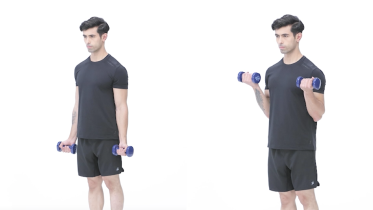
Forearm rotation with a dumbbell strengthens the muscles that turn your palm up (supinators) and turn it down (pronators). You sit beside a table with your wrist resting on its edge and your hand just past it, then slowly roll a light dumbbell from palm down to palm up and back again. It is a common part of rehab after wrist, forearm and elbow injuries, and for people whose work or sport involves a lot of turning, such as using a screwdriver.
How to do the forearm rotation with a dumbbell
- Sit on a chair beside a table, close enough to reach its edge. Hold a light dumbbell in the middle of the handle with the hand you are working.
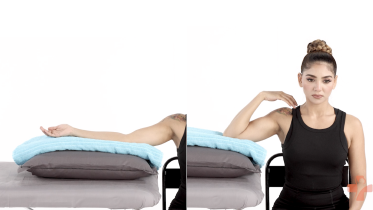
- Rest the underside of your wrist on the table edge, as in the video, so the hand and weight are just past the edge. Many physios prefer the elbow bent to about a right angle with the upper arm by your side and the forearm lying on the table, because this stops the shoulder helping. Use that setup if your physio suggests it.
- Start with your thumb on top. Slowly turn the palm down toward the floor.
- Then roll the other way, back through thumb up, until the palm faces up. Only the forearm turns. Your elbow and upper arm stay still.
- Keep turning slowly from palm down to palm up and back, with the same speed both ways.
What you should feel
Work through the forearm near the elbow, on the front and the outer side. The front of the upper arm often joins in as the palm turns up.
Common mistakes
- Lifting the elbow or swinging the upper arm out to the side to help the turn.
- Letting the weight flop over instead of turning it with control.
- Bending the wrist up or down as you turn instead of keeping it level with the forearm.
- Picking a weight that is too heavy. A light one is plenty to start.
How often
A light weight for 2 to 3 sets of 10 to 15 slow turns, once a day, is a common place to start. Your physio will adjust this and help you choose the weight.
Stop and check with your physio if
- Sharp pain in the wrist, forearm or elbow during a turn.
- A painful click or clunk at the wrist.
- Tingling or numbness in the hand or fingers.
- Pins and needles in your arm or hand that do not go away after you stop, or part of your arm or hand goes numb. Get medical advice the same day. If one side of your face or body suddenly goes numb or weak, or your speech becomes slurred or muddled, call emergency services, even if it goes away.
- A sudden pop or snap at the front of your elbow, sudden sharp pain there, or the muscle at the front of your upper arm bunches up or changes shape. Stop and go to an urgent care center or emergency department the same day, even if you can still bend the elbow, as this can be a torn biceps tendon.
From the clinic
Where you grip the dumbbell changes how hard this feels. Holding it in the middle is the easiest. Gripping nearer one end makes the weight harder to control, and some physios use that, or a small hammer held by the handle, as a later step.
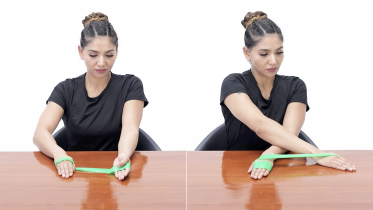
After a broken wrist, hand or forearm, or surgery on any of them such as a tendon repair, start only when your doctor, surgeon, physio or hand therapist says the bone or repair is ready for this, and follow their plan for how much to do. To train each direction with a band instead, see forearm supination with band and forearm pronation with band.
After a broken or dislocated elbow, or elbow surgery such as a tendon repair, follow your surgeon's or physio's plan, and start this exercise only when they have cleared you. If you have just hurt your arm and have severe pain, cannot move the elbow or heard a snap, do not exercise it. Go to an urgent care center or emergency department the same day. If the arm looks a different shape or sits at an odd angle, a bone is showing, or your arm or hand tingles, feels numb or turns cold, pale or blue, go to an emergency department straight away or call emergency services, and do not drive yourself.
Written and checked by the PocketPhysio editorial team. Last updated 2026-09-28.
This page is general education, not a diagnosis or a personal treatment plan. If you have pain, an injury or a health condition, see a physiotherapist or doctor before starting new exercises.