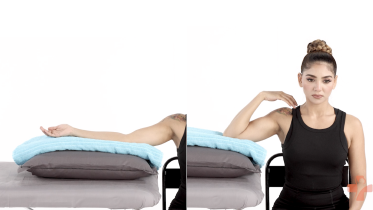
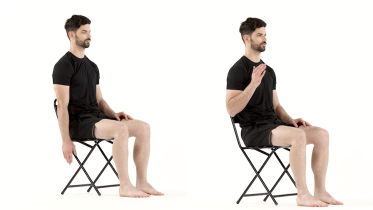
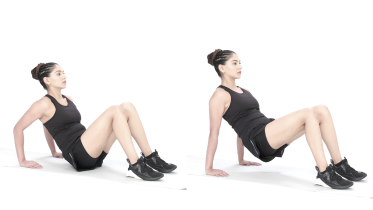
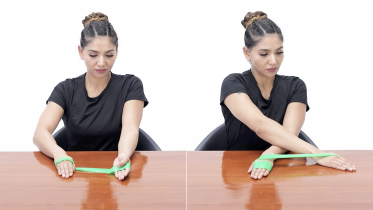
Triceps lifts
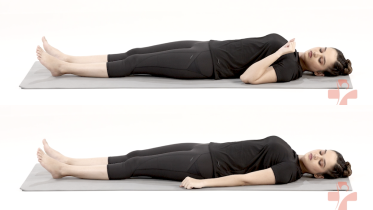
Triceps lifts work the back of your upper arms and shoulders while you lie face down. With your forehead resting on the mat and your arms straight by your sides, you lift both arms up behind you toward the ceiling, hold for a moment, then lower them. The triceps keeps the elbows straight and, together with the muscles at the back of the shoulder, helps draw the arms back.
How to do the triceps lifts
- Lie on your stomach on a mat with your legs straight and your forehead resting on the mat or on a small folded towel.
- Lay your arms straight along your sides, with your hands beside your thighs.
- Straighten your elbows fully and lift both arms up off the mat behind you, as far as you can without your head or chest coming up. Your legs stay on the mat.
- Pause briefly at the top, breathing out as you lift.
- Lower your arms slowly back to the mat, breathing in, and repeat.
What you should feel
Work at the back of your upper arms and the back of your shoulders. You may feel a stretch across the front of the shoulders at the top of each lift.
Common mistakes
- Bending the elbows as the arms rise, which takes the work away from the triceps.
- Lifting your head, chest or legs to get the arms higher.
- Hitching your shoulders up toward your ears as the arms rise.
- Flinging the arms up fast instead of lifting and lowering them under control.
How often
Many programs use 2 to 3 sets of 8 to 12 lifts, with a brief pause at the top of each, 2 to 3 days a week. Your physio will adjust this.
Stop and check with your physio if
- Pinching or sharp pain in the front of the shoulder at the top of the lift.
- Pain, pins and needles or numbness spreading down your arm or into your hand.
- Pins and needles in your arm or hand that do not go away after you stop, or part of your arm or hand goes numb. Get medical advice the same day. If one side of your face or body suddenly goes numb or weak, or your speech becomes slurred or muddled, call emergency services, even if it goes away.
- Lying face down makes your lower back or neck ache more with each lift.
- A sudden pop or tearing feeling in the shoulder that brings sharp pain, new weakness or trouble lifting the arm. Stop and contact your surgical team the same day, or get medical advice the same day if you have not had surgery.
From the clinic
The voice guide describes a harder move, lifting the upper body and then the legs as well. The video shows only the arms lifting while the body and legs stay on the mat, and this page follows the video. Lifting the chest and legs turns it into a back extension exercise such as the superman exercise, which is a separate choice to make with your physio. If you have high blood pressure, breathe steadily through every repetition and never hold your breath.
Lifting straight arms behind the body loads the back of the shoulder and stretches the front of it. After shoulder surgery, including a rotator cuff repair, or after a shoulder fracture or dislocation, follow your surgeon's or physio's plan, and do only the movements and range they have cleared. Many plans allow only passive movement at first, where the arm is moved for you and its muscles stay relaxed. If the front of your shoulder is painful, or it has felt unstable before, ask your physio before you try this, and keep the lift small. After a broken or dislocated elbow, or elbow surgery such as a tendon repair, follow your surgeon's or physio's plan, and start this exercise only when they have cleared you.
If you have just hurt your arm and have severe pain, cannot move the elbow or heard a snap, do not exercise it. Go to an urgent care center or emergency department the same day. If the arm looks a different shape or sits at an odd angle, a bone is showing, or your arm or hand tingles, feels numb or turns cold, pale or blue, go to an emergency department straight away or call emergency services, and do not drive yourself.
Height is not the aim here, so stop each lift where you can still keep your shoulders down and away from your ears. Prone shoulder extension uses the same face-down position with more focus on setting the shoulder blades. If you are pregnant, lying on your stomach usually stops being comfortable as the bump grows, so ask your physio for a version done sitting or standing.
Written and checked by the PocketPhysio editorial team. Last updated 2026-09-28.
This page is general education, not a diagnosis or a personal treatment plan. If you have pain, an injury or a health condition, see a physiotherapist or doctor before starting new exercises.