Prone shoulder extension
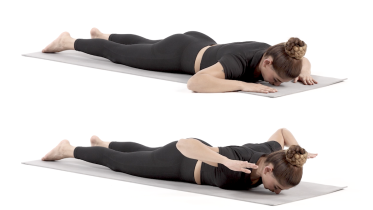
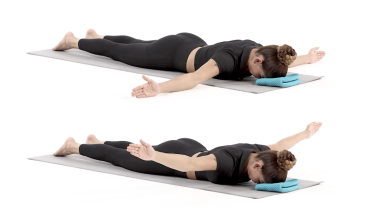
Prone shoulder extension works the muscles that draw your shoulder blades back and down (lower and middle trapezius, rhomboids) and the ones that lift the arms behind you. You lie face down with your arms by your sides, set your shoulder blades, and lift both straight arms off the floor. Physios often use it to train shoulder blade control in shoulder and upper back rehab.
How to do the prone shoulder extension
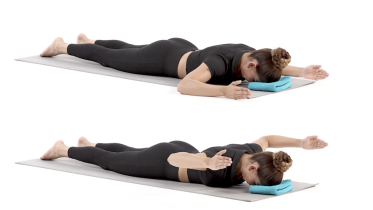
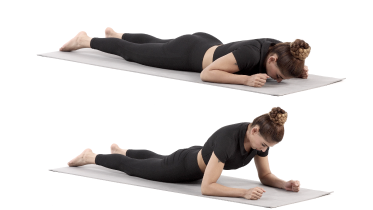
- Lie on your stomach on a mat with your legs straight. Rest your forehead on the mat, or on a small folded towel, so your neck stays in line.
- Place your arms along your sides with the palms facing down and the hands near your hips.
- Gently draw your shoulder blades back and down, toward your back pockets.
- Keep the elbows straight and lift both arms off the floor toward the ceiling. In the video the hands rise to about the height of the hips. Your head and chest stay down.
- Hold briefly, then lower the arms slowly and relax.
What you should feel
Work between and below your shoulder blades and at the back of the shoulders. Your neck and lower back should stay quiet.
Common mistakes
- Shrugging toward your ears as the arms lift.
- Raising your head or chest to get the arms higher.
- Bending the elbows or swinging the arms up quickly.
How often
A common starting point is 2 to 3 sets of 8 to 12 lifts with a hold of 3 to 5 seconds, once a day. Your physio will adjust this.
Stop and check with your physio if
- The shoulder catches or hurts sharply as your arms lift.
- Your arm starts to tingle, or pain spreads down it.
- Pins and needles in your arm or hand that do not go away after you stop, or part of your arm or hand goes numb. Get medical advice the same day. If one side of your face or body suddenly goes numb or weak, or your speech becomes slurred or muddled, call emergency services, even if it goes away.
- Your neck or lower back gets more painful as the set goes on.
From the clinic
Height is not the goal. Lift only as far as you can keep the shoulder blades back and down, and start with a small lift of an inch or so if that is all you can control. Swing the arms up high and the neck tends to take over, so the muscles you are trying to train do less. The voice guide suggests adding weight to the hands to make it harder, and a light dumbbell or a small water bottle in each hand is a common way to do that once the plain version is easy.
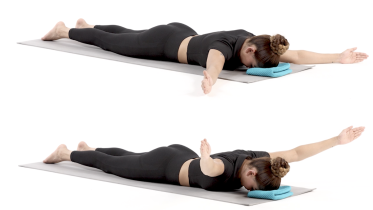
If lying face down is uncomfortable, the seated scapular squeeze trains a similar shoulder blade action sitting up. The prone T raise and prone Y raise use the same face-down position with the arms in other directions. If you are pregnant, lying on your stomach usually stops being comfortable as the bump grows, so ask your physio for a version done sitting or standing. After shoulder surgery, your surgeon's protocol comes first, so check with your surgeon and physio before lifting the arms against gravity like this.
Written and checked by the PocketPhysio editorial team. Last updated 2026-09-28.
This page is general education, not a diagnosis or a personal treatment plan. If you have pain, an injury or a health condition, see a physiotherapist or doctor before starting new exercises.