Prone L lift
The prone L lift is a face-down exercise for the muscles between and below your shoulder blades (middle and lower trapezius, rhomboids). Your upper arms rest out level with your shoulders and your elbows bend to a right angle, so each arm makes an L. You then squeeze the shoulder blades together to lift both arms off the mat. Physios often add it to shoulder and upper back programs when the shoulder blades need better control.
How to do the prone l lift
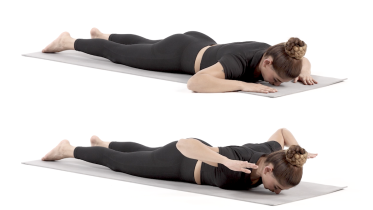
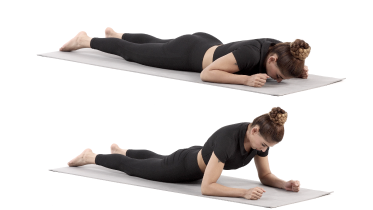
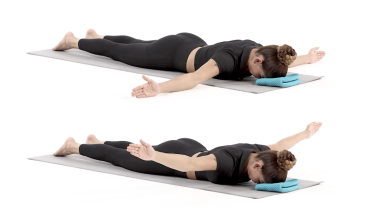
- Lie on your front on a mat. Rest your forehead on a small folded towel and let your legs lie straight.
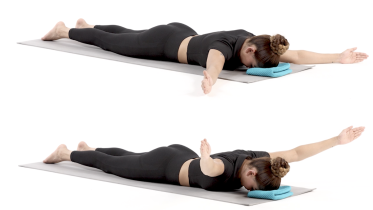
- Take your upper arms out to the sides, level with your shoulders, and bend each elbow to a right angle so your forearms point toward the top of the mat. Each arm now makes an L.
- Turn your hands so the palms face each other and the thumbs point up toward the ceiling.
- Squeeze your shoulder blades back together and let that squeeze raise both arms off the mat, elbows still bent. Your forehead and chest stay down.
- Hold for a few seconds at the top, then lower both arms to the mat and relax before the next lift.
What you should feel
You should feel it between your shoulder blades and around the back of both shoulders, while your neck and the tops of your shoulders stay relaxed.
Common mistakes
- Arching your upper back so your chest comes up with the arms. Only the arms leave the mat.
- Letting the tops of the shoulders creep up as you lift. Keep a long gap between your shoulders and ears.
- Letting the elbows open out or the hands drop toward the mat, so the L loses its shape.
- Flicking the arms up quickly instead of lifting and lowering with control.
How often
Many programs begin with 2 to 3 sets of 8 to 10, with a 3 to 5 second hold at the top of each lift, once a day. Your physio will adjust this.
Stop and check with your physio if
- A sharp pain, a pinch or a catch in the shoulder as the arms rise.
- Pins and needles, numbness or pain spreading down an arm or into your hand.
- Pins and needles in your arm or hand that do not go away after you stop, or part of your arm or hand goes numb. Get medical advice the same day. If one side of your face or body suddenly goes numb or weak, or your speech becomes slurred or muddled, call emergency services, even if it goes away.
- A sudden pop or tearing feeling in the shoulder that brings sharp pain, new weakness or trouble lifting the arm. Stop and contact your surgical team the same day, or get medical advice the same day if you have not had surgery.
- The shoulder feels as if it has slipped out of place, looks a different shape or suddenly locks so you cannot move the arm, or your hand turns cold, pale or blue. Go to an emergency department straight away, without driving yourself, and do not try to put the shoulder back in yourself.
From the clinic
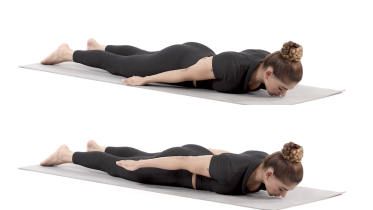
Bent elbows make each arm a shorter lever than in the prone T raise, so it is often the easier of the two. The prone Y raise, arms reaching past your head, is usually harder again. A few centimeters is plenty, as long as the shoulder blades start the lift. If both arms together is too much, work one arm and leave the other resting on the mat.
A pillow under your stomach can take the strain off a sore lower back. If your neck or back still aches after you roll over, mention it to your physio. Lying face down is one to clear with your physio if you are pregnant. If you have high blood pressure, breathe steadily through every hold and never hold your breath.
In the L position each upper arm is out to the side with the forearm turned up toward your head, and the lift takes it slightly behind you. A shoulder that has dislocated forward tends to feel least secure in exactly that position, so if yours has, ask your physio before you add this one. After shoulder surgery, including a rotator cuff repair, or after a shoulder fracture or dislocation, follow your surgeon's or physio's plan, and do only the movements and range they have cleared. Many plans allow only passive movement at first, where the arm is moved for you and its muscles stay relaxed.
Written and checked by the PocketPhysio editorial team. Last updated 2026-09-28.
This page is general education, not a diagnosis or a personal treatment plan. If you have pain, an injury or a health condition, see a physiotherapist or doctor before starting new exercises.