
TFCC injury (ulnar sided wrist pain) exercises and recovery
Warning signs, and when to get help
What is a TFCC injury?
TFCC stands for the triangular fibrocartilage complex. It is a small, tough structure that fills the gap between the end of the ulna, the forearm bone on the little finger side, and the two wrist bones that sit below it. It does two jobs at once: it cushions the load that passes up that side of the wrist, and it ties the two forearm bones together where they meet at the wrist (the distal radioulnar joint).
That second job is the one that decides your treatment. If the complex is torn but the link between the forearm bones still holds, the wrist is stable and the work is rehabilitation. If the link has gone, the end of the ulna can shift against the radius when you turn your palm, and that instability is usually what takes someone to an operation (Atzei and colleagues, 2017).
Two routes lead here. One is a single moment: a fall onto an outstretched hand, a twist with a racket or a bat, a drill or a steering wheel that kicks back. The other is slow, from years of load or from an ulna that sits slightly long, so the pad gets ground down rather than torn in one go (Satria and colleagues, 2025). The slow kind is often painless for a long time and then starts complaining, which is why some people cannot name the day it began.
What it feels like
The pain sits on the little finger side of the wrist, in the soft dip just past the knobbly end of the forearm bone. The movements that find it are the ones that pass load through that corner: pushing up out of a chair, turning a door handle or a key, wringing out a cloth, opening a jar, leaning on the hand, taking a frying pan out of the oven.
Clicking and clunking are common, and so is a wrist that feels as if it might give way under a push. People often say it is not the pain that stops them, it is not trusting the wrist. Swelling is usually mild or absent, which is part of why these injuries get dismissed early on.
Ulnar sided wrist pain: what else it could be
Pain on this side of the wrist is a short list of possibilities rather than one diagnosis, and the TFCC is only the most talked about. The tendon that runs in a groove behind the end of the ulna can be irritated, or it can slip out of that groove altogether. Where the ulna sits slightly long, the small wrist bones can be impacted against the end of it. A ligament between two of the wrist bones can be torn. And a fracture that never showed up on the first X-ray can simply be sitting there.
Satria and colleagues (2025) set out how a clinician works through that list. The order is the part worth knowing: the hands-on assessment for stability comes before imaging, not after it.
Pain on the thumb side of the wrist is a different page. Try de Quervain's tenosynovitis if it hurts to lift the thumb, or pain at the base of the thumb if the ache sits in the joint itself. Numbness or pins and needles in the thumb, index and middle fingers point at carpal tunnel syndrome rather than at the TFCC. If your wrist was broken, follow the broken wrist program and your fracture clinic's plan instead of this one.
TFCC injury treatment without surgery
Most stable tears are treated without an operation, and the published pathway has a shape to it rather than a list of exercises. Liu and Zhou (2026) describe three phases: protect and settle, then load the tissue progressively, then retrain the control and the function the wrist needs. Each phase is entered on how the wrist is behaving, not on the calendar, and their own entry markers are things you can check at home, such as resting pain down to a low level, no pain at night, and grip returning as a share of the other hand.
They also say plainly that the evidence behind TFCC rehabilitation is sparse and uneven, and that their staged pathway is a framework built from the literature and clinical reasoning rather than a tested guideline. That is worth knowing before you follow anybody's protocol, including ours.
The one trial-shaped piece of evidence is small. Teh and colleagues (2026) followed 32 people at a single center with pain on the little finger side and tenderness in the fovea, with or without a loose forearm joint, through 4 weeks in a splint, 3 to 4 weeks of work on the muscles that stabilize the forearm joint, and 4 weeks of retraining. Of the 21 reviewed at a year, average pain had fallen by 4 points on a 10 point scale, the people who completed the program did better than those who dropped out, and nobody had needed surgery in that year. One series at one center is not proof, but it is better than a rep count from a page with no author.
Non-surgical care is more than exercise. Splinting early, changing the loads your wrist meets at work and in sport, and pain relief all sit alongside it. Liu and Zhou put anti-inflammatory medicine and injections in the early settling phase rather than in the treatment of the tear, which is how to think about them: they can make the rehabilitation possible, and they do not mend anything. We give no figure for how long they help, because the one in that review traces back to a trial in a different joint disease altogether.
How to use this program
Start at stage 1 if the wrist is sore at rest or you are in a splint. If it has been quiet for weeks and only complains under load, stage 2 is the better starting point. Move up when the current stage is easy and the wrist is no worse the next morning, and drop back a stage for a few days if it flares.
Each exercise page gives its own starting numbers. Across this program that is mostly 2 to 3 sets of 10 to 15, with the holds at 5 to 10 seconds and the hand movements done in short bursts several times a day. Your physio will adjust the exercises and the numbers to your tear, your job and your sport.
If you have high blood pressure, breathe steadily through every hold and never hold your breath. That covers the grip work and the gripper in the later stages as well as the holds in stage 2, because squeezing hard against something that does not move is the part of this program that pushes blood pressure up.
Two things to settle before you start. First, whether anyone has checked the stability of the joint at the end of your forearm, because an unstable one changes the plan. Second, whether your splint is meant to stop the wrist bending, stop the forearm turning, or both, since the stage 3 rotation work contradicts a splint built to block rotation. If nobody has told you, ask before you start rather than guess.
Two more. If the wrist clicks, catches or locks painfully, or it gives way when you load it, have that looked at before you lean on this program, because the review the pathway comes from keeps non-surgical care for tears that leave the forearm joint stable and for worn tears without those mechanical symptoms (Liu and Zhou, 2026). The program is written for adults, so if a child or teenager has pain on the little finger side of the wrist, get them checked by a doctor or physio first.
If you have had an operation on the wrist, a repair of the TFCC itself or anything else, follow your surgeon's protocol and your hand therapist's plan rather than this page. Those protocols set their own limits on forearm rotation and on weight through the hand, and they come first. The same goes for a wrist that is still in a cast or a splint your fracture clinic fitted.
The exercise program
Stage 1: Settle it and keep everything else moving
For the first week or two, and while you are in a splint. The wrist itself is resting, so the job is to stop the hand, elbow and shoulder stiffening up around it. Open and close the hand, work through the tendon glides, touch the thumb to each fingertip, and bend and straighten the elbow, as far as the splint allows. Many programs use 5 to 10 slow rounds of each hand exercise several times a day and 10 to 15 elbow bends 2 or 3 times a day, and your physio will adjust this. Nothing in this stage should hurt at the back of the wrist. In the pathway described by Liu and Zhou (2026), a wrist support is worn through the day in the first 0 to 2 weeks, and their marker for moving on is pain at rest down to a low level with no pain waking you at night.
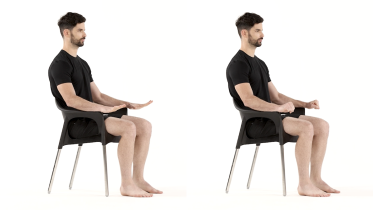 Open and close the hands
 Tendon glides
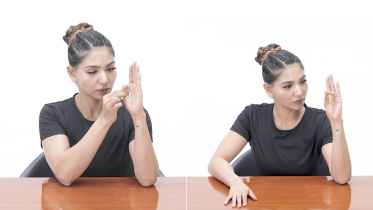 Thumb opposition
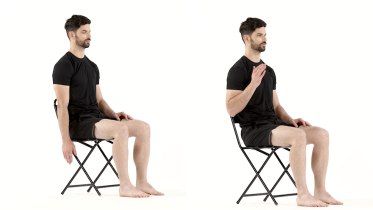 Elbow flexion and extension
Stage 2: Get the wrist moving, and hold it steady
Start when resting pain has settled and your physio or hand therapist says the wrist can move. Tip the wrist up and down, then side to side, and keep the side to side movement small and slow at first, because tipping the wrist toward the little finger is the direction that loads the injured corner. The four holds work the muscles that steady the wrist while the joint barely moves, which is why they usually come before anything that turns the forearm against resistance. A common starting point is 5 to 10 holds of 5 to 10 seconds once or twice a day. Push gently rather than hard: a hold should feel like the muscle switching on, not like a test. If the hold toward the little finger side is sharp at the back of the wrist, leave that one out, keep the other three going and tell your physio. If you have high blood pressure, breathe steadily through every hold and never hold your breath.
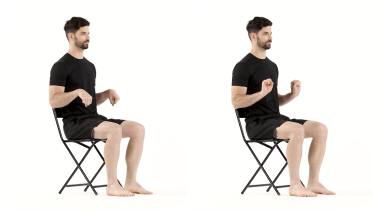 Wrist flexion and extension
 Wrist radial and ulnar deviation
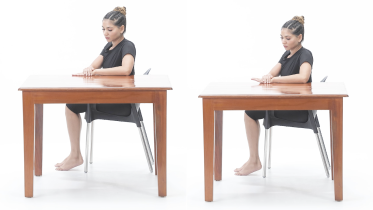 Isometric wrist extension
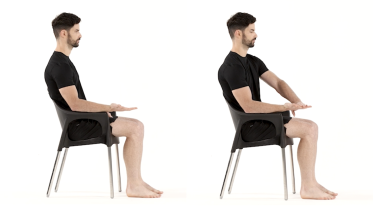 Isometric wrist flexion
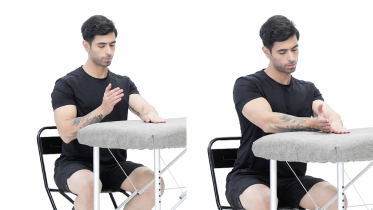 Isometric radial deviation
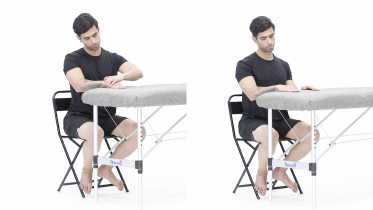 Isometric ulnar deviation
Stage 3: Forearm rotation and grip under load
This is the part most home programs leave out, and it is the part that matters for a TFCC injury, because turning the palm up and down is what the joint at the end of the forearm does. Teh and colleagues (2026) describe 3 to 4 weeks of work on the muscles that stabilize that joint after the splinting phase. Turn the palm up and down against a band, lift the hand against a band, curl the wrist, and squeeze a ball. Most of these start at 2 to 3 sets of 10 to 15, once a day or every other day, and your physio will adjust this. Mild discomfort that settles soon after you stop and leaves the wrist no worse the next morning is fine. A sharp catch on the little finger side means the load or the range was too much.
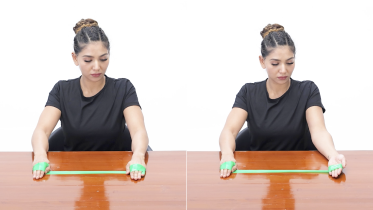 Forearm supination with band
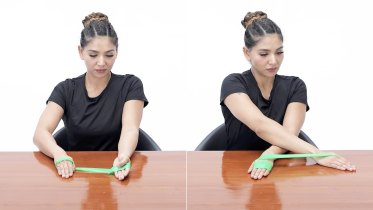 Forearm pronation with band
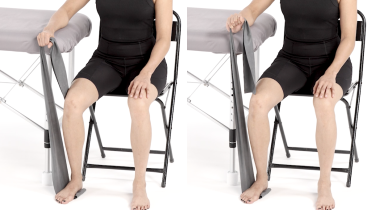 Wrist extension with band
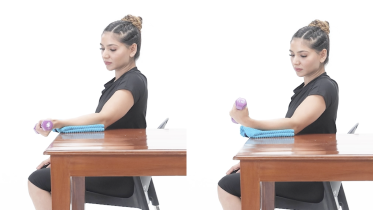 Wrist curl
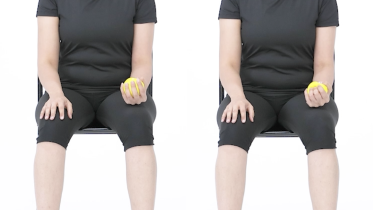 Hand grip squeeze
Stage 4: Load, twist and weight through the hand
Move on when grip no longer hurts and turning the palm up against a band feels easy. These four ask the wrist to control a weight that is trying to twist it, which is what a door handle, a kettle, a dumbbell and a pan all do. Leaning onto the hands comes last and only once your physio agrees, because that position squashes the little finger side of the wrist. Start with very little weight through the hand and build in small steps. If the push up position hurts at the back of the wrist, try it with the hands turned slightly outward or on a fist-free wedge rather than pushing through it, and tell your physio.
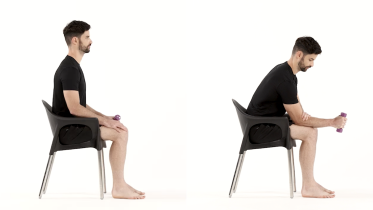 Wrist stability with a weight
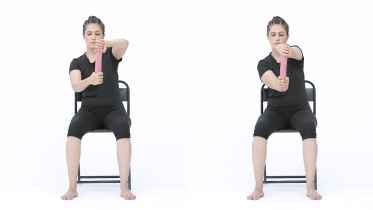 Wrist twist with a flexible bar
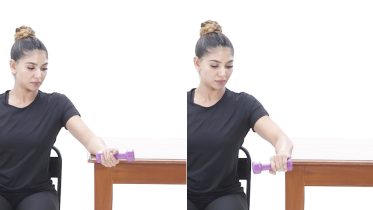 Forearm rotation with a dumbbell
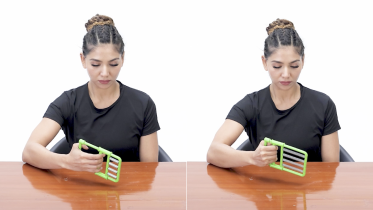 Hand gripper exercise
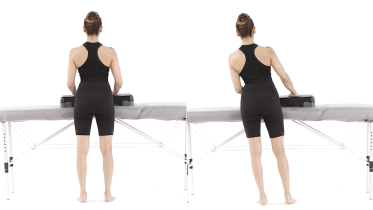 Standing weight shift onto the hands
TFCC tear exercises and the ones to avoid
The exercises that help a TFCC injury are not the ones most people pick for a sore wrist. Stretching the wrist back and forth has a place in getting the movement back, and on its own it does not change how the joint behaves under load. The part both published programs lean on is control: holding the wrist steady against a load, and turning the forearm against a light resistance so the muscles that cross the joint at the end of the forearm help hold it together (Liu and Zhou, 2026; Teh and colleagues, 2026).
Three positions to keep out of the early weeks. Tipping the wrist hard toward the little finger, because that is the direction that compresses the injured corner. Turning the palm up or down against real resistance, until stage 3. And taking body weight through a flat hand, which is why leaning onto the hands sits in stage 4 and nowhere earlier.
The practical swaps are worth more than the banned list. Push up from a chair with the other hand or through the forearm. Lift a pan with two hands, palms facing in, and open jars with a wall-mounted opener. Carry the shopping in a rucksack. And rather than turning the wrist over to pour, hold the kettle by its handle with the forearm vertical, or use a jug.
How long does a TFCC injury take to heal?
Slowly, and less completely than most people are told. The figures circulating on health websites are not sourced, but one study did follow the natural course. Lee and colleagues (2019) treated 72 wrists with a TFCC tear and a stable forearm joint without surgery and followed them for a mean of 16 months: about 3 in 10 were scored as a complete recovery on a wrist questionnaire by 6 months, and about half by a year. Their advice is a minimum of 6 months of non-surgical treatment as the first-line approach.
Liu and Zhou (2026) put the supervised trial at 3 to 6 months, which is the shorter end of the same idea, and in the one published rehabilitation series the structured program itself ran about 11 to 12 weeks (Teh and colleagues, 2026). None of those is a healing time. They are how long it takes to find out whether this wrist is going to settle with rehabilitation, and the honest reading of Lee's numbers is that about half of these wrists are still not fully recovered at a year.
What you can watch instead of a date is the direction of travel. Resting pain goes first, then night pain, then grip comes back, then the twisting tasks. If the wrist is heading the right way month by month, time is on your side. If it has been flat for six to eight weeks of real, loaded work, that is the point to ask what else is going on rather than to keep repeating the same program.
What we notice in the clinic
The commonest reason a TFCC injury drags on is not the tear. It is that the wrist has been rested for months, so the forearm muscles have faded and every task hurts because nothing is strong enough to hold the joint steady. Unloading a sore wrist works for two weeks and then becomes the problem.
Then there is the program that runs alongside the thing that caused the trouble. People get their holds and their band work done in ten minutes and then spend eight hours gripping and twisting at work. The band work is not the load that counts.
And the fist. When pushing up through a flat hand hurts, people try it on a closed fist, which does not take the load off the wrist, it just changes the angle. If the flat hand hurts, it is too early for that stage.
When to see a physio or doctor
See someone if pain on the little finger side of the wrist has not settled over two or three weeks, if the wrist clicks or clunks painfully when you grip or lean on it, or if it feels unstable. Get seen sooner if you cannot turn a key or a door handle, because that is the movement this structure controls.
Ask specifically whether the joint at the end of your forearm has been tested for stability, and what the answer was. It is the question that separates a wrist that needs a rehabilitation program from one that needs a surgeon's opinion, and it is easy to go years without anyone saying it out loud. The warning signs below cover what needs help faster, and how fast.
For physiotherapists
This page frames the non-surgical management of stable TFCC injury around the three-phase pathway in Liu and Zhou (2026), with criteria-based rather than time-based progression, and states openly that the authors describe it as a conceptual framework rather than a validated guideline. Phase entry markers on the page follow theirs: low resting pain and no night pain out of phase 1, pain-free active range and grip as a proportion of the contralateral side out of phase 2. Note the internal inconsistency in that paper between its phase 2 exit range criterion and its phase 3 entry range, which is one reason the page gives no percentage thresholds to the reader.
Teh and colleagues (2026) is the clinical series behind the program's shape (4 weeks of splinting, 3 to 4 weeks of dynamic distal radioulnar joint stabilizer work, 4 weeks of neuromuscular retraining; 32 enrolled, 29 evaluated, 21 reviewed at one year, mean numerical pain rating fall of 4 points, no surgery within one year, completers outperforming defaulters on weight-bearing ability and Modified Mayo Wrist Score at three months). Level IV, single center, high default rate. Barlow (2016) is a single-case report and is cited as such.
Distal radioulnar joint stability is the decision point. Atzei and colleagues (2017) separate class 1 peripheral tears, distal only with a stable distal radioulnar joint, from class 2 and class 3 tears involving the foveal attachment with instability and a positive hook test, which are the ones taken to foveal reattachment. Read their algorithm as arthroscopic throughout: it does not assign class 1 to conservative care, so it is cited here for the stability distinction and not as support for a non-surgical trial. The support for that trial is Lee and colleagues (2019) and Liu and Zhou (2026).
Satria and colleagues (2025) put the stability examination ahead of imaging in the diagnostic sequence. Figures circulating on consumer health pages for TFCC recovery time, and the rep counts on the protocol documents that rank for this search, are not traceable to a primary source and are not reproduced here.
The prognostic figures on the page come from Lee and colleagues (2019), which is the source behind the 3 to 6 month trial length quoted in Liu and Zhou: 72 wrists with a TFCC tear and no distal radioulnar joint instability, managed non-surgically, Kaplan-Meier cumulative incidence of complete recovery (patient-rated wrist evaluation 20 or less) 30 percent at 6 months and 50 percent at 1 year, with a recommended minimum of 6 months of non-surgical treatment. Population, condition and management all match this page. Read it for what it is: a retrospective single-institution cohort, level III, in which 25 of the original 117 patients were excluded at the first visit because they already met surgical indications and a further 19, one in five, were lost before 6 months. The cohort is therefore selected toward wrists thought suitable for non-surgical care, which makes the 30 and 50 percent figures a ceiling rather than a floor. One figure was taken off this page for the opposite reason: the six-week pain reduction attributed to anti-inflammatory medicine in Liu and Zhou traces to a trial of celecoxib, meloxicam and paracetamol in elderly patients with Kashin-Beck disease, which is neither this condition nor this population, so no timeframe for anti-inflammatories is given here.
Warning signs
Get emergency help now
- Emergency: after a fall or injury to the wrist, your hand is numb, tingles or has pins and needles, the wrist has changed shape or sits at an odd angle, or you heard a crack. The same applies to a bone showing through the skin or a cut that is bleeding heavily. Go to an emergency department or call emergency services straight away, and do not drive yourself. The wrist may be broken or out of place.
- Emergency: your arm, hand or fingers turn cold, pale, blue or gray compared with the other side. Call emergency services or go to an emergency department straight away, and do not drive yourself. The blood supply to the arm may be blocked.
- Emergency: you cannot remember the fall that hurt your wrist or how it happened. Go to an emergency department straight away, and do not drive yourself. You may have blacked out or hit your head without knowing it.
- Emergency: after a knock to the head, you were knocked out, even for a moment, you cannot remember what happened just before or after, you have had a headache ever since, or you are being sick (vomiting). The same applies, even if you feel fine, if you take medicine that thins your blood, other than aspirin on its own, have a bleeding or clotting condition, have had brain surgery in the past, or had been drinking alcohol or taking drugs when it happened. Go to an emergency department straight away, and do not drive yourself.
- Emergency: while you are in a cast or splint, your fingers turn blue, white or pale, or feel cold. Do not wait to see if raising your hand helps. Go to an emergency department straight away, and do not drive yourself. The cast or splint may be cutting off the blood supply, or pressure may be building up inside the forearm (compartment syndrome), and both need checking quickly.
Get help now, day or night
- In a cast or splint, the pain gets worse, your fingers feel numb or tingle or look more swollen, or the cast feels too tight. Stop, rest your hand at about the level of your heart, keep moving your fingers and contact your fracture clinic or get medical advice straight away. Do not lift the hand higher than your heart and do not put ice on it, because if pressure is building up inside the forearm both of those cut down the blood reaching it. If you cannot move your fingers, the pain is severe even after painkillers, or the numbness, tingling or swelling has not settled within 30 minutes, go to your fracture clinic or an emergency department straight away, and do not drive yourself.
Get help today
- Same day: after a fall onto your hand, pain, swelling or tenderness on the thumb side of the wrist, especially in the small hollow at the base of the thumb that shows when you give a thumbs-up (the anatomical snuffbox). Leave the exercises out and keep weight off that hand until it has been checked. Get medical advice the same day, even if it feels like a mild sprain, and ask about an X-ray. It can be hard to tell a broken wrist from a bad sprain, and a break in the small wrist bone on the thumb side (scaphoid) does not always show on the first X-ray. If your doctor still suspects one, you may wear a splint or cast and have a repeat X-ray or a scan, so keep that appointment even if the wrist feels better. A missed scaphoid break can fail to heal.
- Same day: new wrist pain after a fall, even a small one, if you are older, have low bone density (osteoporosis) or have taken steroid tablets for a long time, even if you can still move the wrist. Leave the exercises out and keep weight off that hand until it has been checked. Get medical advice the same day and ask about an X-ray. A broken wrist is not always obvious at first.
- Same day: the wrist is very painful, you cannot use it because of the pain, or the pain is getting worse. The same applies to a lot of swelling or bruising, swelling or bruising that is getting worse, or a wrist that feels very stiff and hard to move. Get medical advice the same day, as the wrist may need an X-ray.
- Same day: the wrist is hot, red and swollen, or you have wrist pain with a high temperature or feel hot, cold or shivery. Get medical advice the same day, and go to an emergency department if you feel very unwell. This can be a sign of infection in the joint, which needs treatment quickly.
- Same day: the wrist hurts at night or at rest and the pain keeps getting worse rather than easing as the weeks go by. If you are being treated for cancer now, contact your cancer team the same day.
- You blacked out before the fall that hurt your wrist and nobody has checked why. Get medical advice the same day. A blackout needs its own check, especially if you are over 65 or it came without warning.
Book an appointment
- Since the injury, the hand is getting more painful rather than less, the skin becomes very sensitive to light touch, or the hand changes color, temperature, swelling or sweating compared with the other one, or looks shiny. See your doctor or physio as soon as you can, within a few days at most, as this can be complex regional pain syndrome (CRPS) and early treatment may help.
- The pain and swelling are still there more than 2 days after the injury, the wrist is not clearly getting better 2 weeks after it, or it clicks or clunks painfully when you grip or lean on your hand. See a doctor within a day or two, even if the sprain seemed mild. A torn ligament or a break that did not show at first can look like a simple sprain, and some need treatment early.
- Within a day or two: the wrist hurts at night or at rest and the pain keeps getting worse rather than easing as the weeks go by. If you have had cancer, now or in the past, or are losing weight without trying, see your doctor sooner, within a day or two, and mention it. This applies even if the pain is not getting worse.
- Within a few days: the wrist hurts at night or at rest and the pain keeps getting worse rather than easing as the weeks go by. See your doctor within a few days.
Common questions
How long does a TFCC injury take to heal?
Nobody can give you one number, and the numbers circulating online disagree with each other by a factor of two. The one study that followed the natural course treated 72 wrists with a stable forearm joint without surgery: about 3 in 10 had made a complete recovery by 6 months and about half by a year, and the authors advise at least 6 months of non-surgical treatment first (Lee and colleagues, 2019). Liu and Zhou (2026) describe a supervised non-surgical program of 3 to 6 months before surgery is discussed, with each phase entered on how the wrist is behaving rather than on the date. In one single-center series of 32 people with a clinically diagnosed TFCC injury, the program ran about 11 to 12 weeks in total and nobody needed surgery in the first year (Teh and colleagues, 2026). Your own answer depends on which part is torn and whether the forearm bones are stable at the wrist.
Can a TFCC tear heal on its own?
Some can, and plenty of people get back to normal without an operation whether or not the tear itself closes. The part that decides it is where the tear sits. Only the outer fifth of the pad has a blood supply; the central part is avascular, which is why tears at the rim have some healing potential and tears in the middle have very little (Liu and Zhou, 2026). That is one reason the classification systems divide them up this way (Atzei and colleagues, 2017). A tear that lets the two forearm bones shift against each other at the wrist is the one that usually needs an operation, because no exercise puts that link back. Liu and Zhou (2026) built their pathway for tears where that link is still intact, whether the damage came from one injury or from years of wear, and within that group they are clear that rim tears, which have a blood supply, respond better than worn-down central tissue, which is the least likely of all to settle without an operation.
What exercises should I avoid with a TFCC injury?
Early on, the three positions that load the injured corner: tipping the wrist hard toward the little finger, turning the palm up or down against resistance, and taking body weight through a flat hand. That rules out push-ups, planks on the hands, heavy gripping with a twist, and most yoga weight bearing for a while. It does not rule them out for good, which is why they sit in stage 4 rather than on a banned list. Judge by the next morning: a wrist that is more painful or more swollen the day after means the load was too much.
Do I need an MRI or a scan for a TFCC injury?
Often, but not always first. The decision that actually changes treatment is whether the joint at the end of the forearm is stable, and that is assessed by hand before any scan (Satria and colleagues, 2025). That review does advise a plain X-ray for anyone with wrist pain, new or long standing, which is a separate question from whether you need an MRI. Imaging is then used to confirm where the tear is and to plan an operation if one is being considered. A scan report naming a tear does not settle treatment on its own, because tears turn up in wrists that do not hurt.
Should I wear a wrist brace for a TFCC injury?
Usually yes at the start, and not forever. A wrist support worn through the day in the first couple of weeks is part of the published pathway, and the same pathway moves away from rigid support after that, keeping a lighter one for heavy or provoking tasks only (Liu and Zhou, 2026). Long spells in a rigid splint make a wrist stiff and weak, which is a second problem on top of the first. Ask your physio or hand therapist which type suits your tear, because a brace that blocks forearm rotation is a different thing from one that only stops the wrist bending.
Can I lift weights or climb with a TFCC injury?
Not in the early stages, and the climbing question comes up a lot because crimping and pulling load the little finger side of the wrist hard. The route back is the same as for any load: build the holds and the rotation work first, then add weight in small steps and watch the next morning. Talk the specific grips through with a physio who knows your sport, and expect to change what you do before you change how much.
Is a TFCC injury the same as a wrist sprain?
It overlaps, which is why so many of these injuries get called a sprain at first. A sprain is a general term for stretched or torn ligaments around the wrist, and the wrist sprain program covers that. A TFCC injury names one structure on the little finger side, and the reason it gets its own page is that forearm rotation and the stability of the joint at the end of the forearm change the treatment. A wrist that is still sore 2 weeks after what looked like a mild sprain is worth another look.
References
- Liu P, Zhou T. Anatomy, aetiology, clinical presentation, classification, diagnosis, and non-surgical management of triangular fibrocartilage complex tears: a narrative review. Frontiers in Sports and Active Living. 2026;8:1695616. https://doi.org/10.3389/fspor.2026.1695616
- Lee JK, Hwang JY, Lee SY, Kwon BC. What is the natural history of the triangular fibrocartilage complex tear without distal radioulnar joint instability? Clinical Orthopaedics and Related Research. 2019;477(2):442-449. https://doi.org/10.1097/CORR.0000000000000533
- Teh HY, Pang L, Tai US, Tan DMK, Lee EY. Outcomes of nonsurgical treatment of ulnar-sided wrist pain. Journal of Hand Surgery (Asian-Pacific Volume). 2026;31(5):471-480. https://doi.org/10.1142/S2424835526500451
- Satria O, Aprilya D, Hadinoto SA. Ulnar-sided wrist pain: systematic clinical approach and principles of treatment. Orthopedic Research and Reviews. 2025;17:199-212. https://doi.org/10.2147/ORR.S506374
- Atzei A, Luchetti R, Garagnani L. Classification of ulnar triangular fibrocartilage complex tears. A treatment algorithm for Palmer type IB tears. Journal of Hand Surgery (European Volume). 2017;42(4):405-414. https://doi.org/10.1177/1753193416687479
- Barlow SJ. A non-surgical intervention for triangular fibrocartilage complex tears. Physiotherapy Research International. 2016;21(4):271-276. https://doi.org/10.1002/pri.1672
- British Orthopaedic Association. BOAST: Diagnosis and management of compartment syndrome of the extremities. Updated July 2025. https://www.boa.ac.uk/asset/D0432D40%2D5D99%2D4B64%2D9952F6EB1B60C166/
- NHS. Complex regional pain syndrome. Page last reviewed 27 October 2022. https://www.nhs.uk/conditions/complex-regional-pain-syndrome/
Written and checked by the PocketPhysio editorial team. Last updated 2026-10-27.
This page is general education, not a diagnosis or a personal treatment plan. See a physiotherapist or doctor for advice about your own situation.